

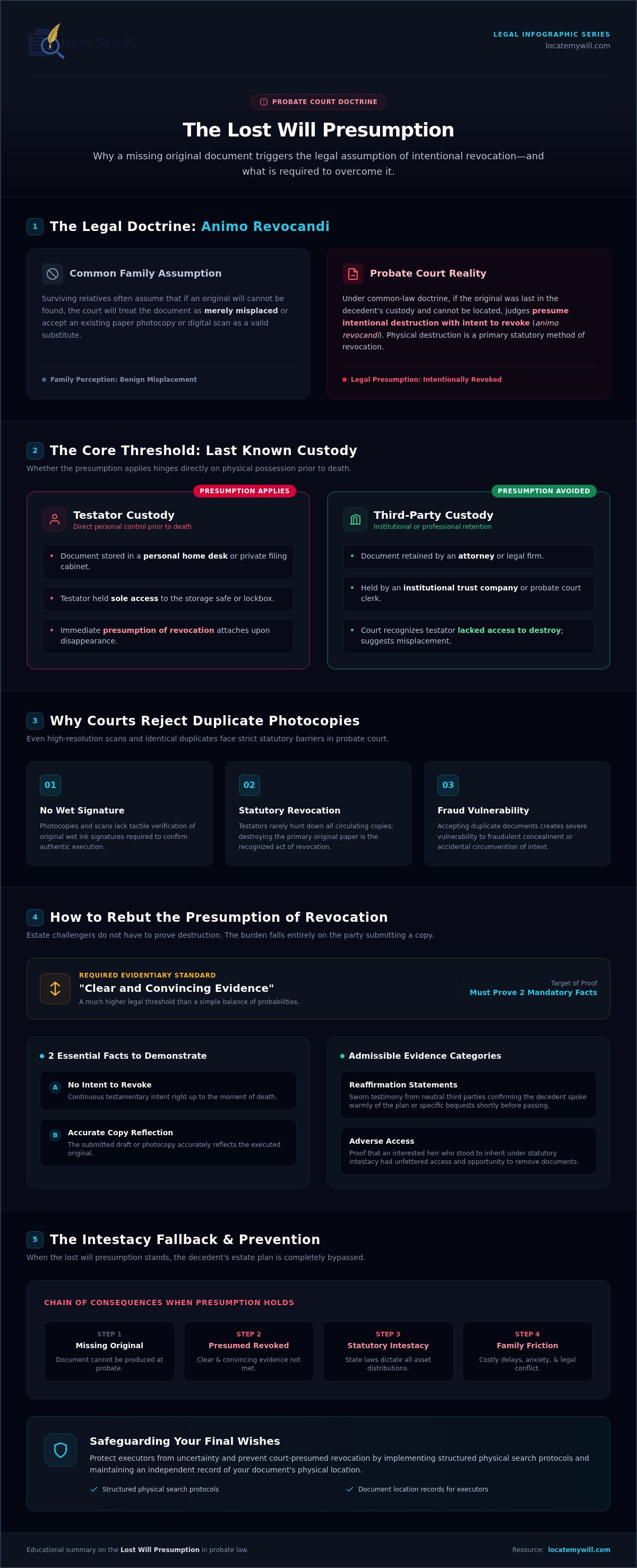
A pristine photocopy or digital scan of an executed estate plan is often completely powerless in probate court. If your original, physical document cannot be located after your death, judges apply the lost will presumption. Under this legal doctrine, the court does not assume the paper was merely misplaced; it presumes you intentionally destroyed and revoked it.
It's deeply unsettling to think that years of thoughtful planning can unravel simply because executors don't know where to look. When an unlocated document opens the door to statutory intestacy, surviving families face costly delays, heightened anxiety, and preventable legal conflict. Fortunately, understanding these procedural hurdles gives you the power to protect your estate from falling into the wrong hands.
In this guide, you'll learn how probate courts treat missing original wills and how to safeguard your estate from unintended distribution rules. We'll examine the strict evidentiary standards required to rebut the presumption of revocation and explore how establishing a secure document location record protects your heirs.
Key Takeaways
- Understand why probate courts apply the lost will presumption, treating missing original documents as intentionally revoked rather than merely misplaced.
- Discover the strict "clear and convincing evidence" standard required to overcome the presumption of revocation using a photocopy or draft.
- Learn how an unlocated document forces an estate into statutory intestacy, leaving asset distribution to state law instead of personal directives.
- Review the structured, step-by-step physical search protocol personal representatives must document to satisfy court due diligence standards.
- See how maintaining an independent record of your document's physical location protects executors from uncertainty and safeguards your final wishes.
What Is the Lost Will Presumption and When Does It Apply?
When an individual passes away, probate courts must verify that the submitted estate documents represent the decedent's true, final wishes. The lost will presumption is a foundational common-law doctrine establishing that if an original will was known to be in the testator's possession prior to death but cannot be found afterward, the court presumes the testator intentionally destroyed it with the intent to revoke it. Legal systems refer to this principle as animo revocandi, or destruction accompanied by the state of mind to revoke.
Probate courts demand the physical, original executed instrument because the act of physical destruction is a primary statutory method for revoking a will. When family members cannot produce the original, judges don't assume benign misplacement. Without evidence to the contrary, the law must presume that a will has been destroyed intentionally. This immediate evidentiary hurdle causes severe administrative friction, prompting steep consequences of a lost will for beneficiaries who must scramble to locate physical assets while facing an assumption of revocation.
The Core Legal Threshold: Last Known Custody
The attachment of the presumption hinges almost entirely on physical custody before death. For the rule to take effect, the missing instrument must have been last seen in the possession or direct control of the decedent. Consider the distinction:
- Testator Custody: If the testator took the original document home, placed it in a personal desk, or held sole access to the storage safe, the presumption applies immediately upon its disappearance.
- Third-Party Custody: If the original remained in the secure possession of an attorney, an institutional trust company, or a county probate court clerk, the presumption of revocation typically does not attach. In these instances, the court recognizes that the testator lacked immediate physical access to destroy the document, suggesting loss or misplacement rather than intentional revocation.
Original Instruments Versus Photocopies in Probate Court
Courts enforce strict statutory barriers against duplicate instruments. While a modern scanned duplicate or photocopy may look identical to an original, it lacks the tactile verification of wet signatures. More critically, an individual rarely takes the time to hunt down and tear up every paper photocopy in circulation. Destroying the original is the recognized legal action to revoke the estate plan.
Judges hesitate to accept copies because probating a duplicate creates a profound vulnerability to fraudulent concealment or accidental circumvention of a testator's actual intent. Unless the proponent presents definitive evidence explaining the absence of the primary physical document, the lost will presumption controls the proceedings, effectively treating the unlocated instrument as legally dead.
How to Rebut the Presumption of Revocation in Probate Court
Overcoming the initial hurdle of a missing document places a heavy procedural burden on the person offering a copy. In probate litigation, the law does not require estate challengers to prove the decedent tore up the paper. Instead, the party submitting a duplicate must produce affirmative proof to overcome the lost will presumption. In most jurisdictions, meeting this threshold demands clear and convincing evidence, a much higher standard than a simple balance of probabilities.
To satisfy the court, the proponent must demonstrate two critical facts: that the testator never intended to revoke the document, and that the submitted copy accurately reflects the executed original instrument.
Admissible Evidence to Prove Non-Revocation
Rebutting the assumption of destruction requires concrete facts establishing continuous testamentary intent right up to the moment of death. Relevant evidentiary categories include:
- Reaffirmation Statements: Sworn testimony from neutral third parties confirming the decedent spoke warmly about the estate plan or referred to its specific bequests shortly before passing.
- Adverse Access: Evidence that an interested heir who stood to inherit under statutory intestacy had unfettered access to the decedent's private papers, creating an opportunity for wrongful removal. Legal analyses of rebutting the presumption of destruction highlight how suspicious circumstances and adverse access can shift judicial scrutiny.
- Accidental Destruction: Verifiable physical catastrophe, such as documented house fires, localized flooding, or commercial storage mishaps, that accounts for the paper instrument's disappearance without human volition.
Proving the Complete Contents of the Missing Will
Establishing lack of revocation solves only half the challenge. The proponent must also establish the document's complete contents through a conforming copy, an attorney draft, or reliable testimony from attesting witnesses who observed the original execution ceremony. If witness recollections conflict or parts of the copy are unreadable, the court will refuse probate.
Contesting the lost will presumption often results in protracted depositions, forensic inquiries, and thousands of dollars in legal expenses paid out of the estate. Rather than forcing your personal representative to litigate against legal presumptions, establishing a will owner registration subscription creates an independent location record that directs your executors to the physical original instantly.
The Intestacy Fallback: Consequences When the Presumption Stands
When a personal representative cannot overcome the lost will presumption, the probate court concludes that the decedent intentionally revoked the instrument. Legally, this finding strips the estate of all customized instructions and forces the estate administration directly into statutory intestate succession. In the eyes of the law, the decedent died without any executed estate plan at all.
At this stage, probate judges cannot accept informal testimony, journal entries, or verbal promises regarding the decedent's true wishes. State statutes assume total control. Default distribution schedules allocate property strictly by legal marriage and direct biological lineage, disregarding whatever personalized intentions the missing instrument originally contained.
Rigid Statutory Formulas Versus Personal Testamentary Intent
Statutory inheritance tables are blunt instruments incapable of adapting to nuanced family structures. When the lost will presumption takes hold, blended families face acute legal vulnerabilities. Stepchildren, foster children, and lifelong domestic partners receive nothing under default intestacy codes, regardless of how long they shared a home or financial life. Instead, assets often pass to distant or estranged biological relatives. Additionally, any nominations for minor guardianship become void, leaving protective custody determinations entirely to judicial discretion. To consult with experienced legal professionals on building a comprehensive estate plan that protects your loved ones from intestacy, click here.
Administrative Delays, Litigation Costs, and Fiduciary Bonds
Transitioning from routine probate into contested intestate administration imposes substantial administrative friction. Estate assets are frequently frozen during proceedings, depriving surviving dependents of needed household liquidity. Without a valid will to specify an executor, family members often file competing petitions for appointment, escalating legal bills and court costs.
Most properly executed wills explicitly waive the requirement for an executor to purchase an insurance bond. Under intestacy, however, courts routinely mandate commercial fiduciary surety bonds to protect potential heirs. The recurring premiums for these bonds are paid directly out of estate funds each year until the estate closes. Examining the cost of a lost will clarifies why preventable document misplacement carries severe structural consequences for every intended beneficiary.
A Methodical Protocol for Searching Before Courts Assume Revocation
Before a probate judge allows you to present secondary evidence or petition for the probate of a copy, the court demands proof of exhaustive due diligence. You cannot simply check a desk drawer, throw up your hands, and request an exception. To challenge the initial application of the lost will presumption, personal representatives must demonstrate that they conducted an uncompromising investigation across every realistic depository.
Executing an orderly inquiry protects the estate from premature intestacy filings. For a structured, comprehensive checklist, review the executor's guide to finding the will to ensure no potential repository is overlooked.
Step 1: Systematic Physical and Institutional Inquiries
A defensible search requires looking beyond obvious living spaces. Executors must systematically inspect personal filing cabinets, fireproof residential lockboxes, and concealed household safes. If the decedent maintained an institutional safe deposit box, state banking statutes generally permit a designated representative or family member to conduct a supervised examination strictly to locate testamentary instruments.
Simultaneously, contact the attorney who drafted the estate plan. If the original firm dissolved or the lawyer retired, reach out to successor legal practices that acquired their client files. Following the structured steps in how to find a deceased person's will helps surviving representatives cover both domestic and institutional channels systematically.
Step 2: Documenting Diligent Search Efforts for Probate Affidavits
Probate courts require verification, not verbal assurances. Maintain a contemporaneous written log detailing every action taken during your search:
- Chronological Activity: Record specific dates, times, and residential locations examined.
- Institutional Records: Log calls to law offices, banking institutions, and probate court registries, noting representative names and written responses.
- Sworn Formal Affidavits: Transcribe your findings into formal affidavits of diligent search for the probate clerk, establishing that unlocated papers are not the result of administrative neglect.
A meticulous paper trail proves to the judge that the document's disappearance warrants further inquiry rather than immediate dismissal. To eliminate this stressful investigative burden for your family, register your will's storage location today so your chosen executors know exactly where your original instrument resides.
Preventing the Presumption: Modern Solutions for Will Location Security
The lost will presumption rarely stems from an intentional change of heart; more often, it represents a preventable failure of discoverability. Executing a legally sound instrument completes only the first stage of planning. If the people entrusted to carry out your directives cannot put their hands on the original paper within days of your passing, the estate faces the exact same legal vulnerability as having drafted no will at all.
Safeguarding your legacy requires an active, structured discoverability mechanism. Rather than leaving the physical location to guesswork, proactive families now choose to register will location online, connecting designated representatives directly to the physical instrument without compromising privacy.
The Limits of Traditional Storage Methods
Conventional storage options carry structural vulnerabilities that frequently trigger estate complications:
- Home Safes: While lockboxes provide day-to-day security, combination codes and physical keys often vanish during a medical emergency or sudden death.
- Safe Deposit Boxes: Commercial bank vaults present rigid access barriers. Without joint signatory privileges or explicit judicial orders, financial institutions routinely seal boxes upon the owner's death, locking away the very document needed to establish authority.
- Attorney Safekeeping: Leaving original paperwork in law firm vaults was once common practice. Today, corporate law firm mergers, partner retirements, and file consolidations create major paper-retention gaps across decades of life changes.
How Locate My Will Protects Your Estate from Presumed Revocation
Locate My Will solves the discoverability problem by serving as an independent, nationwide location registry. The platform does not host digital wills, store physical instruments, or draft legal forms; instead, it establishes an unalterable bridge between your physical document and the people who need it.
Through a Will Owner Registration Subscription, you securely log the exact physical whereabouts of your original instrument. You maintain granular control by utilizing Authorized Searcher Management to designate up to three authorized searchers and three notification recipients. With Search Activation Date Control, you dictate exactly when verified searchers may query the platform to retrieve location details.
This organized protocol shields your estate from the lost will presumption. By giving your personal representatives immediate, authorized access to location details, you eliminate administrative delays, keep your confidential estate terms private, and ensure your final wishes are honored exactly as written.
Securing Your Legacy Through Definitive Document Discoverability
A well-drafted estate plan only fulfills its purpose if your family can produce the physical instrument when it matters most. As court records demonstrate, the lost will presumption transforms simple misplacement into assumed legal revocation, risking statutory intestacy, extended court delays, and unnecessary conflict among surviving heirs. You don't have to leave your family's future to procedural chance.
Maintaining complete confidentiality is straightforward when you record physical storage locations rather than uploading sensitive legal document contents online. By establishing precise activation controls, you empower designated searchers to find physical documents instantly upon activation. Ensure your original will is never lost or presumed revoked—record its location on Locate My Will today. Taking this methodical step ensures your voice controls your legacy, providing lasting peace of mind for the people you care about most.
Frequently Asked Questions
What does the lost will presumption mean in practical legal terms?
In practical legal terms, this doctrine means the probate court assumes an unlocated original will was intentionally destroyed and revoked by the testator before death. Rather than treating the missing paper as accidentally misplaced, judges place the burden of proof on the family to prove otherwise. Without verified evidence demonstrating continuous intent or accidental destruction, the court will refuse to administer the estate under the missing terms.
Can a signed photocopy of a will be probated if the original is lost?
Yes, but only under exceptional legal circumstances. To admit a photocopy or electronic duplicate to probate, the petitioner must formally overcome the lost will presumption by presenting clear and convincing evidence. You must prove the original was validly executed, demonstrate its complete terms, and satisfy the court that the decedent never revoked the document during their lifetime through destruction or replacement.
How do courts decide if a missing will was revoked or simply misplaced?
Courts examine physical custody prior to death alongside recent testator behavior. If the document was last known to be in the decedent's exclusive possession, the law automatically infers intentional revocation. To counter this, judges evaluate witness statements regarding the decedent's recent conversations, the presence of adverse parties who had access to private papers, and any evidence of accidental destruction such as house fires or home flooding.
What kind of evidence is required to overcome the presumption of revocation?
Rebutting the presumption requires clear, compelling proof rather than informal speculation. Admissible evidence includes sworn testimony from neutral acquaintances confirming the decedent reaffirmed the estate plan shortly before passing away. Proponents can also submit evidence showing an interested heir unlawfully accessed personal files, or provide proof of physical disasters that explain why the physical document cannot be produced.
Does the presumption apply if the will was kept in an attorney's office?
Generally, no. The presumption of revocation requires that the original instrument was in the testator's personal custody before disappearing. When an estate planning attorney, institutional trust department, or county clerk maintains continuous third-party custody of the physical paper, the law recognizes the testator lacked immediate access to destroy it. In those scenarios, courts treat the document as lost or misplaced rather than intentionally revoked.
What happens to the estate if the presumption of revocation cannot be rebutted?
If the petitioner fails to rebut the legal presumption, the court declares the decedent legally intestate. The estate is then distributed according to rigid state statutory inheritance schedules, strictly following biological and legal marriage relationships. Verbal promises, informal drafts, and non-profit charitable bequests are entirely discarded, and the court appoints an administrator who may be required to purchase recurring fiduciary surety bonds.
Can an online registry service help prevent the lost will presumption?
Yes. An online location registry ensures your personal representative knows the exact physical whereabouts of your original executed paper. By enrolling in a Will Owner Registration Subscription, you securely document storage coordinates and use Authorized Searcher Management alongside Search Activation Date Control. This structured protocol enables designated searchers to retrieve the physical instrument swiftly, preventing discoverability failures from triggering legal revocation rules.


