

If your family cannot find your original will after you're gone, does the document even exist in the eyes of the court? You've worked hard to build a legacy and likely spent significant resources ensuring your final wishes are documented. It's natural to feel that once the paper is signed and tucked away, your responsibility is complete. However, the actual cost of a lost will can transform a straightforward probate into a years-long legal battle that depletes your family's inheritance before they receive a cent.
We recognize the gravity of long-term planning and the desire for organized efficiency. This guide will help you understand the significant financial and legal burdens caused by lost estate documents and show you how a secure registry protects your family's future. We'll examine why litigation fees in 2026 can exceed fifty thousand dollars for contested estates. You'll also discover a methodical approach to ensuring your executor can always locate your physical documents without compromising your current privacy.
Key Takeaways
- Understand why a missing document is legally presumed revoked and how the total cost of a lost will can lead to litigation fees exceeding $50,000 in complex cases.
- Identify the critical limitations of traditional storage methods, such as safe deposit boxes and law firm archives, which often prevent timely access for executors.
- Learn how a will location registry provides a secure solution that records where your physical documents are kept without the risks associated with digital file hosting.
- Discover how to manage authorized searchers and activation dates to balance your current need for privacy with the future needs of your estate representatives.
- Explore the methodical process of using a subscription-based registry to streamline probate and minimize the administrative burden on your loved ones.
Understanding the High Cost of a Lost Will in 2026
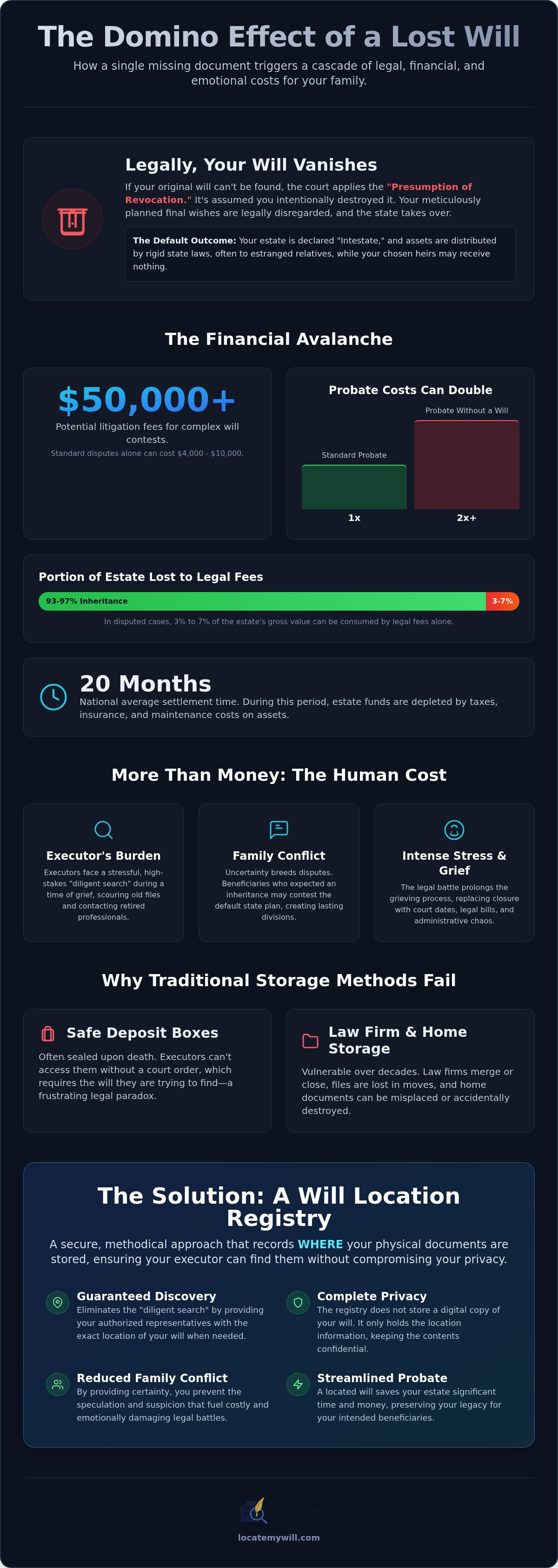
A "lost" will isn't necessarily a document that was never written. In a legal context, it refers to a validly executed document that exists somewhere but cannot be produced when probate begins. While your family might know exactly what you intended, the probate court is bound by strict evidentiary rules that prioritize the physical presence of the original document. When that document is missing, the law often applies a "presumption of revocation." This means the court assumes you intentionally destroyed the will because you no longer agreed with its terms. The absence of a physical will forces the court to ignore your personal preferences and instead execute a generic, state-mandated distribution plan.
The financial cost of a lost will starts with the immediate loss of procedural efficiency. Without the original document to guide the process, simple administrative tasks become complex legal hurdles. To understand the gravity of this situation, it's helpful to consider what is a will in the eyes of the law: it's your only voice in a system that otherwise defaults to rigid, impersonal statutes. When that voice is silenced by a missing paper, your estate enters a legal vacuum that is both expensive and time-consuming to resolve.
The Legal Vacuum: Intestacy by Default
When a will cannot be found, the court typically declares the estate "intestate." This triggers a default distribution process based on state-level bloodline hierarchies. These laws are often blunt instruments that don't account for modern family dynamics. If you're part of a non-traditional family, have step-children you wish to provide for, or intended to leave assets to a specific charity, these wishes are likely to be discarded. Intestacy laws generally favor direct biological relatives, which can lead to your assets being distributed to estranged family members while your chosen heirs are left with nothing. This shift from a private plan to a public, statutory process is a primary driver of the cost of a lost will.
The Emotional Toll on Family and Executors
Beyond the financial drain, a missing will places an immense psychological burden on your loved ones. Executors are legally required to perform a "diligent search" before a court will even consider secondary evidence of a will's existence. This often leads to a stressful, high-stakes treasure hunt during a period of intense grief. Family members may spend weeks scouring safe deposit boxes, old filing cabinets, and retired attorneys' offices. This uncertainty creates fertile ground for disputes. If one beneficiary believes a will existed that favored them, while another benefits from intestacy, the resulting litigation can easily consume 3% to 7% of the estate's gross value in legal fees alone.
The Financial Burden: Legal Fees and Probate Litigation
When an original document is missing, the probate process transitions from a streamlined informal administration to a complex formal proceeding. This shift significantly increases the cost of a lost will due to the heightened level of court supervision required. In many jurisdictions across the United States, probating an estate without an original will can cost more than double the amount required for a standard, uncontested proceeding. These figures represent only the baseline administrative fees and don't account for the extensive legal hours required to overcome the legal challenges of a lost will.
The most devastating financial drain often arises from will contests. When the original document can't be produced, beneficiaries may disagree on which copy or draft represents the owner's final intent. These disputes frequently lead to litigation where legal fees range from $4,000 to over $10,000. In complex cases, the litigation expenses can exceed $50,000 to $100,000, effectively depleting the assets intended for your heirs. You can read more about how these disputes create negative consequences of a lost will for beneficiaries in our detailed overview. Beyond the courtroom, probate delays stall the distribution of assets. During the national average settlement time of 20 months, estate assets like homes or businesses require ongoing maintenance, taxes, and insurance, all of which are paid from the estate's diminishing funds.
Probate Court Delays and Administrative Expenses
A missing will necessitates additional court hearings to establish the validity of secondary evidence. Judges require a higher burden of proof to ensure the document wasn't intentionally revoked, which demands more billable time from attorneys. Additionally, executors may face increased costs for fiduciary bonds. Without the original will's standard clause waiving the bond requirement, the court may mandate a high-premium bond to protect the estate. Every month of delay can result in thousands in administrative erosion.
The Cost of a Diligent Search Protocol
Executors have a legal responsibility to conduct an exhaustive search before the court accepts that a will is lost. This protocol often includes:
- Fees for opening and inventorying safe deposit boxes at multiple financial institutions.
- Administrative costs for contacting every law firm the deceased may have visited.
- Expenses for publishing public notices in local newspapers to find witnesses or the original drafter.
Why Traditional Storage Methods Often Fail
Many individuals rely on storage solutions that seem secure but lack the necessary accessibility for executors. The safe deposit box is a prime example of this failure. While physically protected, these boxes often create a legal paradox for heirs. Banks generally require a court order or the original will to grant access to the box. However, the document needed to secure that access is often locked inside. This circular obstacle forces families to hire attorneys to petition the court just to retrieve a document that was supposed to simplify their lives. The resulting legal complexities of missing wills can quickly accumulate before probate even begins. This friction is a significant factor in the total cost of a lost will.
Similarly, home safes and digital spreadsheets often fail as reliable storage methods. While a home safe provides fire protection, the combination is frequently lost or never shared with the intended executor. Digital spreadsheets, while organized, are easily lost during hardware transitions or buried in inaccessible cloud accounts. These modern solutions often become invisible during the chaos of estate settlement. Without a clear, external record of where these assets and documents are kept, your family is left to guess, which inevitably leads to the administrative erosion we've discussed.
The Myth of the 'Unforgettable' Hiding Place
It's common to choose hiding spots like the back of a freezer or an unmarked folder. While these hide the document from burglars, they also hide it from your grieving family. The first 30 days after a death are critical; if a document isn't found, the likelihood of a contested probate rises. Relying on informal conversations is insufficient as memory fades under stress. This search friction contributes to the total cost of a lost will. If your family is in this position, following a how to find a deceased person's will protocol is a necessary next step.
Law Firm Mergers and Document Migration
Some people assume their drafting attorney will keep the original safely forever. However, the legal industry is highly mobile. Firms merge, partners retire, and offices relocate. Tracking down a document drafted 20 years ago can feel like searching for a ghost if the original practitioner is no longer active. Paper records are inherently fragile in a society where people move frequently. An online record acts as a permanent bridge. It ensures that regardless of where the physical paper moves, the knowledge of its location remains centralized and accessible to those you've authorized.
How an Online Will Registry Service Protects Your Estate
An online will registry service serves as a methodical bridge between the drafting of your estate documents and their eventual retrieval. Instead of hosting the actual legal file, which can present security and privacy risks, a location registry focuses exclusively on the "where." By maintaining a centralized record of a document's physical location, you provide your executor with a reliable search path that bypasses the common pitfalls of forgotten hiding places or closed law offices. This professionalized approach directly mitigates the cost of a lost will by ensuring your estate representatives don't waste precious time or estate funds on exhaustive, unproductive searches. When a registry provides a clear trail to the original document, it effectively prevents the "lost will" presumption that often leads to expensive litigation.
A location registry functions as a reliable guardian of information, prioritizing order and accessibility for authorized parties. It transforms the search process from a stressful "treasure hunt" into a disciplined, step-by-step administrative task. This system is particularly essential in 2026, as families become more geographically dispersed and traditional paper-only records become increasingly difficult to track. By professionalizing the search process, you reduce the administrative burden on your executor and ensure that your final wishes are the primary focus of the probate court, rather than the search for the document itself.
Centralizing Metadata for Maximum Security
Storing location metadata is fundamentally more secure than digital document hosting. Because the registry doesn't contain the contents of your will, your sensitive financial and personal details remain offline and protected from digital breaches. This system acts as a digital breadcrumb for your most important physical paper, offering a sense of calm and organized efficiency for both you and your future searchers. Knowing that a verified record exists provides significant peace of mind, as it removes the anxiety associated with traditional, unrecorded storage methods. This quiet authority ensures that the knowledge of your document's location is permanent, even if you move or change your physical storage method.
Verifying the Searcher's Identity and Authorization
A structured registry offers a level of control that a sticky note or an informal conversation cannot match. Through secure login protocols and multi-step verification, the system ensures that only designated individuals can access your storage instructions. You can manage multiple authorized parties, allowing your chosen representatives to find what they need only when it becomes necessary. This methodical process maintains your privacy during your lifetime while empowering your executor the moment they assume their responsibilities. It ensures that the cost of a lost will never impacts your family's inheritance. To secure your legacy and provide this level of organized stewardship, you can register your will location today.
Locate My Will: A Methodical Approach to Document Security
Locate My Will acts as a methodical facilitator for those who prioritize the integrity of their estate planning. The platform offers a Will Owner Registration Subscription, which serves as a proactive estate tool designed to bridge the gap between your current preparations and the future needs of your representatives. By recording the precise location of your physical documents, you eliminate the ambiguity that often leads to a contested probate. This structured approach ensures that the cost of a lost will does not become a burden for your heirs, as it provides a verified path to your original intent. It's a modern solution for a traditional responsibility, prioritizing security and procedural clarity above all else.
At the core of this service is the Authorized Searcher Management system. You may designate up to three trusted individuals who are granted the authority to search for your document's location. This feature empowers your future executors without compromising your current need for privacy. It creates a secure, neutral platform where information is organized and ready for use, acting as a reliable guardian for your legacy. To begin this process, you can register will location online through our streamlined interface. This step ensures that your representatives have the tools they need to fulfill their roles with confidence.
Privacy Control through Activation Dates
The Search Activation Date is a critical component of our security protocol. It allows you to control exactly when your storage information becomes visible to your authorized searchers. You might set this date for a year in the future and renew it annually, or choose a specific milestone. This feature ensures that your privacy is maintained during your lifetime while guaranteeing that the information is accessible when it's truly needed. Activation dates act as a fail-safe for the user's privacy by preventing premature or unauthorized access to sensitive location data. It's a disciplined way to manage transparency for the future while maintaining strict privacy today.
Automated Notifications for Peace of Mind
Locate My Will also manages notification recipients to ensure the estate settlement process begins promptly. If a search is activated, the system can alert your designated representatives, ensuring no document remains hidden simply because no one knew where to look. This automated layer of protection removes the reliance on memory or informal notes. It provides a rhythmic and predictable progression that guides your family through a difficult time with calm efficiency. By acting as a methodical facilitator, we ensure that your hard work and final wishes are respected and realized without the cost of a lost will impacting your family's future inheritance.
Ensuring Your Legacy Remains Intact
The true cost of a lost will extends far beyond simple administrative delays; it encompasses the potential for six-figure litigation fees and the complete erasure of your final wishes. We've examined why traditional storage often fails during the critical early stages of probate. Whether it's a locked safe deposit box or a retired attorney's office, paper-only records are inherently vulnerable in our mobile society. Relying on memory or informal notes creates unnecessary risk for your heirs.
Locate My Will provides a methodical solution through disciplined digital stewardship. By utilizing features like Authorized Searcher Management and Search Activation Date Control, you maintain absolute privacy today while empowering your representatives for tomorrow. Don't leave your legacy to chance. This system ensures your hard-earned assets reach your chosen heirs rather than being consumed by avoidable legal disputes. You can protect your family from the stress of a document treasure hunt by establishing a clear, verified trail to your original records.
Secure your legacy today by registering your document locations with Locate My Will. Taking this proactive step provides the professional certainty and peace of mind your family deserves.
Frequently Asked Questions
What happens if a will is lost and no one can find it?
If a will cannot be located, probate courts generally apply a legal presumption that the document was intentionally revoked. This vacuum forces the estate into "intestacy," where state-level statutes dictate asset distribution instead of your personal wishes. This transition often results in the high cost of a lost will, as it frequently leads to litigation between potential heirs and increases the administrative burden on the court system to verify the estate's rightful beneficiaries.
Is an online will registry service legally binding in all states?
An online will registry is not a legal document, so it doesn't require state-specific "binding" status in the same way a will does. Instead, it serves as a methodical record of where your binding physical document is stored. This service is available nationally across the United States. It provides executors with the verified information they need to produce the original document for probate court, regardless of which state's laws apply to the estate.
Does an online will registry store a digital copy of my actual will?
Locate My Will does not host digital copies of your legal documents or provide physical storage. We focus exclusively on recording the metadata regarding the location of your physical original. This methodical approach enhances your security by ensuring that sensitive personal and financial information remains offline. By storing the "where" rather than the "what," we act as a secure, neutral platform that guides your authorized representatives to the document they need.
How much does a lost will typically cost an estate in legal fees?
A missing document significantly inflates administrative expenses. In many jurisdictions, probate without a will costs at least double the amount of an uncontested proceeding. If litigation arises because beneficiaries disagree on the document's contents, legal fees can quickly exceed $10,000. In complex or contested cases, the total cost of a lost will can reach $50,000 to $100,000, which is typically paid directly from the assets intended for your family's inheritance.
Can an executor be held liable if they cannot find the original will?
Executors have a fiduciary responsibility to conduct a diligent search for all estate documents. While they aren't personally responsible for the document being lost originally, they can be scrutinized if they don't follow a structured search protocol. Utilizing a registry professionalizes this search process. It provides the executor with a clear, verified trail to follow, which helps protect them from claims that they failed to act with the necessary level of organized efficiency.
How does an online will registry notify my family after I pass away?
The platform manages up to three notification recipients who receive automated alerts when a search is triggered. This process is governed by your Search Activation Date, which controls when your information becomes visible. This fail-safe system ensures that your family is guided to the document's location precisely when it becomes necessary. By bridging the gap between your preparation and their future needs, the registry ensures your hard-earned legacy isn't overlooked during the grieving process.
What is the difference between a will registry and a digital vault?
A digital vault is designed for hosting files, which can expose your private data to digital stewardship risks. In contrast, a will registry is a location management service. We prioritize the integrity of information by recording only the physical coordinates of your document. This distinction is vital for security. It allows you to maintain your privacy while providing a reliable path for authorized searchers to find the paper original required by most probate courts.
Who should I designate as an authorized searcher for my will location?
It's best to designate up to three trusted individuals who are likely to serve as your representatives. Common choices include your primary executor, a successor executor, or a long-term family friend. You might also consider a professional advisor, such as a CPA. Selecting searchers who are organized and reliable ensures that your storage details are accessed only by those with the quiet authority and responsibility to manage your final wishes with the necessary discipline.


