

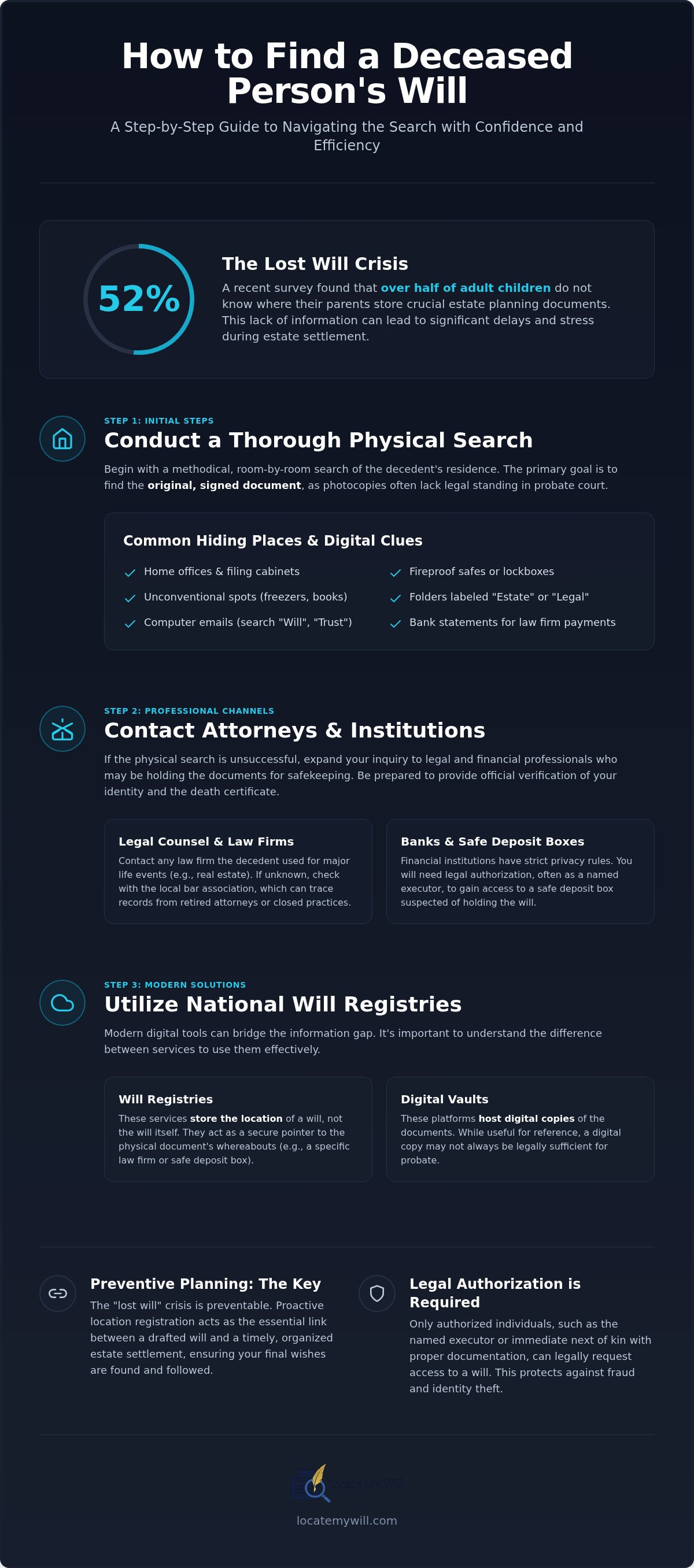
Did you know that 52% of people don't know where their parents store their estate planning documents? When you're tasked with settling an estate, learning how to find a deceased person's will becomes a priority that's often clouded by urgency and emotion. It's understandable to feel overwhelmed by the lack of a central government database or the pressure of looming probate deadlines. You want to fulfill your loved one's wishes with precision, but the path forward isn't always visible.
We agree that this search shouldn't be left to chance or guesswork. This guide provides a professional, step-by-step protocol to help you locate the original document using physical, professional, and digital search methods. By following this systematic approach, you'll gain a definitive checklist of where to look and understand exactly who has the legal right to request these records. We'll examine everything from home safes and safe deposit boxes to attorney records and digital registries, ensuring you have the tools to navigate this responsibility with quiet confidence and organized efficiency.
Key Takeaways
- Establish a methodical room-by-room search protocol within the decedent's residence to identify common physical storage locations like home safes or filing cabinets.
- Learn how to find a deceased person's will by contacting primary attorneys, financial institutions, or local bar associations when physical copies are missing.
- Differentiate between will registries that provide vital location data and digital vaults that host documents to ensure you're using the most effective search tools.
- Verify who has the legal authorization to access sensitive documents and how secure searcher roles prevent unauthorized access and identity theft.
- Recognize how proactive location registration acts as the essential link between a drafted will and a timely, organized estate settlement.
Initial Steps: Conducting a Thorough Physical Search for the Will
Discovering that a will is missing is a frequent challenge during estate settlement, yet it's a hurdle that a disciplined search can resolve. When you're learning how to find a deceased person's will, you should approach the decedent's primary residence with a methodical mindset. The goal is to locate the original, executed document because a simple photocopy often lacks the legal weight required by the court. While a copy might provide clues, the probate process generally demands the original version with wet-ink signatures to prove the document's validity and ensure the decedent's final wishes are honored exactly as intended.
Treat the physical search like a professional inventory. Begin in the home office or any area where they managed finances. Work through each room clockwise, checking behind books, inside desk drawers, and within any locked containers. If you encounter a locked safe and don't have the combination, don't force it immediately. Instead, look for keys or written codes in jewelry boxes or bedside tables. A thorough search is the first step in understanding how to find a deceased person's will when no obvious filing system exists.
Common Hiding Places and Personal Filing Systems
Look beyond obvious filing cabinets. People often store vital records in fireproof safes, but they also use unconventional "secure" spots like the back of a freezer or hollowed-out books to deter theft. Search for folders labeled "Estate Planning," "Legal," or "Vital Documents." Even if you don't find the will itself, keep an eye out for business cards from law firms, receipts for notary services, or invoices from mobile notaries. These small clues often point toward the professional who drafted the document.
Identifying the Digital Paper Trail
Digital clues often lead to physical locations. If you have access to the decedent's computer or phone, search their email inbox for terms like "Will," "Trust," "Safe Deposit," or "Estate." Look for recurring bank transfers to storage facilities or law firms, which may indicate where a physical document is held. Check their browser history for bookmarks related to online will registries or digital vaults. These digital breadcrumbs are essential for identifying professional relationships that might have been overlooked during a physical search.
Professional Channels: Contacting Attorneys and Financial Institutions
When the physical search described previously yields no results, you must shift your focus to professional intermediaries. Attorneys and financial institutions frequently act as the "Reliable Guardians" of estate documents, often holding them in solicitor's custody for decades. Understanding how to find a deceased person's will often requires navigating the administrative layers of these organizations with persistence and the correct documentation. While attorney-client privilege remains a factor, it doesn't generally prevent the release of a will to a named executor or a close relative once a death is verified.
Start by identifying any law firm the decedent used for significant life events, such as real estate transactions or business formations. If the specific attorney is unknown, contact the local bar association in the county where the decedent resided. These organizations maintain records of retired attorneys and can often point you toward the successor firms that inherited their files. By ensuring your own representatives know which law firm holds your documents through a secure registry, you can prevent these administrative hurdles for your own family.
Consulting with Legal Counsel and Law Firms
To begin this process, draft a formal request for information to be sent to suspected law offices. You'll need to provide a certified copy of the death certificate and proof of your relationship to the decedent. Ask specifically if the firm holds the original will or any subsequent codicils that may have updated the document's location. If the original attorney has passed away or the practice has closed, the state bar association can help you identify who purchased the practice's "will bank," which is a common term for the collection of original documents held for safekeeping.
Accessing Safe Deposit Boxes and Bank Records
Financial institutions present a unique set of challenges due to strict privacy protocols. If you suspect the will is in a safe deposit box, you must navigate state-specific "Right of Entry" laws. Some jurisdictions allow a limited search of a box specifically to locate a will or life insurance policy before an executor is officially appointed. You will typically need the following items to request a bank search:
- A certified copy of the death certificate
- Government-issued identification
- The key to the safe deposit box, if available
If the bank refuses access without formal letters of office from the court, you may need to petition for a "Will Search" court order. This legal directive authorizes a bank officer to open the box in your presence to retrieve only the testamentary documents. It's a structured process that ensures the security of the box's other contents while allowing the probate process to move forward.
Utilizing National Will Registries for Location Verification
When physical searches and professional inquiries fail to yield the original document, digital verification offers a structured alternative. It's vital to distinguish between a digital vault and a will registry. While a digital vault hosts an electronic version of the document, a registry functions as a secure pointer to the document's physical location. This distinction is critical because most courts still require the original paper version to begin the estate settlement process. A centralized registry bridges the gap between a decedent's private storage choice and the family's need for immediate information, ensuring that final wishes aren't lost to time or administrative oversight.
Modern digital registries prioritize data privacy through rigorous authorization protocols. These platforms don't typically allow public access; instead, they require searchers to provide specific credentials or death verification before revealing location data. This disciplined approach protects the decedent's privacy while providing a reliable path for those learning how to find a deceased person's will. By using a national database, you can search across state lines with a single inquiry rather than contacting dozens of local probate courts individually.
How Centralized Databases Streamline the Search
The search process involves inputting the decedent's full legal name, date of birth, and last known residence into the database. If a match is found, the registry provides the contact details for the holding attorney, law firm, or specific facility where the document is stored. This system replaces guesswork with verified data, allowing you to move directly to the retrieval phase. A centralized registry effectively eliminates the need for families to conduct months of manual outreach to local law firms and courthouses. It acts as a methodical facilitator, connecting the right people to the right information at the exact moment it's needed.
Searching Probate Court Records
If a private registry search doesn't provide an answer, you should investigate local government records. Some individuals choose to file their will for "safekeeping" or "lodging" with the county clerk's office before their death. This is a formal administrative procedure where the court holds the document in a secure, non-public file. You should conduct a search in the probate records of every county where the decedent lived or owned real estate. Keep in mind that a will only becomes a public record once it's officially filed for probate after death. Until that filing occurs, the court's safekeeping records remain private and accessible only to authorized representatives or the decedent themselves. Understanding how to find a deceased person's will within the court system requires a patient, county-by-county verification of these lodgment records.
Understanding Authorization: Who is Legally Permitted to Search?
While the search process is methodical, it's not open to the general public. Accessing sensitive legal documents requires specific authorization to prevent identity theft and maintain the decedent's privacy. Understanding how to find a deceased person's will involves recognizing the "Authorized Searcher" role. This is a security measure designed to ensure that only vetted individuals, previously approved by the will owner, can access sensitive location data. By requiring pre-authorization during the owner's lifetime, registries create a secure bridge between current preparations and future needs.
Professional registries employ a "Search Activation" process to protect the integrity of the information. The location data remains locked and inaccessible until a searcher initiates the activation, which typically requires verification of the owner's status through a death certificate. This safeguard ensures that information is only released when it's legally necessary. To add another layer of security, registries often alert "Notification Recipients" whenever a search is performed. This transparency prevents unauthorized parties from accessing private data without the knowledge of the family or designated legal representatives.
The Role of the Executor in Document Discovery
The named executor holds the primary responsibility and legal right to find the will. They're the person the decedent trusted to carry out their final wishes. When families are unsure of how to find a deceased person's will, the search usually begins with this designated representative. If the executor is unknown or also deceased, the "Heirs at Law," who are typically the closest living relatives, possess the right to search for the document to initiate the probate process. Establishing an Authorized Searcher management plan ensures these individuals have a clear, legal path to the documents they need.
Privacy Protocols and Identity Verification
Registry security protocols involve multi-step identity verification before releasing any location data. These steps are vital to ensure that the person requesting the information has the right to see it. Activation dates are a critical part of this security; they protect the owner's privacy by ensuring no search can be successful while the owner is still alive. This "Need to Know" basis for sharing the physical location of sensitive documents maintains a professional distance and reinforces the registry's role as a secure, neutral platform for estate organization.
Preventive Planning: How Location Registries Solve the 'Lost Will' Crisis
Transitioning from the anxiety of learning how to find a deceased person's will to the peace of mind of proactive organization is a vital step for any estate owner. A meticulously drafted will is only effective if your family can locate the original document within the first 30 days after your passing. This window is critical for meeting probate court requirements and addressing urgent legal deadlines. Without a clear path to the document, your estate may face unnecessary delays, or worse, your final wishes may go unfulfilled. Locate My Will serves as the proactive solution for digital estate organization, acting as the "Methodical Facilitator" between your legal preparations and your family's future needs.
Our subscription model ensures that your location data remains current as your life changes. Life is rarely static; people move to new homes, switch law firms, or choose different safekeeping methods over time. By maintaining an active registry, you can update your records instantly, ensuring the information stays accurate and robust. This ongoing stewardship prevents the "lost will" crisis that many families face during an already difficult time, providing a steady and dependable presence that prioritizes the integrity of your information.
The Benefit of Designating Authorized Searchers Early
You can name up to three trusted individuals as authorized searchers within our secure platform. These representatives are the only ones permitted to access your document's location, ensuring that your privacy is maintained while providing a definitive answer for those you trust most. By Managing Authorized Searchers for Your Estate Documents, you eliminate the guesswork for your heirs. They won't need to wonder how to find a deceased person's will because they will have been granted the specific authority to retrieve that information when the time is right. This foresight transforms a potentially chaotic search into an orderly, efficient process.
Activation Dates and Notification Protocols
Security and authorization are the cornerstones of our service. We use activation dates to control exactly when a search can be successfully completed by an authorized party. This means your private information remains inaccessible during your lifetime, providing a robust layer of protection for your sensitive data. Additionally, our notification protocols ensure that your designated recipients are alerted the moment a search is triggered. This secondary layer of security maintains transparency and reinforces our role as a "Reliable Guardian" of your data. You can Secure your family's future by registering your will's location today at Locate My Will.
Securing Your Legacy Through Methodical Organization
Locating an estate plan requires a disciplined approach that moves from immediate physical searches to professional inquiries and digital verification. While learning how to find a deceased person's will is often a stressful experience for families, following a systematic protocol ensures that no detail is overlooked. The original document's location is the essential link between a drafted plan and a successful probate process. By moving beyond guesswork, you provide your representatives with the clarity they need during a sensitive time.
You can prevent future uncertainty for your own loved ones by taking proactive steps today. Our national US registry provides secure Authorized Searcher verification and automated notification triggers to protect your privacy while ensuring accessibility. It's a reliable solution that replaces anxiety with organized efficiency. Register your will's location to ensure your family finds it when it matters most. Taking this professional step today provides a permanent foundation for your family's future security and peace of mind.
Frequently Asked Questions
Is there a national database where I can find any deceased person's will?
No, there is no single government-operated national database for wills in the United States. While some private registries exist to record the physical location of these documents, they are not public repositories. Families typically must rely on private records or local probate courts. A centralized registry like Locate My Will acts as a methodical facilitator, providing authorized searchers with the exact location of a document when it's needed most.
Can I find a copy of a will online for free?
You generally cannot find a copy of a private will online for free before it enters probate. Once a will is filed with the court, it becomes a public record, and some jurisdictions provide online access to these documents for a small fee. Before that point, the document remains private. Searching for how to find a deceased person's will online usually leads to registries that verify your authorization before revealing location data.
What should I do if I can't find the original will, only a photocopy?
You should immediately contact the drafting attorney or the law firm that handled the decedent's affairs to see if they hold the original. Probate courts strongly prefer the original document with wet-ink signatures. If only a photocopy is available, the court may require additional evidence to prove the will's validity and that it wasn't intentionally revoked. Finding the original is paramount to ensuring a seamless estate settlement.
How do I know if I am an authorized searcher for someone's will?
You will typically know if you are an authorized searcher because the will owner would have designated you during their lifetime. Within a professional registry, the owner names up to three trusted individuals who are permitted to search for the document's location. If you are designated, the registry's security protocols will verify your identity and the owner's status before releasing any sensitive information. This ensures privacy and prevents unauthorized access.
Does an attorney always keep a copy of the will they drafted?
Attorneys frequently keep copies of the wills they draft, and some may even store the original in a secure "will bank." However, this is not a universal requirement. If a firm closes or an attorney retires, their files are often transferred to a successor firm. It's helpful to contact the local bar association to track down these records if the original firm is no longer in operation. This methodical search is often the key to discovery.
What happens to the estate if a will is never found?
If a will is never found, the estate is typically settled according to state intestacy laws. These laws provide a rigid structure for distributing assets to the closest living relatives, which may not align with the decedent's personal wishes. This risk highlights why knowing how to find a deceased person's will is so important. Without the document, the court cannot honor specific legacies or personal requests made by the deceased.
How long does it typically take to find a will through a registry?
Finding a will location through a registry is usually a swift process once the search is activated and the searcher's identity is verified. The actual search takes only minutes, though the verification of a death certificate may take several days depending on the registry's protocols. This efficiency is a significant improvement over manual searches, which can often take weeks or months of contacting various law firms and courthouses.
Can a bank refuse to let me search a safe deposit box for a will?
A bank can refuse access to a safe deposit box if you don't have the proper legal authority or documentation. Most banks require a death certificate and proof of your relationship or status as a potential executor. If the bank remains uncooperative, you may need a court order specifically authorizing a search for the will. These strict privacy measures are in place to protect the decedent's assets and personal information.


