

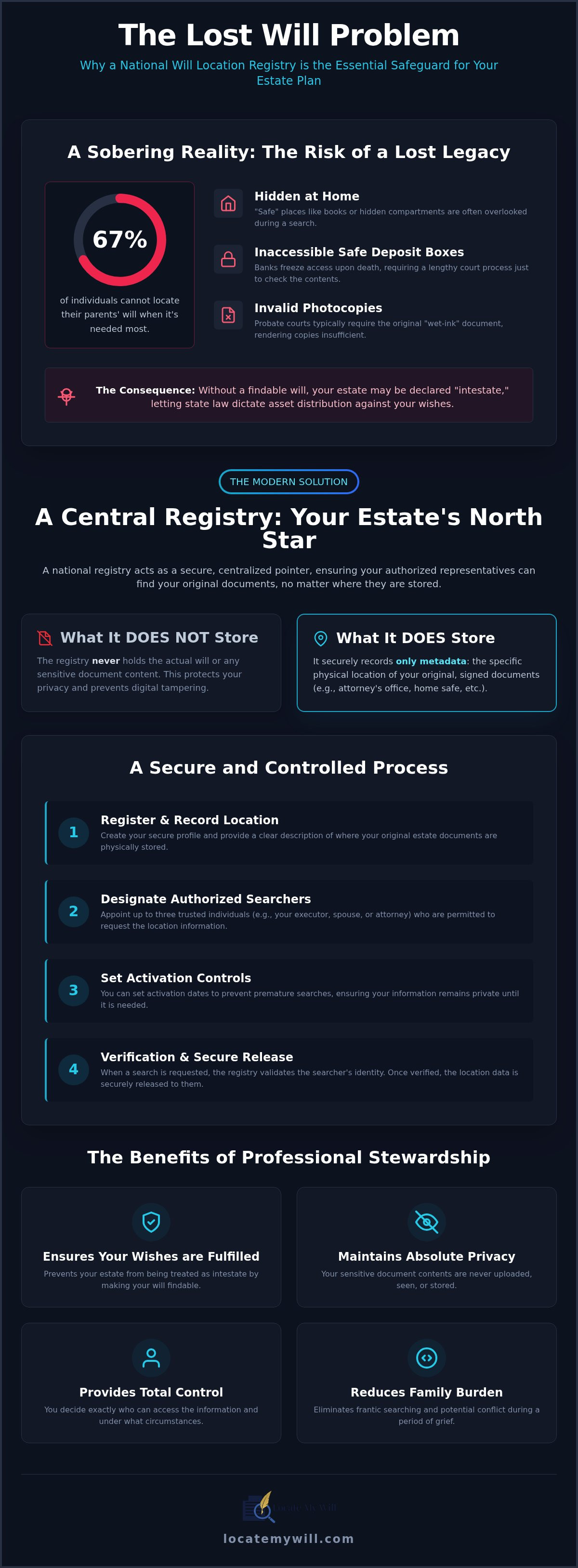
A recent survey revealed that 67% of individuals could not remember where to find their parents' will when the document was needed most. This sobering statistic highlights why a national will location registry is becoming a fundamental component of modern estate planning. You've likely felt the weight of responsibility that comes with preparing for the future, yet the anxiety that a home safe or safe deposit box might remain inaccessible after your passing is a common burden. It's frustrating to think that your careful instructions could be lost in the very moment they are meant to provide guidance.
We agree that your legacy deserves a more reliable safeguard than a hidden folder or a verbal promise. This article will show you how a professional registry ensures your authorized family members can find your documents when they are needed most. We'll preview the essential functions of a secure registry, including how to manage authorized searchers and set activation dates to maintain control. By the end of this guide, you'll understand how to transform your estate plan into a clear, accessible roadmap for your loved ones, ensuring your final wishes are fulfilled with organized efficiency.
Key Takeaways
- Learn why traditional storage methods often fail families and how a central record prevents your estate from being treated as intestate.
- Understand how a national will location registry functions as a secure database for metadata without requiring you to upload the actual document.
- Discover why a managed subscription model provides the long-term stewardship and data integrity needed for multi-generational planning.
- Identify the steps to designate authorized searchers and set activation dates to maintain total control over your private information.
The Critical Role of a National Will Location Registry
The "lost will" problem is a significant hurdle in modern estate administration. Research indicates that approximately 67% of families experience conflict when a family member passes away without a clear, accessible plan. Even when a person has taken the time to understand what is a will and has one professionally drafted, the document's physical location often remains a mystery to those who need it most. A national will location registry addresses this specific vulnerability by providing a definitive record of where the original document is stored.
There is a fundamental difference between a local filing and a national record. A local record, such as a note in an attorney's file or a mention in a personal ledger, is fragile. If an attorney retires or a family moves, that information often vanishes. A national registry acts as a centralized beacon for executors and legal professionals. It ensures that the location of your documents is discoverable regardless of where your family members reside. Without this central record, an estate may be declared "intestate" simply because the valid will could not be found. This leads to state laws determining asset distribution, which rarely aligns perfectly with an individual's actual intentions.
The Reality of Misplaced Estate Documents
Many individuals store their documents in "safe" places that inadvertently create barriers for their heirs. Common hiding spots, such as tucked away in a book or hidden under floorboards, are frequently overlooked by executors. Safe deposit boxes present another challenge; banks often freeze access immediately upon the owner's death, requiring a lengthy court process just to see if a will is inside. If only a photocopy is found, probate courts may reject it, as the law typically requires the original signed document to prove its validity. A national will location registry prevents these complications by clearly stating where the original is held, whether that is in a specific law office or a secure home safe.
Bridging the Gap Between Planning and Execution
A registry serves as a vital roadmap for your executor during a time of high stress. It's not enough to create a plan; you must also ensure that plan is retrievable. By recording the specific location of your documents, you act as a methodical facilitator for your heirs. This professional stewardship eliminates the frantic, often fruitless search through old filing cabinets during a period of grief. Using a registry ensures your final instructions aren't defeated by a simple lack of information, creating a secure bridge between your current preparations and the future needs of your representatives.
How an Online Will Registry Works in the Digital Age
A national will location registry operates as a specialized administrative layer for your estate plan. Unlike digital storage solutions that host actual files, this type of registry acts as a secure pointer. It records the specific physical coordinates of your original documents. This distinction is vital for maintaining the legal integrity of your plan. While some jurisdictions might offer a state will registry, a national option provides broader coverage for families who may live across state lines. It functions as a neutral, third-party record that bridges the gap between your private storage and your family's eventual need for access.
Metadata vs. Digital Document Content
The primary reason for recording location rather than document content is legal compliance. Most probate courts still require the "wet-ink" original document to settle an estate. By storing only metadata, which is the location description, the registry protects your privacy. No one can read your sensitive instructions or asset distributions through the platform. Instead, searchers receive precise directions to the physical safe, attorney's office, or bank where the original resides. This approach minimizes the risk of digital tampering while ensuring the physical document remains the single source of truth. It's a modern solution that respects traditional legal requirements while solving the problem of findability.
The Verification and Search Protocol
Security is maintained through a strict hierarchy of authorization. The process begins when the owner registers their details and designates up to three authorized searchers. These searchers can't simply browse records at will. The registry validates every request through a methodical verification process. This ensures that only the individuals you trust gain access to the location data. You can also set specific activation dates to prevent premature searches, keeping your information private until it's truly needed. This level of authorized searcher management provides the peace of mind that your privacy is guarded by a disciplined system.
The workflow is designed to be predictable and secure, moving from owner registration to searcher verification with administrative precision. Each step reinforces the integrity of your information, ensuring that your final wishes are found by the right people at the right time. This structured approach helps you maintain control over your legacy. By prioritizing verification over simple access, the registry acts as a reliable guardian for your most sensitive data.
Evaluating Registry Options: Privacy, Security, and Control
When selecting a national will location registry, the focus should shift from simple data entry to long-term digital stewardship. A subscription-based model is often the most reliable choice for estate continuity. Unlike free platforms that may lack the resources for permanent data maintenance, a subscription ensures the platform remains technologically current and secure for decades. This commitment to longevity is essential because your estate plan might not be accessed for thirty or forty years. You're investing in a service that acts as a steady, dependable presence for your future representatives.
Effective registry management also requires sophisticated authorized searcher management. This system allows you to designate up to three specific individuals who have permission to inquire about your document's location. By limiting access to a small, verified group, you maintain a high degree of privacy. Additionally, automated notification triggers can alert up to three recipients whenever a search is attempted. This transparency ensures that you, or your designated contacts, are aware of any activity regarding your records, providing an extra layer of security against unauthorized prying.
The Importance of Search Activation Dates
Privacy is not a static concept; it evolves over time. A professional registry allows you to set a specific search activation date, which serves as a primary privacy barrier. This feature prevents anyone, including your authorized searchers, from viewing your document's location before a time you deem appropriate. It's a vital tool for those who are still active and healthy but want their preparations in place. You have the flexibility to adjust these dates as your life circumstances change. This control ensures that your sensitive information remains shielded until the exact moment it becomes necessary for your estate settlement.
Security Standards for National Databases
A professional national will location registry must prioritize the integrity of information through rigorous security standards. This includes high-level encryption and data protection protocols that go beyond the basic offerings of "free" registries. Using a neutral, third-party platform also prevents the biases or administrative shifts that can occur within individual law firms or family offices. A dedicated registry environment is built specifically for verification and authorization. It provides the robust support needed to manage critical metadata without the risks associated with unmonitored or underfunded databases. This methodical approach reinforces the service's role as a reliable guardian of your legacy.
Steps to Register Your Will's Location Online
Engaging with a national will location registry is a straightforward process that prioritizes administrative precision over complex data entry. Before you begin the registration, you should gather the exact physical coordinates of your original documents. This might include the name of the law firm holding your papers or the specific location of a fireproof safe in your residence. Because this service does not store the document itself, your task is to provide a clear, descriptive roadmap that an executor can follow with ease. This preparation transforms your estate plan from a static document into a functional, retrievable asset.
Choosing Your Authorized Searchers
A critical step in your registration is the selection of your authorized searchers. You may designate up to three individuals who will be granted the right to search for your document's location. Ideal candidates often include your named executor, a spouse, or a trusted professional advisor. This limit of three searchers is an intentional security measure; it balances the need for family access with the necessity of keeping your private affairs confidential. Once you have made your selection, it's a professional courtesy to inform these individuals of their role. They don't need immediate access to the registry, but they should know that a secure record exists to guide them when the time comes.
Setting Up Notification Triggers
Transparency is a cornerstone of digital stewardship. During the setup process, you will designate up to three notification recipients. These individuals receive an automated alert whenever a search is attempted against your record. This creates a fail-safe system that prevents unauthorized or fraudulent search attempts. If a searcher tries to access your location data prematurely, your notification recipients are alerted instantly. This layer of oversight ensures that your information remains protected and that your family stays informed about the status of your estate records. It's a disciplined approach to privacy that keeps you in control of your information flow.
The final stage involves securing your record through a Will Owner Registration Subscription. This model ensures that your data is maintained with the highest standards of integrity over the long term. At this point, you will also set your search activation triggers. These dates act as a final barrier, ensuring that your location details remain hidden until the timeframe you have specified. By following these methodical steps, you provide your family with a secure, professional record that eliminates the anxiety of lost documents. Register your will's location today to establish this vital bridge for your estate's future.
Locate My Will: Professional Stewardship for Your Estate
Locate My Will serves as a dedicated partner in your estate continuity efforts. We understand that the most meticulous plan is only effective if it remains accessible to your representatives. Our national will location registry acts as a methodical facilitator, bridging the gap between your private storage and your family's eventual needs. By choosing a professional registry, you empower your executor with the precise tools they need to succeed during a difficult transition. This organized approach removes the guesswork from probate, ensuring that your legacy is settled according to your specific instructions. It replaces uncertainty with a structured, reliable solution that respects the gravity of your long-term planning.
Why Choose Our National Registry Platform?
Our platform is built on the principles of security, verification, and authorized access. We provide a modern interface that simplifies digital stewardship while maintaining the rigorous standards required for sensitive legal information. As a trusted partner, we prioritize the integrity of your records above all else. This isn't just a simple database; it's a managed communication system designed for the digital age of estate planning. We focus on ensuring that only your designated representatives can find your documents, and only when you've authorized them to do so through our activation date controls. This quiet authority provides a sense of calm efficiency that benefits both you and your heirs by providing a secure, neutral platform for information exchange.
Starting Your Journey Toward Peace of Mind
Beginning your journey toward peace of mind is a simple, structured process. You can create an account and enter your storage details in a matter of minutes, ensuring that your final wishes are never lost to history. Once registered, you maintain total control over your settings; this allows you to update storage locations or searcher details as your life evolves. Our subscription-based model reflects a commitment to long-term stewardship, ensuring that your data remains protected and available for as long as it's needed. You don't have to worry about the reliability of "free" services or the fragility of local filings that might be forgotten over time. Instead, you gain the certainty that comes from professional document location management. This proactive step ensures that your family is never left guessing about your intentions. Register your will's location with Locate My Will today.
Securing Your Estate's Future Accessibility
The steps you take today define the ease with which your family navigates the future. By utilizing a national will location registry, you ensure that the physical coordinates of your original documents are discoverable only by those you trust. You've learned how managing authorized searchers and setting precise activation dates creates a robust privacy barrier. This methodical approach prevents the anxiety of lost documents and the legal complications of being declared intestate when a valid will exists but cannot be found.
Professional stewardship is about more than just storage; it's about providing a clear roadmap for your executor. Our platform offers national US coverage and allows you to designate up to three authorized searchers with secure activation date control. This ensures your final instructions are found at the exact moment they are needed. Secure your legacy by registering your will's location today. Taking this proactive step provides the quiet confidence that your wishes will be respected and fulfilled with organized efficiency.
Frequently Asked Questions
Is a national will location registry a public record?
A national will location registry is not a public record. It is a private, secure database designed to protect your sensitive information. Unlike public court filings, your registration remains confidential and is only accessible to the individuals you specifically authorize. This ensures that your storage details aren't subject to general public inquiry, maintaining the privacy of your estate plan while providing a reliable bridge for your chosen representatives when the time arrives.
What is the difference between a will registry and an online will storage service?
A registry records the physical location of your document, whereas storage services typically host digital copies or the document itself. Locate My Will focuses on location metadata to comply with wet-ink legal requirements. Most probate courts require the original paper document to settle an estate. By recording where that original is kept, rather than hosting a digital file, you ensure your family finds the legally valid version they need for court proceedings.
Can an unauthorized person search for the location of my will?
No, an unauthorized person cannot search for your records. Access is strictly limited to the individuals you designate through our authorized searcher management system. Every search request undergoes a methodical verification process to confirm the searcher's identity. Additionally, you can designate up to three notification recipients who are alerted instantly if any search is attempted. This multi-layered security protocol ensures that your information remains shielded from unauthorized prying or fraudulent inquiries.
What happens if my family can't find my will after I pass away?
If your family cannot find the original will, your estate may be declared intestate. This means state laws, rather than your personal wishes, will determine how your assets are distributed. This often leads to significant probate delays and increased legal costs for your heirs. Using a national will location registry prevents this outcome by providing your executor with a definitive roadmap to the original document, ensuring your final instructions are followed with organized efficiency.
How do I update the location if I move my original will?
You can update your storage details at any time by logging into your secure Locate My Will account. Because life circumstances and storage preferences often change, the platform is designed for flexible management. Simply navigate to your record and enter the new coordinates, such as a different law firm or a new home safe location. Maintaining an accurate record ensures that your authorized searchers always have the most current information, which is vital for long-term stewardship.
Does a national registry store the actual contents of my last will and testament?
No, a professional registry does not store the actual contents or digital copies of your last will and testament. It only records the physical location where the original document is kept. This approach prioritizes your privacy, as no sensitive asset distributions or personal instructions are stored in the digital database. By focusing solely on location metadata, the registry acts as a secure pointer that guides your family to the wet-ink original required by probate courts.
What is a search activation date and why do I need one?
A search activation date is a specific trigger you set to control when your information becomes searchable. This serves as a primary privacy barrier, preventing even authorized searchers from viewing your document's location before a time you deem appropriate. It's a critical tool for maintaining confidentiality while you are active and healthy. You have the total control to adjust this date as your estate plan evolves, ensuring your data remains shielded until it is truly necessary.
How many authorized searchers can I designate for my account?
You can designate up to three authorized searchers for your account. This limit is an intentional security feature designed to balance family access with administrative precision. By selecting a small group of trusted individuals, such as your executor or a spouse, you minimize the risk of information leaks. You can also designate up to three notification recipients who will receive automated alerts whenever a search is attempted, ensuring complete transparency for your estate records.


