

What if the greatest risk to your estate plan isn't a legal technicality, but the fact that it's discovered too early by the wrong person? It's a common dilemma. You understand that your will must be accessible to your executors, yet the thought of relatives finding it prematurely creates a sense of unease. This tension often leads to documents being hidden so well they're eventually lost. Achieving true will location privacy doesn't mean burying your secrets in an unmarked box. Instead, it involves a disciplined approach to managing who has access to information and, more importantly, when that access begins.
You've worked hard to organize your affairs, and you deserve a solution that respects your need for current boundaries. This article explains how you can maintain absolute control over your document’s location while guaranteeing it reaches the right hands at the right time. We'll examine the role of search activation dates and authorized searcher management in creating a reliable, private system for your legacy. By the end, you'll see how a methodical registration process provides the security you need and the clarity your loved ones will eventually require.
Key Takeaways
- Learn how to balance the need for absolute confidentiality with the necessity of future access for your executors.
- Understand the importance of will location privacy in preventing family conflict and unauthorized document tampering.
- Discover how search activation dates act as a precise administrative lock that only opens when you intend it to.
- Identify the strategic advantages of designating up to three authorized searchers rather than relying on public records.
- Find out why moving location data from unencrypted digital notes to a professional registry enhances your estate's security.
The Privacy Dilemma: Why the Location of Your Will Must Remain Confidential
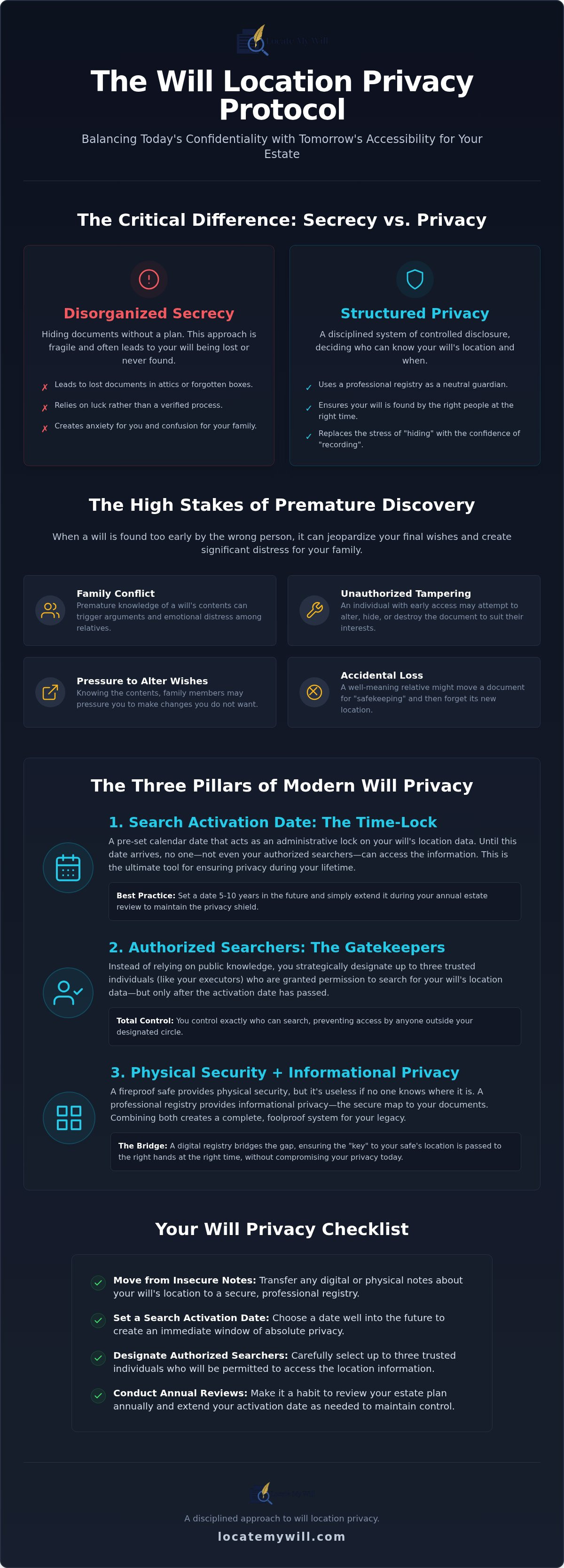
Maintaining will location privacy is a matter of administrative discipline. It's defined as the controlled disclosure of where your last will and testament is stored. Many people confuse secrecy with privacy. Secrecy is often disorganized and leads to documents being lost in attics or forgotten safety deposit boxes. Privacy, however, is a structured system where you decide exactly who knows the location of your documents and when they're allowed to access that information.
There's a heavy psychological burden associated with keeping a document's location entirely secret. You worry that if you tell no one, the document won't be found. If you tell everyone, you lose control over your personal affairs. A private registry alleviates this anxiety by acting as a neutral, professional guardian of your information. It replaces the stress of "hiding" with the confidence of "recording."
The Risk of Unauthorized Access
Family dynamics are often complex. Premature discovery of a will's contents can trigger immediate conflict or pressure to alter your wishes. There's also the risk of unauthorized tampering. Even a well-meaning relative might move a document for safekeeping and then forget where they put it. Simply hiding a document is a fragile strategy. It relies on luck rather than a verified process. Effective will location privacy ensures that the "where" remains hidden until the "when" is met.
Information Privacy vs. Physical Security
It's vital to distinguish between physical security and informational privacy. A heavy fireproof safe provides excellent physical protection. However, it fails as a tool for estate transition if no one knows it exists or where the key is kept. Informational privacy is the management of the knowledge itself. It's the difference between having a lock and knowing who holds the key.
Digital stewardship bridges this gap. By recording the physical location of your documents in a secure, administrative platform, you ensure that the map to your legacy is preserved. You don't need to choose between a document being too secret or too public. You can maintain physical security in your home or office while using a registry to manage the authorization required to find it. This layered approach creates a reliable path for your representatives without compromising your current need for confidentiality. It's an orderly way to ensure your final wishes are respected without inviting unwanted scrutiny today.
How Search Activation Dates Ensure Your Privacy Today
A Search Activation Date is a pre-set calendar trigger that governs the release of your information. Think of it as an administrative "on" switch for your records. Until this specific date arrives, the database remains locked. Even if an authorized searcher attempts a query, the system denies access and provides no information. This adds a critical temporal layer to will location privacy, ensuring your records are protected during your lifetime. It's a disciplined way to manage access without relying on verbal promises or hidden keys.
This system offers a unique level of control that traditional estate planning often lacks. Digital notes can be hacked, and physical letters can be opened. A search activation date relies on a systematic, time-locked protocol. It's a robust way to manage your boundaries. You can rest easy knowing that your privacy is the default state of your account until the moment you've determined is appropriate for disclosure.
Setting Your Activation Parameters
Choosing a date requires a methodical approach. Most users select a date five or ten years in the future to create a window of absolute privacy. You should integrate this into your annual estate review. If you're healthy and your circumstances haven't changed, you simply extend the date. The administrative process is straightforward. You log in, select a new date, and the system resets the countdown. This keeps you in constant command of your data and allows you to adapt to life's changes with minimal effort.
The "Fail-Safe" Nature of Activation Dates
The activation date acts as a digital seal on your location records. It prevents accidental data leaks by requiring a verified trigger before any information is shared. Once the date arrives, the platform initiates a notification process. It alerts you that the date has passed, giving you a final opportunity to extend the block. If no action is taken, the records become searchable by your designated representatives. This ensures that information is only released when it's truly needed, maintaining the integrity of your estate plan.
This "fail-safe" mechanism eliminates the risk of premature discovery by relatives or third parties. It provides peace of mind that your privacy is protected by a disciplined, automated system. To begin managing your own timeline, you can set your own search activation dates today.
Authorized Searchers vs. Public Knowledge: Controlling Access
Controlled access is the cornerstone of estate document security. Relying on public records or casual "word of mouth" instructions creates significant risks. Public records are often too transparent, while verbal instructions are easily forgotten or misinterpreted. A private registry provides a disciplined alternative. It ensures that only specifically designated individuals can discover where your documents are kept. This approach solidifies your will location privacy by replacing vague intentions with a verified administrative framework. It's a professional way to manage your legacy without leaving things to chance.
Notification recipients also play a vital role in this ecosystem. They receive automated alerts when an activation date is reached or when a search is attempted. This creates a transparent log of activity, ensuring that you're always aware of who's interacting with your records. It’s an extra layer of digital stewardship that reinforces your control over the process. By keeping the information out of the public eye and within a secure circle, you maintain the integrity of your planning.
Selecting Your Authorized Searchers
Selecting the right individuals is a critical step in your planning. You're permitted to designate up to three authorized searchers. These people should be individuals you trust to respect your boundaries and act only when necessary. It's often wise to choose searchers who are younger than you or in good health to ensure they're available when the time comes. Consider the following criteria when making your selection:
- Reliability: Choose individuals who are organized and likely to follow through on administrative tasks.
- Discretion: Your searchers should understand the importance of your privacy and not share your information prematurely.
- Longevity: Select people who are likely to be active and reachable in the decades to come.
If your relationships change, your registry should reflect that. You can update your authorized searchers at any time through your dashboard. This flexibility allows you to maintain a current list of representatives without needing to redistribute physical keys or update multiple family members. It's a clean, efficient way to manage your legacy's "gatekeepers."
Verification and Authorization Protocols
The system employs a methodical verification process to protect your data. When a searcher initiates a query, they must provide specific identifying information. This prevents "fishing" attempts by unauthorized parties who might be curious about your affairs. The registry remains silent unless the searcher's identity matches your pre-registered data exactly. This administrative layer acts as a barrier against unauthorized queries. Even if someone knows you use a registry, they can't access your records without being one of your three designated searchers. The result is a robust, multi-stage authorization protocol that ensures your information is only released to the right people at the right time.
Best Practices for Maintaining Estate Document Confidentiality
Maintaining will location privacy requires a disciplined approach that combines physical barriers with digital oversight. It's a common mistake to assume that a single layer of security is sufficient. Instead, you should view your estate plan as a system with two distinct parts: the physical document and the information required to find it. By separating these two elements, you ensure that even if someone understands your document exists, they cannot discover its location without your authorization. This layered defense is the most effective way to protect your legacy from premature discovery or tampering.
One critical rule is to avoid storing sensitive location data in unencrypted digital formats. Spreadsheets, standard notes apps, or basic text files are highly vulnerable to security breaches. They lack the administrative controls and time-locked triggers necessary for true privacy. A professional registry provides a secure, administrative environment specifically designed for this purpose. If you're ready to secure your records, you can register your will location today to establish a professional layer of defense.
Layered Privacy Strategies
An effective strategy involves using a registry as a directory while keeping the actual document in a physical vault. Your "Letter of Instruction" should not list a specific drawer or safe combination. Instead, it should simply point your representatives to the registry. This ensures that even if the letter is found early, the location remains private until the search activation date occurs. Because our platform is national, this system remains reliable even if your family moves across state lines. It provides a permanent point of reference that isn't tied to a specific physical address or local jurisdiction.
Common Privacy Mistakes to Avoid
Security is often compromised by telling too many people the exact location of your documents. While it's helpful to inform your searchers of their role, you don't need to reveal the physical coordinates yet. Simply let them know they are your designated representatives in the registry. This prepares them for their future responsibility without compromising your current confidentiality. You should also avoid leaving "clues" in obvious places, such as sticky notes in desk drawers or unlabelled keys in common household areas.
We recommend performing a privacy audit every 12 months. During this review, verify that your physical storage is still secure and that your registry data is accurate. If you've moved to a new home or changed your safe deposit box, update the registry immediately. This methodical habit ensures that your plan remains current and that your will location privacy is never compromised by outdated information. It's a small administrative task that provides significant long-term peace of mind.
Locate My Will: A Disciplined Approach to Will Location Privacy
Locate My Will serves as a dedicated administrative guardian for your estate planning information. Our platform focuses specifically on will location privacy, providing a neutral and secure environment to record where your physical documents are kept. Unlike informal methods that rely on memory or unencrypted notes, this structured approach ensures that your final wishes are reachable only through a verified, disciplined process. The synergy between search activation dates and authorized searchers creates a robust framework that protects your confidentiality today while guaranteeing accessibility tomorrow.
Maintaining a paid subscription is a vital part of this commitment. It ensures the permanence and reliability of your records over many years. This model supports a high standard of digital stewardship, allowing the platform to act as a steady, dependable presence for your representatives. You aren't just storing a piece of data; you're establishing a long-term partnership with a facilitator that values order and integrity above all else. This professional distance reinforces the security of your information, keeping it separate from your daily digital life.
The Registration Process
Creating a secure account is the first step in establishing your administrative defense. The process is designed to be methodical and clear, guiding you through each necessary action without overwhelming you. Once your account is active, you can record the precise storage details of your documents. This might include the specific location of a home safe or the details of a safe deposit box. Following this, you'll manage your access permissions by designating up to three authorized searchers and three notification recipients. Finally, you'll set your first search activation date, which serves as the primary lock on your information. This step-by-step logic ensures that every parameter of your privacy is defined and enforced.
Security and Stewardship
Our commitment to data integrity is reflected in our rigorous verification protocols. Access is never granted to your records unless the specific triggers you've established are met. This means that even your authorized searchers cannot view your data until the activation date has passed and their identity is confirmed. This methodical facilitation acts as a bridge between your current preparations and the future needs of your representatives. It provides a sense of calm efficiency, knowing that your wishes are protected by a system that prioritizes authorization over convenience. To establish this level of security for your own estate plan, you can Register your will’s location with Locate My Will today.
Take Command of Your Legacy's Discovery
Establishing absolute control over your estate plan requires more than just a secure physical storage space. It demands a disciplined approach to information management. By utilizing search activation dates and managing authorized searchers, you can ensure that your personal boundaries are respected. This methodical framework replaces the anxiety of secrecy with the certainty of a professional registry. True will location privacy is achieved when you are the sole authority over who knows where your documents are kept and exactly when that information is released.
Our national US platform provides the reliable stewardship needed to maintain this security over the long term. With activation date control and a verified network of recipients, you can rest assured that your preparations won't be lost or prematurely discovered. You've taken the important step of drafting your wishes; now, you must ensure they're protected by a system that values integrity and order. Secure your family’s future by registering your will’s location today. Taking these steps now provides a clear path for your representatives and lasting peace of mind for you.
Frequently Asked Questions
Is my will location information kept private from the public?
Yes, your information's strictly shielded from public view. Unlike public records offices, which may become accessible after probate, our platform's a private administrative registry. We ensure that your data's only visible to the specific individuals you've authorized. This level of will location privacy is a core feature of our service. Your records are protected by multiple layers of security and are never sold or shared with third-party marketing entities.
Can anyone search for my will on Locate My Will?
No, the platform's not an open directory. Only individuals you've specifically designated as authorized searchers can initiate a query. Even then, they must provide verified credentials that match your registration data exactly. If an unauthorized person attempts to search for your records, the system won't acknowledge that an account even exists. This prevents "fishing" attempts and ensures your document's whereabouts remain confidential within your trusted circle.
What happens if an authorized searcher tries to look for my will before the activation date?
If a search's attempted before the designated trigger, the system denies the request. The authorized searcher will receive a message stating that no information's available for release at this time. This ensures that your will location privacy remains intact during your lifetime. You remain in complete control of the timeline. The administrative lock only disengages once the calendar reaches the specific date you've pre-set in your account settings.
How do I change my will location privacy settings after I subscribe?
You can update your settings at any time by logging into your secure dashboard. This allows you to extend your activation date, update the physical location of your documents, or change your designated searchers. These changes take effect immediately within our system. We recommend reviewing these settings annually to ensure they reflect your current wishes. This flexibility allows your estate plan to adapt as your life circumstances or relationships evolve over time.
Does Locate My Will store a digital copy of my actual will?
No, we don't host or store digital copies of your actual legal documents. Our service's strictly an administrative registry for recording where your physical documents are kept. We manage the information about the location, such as a specific safe or a law office address. This distinction's important for your security. By not hosting the document itself, we eliminate the risks associated with digital document theft or unauthorized viewing of your private instructions.
What is the difference between a notification recipient and an authorized searcher?
These roles serve different administrative functions. An authorized searcher's someone you've granted permission to view your document's location after the activation date. A notification recipient is an individual who receives automated alerts about account activity. For example, they're notified if a search's attempted or if an activation date's approaching. You can designate up to three people for each role to create a balanced system of transparency and access.
Are there national standards for will location privacy in the US?
There aren't currently any centralized federal mandates for private will registries in the United States. However, Locate My Will operates as a national platform that follows high standards of digital stewardship and data integrity. We provide a consistent, professional framework that bridges the gap between various state-level probate customs. This ensures that your representatives have a reliable, standardized way to find your documents regardless of which state you reside in or where you move.
How does Locate My Will verify the identity of a searcher?
We employ a methodical verification process to confirm a searcher's identity. When you register, you provide specific identifying details for each authorized searcher. To gain access, the searcher must provide matching information that satisfies our security protocols. This administrative layer ensures that only the individuals you've personally vetted can retrieve your location data. It's a precise system designed to prevent unauthorized access while ensuring the right people can act when the time's right.


