

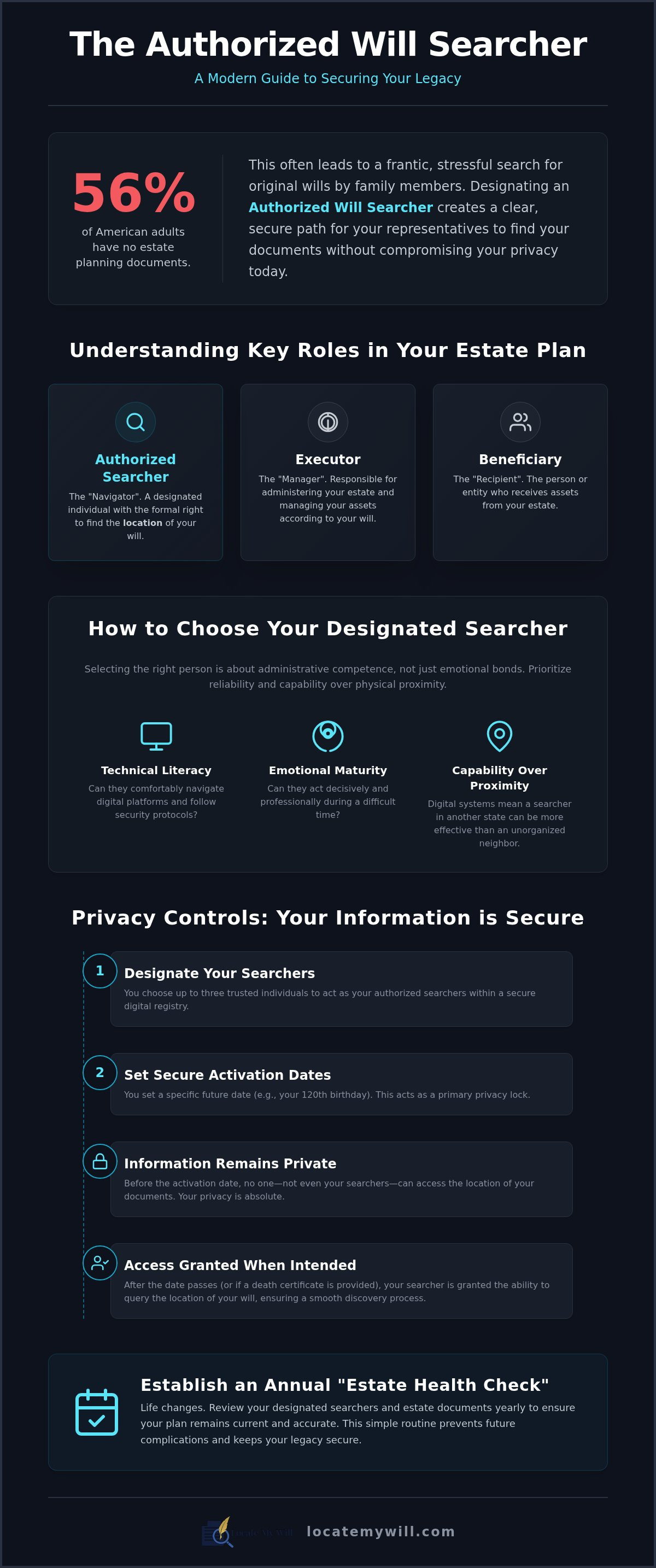
Imagine your family members searching through desk drawers and safe deposit boxes, only to realize they have no idea where your original will is kept. It's a stressful scenario that many people fear, especially when 56% of American adults currently lack any estate planning documents. You likely want your records to remain private during your lifetime, but you don't want your executor to face a frantic search later. Designating an authorized will searcher helps you strike a delicate balance between maintaining your current autonomy and ensuring future order.
You'll learn how to select trusted individuals to locate your documents while keeping your information locked behind precise activation controls. This article explains the difference between a searcher and a beneficiary, how to manage up to three contacts, and how to use specific dates to ensure access is only granted when you intend it. This methodical approach provides a clear path for document discovery without sacrificing your peace of mind today. By the end of this guide, you will have a structured plan to ensure your representatives can fulfill your wishes without compromising your security.
Key Takeaways
- Define the specific responsibilities of a designated searcher to distinguish this role from that of an executor or beneficiary.
- Identify the essential criteria for selecting your representatives, prioritizing emotional maturity and technical literacy over physical proximity.
- Learn how to appoint an authorized will searcher while maintaining absolute privacy through the use of secure activation dates.
- Establish a routine for an annual "Estate Health Check" to ensure your list of trusted contacts remains current and accurate.
- Bridge the gap between document storage and eventual discovery by implementing a professional stewardship plan for your records.
What is an Authorized Will Searcher?
An authorized will searcher is a verified individual you designate within a secure registry to query the location of your estate documents. Unlike casual verbal agreements, this role is a formal administrative status. It ensures that when the time comes, a specific person has the rights to request information about where your original will is stored. This designation is a practical necessity because it establishes a clear, pre-verified identity for search requests, preventing unauthorized parties from accessing sensitive location data. By formalizing this role, you create a disciplined bridge between your private records and the people responsible for your final affairs.
It's common to confuse this role with other estate planning positions. An executor is responsible for managing your assets and settling your estate. A beneficiary is the recipient of those assets. In contrast, a designated searcher is the navigator whose primary responsibility is document discovery. By separating these roles, you add a layer of security. You might want a trusted friend or a professional advisor to be the searcher, even if a family member is the executor. This distinction ensures that the search process is handled by someone you've specifically vetted for the task, reducing the risk of administrative confusion during a sensitive time.
Relying on a "tell a friend" strategy is inherently risky. As the legal landscape modernizes, there's a growing awareness that verbal instructions often fail when families are under stress. A formal digital designation provides a reliable bridge between your current preparations and the future needs of your representatives. It removes the ambiguity of lost notes or forgotten conversations, replacing them with a disciplined, verifiable process. This is especially vital as more individuals consider their digital inheritance, which requires a structured approach to passing on access to critical information and records.
Searchers vs. Notification Recipients
There is a functional difference between those who perform a search and those who receive notifications. A searcher is an active participant who initiates a query to find your will's location. Notification recipients are passive contacts who are alerted when a search is attempted or completed. Using multiple layers of contact ensures that your estate plan doesn't rely on a single point of failure. It keeps your representatives informed while restricting sensitive location data to the specific individuals you trust most. This tiered approach provides a methodical system of checks and balances for your estate discovery process.
The Legal Significance of Pre-Authorization
Pre-authorizing a searcher significantly reduces friction during the probate process. As jurisdictions across the country modernize their laws to accommodate digital records and electronic signatures, having a verified search protocol becomes essential. It ensures your wishes are followed by the exact people you choose, rather than leaving document discovery to chance or court-appointed representatives. This proactive step validates your intent and provides your family with a clear, authoritative path to follow. The authorized will searcher role stands as a modern pillar of digital estate stewardship.
How to Choose Your Designated Will Searchers
Selecting your authorized will searcher requires a shift in perspective. While estate planning often focuses on emotional bonds, this specific role demands administrative competence. You're looking for a methodical facilitator in your own life. Reliability is the most critical trait. You need someone who remains organized under pressure and understands their role is to bridge the gap between your physical documents and the legal system. This person acts as a steady guardian of your legacy's location.
When evaluating candidates, consider these three primary criteria:
- Technical Literacy: The ability to navigate digital platforms securely and follow verification protocols.
- Emotional Maturity: The capacity to act decisively and professionally during a period of transition.
- Consistency: A history of following through on long-term commitments and maintaining organized records.
Physical proximity to your home is a secondary concern. In the past, you might have left a key with a neighbor. Today, digital stewardship ensures that a searcher in a different state can effectively initiate the discovery process. This modernization allows you to prioritize capability over geography. You can manage these trusted contacts through a centralized dashboard to ensure your list remains current as your life circumstances evolve.
Maintaining a tight security circle is essential for your privacy. Limiting your list to three searchers prevents administrative bloat and ensures that only your most trusted contacts have the authority to query the registry. A mix of family members and professional advisors, such as an attorney or a long-term accountant, often provides the most robust coverage. This balanced approach protects against unforeseen changes in any single individual's availability.
Assessing Reliability and Responsibility
Your executor is often the primary candidate for this role. Since they're legally tasked with settling your estate, granting them the status of an authorized will searcher aligns their responsibilities with their access. However, it's prudent to name at least one backup. Life is unpredictable; having a secondary contact ensures that your documents don't remain hidden if your primary searcher is unavailable when needed.
Communication with Your Searchers
Professionalism is key when informing your chosen searchers. You don't need to reveal the specific contents of your estate plan. Instead, focus on the process. Explain that you've registered your will's location and designated them as a person permitted to query that location. They should know that if they ever need to get a copy of a will through the probate court, your registration service will be their first point of reference. Sharing the name of the platform, such as Locate My Will, ensures they know exactly where to turn.
Privacy Controls: Protecting Your Information with Activation Dates
Security in estate planning isn't just about who has access, but exactly when they have it. A common anxiety for many involves the fear of family members or advisors discovering sensitive details prematurely. The Search Activation Date solves this by acting as a primary security barrier between your private records and your representatives. This feature allows you to appoint an authorized will searcher today without granting them immediate visibility into your documents. It functions as a delayed-access mechanism, ensuring that your location data remains shielded until the specific date you've determined. This hard-coded privacy provides a profound sense of relief, as the system's logic replaces the need for constant manual oversight.
The psychological benefit of this approach can't be overstated. Knowing that your privacy is protected by a disciplined digital protocol allows you to plan with confidence. You aren't relying on a person's promise to "wait until the right time"; you're relying on a secure, neutral platform to enforce your boundaries. This methodical gatekeeping ensures that your estate discovery process is orderly and follows your exact timeline.
Setting and Adjusting Activation Dates
Selecting an activation date is a strategic decision. You might choose a date ten years into the future, or perhaps align it with a milestone birthday. This isn't a permanent "set and forget" action; rather, it's a dynamic control that you can adjust as your life evolves. If you're in good health, you simply push the date further out during your yearly estate health check. This process ensures your information is always protected by a future-dated barrier. An activation date acts as a digital seal on your most sensitive location data. It provides a structured way to manage the transition of information from your private care to the hands of your trusted searchers.
What Happens When a Search is Attempted Early?
When a query is initiated before the activation date, the platform maintains a disciplined silence. The system won't release any location details, effectively preventing any premature "snooping" or accidental discovery. This automated gatekeeping is vital for maintaining the integrity of your plan. It ensures that your authorized will searcher only receives information when the conditions you've set are met. This layer of protection fosters a sense of security for both you and your representatives. They don't have to worry about accidentally seeing something too soon, and you don't have to worry about your privacy being compromised. The platform acts as a neutral, reliable guardian that follows your instructions with absolute precision.
Managing and Updating Your Authorized Searcher List
Effective estate planning is a dynamic process, not a static document. Since relationships and life circumstances evolve over decades, your list of trusted contacts must reflect your current reality. A disciplined "Estate Health Check" performed annually ensures that your designated authorized will searcher is still the right person for the task. This routine review prevents administrative gaps that could occur if a contact's information becomes outdated or if a personal relationship changes. It's also the ideal time to verify that their email addresses and phone numbers are correct within the registry so that verification protocols can be followed without delay.
Subscription renewals play a critical role in this ongoing stewardship. They serve as a scheduled prompt to re-evaluate your security settings and confirm that your data remains protected. Maintaining an active subscription ensures that your records are not only preserved but are also governed by the most current privacy controls. This methodical approach to record-keeping provides a continuous bridge between your current wishes and the eventual needs of your representatives.
Life Events That Require a Searcher Update
Life changes often necessitate immediate updates to your searcher list. A major family fallout or a divorce requires a swift reassessment of who has the authority to query your records. If a designated searcher passes away or becomes incapacitated, you must appoint a replacement to maintain your three-person safety net. Similarly, as children reach the age of majority, you might decide to transition them into a searcher role. These updates ensure that the responsibility of finding your will always rests with the most capable and trusted individuals in your current circle. Keeping these roles filled by reliable people is a fundamental part of responsible planning.
The Process of Revoking Authorization
Revoking access is a straightforward but essential part of digital stewardship. If a contact is no longer suitable, you can remove their access rights instantly through your management dashboard. The platform handles these transitions seamlessly, ensuring that the revoked individual no longer has the authority to initiate a search or receive notifications. Maintaining this disciplined record of current access is vital for your long-term security. You can update your authorized searchers at any time to ensure your plan remains robust and accurate. This level of control allows you to manage your privacy with the same precision you applied when first creating your estate documents.
Securing Your Legacy with Locate My Will
Locate My Will provides the necessary infrastructure to ensure your estate planning efforts aren't lost to time. It acts as a digital stewardship platform that bridges the gap between the initial drafting of your documents and their eventual discovery. Many estate plans fail not because the documents are invalid, but because they simply cannot be found when they are needed most. By registering your will's location, you create a reliable path for your representatives to follow. You can designate an authorized will searcher within a framework designed for maximum security and administrative clarity.
The service operates on a structured framework that allows for up to three authorized searchers and three notification recipients. This dual-layered approach ensures that multiple trusted individuals are aware of the process while strictly limiting who can actually access the location data. It provides a robust safety net that accounts for the potential unavailability or incapacity of any single contact. This methodical distribution of responsibility prevents your estate discovery from relying on a single point of failure, offering a higher degree of reliability than simple verbal instructions.
The Subscription Model Explained
A paid subscription model offers a level of permanence and security that free registries often lack. Professional administration of your estate document locations ensures long-term data integrity and consistent availability. Free services may lack the robust verification protocols and dedicated support required for managing sensitive information over several decades. Starting a new account involves a logical, step-by-step process of defining your document locations and setting your initial activation dates. This investment in digital stewardship reflects a disciplined commitment to your family’s future peace of mind and the fulfillment of your personal wishes.
Final Steps for Total Peace of Mind
Completing your registration requires a methodical approach to ensure no detail is overlooked. Use this checklist to finalize your setup:
- Confirm the exact physical location of your original paper documents.
- Select and verify the contact information for your three searchers.
- Establish a future activation date that aligns with your current privacy needs.
- Schedule an annual reminder to review your authorized will searcher list.
Organizing your estate is a profound responsibility that requires a steady, dependable partner. By taking these steps today, you ensure that your intentions are carried out exactly as you planned. Ensure your family can find your will with Locate My Will.
Establish a Disciplined Protocol for Your Estate Discovery
Establishing a clear protocol for document discovery is the final, essential step in responsible estate stewardship. By appointing an authorized will searcher, you bridge the gap between your current private preparations and your representatives' future needs. This disciplined approach ensures that your records remain shielded behind secure Search Activation Date controls, providing you with total privacy until the exact moment access is required. You can designate up to three searchers within this national US registry service, allowing for a robust safety net that adapts to your evolving life circumstances.
It's time to move beyond the inherent risks of verbal instructions or hidden notes. You can register your will location and designate your searchers today to establish a permanent, verifiable administrative protocol. Taking this action replaces potential family anxiety with a sense of calm, organized efficiency. Your legacy deserves the protection of a reliable guardian that values privacy and order above all else. Start your registration today to ensure your wishes are carried out with precision and care.
Frequently Asked Questions
Who can search for a will on Locate My Will?
Only the individuals you've specifically designated as an authorized will searcher can initiate a query. These individuals must undergo a verification process to ensure their identity matches the records you provided. This restriction prevents random third parties from accessing your sensitive location data. By limiting access to pre-vetted representatives, the platform maintains a disciplined security perimeter around your estate records, ensuring that only trusted people can navigate your legacy.
Can I change my authorized searchers after I sign up?
Yes, you can update your list of designated searchers at any time through your management dashboard. Life events like marriage, divorce, or the passing of a loved one often necessitate these administrative adjustments. You have full control over revoking old permissions and adding new representatives as your circumstances evolve. Regular reviews of these contacts are encouraged to ensure your estate plan remains accurate and reflective of your current trusted circle of representatives.
How does the Search Activation Date protect my privacy?
The Search Activation Date acts as a digital seal that prevents any information from being released before a specific date you choose. Even if a designated searcher attempts a query, the system won't disclose your will's location until that date has passed. This mechanism is designed to prevent premature discovery while you're still active and healthy. You can adjust this date forward as needed during your annual reviews to maintain your privacy.
What happens if an unauthorized person tries to search for my will?
If a person who isn't on your designated list attempts to perform a search, the platform will deny the request immediately. The system's built on a strict verification model that only recognizes pre-authorized identities. The platform doesn't reveal whether a record even exists to unauthorized parties. This automated gatekeeping ensures that your privacy is maintained and that sensitive location data's never exposed to unverified individuals, providing a robust layer of protection.
Is my actual will stored on the Locate My Will platform?
No, the Locate My Will platform doesn't host digital copies of your legal documents or offer physical storage. Instead, it serves as a secure registry for the location of your original paper will. You record exactly where the document's kept, such as a specific safe deposit box or a lawyer's office. This approach prioritizes the security of the discovery process without the risks associated with digital document hosting or the loss of physical originals.
How many searchers can I designate with my subscription?
You can designate up to three individuals to serve as an authorized will searcher on your account. This limit's intentionally set to maintain a tight security circle while providing enough redundancy for your estate plan. Having multiple searchers ensures that if one person's unavailable or incapacitated, others can still fulfill the responsibility. You also manage three notification recipients to keep your broader inner circle informed of any search activity that occurs.
What information do my searchers need to perform a search?
Your designated searchers will need to provide their verified identity and the specific details you established during your registration process. They must use the Locate My Will platform to initiate the query. It's helpful to inform your searchers about the registry's name so they know exactly where to turn when the time comes. The platform guides them through a methodical verification sequence to ensure they're the correct individuals permitted to receive your data.
Can my searchers see the location of my will immediately?
No, your searchers can't see the location of your will until the Search Activation Date you set has passed. If they attempt to search before this date, the system will maintain confidentiality and withhold all location details. This delay ensures that your information's only available when it's truly needed. It provides peace of mind by hard-coding your privacy into the system's operational logic, preventing any accidental or premature discovery of your records.


