

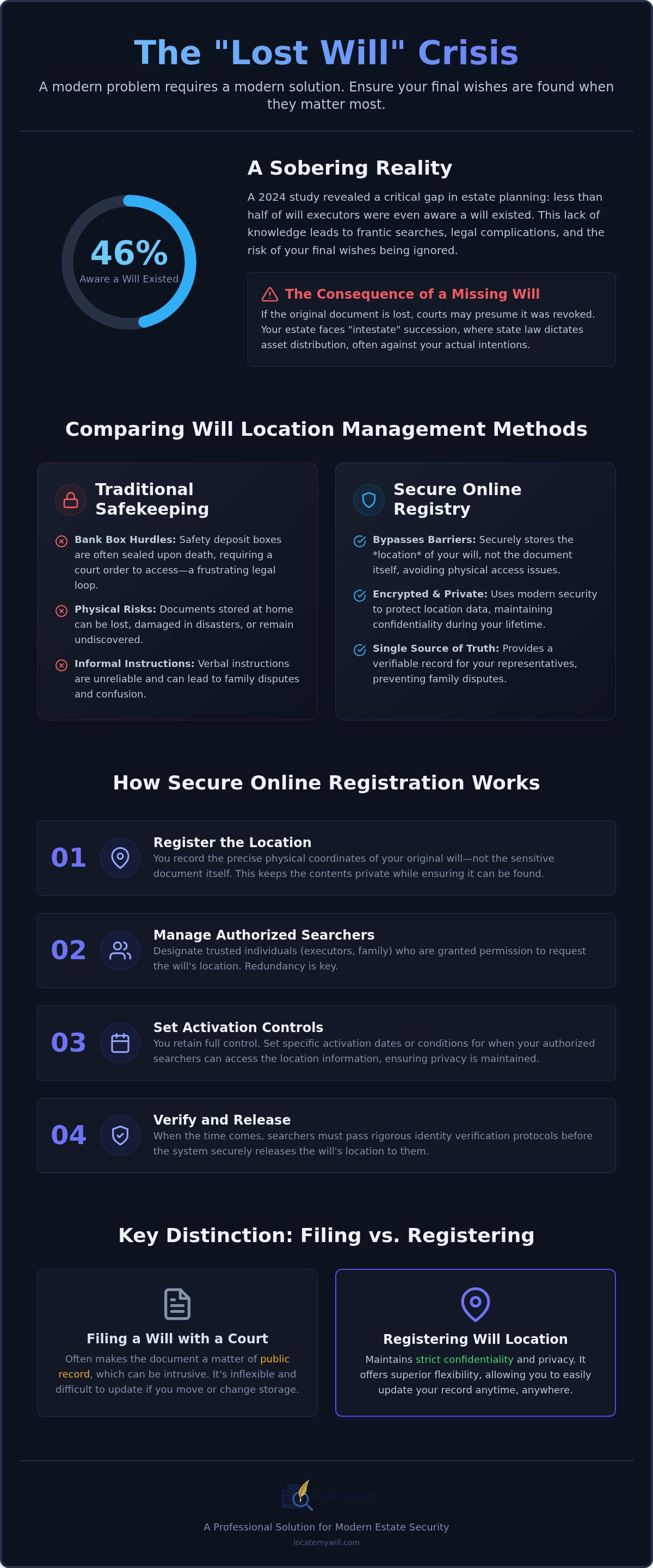
A 2024 study revealed that only 46% of will executors were even aware that a will existed. It's a sobering reality that underscores a critical gap in estate planning. You've done the hard work of drafting your final wishes, but those documents are useless if they remain undiscovered in a desk drawer or a safe deposit box. To solve this, you can now register will location online to bridge the gap between your private preparations and your family's eventual needs.
You likely feel a deep responsibility to protect your legacy, yet you probably worry about family members accessing your documents prematurely. It's frustrating that a centralized, national database for this sensitive information doesn't exist. This guide explains how to securely record where your will is kept so your loved ones can find it exactly when they need it. We'll explore how to manage authorized searchers and set specific activation dates. This methodical approach gives you total control over your digital stewardship and the peace of mind that your estate process will remain orderly and efficient.
Key Takeaways
- Understand why traditional storage methods like bank boxes often fail during the probate process.
- Learn how to register will location online to ensure your family can find your documents without compromising your current privacy.
- Discover the importance of managing authorized searchers and setting specific activation dates for your information.
- Compare the security of encrypted digital registries against the risks of informal verbal instructions or physical-only records.
- Explore how a dedicated subscription service provides long-term data stewardship and national accessibility for your estate representatives.
Why Registering Your Will Location Online is Essential for Estate Planning
A will is a legal document that expresses a person's wishes regarding the distribution of their property and the care of any minor children. While drafting this document is a vital first step, its existence is only half of the equation. Will location registration is the act of recording the precise physical or digital coordinates of your original legal documents. It acts as the bridge between your private intentions and the eventual execution of your estate. Without a clear record, even the most meticulously drafted plan can remain dormant and ineffective.
The "Lost Will" crisis is a frequent hurdle in the probate process. According to a 2024 study, only 46% of executors were aware that a will even existed. This lack of awareness often leads to a frantic search during an already stressful time. If an original document cannot be located, the court may presume the testator intended to revoke it. When you register will location online, you eliminate this ambiguity. You provide your representatives with a reliable roadmap, ensuring they don't have to rely on memory or guesswork.
Many individuals hesitate to share the details of their estate plan because they value privacy. They don't want family members reading the contents of the will prematurely, yet they understand the need for accessibility. The 2026 digital estate landscape offers sophisticated ways to manage this tension. Modern registration allows you to keep your documents locked away while providing a secure method for authorized parties to find them only when the time is right.
The Legal Consequences of a Missing Will
Courts maintain strict standards for validating an estate plan. If the original document is missing, the estate faces the risk of "intestate" succession. Intestacy is the default legal process when no valid will is found. In these cases, state law determines the distribution of assets, which often contradicts the deceased person's actual preferences. Producing a photocopy is rarely sufficient; most jurisdictions require the physical original to prove it hasn't been tampered with or revoked. A secure location record prevents these legal complications from arising.
The Difference Between Filing and Registering
It's vital to distinguish between filing a document with a court and registering its location privately. Filing often makes the document a matter of public record, which many find intrusive. In contrast, to register will location online is to maintain strict confidentiality. This method offers superior flexibility, especially for those who move frequently or change their storage habits. Instead of updating a court filing, you simply update your private registry. This keeps your information current and your documents protected from prying eyes during your lifetime.
How Secure Online Registries Protect Your Final Wishes
Traditional methods like safety deposit boxes often create more problems than they solve. Banks frequently seal these boxes upon the owner's death, which requires a court order just to retrieve the will. This creates a circular legal hurdle that delays the entire probate process. A digital registry bypasses these physical barriers. When you register will location online, you aren't uploading the document itself. Instead, you store the precise coordinates of the physical original in an encrypted environment. This architecture ensures that sensitive data remains protected by modern security standards while remaining accessible to the right people at the right time.
Centralizing this information prevents the family disputes that often arise when heirs have conflicting memories of past conversations. Using a secure location registry provides a single, verifiable point of truth for your representatives. This methodical approach replaces anxiety with a structured system of authorization and verification.
Managing Authorized Searchers
An Authorized Searcher is a designated individual granted the right to request the location of your will. It's a role built on trust and administrative necessity. You should designate multiple searchers to ensure redundancy. If one person is unavailable, others can still facilitate the estate process. These individuals don't have immediate or unfettered access to your records. They must pass through rigorous verification protocols designed to confirm their identity and authority before any information is released. This ensures your information only moves into the hands of those you have explicitly chosen.
Search Activation Dates and Privacy
Control is a central pillar of effective digital stewardship. You can set a specific Search Activation Date to ensure your information remains strictly private during your lifetime. This prevents family members from conducting premature searches out of curiosity or impatience. If an unauthorized search is attempted, or if a search occurs before the designated date, the system triggers alerts to your notification recipients. This mechanism balances your current right to privacy with the future need for transparency. It acts as a protective shield, ensuring that your final preparations remain confidential until they are truly required for the settlement of your estate.
Comparing Will Location Management Methods: Registry vs. Physical Safekeeping
Traditional storage methods often rely on physical proximity or the longevity of a single professional relationship. While a fireproof home safe or a local attorney's office might seem secure, these methods are vulnerable to environmental hazards or the simple passage of time. If you move or your lawyer retires, the link between your documents and your heirs can easily break. Even the common practice of "just telling the family" is notoriously unreliable. In the high-stress environment following a loss, memory often fails. Specific details like safe combinations or the name of a specific law firm are easily lost during a crisis.
When you choose to register will location online, you replace these fragile links with a resilient digital record. This method doesn't replace physical storage; it secures the path to it. Professional subscription services provide a disciplined framework for this information. This ensures your data remains accessible even as your life circumstances change. A subscription-based model allows you to register will location online with the confidence that the platform will remain active for decades. It's a methodical way to bridge the gap between your current preparations and your family's future needs.
The Limitations of Local Government Registries
Some local jurisdictions offer official filing or safekeeping options through court clerks or registrars. However, these government-run systems are almost always siloed. If you register your documents in one county but move across the country, your executor may never think to check your previous residence's local records. These offices rarely offer proactive notification services or modern searcher management. They lack a standardized digital interface that works across state lines. This makes them an inefficient choice for a mobile population that needs a portable, national solution. A subscription registry provides the national reach that local government offices cannot match.
Registry vs. Digital Document Hosting
It's a common misconception that modern estate planning requires uploading a full copy of your will to the cloud. In fact, keeping a location record is often significantly safer than digital document hosting. Most probate courts still require the physical document with "original ink" signatures to grant probate. A digital scan is often legally insufficient on its own. By storing only the location metadata, you avoid the cybersecurity risks associated with hosting full legal documents online. You maintain the integrity of your physical original while ensuring its location is never a mystery. This methodical separation of the document from its location data is a hallmark of professional estate security.
How to Successfully Register and Manage Your Will Information Online
Completing your estate plan is a significant achievement, but the administrative task of ensuring document discovery remains. The process to register will location online is designed to be methodical and secure. It moves through four distinct stages of preparation. First, you must document the exact physical coordinates of your original documents. Vague descriptions like "in the study" are insufficient. Instead, use precise details such as "the black fireproof safe in the master closet, entry code 5678." This level of specificity removes any doubt for your representatives during a difficult time.
Second, you will select your authorized searchers and notification recipients. Our system allows you to manage up to three searchers who can request information when necessary. Third, you must establish a search activation date. This date acts as a protective barrier, ensuring your data remains private until a time you deem appropriate based on your current age and health. Finally, you should commit to a periodic review of your registration. A legacy plan is not a static document; it is a living record that must reflect your current circumstances. To begin this disciplined approach to your estate security, you can start your registration today.
Selecting Your Authorized Searchers
Choosing the right individuals to act as authorized searchers is a decision that requires careful thought. Ideally, these should be people characterized by their reliability and organizational skills, such as your named executor, a spouse, or an adult child. It is a professional best practice to include at least one individual who does not reside in your household. This redundancy ensures that your information remains accessible even if a localized emergency affects your primary residence. Once you've made your selections, communicate the existence of the registry to them. They don't need the specific details of your will, but they must know that a secure system exists to guide them when the time comes.
Updating Your Registry Record
Life events often necessitate changes to your estate documents, and your location record must keep pace. Common triggers for an update include moving to a new home, appointing a different executor, or drafting a completely new will. One of the primary advantages of a digital registry is the ease of these updates. Unlike the cumbersome process of withdrawing and refiling a physical document at a local court office, digital records can be adjusted in minutes. Always ensure that your location descriptions remain actionable. If you move your safe or change a digital access key, update your record immediately to maintain the integrity of your estate's "final mile" instructions.
Locate My Will: A Professional Solution for Modern Estate Security
Locate My Will serves as a disciplined partner in your estate planning journey. Unlike local county offices that operate within narrow geographic silos, this US-based platform provides a national solution that moves with you. Whether you relocate for retirement or move closer to family, your record remains secure and accessible. This continuity is essential for modern families whose members often reside in different states. The paid subscription model is a deliberate choice to ensure long-term data stewardship. It provides the necessary resources to maintain high-level security and platform availability for decades. It acts as a permanent digital bridge to your physical documents, providing a steady presence that prioritizes the integrity of your information above all else.
When you choose to register will location online with a professional service, you're investing in a methodical system of organization. This organized approach replaces the anxiety of a lost document with the certainty of a verified plan. It's the final, critical step that transforms a legal document into a functional reality for your heirs. Peace of mind comes from knowing that your representatives won't face a frantic search during a period of grief. Instead, they will have a clear, authorized path to follow.
Security and Verification Protocols
Our platform operates on a privacy-first philosophy. We don't host digital copies of your legal documents; instead, we act as a "Reliable Guardian" of their location. This separation of "where" from "what" ensures that your sensitive legal details remain strictly between you and your attorney. Before any information is released, our system employs rigorous verification protocols to confirm the identity of an authorized searcher. Combined with user-defined search activation dates, these measures ensure that you maintain total control over your information during your lifetime. This methodical verification process prevents unauthorized access and maintains the high register of security your estate deserves.
Getting Started with Your Subscription
The process of establishing your digital legacy is straightforward and efficient. After creating your secure account, you can record the precise location of your documents and manage up to three authorized searchers. To ensure maximum redundancy, you can also designate up to three notification recipients who will be alerted if a search is ever initiated. This layered approach to communication ensures that no action happens in secret. You've spent a lifetime building your legacy; don't let it be lost in the final mile. You can take the final step in your estate plan and Register your will location with Locate My Will today.
Finalizing Your Legacy with Confidence
You've taken the essential step of drafting your final wishes. Now, you must ensure they aren't lost in the administrative gap between storage and discovery. We've explored why traditional methods often fail due to physical barriers or simple memory loss. By choosing to register will location online, you create a robust safeguard with national US coverage that remains current regardless of where you live or how your life changes. This transition from informal arrangements to a professional registry is a hallmark of responsible planning.
Our platform offers a disciplined framework for this critical information. You maintain total control through customizable activation dates and secure searcher verification. This methodical approach ensures your family finds exactly what they need at the right time without compromising your privacy today. Secure your family’s future by registering your will location with Locate My Will. Taking this final step provides the lasting peace of mind that your preparations will be honored exactly as you intended.
Frequently Asked Questions
Can I register my will location online if I live in another state?
Yes, you can register will location online regardless of which state you currently reside in. Our service provides national US coverage, which is a significant advantage over county-specific government registries that don't communicate across state lines. This portability ensures that if you move or if your executor lives in a different jurisdiction, the path to your original documents remains clear and accessible for your representatives.
Is it safe to store my will’s location in an online database?
Storing location metadata is a highly secure practice because the actual legal document is never uploaded to our servers. We utilize modern encryption and rigorous verification protocols to protect your data from unauthorized access. By only recording the "where" and not the "what," you eliminate the cybersecurity risks associated with hosting full legal documents while ensuring your family has the necessary roadmap when the time comes.
How does an authorized searcher access the information when I pass away?
An authorized searcher must initiate a formal request through our platform to access your records. Once a search is requested, our system verifies the individual's identity and checks the search activation date you established. If the search is authorized and the date has passed, the location details are released. This methodical process ensures that your sensitive information only reaches the hands of those you have explicitly trusted.
What is the difference between a will registry and a digital will?
A will registry records the precise physical or digital coordinates of your original document, whereas a digital will is the electronic document itself. Most probate courts still require the original document with "original ink" signatures to settle an estate. Our registry focuses on the "final mile" of estate planning, ensuring your executors can find that legally binding physical original exactly when they need it for court.
Can I change my authorized searchers after I have registered?
You maintain total control over your list of authorized searchers and can update them at any time through your subscription dashboard. We allow you to manage up to three searchers to ensure redundancy in your plan. If a relationship changes or a designated individual is no longer able to serve, you can simply remove them and appoint a new representative without the need for physical paperwork.
What happens if my authorized searcher tries to search before the activation date?
If a search is attempted before your designated activation date, the request is automatically denied. Additionally, our system sends immediate alerts to your notification recipients to inform them of the attempt. This feature acts as a protective shield for your privacy, preventing premature discovery of your estate plans by curious family members while you are still healthy and maintaining your current affairs.
Do I need to upload a copy of my actual will to the registry?
No, you don't need to upload a copy of your actual will to our platform. We intentionally don't host digital versions of legal documents to maintain the highest level of privacy and security for our users. You only need to provide a clear, actionable description of where the physical original is stored, such as a specific safe location or a lawyer's office address.
Is an online will location registry recognized by probate courts?
While probate courts require the physical original document for legal proceedings, an online will location registry is a vital tool for the discovery phase. It doesn't replace the court's role; instead, it empowers your executor to produce the document the court requires. By using a service to register will location online, you prevent your estate from falling into intestate probate simply because the original will couldn't be found.


