

A missing will can change how an estate is handled. If a will cannot be found, a probate court may presume the original was revoked. If the court accepts no will, the estate is generally distributed under the state’s intestacy laws. A copy or other evidence may help establish the will’s contents, but the outcome depends on state law and the evidence available.
It’s understandable to expect a person’s final wishes to guide what happens next. When the document is missing, finding it or establishing that a copy is valid can become an important part of settling the estate.
This article explains what happens if a will cannot be found, where families commonly search, and what a missing or invalid will may mean for the estate. It also covers how state-specific rules affect whether a copy or lost will is considered, and what may happen if the court doesn’t recognize one.
Key Takeaways
- Check whether the will was filed with the local probate court, and search likely storage places and the deceased person’s attorney’s records.
- A copy or evidence of a lost will may be considered, but the court needs evidence to establish its validity and contents.
- If no will is recognized, the estate is generally distributed under the state’s intestacy laws, which determine who inherits.
- Plan ahead by recording where your will is kept and designating authorized searchers through Locate My Will.
What Happens When No Will Is Found?
Start by checking the probate court in the county where the deceased person lived. Some older Americans filed wills there, and the court may be able to retrieve a filed document for the application to open the estate.
Starting Probate Without the Original
Probate can begin without the original will when an interested person applies to open the estate and explains that the document cannot be located. This can establish the estate proceeding while the family continues searching for the original or a signed copy.
Search the deceased person’s home, including safes, desk drawers, filing cabinets, and papers kept with tax documents. Ask the person’s attorney or former law firm about its records, and ask the bank whether a safe deposit box exists. In Michigan, a probate court order is generally needed to open a deceased person’s safe deposit box and remove a will.
How do probate rules for lost wills vary by state? State law determines whether a copy or evidence of a lost will can be admitted, and what proof the court requires. Georgia, for example, has a specific procedure under OCGA § 53-3-6.
Proving a Lost Will in Court
To prove a lost will, provide the probate court with evidence that the document was valid and establish its contents. The court must assess whether a copy reflects the deceased person’s final will, rather than a document later changed or revoked.
For a signed copy, evidence may include the deceased person’s signature and the signatures of two witnesses. In Georgia, a copy may be admitted when the required circumstances apply and witnesses and other evidence clearly prove it. If the copy lacks self-proving affidavits, Georgia law requires an affidavit from at least one witness who signed the will.
What evidence is needed to prove a lost will in probate court? The court may consider a signed copy, witness evidence, and proof that the original was lost rather than destroyed. In Georgia, the copy’s contents must be clearly proved.
Probate Administration and Estate Distribution
If the court recognizes the will, its named executor can settle debts and distribute assets under its instructions. An executor named in a missing will can serve only if the will is accepted and the court authorizes the appointment. Being named alone does not establish that role.
If the missing will is not validated, the court may appoint an administrator, usually a close relative. The administrator distributes the estate under the state’s intestacy laws, rather than the missing document’s instructions. A dispute over a copy can require additional evidence and, in a large or complicated estate, take years to resolve.
How long does probate take when a will cannot be found, and what does it cost? A complicated dispute over a copy can take years. The time and expense depend on the evidence, court process, and whether anyone contests the will.
What Happens When a Will Is Missing or Invalid?
If probate doesn’t recognize a missing will, the estate is generally treated as though no will existed. The state’s intestacy laws then determine which relatives inherit and how assets pass.
What are the risks of distributing estate assets before determining whether a will exists? Assets may go to people who wouldn’t inherit under a valid will, and later changes can lead to disputes over what was distributed. A will found after distribution may complicate efforts to follow its instructions.
Intestate Estate Distribution
Intestate distribution means allocating an estate under state law when probate recognizes no valid will. The legal order of inheritance may differ from the deceased person’s intended plan.
Virginia Code § 64.2-200 governs distribution when no valid will is recognized in Virginia. For example, the Virginia General Assembly states that when the deceased had children from a previous relationship, the surviving spouse inherits one-third of the estate. The remaining distribution follows the applicable rules for relatives.
Some jurisdictions allow beneficiaries and potential heirs to agree to follow a missing will’s provisions, even if the court hasn’t validated it. That agreement can preserve the deceased person’s stated wishes, but it depends on the parties’ consent and applicable state law.
Presuming a Missing Will Was Revoked
In Virginia, a will missing after the testator’s death is presumed destroyed with the intent to revoke it, especially when it was last in the testator’s possession. A family may need to overcome this presumption before probate accepts a copy or lost-will claim.
The inference is weaker when the original was stored securely, such as at an attorney’s office or in a safe deposit box. Virginia Code § 64.2-410 addresses proving a lost will’s validity and contents. The location where the original was kept can therefore affect how the court assesses the evidence.
In Michigan, a probate judge may admit a copy if clear and convincing evidence shows it duplicates the deceased person’s last original will. The petitioner must explain efforts to locate the original and why the copy is believed to match it. Witnesses and document details can help distinguish the final version from an earlier draft.
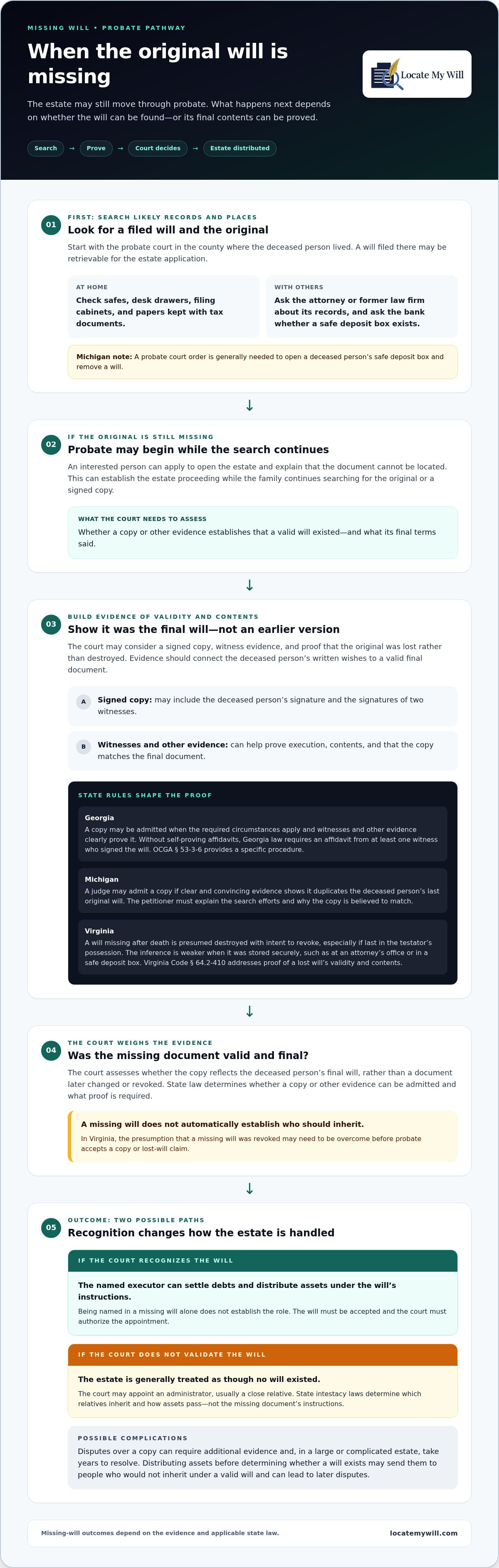
What may happen when a will cannot be found
What happens if a will cannot be found depends on whether anyone can establish that it existed and prove its terms. A court may consider evidence of a lost will, probate may proceed under intestacy rules, or a document found later may affect administration. The key question is whether the evidence connects the deceased person’s written wishes to a valid final document.
Kansas allows a lost-will procedure when evidence shows that a will once existed. A person seeking to establish it can present evidence of its contents and execution, such as testimony from people present at signing or a prior copy. These details help the court assess what the document said and whether it represented the deceased person’s final instructions. A lawyer’s recollection may help locate records, but evidence must support the claim.
Florida illustrates a different practical distinction. Probate may begin while a will is missing, but the process may still require the original document. Copies may help relatives understand the deceased person’s wishes, yet they don’t replace the original in that process. If no will is found, Florida’s intestacy statutes determine how the estate’s assets pass. A will discovered after proceedings begin can still be submitted and honored.
For beneficiaries, the difference is significant: a written plan may direct assets to people who would not inherit under intestacy. If a court accepts evidence of a lost will, its terms may guide distribution; without recognition, state succession rules control. Keep prior copies, signing details, and records identifying the drafting lawyer together, since each may help locate or establish the document. The deciding evidence is not simply what relatives remember, but whether the available proof establishes the will’s existence and contents under the relevant state procedure.
What happens to an estate if the original will cannot be found in the United States?
In the United States, the outcome depends on state probate rules and the evidence available. The court may consider a copy or lost-will evidence; if no will is recognized, state intestacy laws generally govern distribution. Probate can also begin while the family continues searching, so a missing original doesn’t automatically stop estate administration.
Search for the original in places connected to the deceased person’s records. Check home safes, filing cabinets, desk drawers, and papers stored with tax documents. Ask the bank where the deceased held an account whether a safe deposit box exists. Contact the drafting lawyer’s former firm, which may still hold a copy or know where client files went. A county bar association may help identify who inherited a deceased or retired lawyer’s files.
The court’s requirements matter. A signed copy may support a request to probate a lost will, but it doesn’t automatically establish that it was the final version. Evidence about the will’s execution and contents can help. The probate court authenticates the original before authorizing the executor to carry out its instructions. When the original is missing, the court must assess the applicable proof before recognizing a copy or lost-will claim.
If the court doesn’t accept the will, an administrator may distribute the estate under state intestacy law. That can change who receives assets compared with the missing document’s instructions. Preserve any copies and signing records, and tell the probate court about a will discovered after proceedings begin. In Florida, a will found after probate starts can still be submitted and honored.
To help authorized people locate your document in the future, record where your will is kept and designate searchers.
Locate My Will: Will Owner Registration Subscription
Locate My Will helps you record where your will is kept, so authorized people know where to search when needed. Its Will Owner Registration Subscription lets you register location details and designate up to three authorized searchers and three notification recipients. Authorized Searcher Management helps organize those permissions, while Search Activation Date Control sets when searches can be performed and notifications sent.
This service is useful if you want to clarify the will’s location and search arrangements without placing the document itself on the platform. Recording the location gives designated searchers a practical starting point, while activation-date controls let you set when searches become available.
Visit Locate My Will to learn more about recording your will’s location.
Make Your Will Easier to Locate
Estate planning is not complete when a will is signed. Make sure the people responsible for carrying out your wishes can find the document when needed. Review where it is kept whenever your arrangements change, and keep the location information accurate. Recording that information gives your representatives a clear starting point without sharing the will’s contents unnecessarily.
Understanding what happens if a will cannot be found can prompt a useful conversation with trusted family members. Tell them who is authorized to search and where they can find reliable location details. Clear, orderly information can reduce uncertainty at a difficult time and help preserve the purpose behind your planning.
Locate My Will provides a way to record will-location details and manage search arrangements. If you’re ready to put those details in order, contact Locate My Will for help. A thoughtful step now can make it easier for the right people to act with confidence later.
Frequently Asked Questions
What happens if you can’t find the will?
What happens if a will cannot be found depends on whether a court accepts evidence of its existence and terms. If no will is recognized, the estate may be handled under the state’s intestacy laws. Before assets are distributed, gather known copies and signing information, and tell the probate court if a document appears later. A later-found will may still affect proceedings, including in Florida.
What Happens If You Lost the Original Will?
A lost original doesn’t automatically mean the deceased person had no will, but the court may need convincing evidence before honoring a copy. Preserve copies, drafts, and correspondence that identify when the will was prepared or signed. Record who last saw the original and where it was kept. These details can help explain how it went missing and whether it may have been changed.
Is a missing will presumed revoked if the person who made it kept it?
In Virginia, a will that cannot be found after the maker’s death is presumed destroyed with the intent to revoke it, particularly when it was last in that person’s possession. The inference may be weaker if the original was stored securely, such as at an attorney’s office or in a safe deposit box. The storage history can matter when the court considers a lost-will claim.
Can a copy or digital copy of a missing will be admitted to probate?
Sometimes, but a scan or photocopy isn’t automatically accepted as a valid will. State rules and evidence of the document’s authenticity and finality matter. In Michigan, a judge may admit a copy when clear and convincing evidence shows it duplicates the deceased person’s last original will. Keep the complete image, including signatures and witness details, and preserve information about where it came from.
Who inherits if no will is found and the estate is treated as intestate?
State intestacy law determines which relatives inherit, rather than the deceased person’s unwritten wishes or a family’s preferred arrangement. The order depends on surviving relatives and state rules. For example, Florida’s general hierarchy when there’s no surviving spouse begins with children, then parents, then siblings, followed by more distant relatives if needed. A family tree can help clarify who may have an interest.
What steps should family take to search for a missing will before probate?
Assign one family member to coordinate the search and keep a written record of places checked, people contacted, and responses. Search household papers and storage areas, then contact the drafting lawyer or former firm. Ask the bank about a safe deposit box. In Michigan, a probate court order is generally needed to open the deceased person’s box and remove a will. Save any copies and related correspondence.


