

A will can’t guide your family if they can’t find the current signed original. If you’re deciding how to let family know where your will is, tell your executor and a trusted person where it’s kept and how to access it. Whenever you update the will, share the new location and remove outdated copies.
It’s understandable to want your wishes kept private while ensuring loved ones can act on them. Share the will’s location without revealing all its contents, and decide what other information you feel comfortable sharing with your family.
This guide explains how to keep your will accessible, decide what to disclose, and tell the right people where to find the current copy. It also covers organizing related records and keeping those who may need them informed, so they know where to begin.
Key Takeaways
- Tell your executor and a trusted person where the signed original is kept and how they can access it.
- You can share the will’s location without revealing its contents; choose the level of detail that feels right for your family.
- After changing your will, make sure loved ones know where to find the current version and remove outdated copies.
- Organize related estate and health care papers so the people who may need them know where to look.
- Consider how a home safe or trusted advisor fits into your storage plan, and explain any access steps clearly.
1. Keeping your will and estate-planning documents accessible
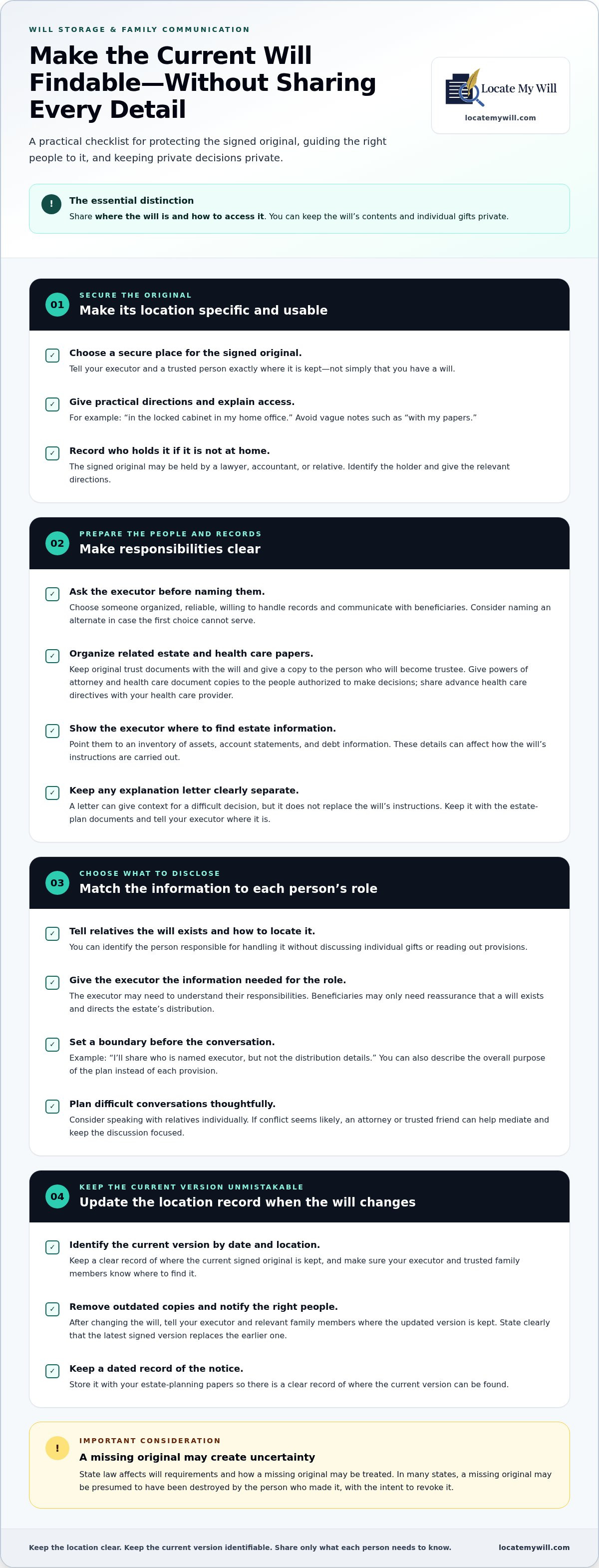
Choose a secure place for the signed original, then tell your executor and a trusted person exactly where it is. Give practical directions, such as “in the locked cabinet in my home office,” and explain how to access it. Knowing only that you have a will may not help family members locate it when they need it.
The executor, also called a personal representative, manages the estate after your death. Choose someone organized, reliable, and willing to handle records, communicate with beneficiaries, and follow the estate plan. Ask the person before naming them, and consider an alternate in case your first choice cannot serve. The original will is typically needed to carry out the plan and may need to be filed with the county clerk and probate court.
Store related documents in a clearly labeled, secure place. Keep original trust documents with the will, and give a copy to the person who will become trustee. Give copies of powers of attorney and health care documents to the people authorized to make decisions. Share advance health care directives with your health care provider, too, so they can be found when needed.
Access rules can affect how an estate is handled. This applies to particular property and does not replace clear directions about where the will is kept.
Prepare your executor by explaining where to find an inventory of assets, account statements, and debt information. Debt balances and asset values can affect how the will’s instructions are carried out. Let beneficiaries know that valuations and estate administration may affect the timing of distributions, and update them as information becomes available.
If you prefer not to explain difficult decisions in person, leave a letter with the estate plan. For example, it can explain why a child with special needs receives additional support or why assets are divided unequally. A letter can provide context, but it does not replace the will’s instructions. Keep it with the documents and tell your executor where to find it.
2. Choosing how much will information to disclose
Decide what to share by separating the will’s location from its contents. You can tell relatives that you have made a will, identify the person responsible for handling it, and explain how to find it without discussing individual gifts. This gives loved ones practical direction while keeping private decisions private. Set boundaries before speaking, such as, “I’ll share who is named executor, but not the distribution details.”
If you want to offer more context, describe the overall purpose instead of reading out every provision. For example, you might say your estate plan aims to provide for dependents and distribute assets according to your wishes. You can explain that a will is a legal document, not a personal letter. If you’re concerned about a provision, prepare a short explanation or separate letter rather than starting an unplanned family discussion.
Choose an executor for their ability and willingness to manage the role, not solely because of their place in the family. Consider whether they are organized, communicate clearly, and can handle practical decisions under pressure. Ask directly before naming them in your will. If your first choice declines or cannot serve, name an alternate and make sure both people understand their roles. An attorney can help you consider how your choice fits your estate plan.
Before sharing details, consider each person’s role and what they need to know. Your executor may need to understand the responsibilities involved, while beneficiaries may only need reassurance that the will exists and directs the estate’s distribution. In the United States, an executor generally does not have to discuss the will’s contents with family members or beneficiaries before filing it. You may still choose to share information to encourage open communication.
For difficult conversations, speak with relatives individually instead of announcing every provision at a family gathering. Explain the decision affecting that person, listen to their concerns, and clarify what happens next. If conflict seems likely, an attorney or trusted friend can help mediate. A neutral person can keep the discussion focused on your wishes and prevent disagreement over one bequest from overshadowing the broader plan.
Set a clear boundary and a practical next step. For example, tell relatives, “I’m not discussing individual gifts, but my executor knows where to find the current will.” Then make sure the executor has agreed to serve and understands where the document is kept. A secure record of its location can support that conversation; you can document where the will is kept without sharing its provisions.
3. Keeping will copies and telling family where to find the current version
Yes. State law affects a will’s legal requirements and how a missing original may be treated. In many states, a missing original may be presumed to have been destroyed by the person who made it, with the intent to revoke it.
Keep a clear record of the current version’s location and identify it by date. Tell your executor and trusted family members whether the signed original is at home or held by a lawyer, accountant, or relative. Give practical directions, such as the office cabinet or the name of the person holding it. Avoid vague notes like “the will is with my papers.”
After changing a will, remove outdated copies and tell your executor and relevant family members where the updated version is kept. Otherwise, relatives may find conflicting versions and be unsure which reflects your wishes. State clearly that the latest signed version replaces the earlier one, then give the current original’s location. Keep a dated record of the notice with your estate-planning papers.
Keep any explanation letter with the will, and label it as a separate letter rather than part of the signed document. It might explain why you chose a particular distribution or why one person receives a different share. The letter can help family members understand your reasons, while the will remains the document that directs how assets are distributed. Tell your executor where both are kept.
Consider how to communicate with relatives who are excluded from the will. An executor generally has no legal obligation to discuss the will with people who were left out, but keeping family members informed can reduce confusion about what happens next. A short, respectful message could confirm that the estate is being administered and explain when further information will be shared. Avoid promising a distribution or timeline before the executor has reviewed the documents and estate details.
If the original cannot be found, don’t assume a photocopy will automatically serve instead. Interested parties may ask a court to accept a signed photocopy, particularly if they agree it reflects the person’s wishes. The process can be costly and time-consuming, and the court may reject the copy. If the will has already been filed with probate court, it becomes a public record that anyone can obtain a copy of. Clear directions to the current original can help avoid these complications.
Make your location notice easy to act on. Give your executor a written note with the current version’s date, its physical location, and whom to contact if someone else holds it. When you revise the will, update the note and tell relevant family members where the new version is kept.
4. Telling loved ones where important papers are kept
Besides your executor, tell a trusted family member where the will is kept. Also inform the people named to make health care or financial decisions, and the person who will become trustee. Give each person directions suited to their role, not unrestricted access to every private record.
Give your executor a written location guide. Identify each document, where it is stored, and who can provide access. For example, note that the original will is in a home safe and that access instructions are kept separately. Review the guide together so your executor can ask questions while you’re available.
Use a simple inventory to organize papers by purpose. List the will and trust documents, powers of attorney, health care directives, insurance information, and account records. For each item, note its location and who should receive or use it. Keep the inventory with your estate-planning records, but store passwords and account credentials separately in a secure place.
Share copies with the people responsible for acting on specific documents. Give a copy to the person named in a power of attorney, and provide health care directives to the people authorized to make medical decisions. Share an advance health care directive with your health care provider, too. If a family member will be trustee, provide that person with a trust copy and explain where the original is kept.
- For your executor: Provide the will’s location, your inventory, and contact details for anyone holding documents.
- For health care decision-makers: Share the directive and identify your health care provider.
- For a future trustee: Provide a trust copy and the original’s location.
- For digital records: Identify the separate secure file and the person authorized to use its contents.
Make your directions useful if you’re away from home or unable to explain them. Include the office, cabinet, or safe location, along with any access steps the person needs. Don’t keep a safe combination beside the safe. If an accountant, attorney, or relative holds a document, record their name and how your executor can reach them.
Keep the message focused on access, not every personal detail. You might tell a sibling, “My health care directive is with my provider, and my agent has a copy.” Tell your executor what to do if a document has moved, and update the inventory whenever details change. Knowing where to begin can help a loved one act efficiently and avoid searching through unrelated papers.
5. Home safes and trusted advisors
Yes, you can keep a will in a bank safe-deposit box, but access after death depends on state law and bank policy. A court order may be required in many states, so tell your executor how to locate the box and whom to contact.
A home safe keeps the document close, but your executor needs a workable way to access it. Share the safe’s location and explain how to obtain access without placing the combination beside it. For example, keep access instructions in a separate secure record and tell your executor where that record is. Review your directions if you move the safe or change how it can be opened.
Before choosing a bank box, consider what happens if you become incapacitated or die. Joint ownership with a spouse or family member may allow that person to access the box in those circumstances. However, access after death can still depend on state law and bank policy. Tell your executor whether the box is jointly owned and where it is held.
An estate-planning lawyer can explain the legal implications of your storage choice and answer questions about your will. Bring a simple outline showing where the original, any trust papers, and related records are kept. The lawyer can discuss how your decision fits your estate plan and the rules that apply where you live. Keep the final location directions with your planning records.
Decide who needs each piece of information. Your executor needs the will’s location and the steps to access it. A joint box holder needs to know the box exists and how to contact the bank. A beneficiary may only need to know whom to contact after your death, rather than have access to the safe or its contents.
- Home safe: Tell the executor its location and where separate access instructions are kept.
- Bank box: Record the bank’s name, branch, and any joint owner.
- Trusted advisor: Tell your lawyer or accountant which documents they hold and whom to notify.
Then test your directions with your executor. Ask them to explain where they would begin and whom they would contact if you couldn’t answer. Correct unclear details, such as a missing branch name or an outdated safe location. A written guide can help your family act without searching through unrelated papers.
For an organized record of your will’s location and the people authorized to search for it, record your will’s location.
Locate My Will: Will Owner Registration Subscription
Locate My Will helps you record where your will is kept and manage who can search for that location. The Will Owner Registration service lets you enter location details, while Authorized Searcher Management lets you designate up to three authorized searchers and up to three notification recipients.
Use Search Activation Date Control to set when searches can begin and notifications can be sent. This gives loved ones a clear way to find the will’s location without sharing that information immediately. The platform records the location; it does not store the will, draft legal documents, or provide physical document storage.
If you want a structured way to record your will’s location and designate the people involved, visit locatemywill.com.
Put Your Plan Into Motion
If you’re still deciding how to let family know where your will is, choose who should be able to find it and when they should be informed. A brief conversation can clarify your wishes while keeping the will’s contents private. Make the next step manageable: decide who needs the location information, then record it in a way you can keep up to date.
Locate My Will’s Will Owner Registration service records the will’s location. Authorized Searcher Management helps you designate who can search, while Search Activation Date Control sets when searches can be activated. These tools support your location-sharing plan, but they don’t replace the will or legal guidance about your estate.
Taking this step now gives you a clear process to revisit when your circumstances or documents change. You can contact Locate My Will for help setting up a location record and managing authorized searchers. Choose an approach that respects your privacy and gives the right people a clear path forward.
Frequently Asked Questions
What information should you share with family about where your will is stored?
Share the current document’s location, its date, and the steps needed to access it. To explain how to let your family know where your will is, give your executor clear directions and identify another trusted person who can answer practical questions. You can keep the will’s contents private. For example, tell relatives which office holds it without describing individual gifts or naming every beneficiary.
Should you give family copies of your will or only tell them where the original is?
You can tell relatives where the original is without giving everyone a copy. A copy can help someone understand your intentions, but it may not replace the signed original during estate administration. If you share copies, mark them clearly and record who received them. Ask your lawyer how copies fit your plan, especially if the original changes or you revoke an earlier version.
Can a lawyer or online registry help family find your will after death?
Yes. A lawyer may hold the original or explain how to locate it, while an online registry can record its location. Locate My Will records location details, not the will itself. The service lets you designate up to three authorized searchers, who must verify their identity using government-issued identification, and up to three notification recipients. Search Activation Date Control sets when searches can begin.
What happens if family cannot find the original will?
The result depends on state law and the evidence available. In many states, a missing original may be presumed to have been destroyed by the person who made it, intending to revoke it. Interested parties may ask a court to accept a signed photocopy, particularly if they agree it reflects the person’s wishes. If the court rejects the copy, the estate may be administered as if no will existed.
How should you update family if you move or change where your will is stored?
Update your written location record as soon as the document moves, then give your executor and trusted backup person the new directions. Include the new holder’s name if a lawyer, accountant, or relative now keeps it. Ask each person to replace old instructions, and destroy outdated copies when appropriate. If the will itself changed, clarify which signed version is current and where to find the original.


