

A missing original can make probate more involved if the court needs evidence to establish the will’s validity.
It’s understandable to want a clear estimate before estate costs add up. The filing fee is only one part of the total; the amount of legal and administrative work also affects the cost.
This article explains how court fees, attorney and accounting charges, and added steps such as hearings, notices, or bond requirements may affect the total. It also covers why a lost will can require additional proof and court oversight, and which factors are most likely to shape estate expenses.
Key Takeaways
- Navigating the legal process for a missing document requires specialized steps that directly influence the overall cost of probating a lost will.
- Look beyond basic filing fees: professional services, required notices, bonds, and estate valuations can add significantly to probate expenses.
- Attorney and accounting charges depend on the estate’s value, complexity, and whether disagreements require additional legal work.
- A lost will may require clear evidence from witnesses or other records, and the proof needed can affect both the process and its total costs.
- Understand how court supervision, formal hearings, and required filings may shape the estate’s timeline and overall financial expense.
Probate court filing fees
The filing charge is only one part of estate administration, especially when a lost will requires additional court review.
Filing and Administrative Charges
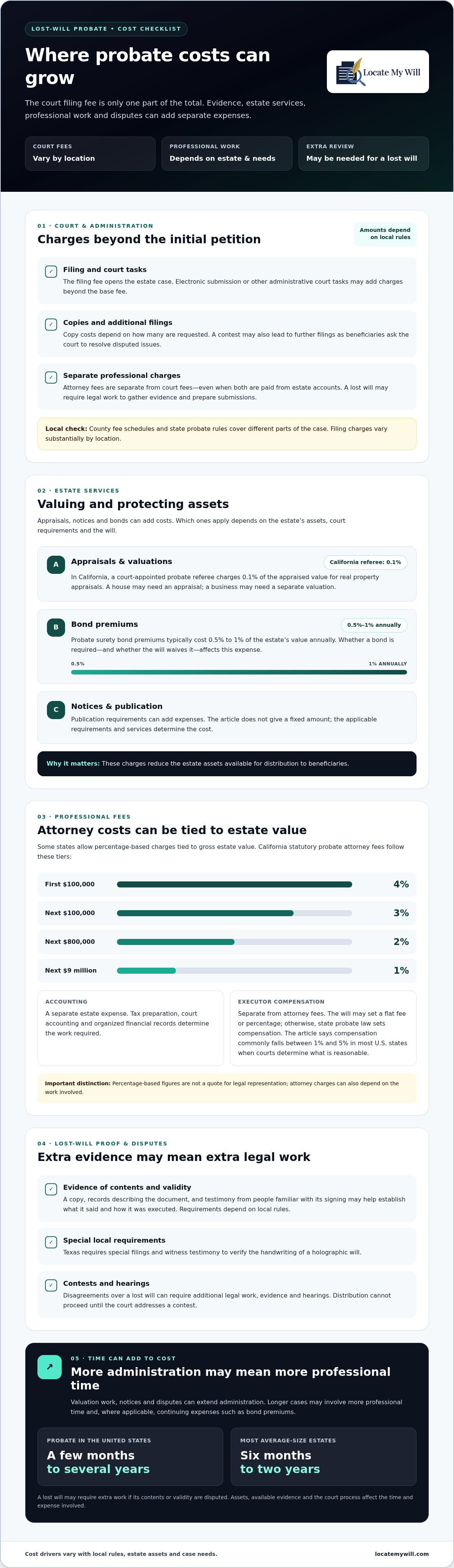
A probate filing fee is the court’s charge for accepting a petition and opening an estate case. Filing begins formal administration, while related court tasks may create separate expenses.
Fees vary substantially by location. These examples show why a national range cannot predict a county’s exact charge.
A contest can also lead to additional filings as beneficiaries ask the court to resolve disputed issues.
Families may need copies to document an appointment or support estate administration with financial institutions. The number of copies requested affects this administrative expense, which is separate from the initial petition fee.
Attorney fees are separate from court filing fees, even when both are paid from estate accounts. A lost will may require legal work to gather evidence and prepare court submissions, so distinguish professional charges from the clerk’s filing and copy fees.
Electronic filing and other administrative charges may appear in addition to a base court fee. Before submitting paperwork, identify the court’s filing method and review its fee schedule for separate submission or copy charges. The total depends on the filings and services the case requires.
Evidence and Local Fee Rules
Evidence helps the court assess a lost will’s contents and validity. A copy, records describing the document, and testimony from people familiar with its signing may help establish what it said and how it was executed. Requirements depend on local rules. Texas requires special filings and witness testimony to verify the handwriting of a holographic will.
To find local fees and lost-will probate rules, identify the county handling the estate, then consult that probate court’s official fee schedule and filing instructions. Review the applicable state probate rules for evidence requirements: county charges and state procedures address different parts of the case.
Factors that may increase probate expenses
Appraisals, required notices, bonds, and disputes can add separate charges to estate administration. Each expense reduces the assets available for distribution to heirs.
Estate Administration Expenses
Estate administration expenses are incurred while identifying, valuing, protecting, and distributing a deceased person’s assets. The probate court may require records and valuations before the personal representative can complete the process.
In California, a court-appointed probate referee charges 0.1% of the appraised value for real property appraisals.
Publication and bond requirements can add further expenses. Probate surety bond premiums typically cost 0.5% to 1% of the estate’s value annually. Whether a bond is required, and whether the will waives it, affects this expense.
These charges reduce the estate available to beneficiaries. An estate that includes a house, for example, may need an appraisal before its value can be recorded; an estate with a business may need a separate valuation. The assets and services required determine which expenses apply.
Delays and Increased Costs
Valuation work, notices, and disputes can add time and cost. Longer administration may mean more professional time and, where applicable, continuing expenses such as bond premiums.
Probate in the United States can take from a few months to several years. Probate for most average-size estates typically takes six months to two years. A lost will may require extra work if its contents or validity are disputed. The estate’s assets, available evidence, and court process affect how much additional time and expense follow.
If heirs or beneficiaries contest a lost will, the court must address the disagreement before distribution can proceed. Disputes can substantially increase probate costs because they may require additional legal work, evidence, and hearings. The scope of the disagreement and the claims involved shape the added work.
To understand how estate planning could affect future administration, consider which assets need valuation and whether the estate includes real property or a business. These details help explain why expenses vary. A plan that clearly records wishes and asset information can also give representatives a more organized starting point, though it cannot eliminate court-required steps.
Probate attorney and accounting fees
Attorney and accounting charges depend on the estate’s value, administration needs, and disputes. A missing will can add legal work if the court must assess evidence before deciding whether to admit it.
How does the cost of probating a lost will compare with intestate probate or probate of an original will? A lost will may require extra work to prove its contents and validity, while an original avoids that specific evidentiary task. Intestate probate does not involve establishing a will, but disagreements over heirs or administration can still increase legal work and expenses.
Some states also allow percentage-based charges tied to the estate’s gross value, so the estate’s assets and local fee rules matter. California Legislature sets statutory probate attorney fees at 4% of the first $100,000, 3% of the next $100,000, 2% of the next $800,000, and 1% of the next $9 million.
Percentage-based fees can make attorney costs rise with estate value, even when the work involved differs. These figures include more than attorney charges, so they are not a quote for legal representation.
Accounting work is a separate estate expense. The need for tax preparation, court accounting, and organized financial records determines the work required.
An executor’s compensation is separate from attorney fees. The will may set a flat fee or percentage; otherwise, state probate law sets compensation. In most U.S. states, executor compensation commonly falls between 1 and 5 percent when courts determine what is reasonable. An executor may waive payment, which can preserve more dollars for beneficiaries.
Reducing probate expenses starts with identifying which assets require court administration. Jointly owned assets with rights of survivorship pass to the surviving co-owner, while eligible accounts with named beneficiaries can transfer directly. Small-estate affidavit procedures may also reduce probate when strict statutory conditions are met; thresholds typically range from $50,000 to $208,850, depending on the state. Legal advice can help clarify which procedure applies to an estate’s assets and petition.
Probate process and court supervision
State rules shape how a probate court reviews a lost will and supervises estate administration. The court’s role can affect the evidence, filings, and authorization needed before assets transfer.
What legal requirements must be met to probate a lost will in each state? Requirements vary, but the court must assess whether the will’s contents and validity are established under local probate rules. Texas, for example, requires special filings and witness testimony to verify the handwriting of a holographic will.
What steps are involved in petitioning the court to probate a lost will? A representative generally files a petition, presents evidence about the will, gives required notice, and asks the court to authorize estate administration. The court reviews the submission and decides whether further hearings or proof are needed.
That review matters because the court’s order establishes who may act for the estate. Depending on the circumstances, a bond may be required before an executor receives permission to administer it. A will can waive a bond requirement in Georgia, while other states apply their own rules. Required bond premiums add an expense beyond the petition and other filings.
Court supervision also affects how quickly an executor can transfer property or distribute assets. A probate case may involve an asset inventory, notice to beneficiaries, creditor claims, and court accounting. Each required filing gives the court a chance to review whether administration can proceed. Missing information or a contested issue may require further submissions or hearings.
Probate filings, including a will, asset inventory, and beneficiary list, become public records. Court supervision can therefore involve disclosure as well as authorization. Families should consider what information appears in filed documents.
Timing varies with the estate and state procedure. Probate in the United States can take from a few months to several years; most average-size estates typically take six months to two years. A lost will may add time if witnesses or other evidence are needed. Disputes over validity or beneficiaries can also require more court attention.
Rules on legal representation differ by state. A lawyer is not legally required for probate in most states, but Florida and Texas require an estate representative to have an attorney in most formal probate cases. This distinction matters when estimating administration expenses. A professional’s flat fee does not replace court supervision, required filings, or a judge’s decision.
Court costs depend on the case and jurisdiction. Whether the court reviews a straightforward petition or must resolve disputed proof affects the filings and hearings involved, and therefore the work required to complete administration.
What additional costs arise for locating witnesses, obtaining affidavits, and proving a lost will?
Proving a lost will can require work beyond the initial petition. The estate may need to identify witnesses, gather records, and present evidence about the document’s contents and execution. Depending on what evidence remains and how readily it can be obtained, each task may add professional time or administrative expense.
Start by identifying people who saw the will being signed or discussed its provisions with the deceased. The drafting attorney, witnesses, or someone who handled the original may help establish relevant details. Finding an outdated address or contacting someone who has moved can take additional time. The scope of the search depends on available names, contact records, and distance.
An affidavit is a written statement that may record a witness’s account for the probate case. Preparing one can involve gathering accurate details, reviewing the statement, and arranging any formalities required by local rules. If a witness is unavailable or remembers only part of the signing, further questions or supporting records may be needed, adding legal work.
Texas provides a specific example: courts require special filings and witness testimony to verify the handwriting of a holographic will. This shows how a will’s form can affect the evidence presented. A typed document, handwritten document, or available copy may raise different proof questions under the applicable state process.
Records can help corroborate a witness’s memory. Look for a draft, scanned copy, email, letter, or notes describing where the original was kept. These materials may help clarify the document’s wording and the deceased person’s intentions. Organizing records by date and source can make gaps easier to identify before evidence is submitted.
Costs may rise if testimony conflicts, a witness cannot be located, or a beneficiary contests the document. The court may require more evidence or proceedings, increasing attorney time and delaying administration. Certified-mail notices in a U.S. probate case cost a few dollars per notice, and the number required depends on the case.
Keep a record of each witness’s name, connection to the will, contact information, and relevant recollection. Add the location and date of any copy or related record. This organized inventory helps the representative and attorney focus on missing proof rather than repeating searches. For future planning, record where your will is kept so authorized searchers can locate its stated location.
Locate My Will: Will Owner Registration Subscription
Locate My Will helps you record where your will is kept, so authorized people have a reference when it’s needed. Its Will Owner Registration Subscription supports recording the will’s location, while Authorized Searcher Management lets you designate people who may search for that information. Search Activation Date Control lets you set when searches can be performed and notifications sent.
This service is useful when you want your chosen representatives to have a clear reference for finding your will. Locate My Will records location information, not the will itself, and does not replace the original document or resolve court requirements for proving a lost will. A location record can, however, help reduce uncertainty about where to begin.
Record your will’s location and manage authorized searchers with Locate My Will.
Make the will easier to find when it matters
The cost of probating a lost will can involve more than court expenses. Recording where the document is held gives the people responsible for your affairs a practical starting point. It also distinguishes locating a will from proving its validity, which remains a separate court matter.
Locate My Will supports this preparation through its Will Owner Registration Subscription. You can record your will’s location, designate up to three identity-verified searchers and up to three notification recipients, and set a search activation date. Searches and notifications are enabled only after that date. The platform does not store the will itself.
If you’re organizing your records now, decide who should be authorized to search and when searches should begin. A deliberate plan can make your will’s location easier to communicate when representatives need it.
Contact Locate My Will to learn about recording your will’s location and managing authorized searchers. A clear next step today can support more orderly estate administration later.
Frequently Asked Questions
How much does probate cost?
Probate costs may equal 3% to 8% of an estate’s value, although expenses depend on the estate and state rules. For budgeting, separate court charges from attorney, accounting, appraisal, and bond expenses. An estate with a business or disputed claims can require different professional work than a straightforward estate.
Who Actually Pays for All of This?
Probate lawyer fees are paid from estate assets before distributions to beneficiaries. The expense therefore reduces what remains for inheritance rather than being a separate bill for each beneficiary. If an estate pays legal and accounting charges, for example, those payments reduce the funds available for distribution. The executor or personal representative coordinates estate administration and records expenses as part of that process.
What are the typical costs to probate a lost will in the United States?
The cost of probating a lost will combines ordinary estate administration expenses with any additional work needed to establish the will’s contents and validity. A useful estimate starts with local court charges, then accounts for the estate’s assets, available evidence, and whether beneficiaries dispute the document.
What court filing fees apply when probating a lost will?
Filing fees depend on the state, county, and type of filing. A lost will may also require additional submissions, so distinguish the initial petition charge from later filing and copy expenses.
How much do attorneys charge to probate a lost will, and what fee structures are common?
Some states charge a flat fee for straightforward cases, while others allow percentage-based fees tied to an estate’s gross value. A lost will may require additional legal work to present evidence or address objections, affecting the hours billed under an hourly arrangement. The applicable state fee rules and the estate’s circumstances determine the structure.
Who pays the costs of proving and probating a lost will?
Probate lawyer fees, including legal work to prove a lost will, are paid from estate assets before distributions to beneficiaries. The estate’s funds cover those charges before heirs receive their shares. The personal representative’s compensation is separate from attorney fees; the will or state probate law may govern that compensation, and an executor may waive payment. Keep legal charges and representative compensation as distinct entries in estate accounting.


