

The best way to inform your executor of your will’s location is to give them clear, written instructions stating where the original is kept and how to retrieve it, including any keys, access codes, or contact details they’ll need. Tell trusted family members where to find those instructions, too, so they can help if your executor isn’t immediately available.
It’s natural to want important papers kept private and secure. But if no one knows where your will is or how to access it, that privacy can make it harder for the people you trust to carry out your wishes.
This guide covers four practical ways to share the location and access details while protecting the will itself. You’ll learn what to tell your executor, which trusted family members to inform, and how to keep your instructions current when your circumstances or storage arrangements change.
Key Takeaways
- Give your executor clear written directions to the original will, including any keys, access codes, or retrieval contacts they may need.
- Tell trusted family members where the instructions are kept so they can help your executor locate them when needed.
- Explain the access steps for the storage location, and update those instructions whenever the location or access details change.
- Tell the person you’ve nominated as executor about the role and discuss whether they’re willing to accept it.
- A copy can help your executor understand whom to contact, but make sure they also know where to find the original.
1. Providing keys, codes, or retrieval contacts
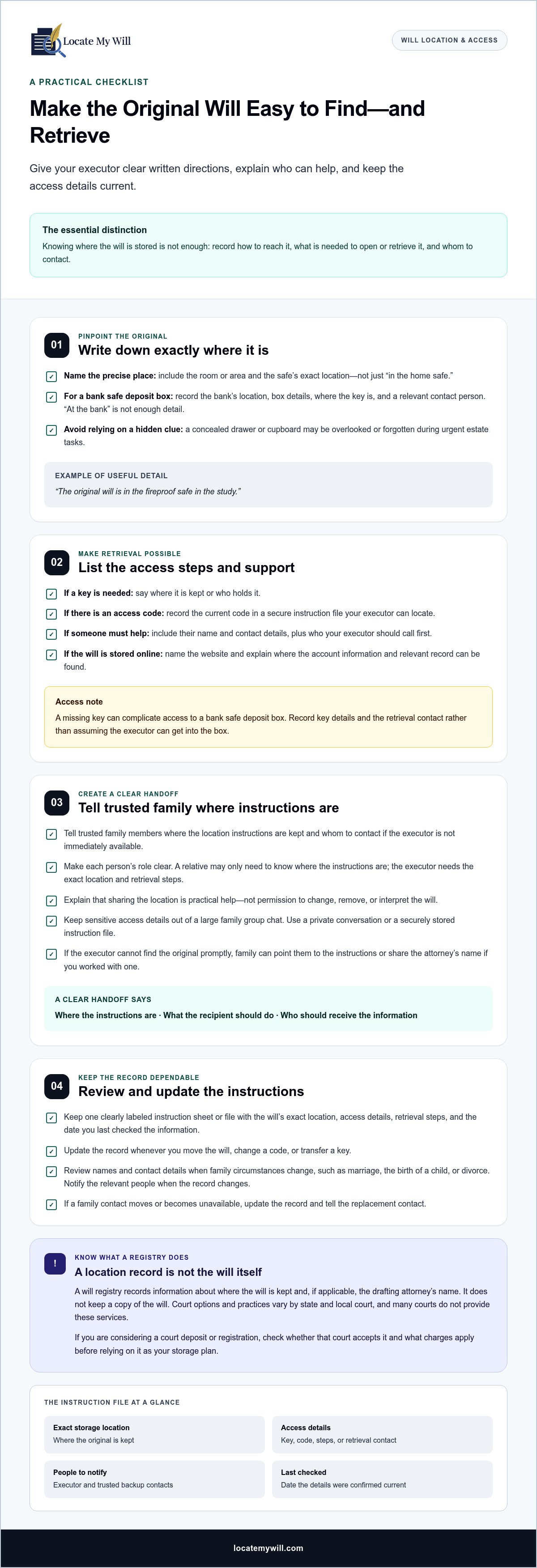
Write down exactly where the original will is kept and how your executor can retrieve it. “In the home safe” is only a starting point. Add the room or area and the safe’s precise location, along with the steps needed to open it. If a key is required, say where it is kept or who holds it. If the safe uses a code, record the current code in a secure instruction file your executor can locate. Include the name and contact details of anyone who can help retrieve the document.
For example, your instructions might say: “The original will is in the fireproof safe in the study. The key is in a labeled envelope with my financial papers. If the safe cannot be opened, contact the person named in this file.” Don’t rely on a concealed drawer or cupboard as the only clue. A hidden location can be overlooked or forgotten, especially when someone is handling urgent estate tasks.
Do rules for storing or filing a will vary by state? Yes. Court practices and options for depositing a will or registering location information vary by state and local court, and many courts don’t provide these services. Make your executor’s instructions specific to where the original is actually kept, rather than assuming a court will hold or locate it.
Can you deposit a will with a probate court, and what does it cost? Some courts allow a will or information about its location to be deposited or registered, while many don’t offer that service. Any cost depends on the court’s process and fee schedule, so find out whether it accepts filings and what charges apply before relying on it as your storage plan.
A bank safe deposit box can create an access problem if the key is missing. An executor may also need the will to access important papers in the deceased person’s box. Record the bank’s location, box details, key location, and relevant contact person, not simply the word “bank.”
Use one clearly labeled instruction sheet or file to record the retrieval details. Include:
- The will’s exact storage location.
- Any key location, access code, or retrieval contact.
- The steps to reach the document, including who to call first.
- The date you last checked that the details were current.
Review the instructions whenever you move the will, change a code, or transfer a key. A brief update can prevent an old location or access method from sending your executor searching in the wrong place.
2. Telling trusted family members where the will is stored
Your executor should know where the will is, but may not be the first person available to act. Tell trusted family members where to find the location instructions and whom to contact. For example, if your executor is a sibling who lives far away, a nearby relative can help locate the instructions and share them when needed.
Choose people who can handle private information responsibly. Explain that the will’s location is practical information, not permission to change, remove, or interpret the document. You might tell an adult child, “The location instructions are in my estate file. Please give them to my executor if I can no longer do so.” Keep the message direct and clear.
Decide what each person needs to know. A trusted relative may only need to know where the instructions are kept, while your executor needs the exact location and retrieval steps. Avoid sending sensitive access details to a large family group chat. A private conversation or securely stored instruction file limits unnecessary sharing while ensuring the right people can act.
Use a written record rather than relying on memory. Keep the instructions in a clearly identified file or book in a safe place, then tell the designated relatives how to find it. Include the executor’s name and contact information, the will’s location, and a backup contact’s name. If the family member who knows the details moves or becomes unavailable, update the record and notify the replacement contact.
Make the conversation specific. Say where the instructions are, what role the recipient has, and who should receive the information if needed. For instance, tell a trusted family member not to search through personal papers independently, but to contact the executor and share the recorded directions. This creates a clear process during a stressful period and reduces the risk of conflicting guesses.
Review the arrangement when family circumstances change. Marriage, the birth of a child, or divorce can affect whom you trust with private information or whom you’ve nominated to manage your affairs. Update the names and contact details in your instructions, then tell the relevant family members that the record has changed. Don’t leave an old note pointing relatives to a former executor or outdated location.
Family members can also help identify the next step if the executor can’t find the original promptly. They can direct the executor to the location instructions or, if you worked with an attorney, share that attorney’s name. The goal isn’t to make every relative responsible for the estate or probate. It’s to ensure a trusted person can connect the executor with accurate information instead of memory or guesswork.
3. Explaining how to access the will
A location alone may not explain how your executor can obtain the document. Write down the access route, the person or service involved, and what your executor should do first. If the will is stored online, name the website in your instructions. Explain where the account information is kept and how the executor can find the relevant record. Don’t assume they’ll know which platform you used.
If you use a will registry, distinguish its location record from the will itself. A registry records information about where the will is kept and, if applicable, the drafting attorney’s name. It does not keep a copy of the will. Tell your executor where the registry information is recorded and identify where the actual document is stored.
An attorney you worked with may also hold a valid copy. Record the attorney’s name and contact details alongside the location instructions. If you created a copy for your executor, explain where it is and label it as a copy. That helps them know whom to contact without mistaking a duplicate for the original.
Be cautious about making a bank safe deposit box the only place to keep your will. Access after death can involve court approval and may delay probate. Many jurisdictions allow a safe deposit box to be searched for a will and cemetery deed before formal probate begins, but other items typically cannot be removed until an inventory is completed. State the bank, branch, box information, and key location in your access instructions, while recognizing that opening the box may involve additional legal steps.
Give the executor a clear sequence to follow, rather than scattered clues. A short instruction file can explain:
- Which website, attorney, registry, or institution holds information about the will.
- Where the original will is stored and how the executor can reach it.
- Whether a document is an original, a notarized copy, or a digital copy.
- Who to contact if the first access route does not work.
Digital copies can provide a useful reference. You can email copies of important documents to an attorney or executor, or keep them on a thumb drive at home. Label each copy clearly and record the thumb drive’s location. These copies can help the executor identify relevant contacts, but your instructions should still point to the original will.
Finally, describe the next practical step after retrieval. A will must be submitted to the local court along with a petition to initiate probate. Clear access directions help your executor locate the proper document and understand what comes next, rather than spending time searching through accounts, devices, or unrelated files when utilizing the best way to inform executor of will location.
4. Informing the nominated executor
Tell the person you’ve nominated that you named them executor, then ask whether they’re willing to accept the role. This conversation gives them a chance to understand what you expect and raise practical concerns before they need to act. Explain where the will is kept, how to access it, and where you keep related estate documents. A nomination alone doesn’t ensure they know about the appointment.
What information should you give your executor about the will, attorney, and estate documents? Provide the will’s location, the attorney’s name and contact details, and directions to financial records, insurance policies, and identification documents. If you have a living will, tell them where it is and whom to contact about your healthcare wishes.
Make access instructions usable. Give your executor the written directions and explain how to locate the file or record containing them. Include contact details for an attorney who may have a valid copy of the will. Keep financial documents together in one central location, then tell the executor where to find that file. If your arrangements change, update the written record and communicate the change directly.
How can you make sure your executor can access your will immediately after death? Tell them the location and retrieval steps in advance, provide the access details they need, and keep the instructions current. Also tell them where key estate records are kept, so they can find relevant information without guesswork.
If the executor can’t find the original will, the next steps may take more effort. Probating a photocopy may be difficult and may not succeed. If you worked with an attorney, they may have a valid copy on file. Your nominated executor or another person may also have filed the will with probate court, where the filing information is public.
How often should you update your executor about changes to the will or its location? Update them whenever you change the will, move it, or alter how it can be accessed. Review the instructions after major life changes, including marriage, having a child, or divorce, and tell the executor about any revised arrangements.
Give your executor a concise reference file, not a scattered collection of clues. Include the following information and identify where each record is stored:
- The will’s location and the instructions for retrieving it.
- The attorney’s name and contact details, if applicable.
- Where financial papers, insurance information, and identification documents are kept.
- Names and phone numbers of relevant contacts, such as doctors or an employer’s human resources representative.
An executor’s responsibilities include collecting estate assets, paying debts, and distributing assets according to the will. Sharing the will’s location and organized records helps them identify the documents and contacts they need for those duties. Keep the file current, and tell your executor when you revise it.
5. Should I give my executor a copy of my will or only its location?
Give your executor clear directions to the original will, and consider providing a copy for reference. A copy can help them understand your wishes and identify whom to contact, but it doesn’t eliminate the need to locate the original. Probating a photocopy may be difficult and may not succeed, so make the original’s location and retrieval process clear.
A copy can be useful before the original is retrieved. Your executor can review names, contact an attorney, and identify people mentioned in the document. If you also have a living will, a copy can help your executor identify whom to contact about your healthcare directions. Label each document clearly so nobody mistakes a copy for the original.
Decide how to share copies based on privacy and usefulness. You might give the nominated executor a copy directly, leave another with your attorney, or keep one in a secure place at home. Notarized copies can also be kept with a lawyer and in a safe place at home. Record where each copy is stored, and tell the executor how to access it.
Keep the copy and original consistent. If you revise your will, replace outdated copies and notify the people holding them. For example, if your attorney has an earlier version, tell them you made a new will and provide the current document. Update your executor’s instructions at the same time, including the original’s current location.
Make your written directions distinguish between three things: the original, any copies, and related documents. A simple note might say, “The signed original is in the home safe. The copy for reference is in the estate file. My attorney’s contact details are on the first page.” This specific wording helps your executor avoid treating a reference copy as the document they need to retrieve.
Store copies so they assist rather than confuse the process. Give the file a descriptive name or paper label, such as “Will copy for reference,” and identify its date. Tell your executor where the file is kept and who else holds a copy. If a digital copy is emailed, explain where the message or attachment can be found without relying on a single device or account.
For an organized record of the will’s location and access instructions, record your will’s location securely. Keep your executor’s copy clearly marked, but make locating the original the central instruction.
Locate My Will: Will Owner Registration Subscription
Locate My Will’s Will Owner Registration Subscription lets you record where your will is stored while keeping the original in its chosen location. It can provide a separate record of the location and access plan alongside the instructions you share with your executor and trusted family members.
With Authorized Searcher Management, you can designate up to three authorized searchers and three notification recipients. Search Activation Date Control lets you set when searches can be performed and notifications sent. These options help organize who may search for the location information and when the process can begin.
If you want a structured way to record your will’s location and manage search access, start a Locate My Will subscription. You can record location information without uploading or storing the will itself.
Make your next step part of the plan
The best way to inform an executor of your will’s location is the approach that stays clear and useful as your circumstances change. Treat those instructions as part of your ongoing estate planning, not a note to prepare once and forget. A move, a revised will, or a change in your chosen executor can all be reasons to review who knows what and whether the recorded details are current.
Locate My Will’s Will Owner Registration Subscription offers a structured way to record your will’s location. Authorized Searcher Management lets you designate people who may search for that information, while Search Activation Date Control lets you set when searches and notifications can begin. These features support your location and access planning alongside the arrangements you make with your executor and family.
Contact Locate My Will to discuss recording your will’s location and take a considered next step toward keeping your wishes accessible to the people you trust.
Frequently Asked Questions
Where Should Important Papers Be Stored?
Keep important estate papers together in a secure, organized place, such as a fireproof and waterproof home safe. Add a simple index that identifies each document and distinguishes originals from copies. For example, list the will, insurance policies, and identification records, then note which documents are originals. Make the index accessible to your executor without putting sensitive papers somewhere family members might discard or overlook.
What is the best way to tell an executor where the original will is kept?
A practical way to inform your executor of your will’s location is to give them a written location note and explain it in person. State the exact storage place, who can provide access, and where supporting instructions are kept. For example, name the room containing a home safe and identify the file holding its access details. Ask your executor to confirm they understand the directions.
Where should I store an original will so my executor can access it?
Choose a secure place your executor can reach without relying on an unclear chain of access. A home safe may work if your executor knows its location and how to open it. An attorney may also keep a valid copy on file. Avoid making a bank safe deposit box the only option, since access after death can involve additional steps and delay.
Should an executor have a key or access instructions for a home safe or bank safe-deposit box?
Yes. Give the executor the key’s location or clear retrieval instructions, along with the bank’s name and contact details. Keep the information current if a key or access method changes. Pennsylvania law allows a safe deposit box to be searched for a will and cemetery deed before probate; other items can’t be removed until the executor inventories the box after probate.


