

A safe-deposit box may protect your will, but it can also make the original harder for loved ones to reach after your death. The best practices for storing a will balance security with access. In many U.S. states, the right to open a box may end when its owner dies, and there is generally no legal requirement specifying where a will must be kept. Choose a location your executor can access, and make sure they know where the original is and how to retrieve it.
It makes sense to keep a signed will private and protected from damage. The practical challenge is making sure security does not become an obstacle when the document is needed. This guide compares safe-deposit boxes, storage with an executor, and keeping the will at home, with key access considerations for each. You will also learn how to share its location and retrieval details with the people who may need them, so your wishes are easier to carry out.
Key Takeaways
- Compare a safe-deposit box with executor or home storage by weighing protection against how quickly your representative can reach the original.
- Keep the signed original accessible; a scan may not serve as a substitute during probate.
- If your executor holds the will, tell them where it is and consider keeping a secure backup copy.
- For home storage, use a fireproof and waterproof safe, and make sure your executor knows how to access it.
- Share clear retrieval instructions with the people who may need the will, and update them when its location or your executor changes.
1. Should You Use a Safe-Deposit Box?
A bank safe-deposit box can protect an original will from household damage, but accessing it after death may take extra steps. In many U.S. states, the owner’s death can end another person’s automatic right to open the box. That may delay the executor from obtaining the original and beginning probate. The legal effect of a storage method can also depend on the state, so a box is not a one-size-fits-all choice.
Before choosing a deposit box, ask the bank how it handles a deceased customer’s box and whether a named executor can access it. Procedures vary between banks and jurisdictions. If access requires court approval or an inventory, the executor may need to locate the box, provide required documents, and wait for the process to be completed. A bank may also charge fees to keep the will there. Record the bank, branch, box details, and access instructions somewhere your executor can find them.
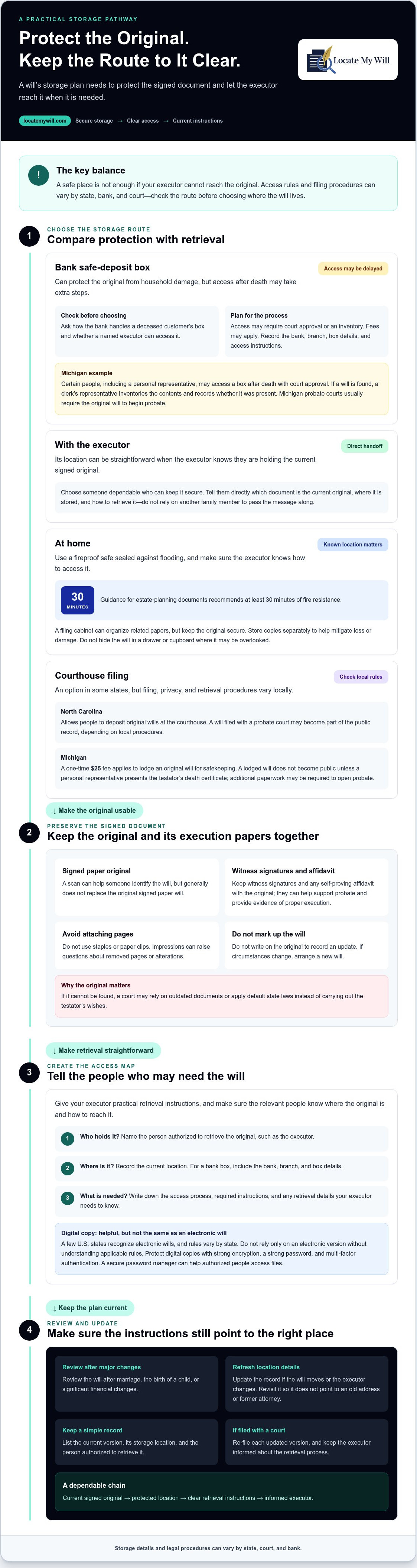
Michigan illustrates why these details matter. Certain people, including a personal representative, may access a safe-deposit box after death with court approval. When a will is found in a bank box, a clerk’s representative inventories the contents and records whether the will was present. Michigan probate courts usually require the original will to begin probate, so a delay in locating or opening the box can affect the next step. Tell your executor where the box is and how to request access, and ask the bank about its post-death procedure.
Courthouse filing is another option in some states, but local procedures and privacy rules vary. North Carolina allows people to deposit original wills at the courthouse. A will filed with a probate court may become part of the public record, depending on local procedures. Michigan has a different rule: a will lodged with its probate court does not become public unless a personal representative presents the testator’s death certificate. Even then, the court may require additional paperwork to open probate. Before choosing this route, check the filing process and how your executor will retrieve the document.
Michigan probate courts charge a one-time $25 fee to lodge an original will for safekeeping. Compare that filing option with a bank box by considering privacy, retrieval steps, and the person who can access the original. If you choose a bank, write down its name, branch, and access process, then share those details with your executor. Revisit the instructions if you move the will or change banks. The best choice protects the original and gives the person handling probate a clear path to it.
2. Why original signed documents need secure, accessible storage
A will needs both protection and a clear route to the person responsible for probate. A scan can help someone identify the document, but generally does not replace the original signed paper will. If the original cannot be found, a court may rely on outdated documents or apply default state laws instead of carrying out the testator’s wishes. Keep the signed original in a known location and give your executor practical retrieval instructions.
Preserve the papers that show how the will was executed. Witness signatures and a self-proving affidavit can help support probate and provide evidence of proper execution. Keep these materials with the original, but avoid attaching pages with staples or paper clips. Impressions can raise questions about removed pages or alterations. Do not write on the original to record an update. If circumstances change, arrange a new will rather than marking up the signed document.
Review the will after major life changes, such as marriage, the birth of a child, or significant financial changes. Also review the location details if the document moves or the executor changes. If the will was filed with a court, re-file each updated version. A simple record can list the current version, its storage location, and the person authorized to retrieve it. Revisit the record so it does not point loved ones to an old address or former attorney.
For home storage, use a fireproof safe sealed against flooding. Guidance for estate-planning documents recommends at least 30 minutes of fire resistance. A filing cabinet can keep related papers organized, but store the original securely and tell the executor where it is and how to access it. Keep copies separately to help mitigate loss or damage. Don’t conceal the will in a drawer or cupboard where someone may overlook it.
Online storage can make a copy easier to locate, but a digital file and an electronic will are not the same thing. A few U.S. states recognize electronic wills, while rules vary by state. Do not rely only on an electronic version without understanding the applicable rules. Protect digital copies with strong encryption, a strong password, and multi-factor authentication. A secure password manager can help authorized people access those files without weakening account security.
Make access instructions part of the storage plan. Write down who holds the original, where it is, and what the executor needs to retrieve it. If you use an online record to keep track of the will’s location, make sure its details stay current. The goal is a dependable chain from the signed document to the person who must act on it, without exposing private estate papers to unnecessary access.
3. Storing a will with the executor
Keeping the original with the executor can make its location straightforward, provided the executor knows they have it. Executors need the original will to begin probate, so an unclear handoff can slow the first steps. Choose someone dependable who can keep the document secure and follow your instructions. Tell them directly that they are holding the current signed original, not an outdated version or reference copy. Explain where it is stored and how to retrieve it, rather than relying on another family member to pass along the message.
Make the handoff specific. Place the will in a clearly labeled, sealed folder, then tell the executor where it is kept and what other papers are stored with it. For example, explain whether the folder is in a locked filing cabinet or a home safe, and provide access instructions separately. Do not write access details on the will itself. If the executor moves, changes contact details, or can no longer serve, update the storage plan and inform the person taking over.
Discuss the arrangement before leaving the original in someone else’s care. Confirm that the executor understands the document must remain intact and that no one should mark it, remove pages, or substitute a copy. Keep a secure backup copy in a separate place to help guard against loss or damage. Clearly label it as a copy so loved ones do not mistake it for the signed original during probate.
Oklahoma provides a useful example of why the original and its execution papers should stay organized. According to the Oklahoma Legislature, Oklahoma Statutes Title 84 addresses will execution, witness requirements, and handling of originals. Keep the signed will together with relevant execution records, such as witness information or a self-proving affidavit, when those papers exist. Tell the executor where each document is stored. If the original is separated from its supporting paperwork, the executor may have to locate those items while preparing the estate materials.
Give the executor a short written record of the will’s location, the date of the current version, and the names of people who can help retrieve it. Keep that record somewhere the executor can access without opening the will folder. If the executor is holding the original, state that clearly and identify the separate backup location. Review these instructions after updating the will, changing the executor, or moving the document. A direct conversation and a written location record help loved ones find the right original when probate begins.
4. Storing wills and other estate planning documents at home
Store your original will at home in a secure place your executor can reach, such as a fireproof safe sealed against flooding. In the United States, there is generally no legal requirement specifying where a will must be stored. The practical test is whether the location protects the signed document and whether your executor knows where it is and how to access it.
Choose a home safe designed for estate planning papers, not just valuables. Storage guidance recommends at least 30 minutes of fire resistance and a seal against flooding. Place the will flat inside a protective folder, with related papers such as witness information stored together. Keep the safe away from places where water damage is more likely, and avoid a concealed drawer or cupboard that loved ones could overlook.
A fireproof safe reduces some household risks, but it does not eliminate every access problem. Fire or flooding may still damage the safe or its contents, and a lost combination can prevent the executor from opening it. Write down the safe’s location and access instructions separately from the will. Give those details to the executor, and make sure they know whom to contact if the combination or key is unavailable.
Keep a clearly labeled copy in a separate location to help reduce the impact of loss or damage to the original. The copy can help loved ones identify the current document, but generally does not replace the signed original for probate. Do not mark up the original to record changes. If you update the will, organize the new signed version and remove outdated copies from places where someone might mistake them for the current document.
Store other estate planning documents with access in mind, not necessarily in the same locked container. Durable powers of attorney and advance directives need to be accessible to the people named to act under them. For example, an agent may need the relevant document before carrying out their role. Keep those papers organized, and tell each named person where to find the document that concerns them.
Set a calendar reminder to review your storage plan every 1–2 years. Confirm that the executor still knows the safe’s location, that the access method works, and that the original is the current version. Revisit the plan after moving homes, changing the executor, or making a new will. This simple review keeps household storage instructions aligned with your estate documents and the people expected to use them.
5. Telling loved ones where the will is and how to access it
Give your executor clear, practical instructions for locating the current original. Share the storage address, the person or institution holding it, and the steps needed to retrieve it. If a lawyer holds the will, give the executor the lawyer’s name and contact information. If you filed it with a probate court, tell the executor which court has it. These details can help prevent avoidable delays when probate begins.
Should you give copies of your will to your executor or beneficiaries? You can share copies with loved ones, but label them clearly as copies and tell the executor where the signed original is stored. When you make a new will, provide updated copies and consider locating and destroying copies of the old version.
Keep a separate location record with the current version date, storage place, and retrieval instructions. For a bank deposit box, record the bank and branch, then explain the access process. For a lawyer-held will, list the lawyer’s contact details. For a waterproof home safe, state where it is and how the executor can open it. Store this record somewhere the executor can access without first finding the will.
Update loved ones whenever the beneficiaries, executor, or storage location changes. A change in executor matters because the former representative may still have the only access instructions. A move can also make an old address misleading. Tell the new executor where the original is, and confirm they understand which version is current. Keep the update factual and concise so family members do not confuse an old copy with the signed document.
Choose carefully who receives a copy. The executor needs to know the original’s location, while beneficiaries may need only enough information to understand that a will exists. A copy can help someone identify the document, but generally does not replace the original for probate. Avoid sharing sensitive details unnecessarily, such as a safe combination. A private conversation with the executor can provide access instructions more securely.
Make the location record part of your estate-planning review. Recheck it after you revise the will, change lawyers, move, or change the executor. If a court filing is involved, ensure your executor knows the filing location and that each updated version is filed where required. For help keeping the will’s location and authorized searchers organized, record your will’s location and access details.
Locate My Will: Will Owner Registration Subscription
Locate My Will helps you record where your will is located and manage who can search for that information. Its Will Owner Registration Subscription lets you record the will’s location, while Authorized Searcher Management lets you designate up to three identity-verified searchers. Search Activation Date Control lets you set when searches can be enabled. The service supports your access plan; keep the signed original in your chosen physical location and make sure your executor knows how to retrieve it.
Consider this option if your storage plan is settled but loved ones may not know where to look or when they can search. Keeping the location details current can help connect your executor with the original when it’s needed. To learn more about recording your will’s location, visit locatemywill.com.
Make Your Will Easier to Find When It Matters
A useful next step is to turn your storage decision into a record someone can act on. Write down where the original is kept, who can retrieve it, and who should be notified. Then share those instructions with your executor and decide how you will keep them current if your plans change. The best practices for storing a will work only when the right person can find and use the information.
Locate My Will can support that coordination through its Will Owner Registration Subscription, Authorized Searcher Management, and Search Activation Date Control. These tools let you record the will’s location, manage authorized searchers, and set when searches can be enabled. They complement your chosen physical storage arrangement; the original still needs to remain in its designated location.
Take a moment to put your access plan in writing and share it with the people who need it. If you’d like to organize the location and search details, contact Locate My Will. A clear plan today can help loved ones take the next step with greater confidence.
Frequently Asked Questions
Should You Use a Safe-Deposit Box?
A safe-deposit box can suit you if your bank’s process gives your executor a clear way to locate and access the will. Before choosing one, consider whether your executor lives nearby, knows the branch, and can follow the bank’s post-death procedure. State rules differ, so the same arrangement may work differently across jurisdictions. If these steps are unclear, a location your executor can access more directly may be more practical.
Is it safe to keep a will in a home safe or fireproof box?
Yes, a home safe can be a suitable option if it protects the paper and your executor can open it. Choose a fireproof safe with at least 30 minutes of fire resistance and protection against flooding. Keep the key or combination accessible through a secure arrangement, rather than relying on memory alone. A fire rating helps address one risk, but it doesn’t protect against a lost combination or an undisclosed location.
Should I store my will with an attorney or in a bank safe deposit box?
Choose based on the custody and access process, not just the setting. Some attorneys keep records and backup copies of wills they hold, and may provide the original to the executor when needed. A bank box can offer secure storage, but accessing it after your death may require additional steps. For either option, record the custodian’s details and tell your executor how to request the original.
Can storing a will in a safe deposit box delay probate or prevent access after death?
Yes. In many states, the owner’s death may end another person’s right to open the box, creating a delay while access is arranged. In Michigan, certain people, including a personal representative, may access a box after death with court approval. If the original is inside, the executor may need to complete the bank’s and court’s required steps before moving forward with probate.
How should I tell my executor where the original will is stored?
Give your executor a written location record and explain it in a private conversation. Include the custodian’s name, address, relevant contact details, and the steps for retrieving the will. If an attorney holds it, provide the attorney’s name and contact information; if a court holds it, identify the filing court. Keep the record separate from the original, and revise it whenever the will moves.
How do I protect a will from loss, fire, water damage, or unauthorized changes?
Keep the signed original in a secure, dry place and store a clearly labeled copy separately. Avoid writing on the will or attaching papers with staples or clips, since marks or impressions can raise questions about changes or removed pages. Tell the executor where the original is, but limit access to people who need it. For digital copies, use encryption and a strong password.
Can I store a digital copy or electronic will instead of the original signed will?
A digital copy generally does not replace the original signed paper will for probate. A few U.S. states recognize electronic wills, but laws vary by state, so the electronic format may not meet the rules where you live. If you keep a scan for reference, secure it with encryption and a strong password. Maintain the signed original unless your state’s rules support relying on an electronic will.
What should I do with an old will after making a new one?
Update the instructions you have shared and prevent outdated copies from being mistaken for the current version. Locate copies given to family members or kept among household papers, then consider destroying them when you provide updated ones. If a will was filed with a court, re-file each updated version. Tell your executor which signed original is current and where it is kept.


