

A will is only one part of a thoughtful plan. End of life planning for peace of mind means recording your medical preferences, financial affairs, funeral wishes, and instructions for important online accounts, then making sure trusted people know where to find that information. The goal is to make your choices easier to understand and follow.
It’s natural to want loved ones to feel prepared rather than left guessing. A clear checklist can help you organize decisions at a manageable pace, including who may speak for you, what care you prefer, and how you want personal and digital records handled.
This guide explains key documents and choices to consider, how to record funeral and memorial preferences, and how to leave practical guidance for online accounts and digital belongings. You’ll also learn how to keep your records accessible and review them as your circumstances change.
Key Takeaways
- Choose a trusted medical decision-maker who understands your values, and identify an alternate in case they can’t serve.
- Prepare advance care instructions and discuss your preferences with loved ones and your doctor so they’re easier to follow.
- Record funeral, burial, or cremation preferences, including the traditions and service details that matter to you.
- Organize key documents and tell a trusted person where to find them, so important information is accessible when needed.
- Include digital accounts in your plan by listing what exists and recording guidance for how each should be handled.
What is a medical power of attorney?
A medical power of attorney names someone to make medical decisions if you can’t make them yourself. Choose an agent who understands your values, respects your wishes, and can communicate them clearly. Naming an alternate gives you another option if your first choice is unavailable or unwilling to act.
A will explains how your estate should be distributed after death, while a revocable living trust names a trustee to manage and distribute property. A will may require probate and become public after death; a trust may avoid probate and remain private. Beneficiary designations identify who should receive assets such as retirement accounts or life insurance.
Discuss your health wishes directly with your chosen agent and family members. Use examples, such as whether comfort-focused care matters more to you than life support in a particular situation. Explain your priorities, invite questions, and record decisions in your advance care documents. A calm conversation helps someone act in line with your values rather than guess.
Prepare for the discussion with a brief record of your health history, current medications, allergies, and care-team contact details. Include the location of your medical power of attorney and advance directive. Share the information with your agent and explain how to access updates. Keep the record current when a diagnosis, medication, or treatment preference changes.
Financial authority is separate. A durable power of attorney for finances names someone to make financial decisions when you’re unable to do so. Choose a person who can manage practical tasks, such as paying bills or communicating with financial institutions, and tell them where the signed document is kept.
Make a clear inventory of accounts and assets, including banks, retirement accounts, insurance policies, property, and recurring bills. Record each institution’s name and the account’s purpose. Don’t put passwords in a will, which may become public after death. Instead, document secure access instructions separately and tell your chosen representative where to find them.
Keep estate and financial documents together, or create an index showing where they are. Include your will, trust documents, powers of attorney, account records, and insurance information. If a document is held in a bank safe deposit box, keep a copy at home so someone can locate essential details without relying on a single location.
Include online accounts in your records. Pew Research Center reports that 72% of American adults use social media, so accounts may hold important messages, photos, and personal information. List platforms and note your preferences for each account, such as whether you want content preserved or an account closed. Give trusted family members clear instructions for finding this guidance.
- Choose a medical agent and alternate who understand your wishes, because the appointed person may need to speak for you.
- Discuss health and financial decisions with family members, so they know your priorities and where essential records are kept.
What are advance directives?
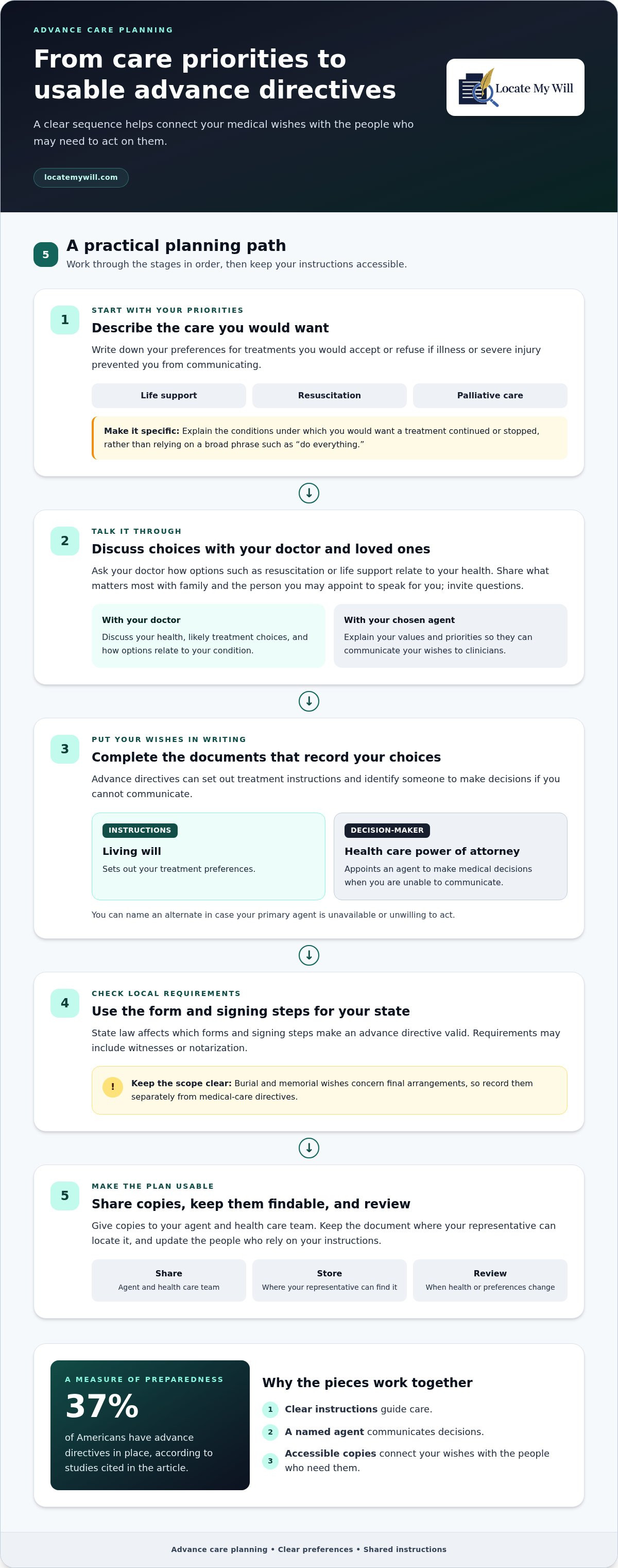
Advance directives record your medical-care instructions for a time when illness or severe injury prevents you from communicating. They can describe treatments you would accept or refuse and identify someone to make decisions on your behalf. A living will sets out treatment preferences, while a health care power of attorney appoints a decision-maker. Together, these documents help loved ones understand your choices instead of having to infer them.
State law affects which forms and signing steps make an advance directive valid, including whether witnesses or notarization are required. State requirements also shape wills and estate administration, so use the rules that apply where you live when preparing or updating documents.
Advance directives can address decisions about life support, resuscitation, and palliative care. For example, you can describe the conditions under which you would want a treatment continued or stopped. Use clear instructions rather than relying on a broad phrase such as “do everything.” Your health care agent can then apply your stated priorities to circumstances you haven’t anticipated.
A health care power of attorney, sometimes called a health care proxy, names an agent to make medical decisions when you’re unable to communicate. Choose someone who knows your values and can explain them to clinicians. You can also name an alternate in case your primary agent is unavailable or unwilling to act. Discuss the role before naming that person, and give them access to the completed document.
Advance care planning is a conversation as well as paperwork. Arrange time with your doctor to discuss your health, likely treatment choices, and what matters most to you. Ask how options such as resuscitation or life support relate to your condition. Then share those priorities with loved ones, including your appointed agent, and invite them to ask questions. Studies cited on advance care planning found that 37% of Americans have advance directives in place.
Use a practical sequence: write down your priorities, discuss them with your doctor, complete the appropriate state form, and share copies with your agent and health care team. Keep the document where your representative can locate it. Review it when your health or treatment preferences change, and update the people who rely on your instructions. Burial and memorial wishes concern final arrangements, so record them separately from medical-care directives.
These steps make the documents easier to use: clear treatment instructions guide care, a named agent communicates decisions, and accessible copies connect your wishes with the people who need them.
Funeral, burial, and cremation preferences
Record your funeral and final-arrangement preferences in a separate, clearly labeled document. Include whether you prefer burial or cremation, what kind of service feels appropriate, and any religious, spiritual, or cultural traditions you want observed. Specific instructions give loved ones practical guidance when they’re coordinating arrangements. Share the document’s location with the people likely to organize the service, and revisit it if your wishes or circumstances change.
- Choose burial, cremation, or another preferred arrangement. State your choice plainly, because loved ones shouldn’t have to infer it from scattered notes or family assumptions.
- Describe the service you want, or whether you prefer no formal service. For example, note whether you envision a funeral, a memorial gathering, or a private family event, so the format reflects your wishes.
- Record the location or type of final resting place you prefer. You might name a cemetery, family plot, or another meaningful setting, giving relatives a clearer starting point for arrangements.
- List religious, spiritual, or cultural practices that should be included. Name specific traditions, music, readings, or ceremonial steps, because a concrete example is easier to follow than a general request.
- Write down service details that matter to you. Note preferences such as who should speak, which songs to play, or whether guests should bring flowers, helping family members organize a service that feels personal.
- Decide what personal items or photographs should be part of the gathering. For example, identify a photo collection or a meaningful object, so relatives know what to display without searching through belongings.
- Tell trusted family members where your written preferences are kept. Give the organizer the document’s location and explain which copy is current, so outdated notes don’t compete with your instructions.
- Review your arrangements as your circumstances change. Reconsider choices after a move, a change in family circumstances, or a shift in your preferences, then share the updated version with the same people.
Pre-planning can also involve organizing practical details, such as relatives’ contact information, a preferred place for the service, and the person who should coordinate communications. Keep those notes with your funeral preferences, separate from medical instructions and financial records. If you’ve made arrangements in advance, write down the relevant details and tell a trusted person where to find them. The purpose is simple: make your wishes clear, accessible, and available to the people who may need to act on them.
What Is End-of-Life Planning?
End-of-life planning is a practical way to organize medical wishes, finances, personal records, and final arrangements. A checklist for end of life planning for peace of mind can identify which documents exist, where they’re kept, and who should know how to find them. It can also include choices that aren’t legal documents, such as preserving family stories or recording personal instructions.
Costs depend on the case and are provided after a quote request; factors include document complexity, estate needs, and the legal support required.
Avoid leaving records unsigned or outdated, failing to tell anyone where they are, or putting passwords in a will. These oversights can make it harder for family members to find information or carry out your wishes.
Use this checklist to organize your records and share their locations:
- Gather estate documents. Include your will, trust documents, and powers of attorney so a trusted person can identify the instructions covering property and decision-making.
- Collect identity and ownership records. Organize identification, insurance details, property records, and financial account information to help representatives match records to the right person and assets.
- Make a document-location index. Note where each original and copy is kept, such as a home file, safe, or bank safe deposit box. Keep copies at home if important papers are stored at a bank.
- Choose someone to share the locations with. Tell a trusted person where the current records and index are, rather than relying on family members to discover them later.
- Record accounts and regular obligations. List financial institutions, insurance policies, and recurring bills, while keeping passwords separate from legal documents.
- Include instructions for children and dependents. A will can address guardianship for children under 18, so make the relevant document accessible to the person who may need it.
Store records in a secure, clearly labeled place and keep an index of what’s inside. If originals are in a bank safe deposit box, copies at home can help family members locate the records and understand what exists. Share access instructions carefully to protect sensitive information.
Your plan can also preserve personal history. Write letters, label photographs, record family stories, or note who should receive a meaningful keepsake. For example, add names to a photo folder so future generations can recognize relatives. Discussing these choices with family helps explain the values behind them.
For end of life planning for peace of mind, revisit your checklist at least once each year and after major life events, such as marriage, retirement, moving to another state, or changes in health. Update location notes alongside revised documents, then tell your trusted person where to find the current version. This routine keeps your plans connected to your life as it changes.
Digital legacy and online accounts
Your digital legacy includes online accounts, stored files, messages, photographs, and other information connected to your identity. A useful plan tells trusted people which accounts exist and what you want done with them. For example, you might want family photos preserved, a social profile memorialized, and shopping accounts closed. Record your preferences without assuming every service handles inactive accounts the same way.
Build an inventory that names each account, its purpose, and your preferred action. Include accounts that may be easy to overlook, such as:
- Email and social media. Note which profiles you want preserved, memorialized, or closed, because these accounts may contain messages and photographs important to family members.
- Cloud storage and personal devices. Identify where documents, family videos, and photo libraries are stored, so someone can find meaningful files without searching every device.
- Financial and insurance portals. List the institutions that manage banking, insurance, and retirement accounts, so representatives can locate relevant records and understand which accounts require attention.
- Subscriptions and online services. Record recurring memberships, digital purchases, and services such as music or video platforms, because a clear list helps someone identify accounts to review.
- Websites and creative work. Include blogs, domains, online shops, or portfolios, then state whether you want the content maintained, transferred, or removed.
- Health portals and care notes. Identify where you keep appointment records or written preferences, such as notes about palliative care, so your chosen representative can locate the information.
Keep the inventory separate from your will and avoid writing passwords in documents that may be widely shared. Instead, record how an authorized person can access your password manager or secure account-recovery instructions. Set up any emergency-access feature yourself, and explain where its instructions are kept. This helps protect your privacy while giving a trusted person a practical way to reach the records.
For each account, write a simple instruction: preserve, download, transfer, close, or review. Add the reason when it reflects personal values, such as keeping a shared family album available to children. For a retirement provider or insurance portal, distinguish the account’s location from beneficiary information, which should be managed through the institution’s own records.
Assign one trusted person to locate the inventory, and tell them where its current copy is stored. Review it at least once each year and after changes such as opening a new account, changing email providers, or replacing a device. Update instructions when your preferences change, then tell that person where to find the revised record. A concise, current inventory gives someone a clear starting point without requiring them to guess what mattered to you.
Locate My Will: Will Owner Registration Subscription
Locate My Will helps you record where your will is kept, so authorized people can locate it when needed. Its Will Owner Registration Subscription lets you register the will’s location without storing the document on the platform. You can designate up to three authorized searchers and up to three notification recipients. Search Activation Date Control lets you set when searches can be performed and notifications sent. Each authorized searcher must verify their identity with an unexpired state-issued driver’s license or other government-issued ID.
This can be a practical next step after preparing your will and deciding who should know where it is. Keep the document itself in your chosen location, and record accurate location details for the searchers you authorize.
To learn more about recording your will’s location and managing authorized searchers, visit locatemywill.com.
Make Your Next Step a Simple One
A plan becomes more useful when someone you trust can locate the will and understand how to act. Treat end of life planning for peace of mind as a living record: keep your intentions clear and revisit them when your priorities change. You don’t need to settle every decision at once. Choose one practical next step, such as recording your will’s location and identifying who should be authorized to search for it.
Locate My Will’s Will Owner Registration Subscription, Authorized Searcher Management, and Search Activation Date Control support those specific steps. They connect your will’s recorded location with the people you authorize and the timing you choose for searches and notifications.
If recording your will’s location is the next step for you, contact Locate My Will to learn more. A clear, manageable action today can help make your wishes easier for trusted people to follow.
Frequently Asked Questions
What is a living will?
A living will records the medical treatments you would want or refuse if illness or injury prevents you from communicating. For example, it can describe your preferences about resuscitation, medication, or life support, and the circumstances that matter to each choice. It is a medical instruction document, not a will distributing property. Keep its instructions consistent with conversations you’ve had with your health care agent and medical team.
What other decisions can you prepare for in advance?
You can plan for financial management, asset distribution, funeral arrangements, and what should happen to online accounts. For example, identify who should manage bills if you become unable to do so, and record beneficiaries for retirement accounts or insurance policies. You can also preserve personal memories through letters, family stories, or labeled photographs. Discussing these choices with the people involved helps them understand the reasons behind your instructions.
Which documents do you need to have in place?
Consider a will, advance directive, health care power of attorney, and durable financial power of attorney. Depending on your estate and wishes, you may also consider a trust and beneficiary designations for applicable accounts. Keep insurance details, property records, and account information organized alongside an index of document locations. The right set depends on your circumstances, and state rules affect signing requirements for documents such as advance directives.
Who can help with getting your affairs in order?
Trusted family members can help organize records and understand your priorities, while your doctor can discuss treatment choices and health care instructions. An estate-planning attorney can advise on wills, trusts, and documents under your state’s rules. Financial institutions can explain how to update account beneficiaries or authorized contacts. If a caregiver needs to communicate with your doctor, lawyer, insurer, or bank, the organization may require a signed permission form.
What documents are needed for end-of-life planning in the United States?
Useful records often include a will, advance directive, health care and financial powers of attorney, insurance information, property records, and account details. Beneficiary designations are maintained through the relevant financial or insurance institution. The exact forms and signing steps for advance directives vary by state, so organize documents according to the rules where you live. Keep an index that identifies each record’s location and who can access it.
How do you choose and document a health care proxy and end-of-life care preferences?
Choose someone who understands your values, can communicate clearly, and is willing to make decisions on your behalf. Discuss specific situations, such as whether you would want resuscitation or palliative care, and explain what matters most to you. Name an alternate, then record your instructions on the appropriate advance directive form. Share copies with your proxy and medical team, and review the document if your health or preferences change.
How can you organize and securely share end-of-life documents and account information with family?
Keep an up-to-date document index, store originals securely, and tell a trusted person how to locate them. Keep passwords separate from legal documents; use a password manager or secure access instructions for online accounts. Locate My Will records where your will is located, not the will itself. You can designate up to three authorized searchers, who must verify their identity with an unexpired state-issued driver’s license or other government-issued ID, and up to three notification recipients.


