

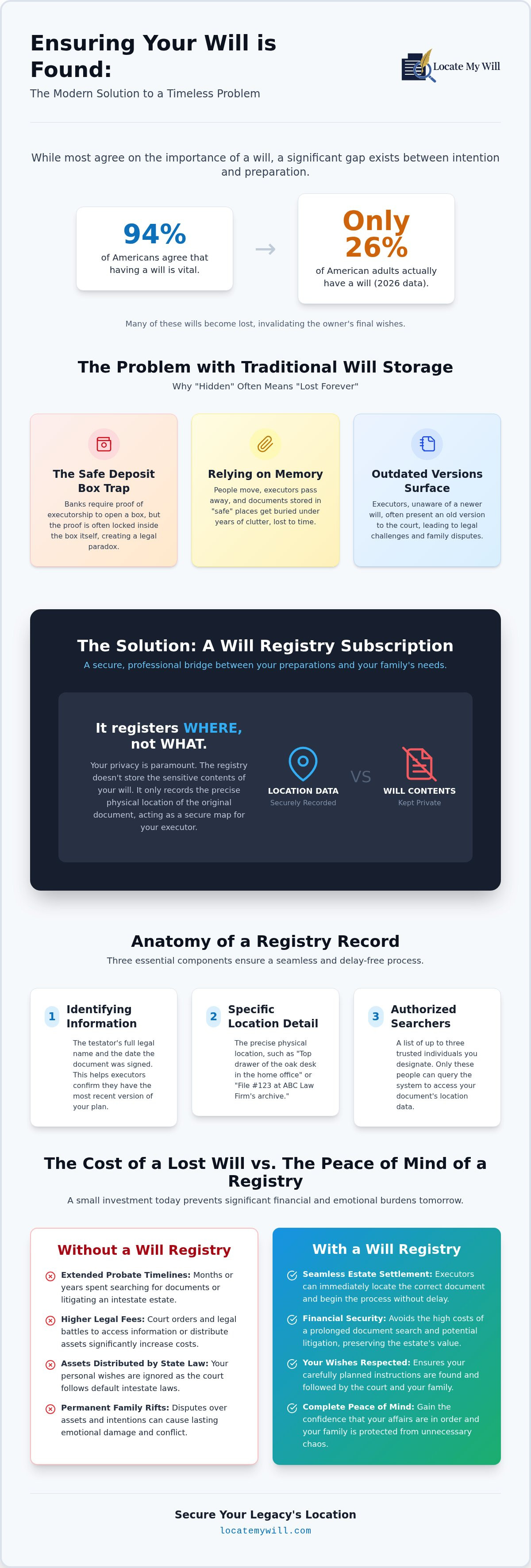
What if the most important legal document you ever sign is hidden so well that your heirs cannot find it when the time comes? While 94% of Americans agree that having a will is vital, the reality is that many valid documents are lost or misplaced every year, leaving families in a state of preventable chaos. You likely feel a deep responsibility to ensure your final wishes are respected, yet the fear of a "missing" document causing family friction is a heavy burden to carry.
Maintaining a will registry subscription solves this dilemma by acting as a secure, professional bridge between your private preparations and your family's future needs. This article explains how a subscription ensures your documents are found exactly when they are needed, without requiring you to store sensitive personal contents on the internet today. We will examine the methodical steps you can take to authorize specific searchers, set activation dates, and achieve the peace of mind that comes from a perfectly organized estate settlement process.
Key Takeaways
- Learn why traditional storage methods like safe deposit boxes often fail and how to ensure your heirs aren't locked out of your final instructions.
- Understand how a will registry subscription prioritizes your privacy by recording only the physical location of your documents rather than the actual contents.
- Discover how to designate up to three authorized searchers and set specific activation dates to maintain absolute control over your information.
- Identify the methodical steps required to gather document versions and storage details for a seamless, delay-free estate settlement process.
The Problem with Traditional Will Storage: Why "Hidden" is Often "Lost"
Estate planning often focuses on the legal language of a document, but the physical reality of storage is just as critical. Many people believe that putting their will in a safe deposit box is the ultimate security measure. It's actually a common trap. Banks often require proof of executorship to grant access to a box, but that proof is frequently found inside the very box the family is trying to open. This circular logic creates immediate delays during an already stressful time, often requiring expensive court orders just to begin the search.
When a document cannot be located, the legal system may treat the estate as if the person died intestate. This is a growing concern, as 2026 data indicates that only 26% of American adults have a will, a significant drop from 31% in 2025. To understand the gravity of this, it helps to review the basic legal requirements of What is a Will and Testament? and how courts validate these documents. If a court assumes no will exists, state laws dictate asset distribution, often ignoring your personal wishes. A digital location record acts as a vital bridge, ensuring the paper document is found before the court intervenes.
Common Failures in Manual Will Organization
Relying on a single person's memory is a fragile strategy. People move houses, storage units are cleared out, and executors age or pass away themselves. A document placed in a "safe" desk drawer in 2010 may be buried under a decade of household clutter by the time it's needed. Research suggests that a significant number of executors are unaware of the most recent versions of a will. They often present outdated documents to probate courts because they simply didn't know a newer one existed, leading to legal challenges and family disputes.
The Financial Impact of a Missing Will
The cost of a lost will isn't just emotional; it's financial. Families face extended probate timelines and significantly higher legal fees when searching for documents or litigating intestate estates. Assets may be distributed to the wrong individuals, causing permanent family rifts. Investing in a will registry subscription serves as a methodical insurance policy against these risks. It provides a permanent, searchable record of where the physical document is kept, ensuring that your final wishes are executed without the financial burden of an exhaustive document search. A will registry subscription maintains the integrity of your planning by keeping the location data current even as your life changes.
What is a Will Registry Subscription and How Does it Work?
A will registry subscription is a specialized administrative service designed to bridge the gap between your private legal documents and your heirs. Unlike a digital locker, it doesn't store the contents of your will. Instead, it records the precise physical location where the original paper document is kept. This "Where, not What" approach ensures your privacy remains intact during your lifetime while providing a clear roadmap for your executors when the time comes. It's a methodical way to ensure your hard work in estate planning isn't undone by a simple lack of communication.
When evaluating Should You Register Your Will, it's helpful to distinguish between a static database and an active subscription. A paid model provides a higher level of data integrity and security. It ensures that the system is regularly maintained and that the link between the document owner and authorized searchers remains verified and functional over many years. This disciplined approach prevents the record from becoming obsolete as technology or family circumstances change. It acts as a permanent guardian for your document's location.
The Anatomy of a Registry Record
A standard record contains three essential components to ensure clarity and accuracy. First, it includes identifying information such as the testator's full legal name and the date the document was signed. This helps executors confirm they've found the most recent version of your estate plan. Second, it provides the specific location detail. This might be a specific cabinet in a home office or a law firm's archive. Finally, it includes a list of authorized searchers. By managing these names in advance, you dictate exactly who has the right to query the system, ensuring that only trusted individuals can access your location data.
Privacy vs. Accessibility: The Digital Gatekeeper
The registry acts as a digital gatekeeper, balancing the need for future access with current security. Your information is protected by modern encryption, making it inaccessible to unauthorized parties or public searches. Unlike public government records, a private registry keeps your data confidential until a search is triggered by an authorized person. You maintain full control over the record throughout your life. You can update the document's location or change your list of searchers whenever necessary. This methodical system provides a reliable way to manage your legacy. If you're ready to secure your document's location, you can start a will owner registration subscription to ensure your planning isn't left to chance.
Key Features of a Premium Will Registry Service
A premium service doesn't just store data; it manages the lifecycle of your record with precision. While a state-run will registry offers a reliable way to note a document's existence, a private will registry subscription adds layers of active protection. These layers include robust verification protocols that confirm a searcher’s identity before any data is released. This ensures that sensitive location details never fall into the wrong hands. The system acts as a methodical facilitator, requiring specific credentials or documentation to validate that a search is legitimate and authorized. It's a disciplined approach to information management that prioritizes security above all else.
Managing Your Authorized Searchers
One of the most practical features is the ability to designate up to three distinct authorized searchers. This flexibility allows you to include your executor, your spouse, and your attorney. You aren't forced to rely on a single point of failure. If one person is unavailable, the others can still access the necessary information to move probate forward. As family dynamics change over time, you can update these permissions instantly. This reduces the emotional and administrative burden on your executor. They won't have to guess where you kept the original document because you've already provided a clear, digital path for them to follow.
Understanding Search Activation Dates
A significant gap in traditional registries is the lack of timing controls. A premium will registry subscription addresses this through search activation dates. This feature allows you to set a specific "clock" for when your information becomes searchable. It acts as a digital safety mechanism, preventing premature queries or accidental disclosures during your lifetime. Think of it as a methodical way to release information only when it's appropriate. You can customize this timeline based on your specific estate planning needs, ensuring that your privacy is maintained until the exact moment the information is required for settlement.
The system also utilizes notification recipients to add an extra layer of oversight. You can name up to three people who will be alerted if a search is performed against your record. This automated trigger ensures that your inner circle is aware of any activity, providing a fail-safe against unauthorized access. These features work together to create a robust environment where your legacy is protected and your representatives are guided through the process with calm, organized efficiency. It's about providing a structured and reliable solution for the future.
How to Set Up Your Will Registry Subscription
Setting up your will registry subscription is a methodical process that prioritizes accuracy and security. It moves beyond the simple act of "finding" a will and focuses on the active management of your legacy. You start by creating a secure account and selecting a plan that fits your needs. This initial step establishes you as the authoritative administrator of your record, ensuring that you alone control who sees your information and when they see it. It's a disciplined way to manage expectations and define the boundaries of your estate's accessibility.
Step 1: Document Location Audit
Before entering data, perform a thorough audit of your physical documents. You must identify the exact location of your original will and testament. Be precise. Instead of writing "at home," specify a location like "the fireproof safe in the master bedroom closet, code held by Attorney Smith." This level of detail eliminates ambiguity for your heirs and prevents unnecessary delays. Ensure the registry record matches the version date of your most recent document to avoid legal confusion. If you maintain duplicate copies in a secondary location, such as a law firm's archive, note those as well to provide a complete roadmap for your executor.
Step 2: Configuring Your Notification Network
A robust registry relies on a verified network of contacts. You'll need to input contact data for up to three authorized searchers and up to three notification recipients. These roles can overlap, or they can be entirely different people. For example, you might want your spouse as a searcher but your adult children as notification recipients who are alerted if a search occurs. This structure ensures transparency and security throughout the process.
- Verify all email addresses and phone numbers for accuracy to ensure future alerts are successful.
- Brief your chosen searchers on how the registry works so they aren't surprised by the process.
- Explain that they'll need to provide identification to trigger the record release.
- Set your search activation date to ensure the "clock" for information release meets your privacy requirements.
Once your data is entered, the system acts as a steady, dependable presence, monitoring for authorized queries. Your search activation preferences are the final piece of the puzzle, acting as a gatekeeper for your privacy. By following this structured approach, you bridge the gap between your current preparations and the eventual needs of your family. To begin this process and secure your legacy, you can register for a will owner registration subscription today and gain the peace of mind that comes with professional organization.
Locate My Will: The Modern Standard for Estate Security
Locate My Will represents a shift from static data collection to active estate stewardship. While previous sections highlighted the risks of lost documents and the technical features of registry tools, the value of a professional platform lies in its role as a steady, dependable presence. We operate with a high degree of integrity, prioritizing the security of your information above all else. This methodical approach ensures that your representatives aren't just given a name, but a verified and authorized path to the documents they need. By maintaining a will registry subscription with a dedicated facilitator, you ensure that the integrity of your planning is preserved over decades of life changes.
A Dedicated Subscription for Your Legacy
A professional registry is not a "set and forget" database. It is an active service that provides continuous management of your location records. Because our registry is national in scope, it remains a reliable constant even if you move across state lines or change legal representation. We act as a secure bridge between your current preparations and the eventual needs of your family. This is particularly important given that 56% of U.S. adults currently lack any estate planning documents. For those who have taken the step to create a will, ensuring it can be found is the final, essential act of responsibility.
Getting Started with Locate My Will
The platform is designed with a focus on organized efficiency. Our interface avoids unnecessary jargon, opting instead for clear, descriptive terms that outline rights and roles. This administrative precision helps alleviate the anxiety often associated with long-term planning. We offer a transparent model that focuses purely on location management. This means you won't encounter hidden legal fees or complex document drafting requirements during the registration process. Our goal is to provide a calm, structured environment for your data.
- Manage up to three authorized searchers with ease.
- Configure automated notification triggers for your inner circle.
- Maintain absolute control over search activation dates.
Choosing a will registry subscription through Locate My Will is an investment in your family's future peace of mind. It provides a structured and reliable solution that removes the guesswork from estate settlement. It's a quiet authority that suggests competence without being cold. You can secure your will’s location today with Locate My Will and ensure your legacy is never left to chance.
Securing Your Legacy Through Methodical Organization
The act of creating a will is a profound expression of responsibility, but its value depends entirely on its accessibility. We've explored how traditional storage methods often lead to lost documents and preventable family conflict. By maintaining a will registry subscription, you move from a passive hope that your documents will be found to an active, disciplined strategy for estate security. This methodical approach ensures that your hard work in planning translates into a seamless transition for your heirs.
Locate My Will provides the professional tools necessary to bridge the gap between your private documents and your family's future needs. You can manage up to three authorized searchers, set customizable search activation dates for total privacy, and rely on automated notification triggers for your loved ones. These features work together to provide a structured and reliable solution that removes the guesswork from estate settlement.
Take the final step in your estate planning journey. Register your will location and protect your family today. Your preparation is a gift to your representatives. Ensure they have the roadmap they need to honor your wishes with absolute confidence.
Frequently Asked Questions
What is the difference between a will registry and a digital will?
A will registry records the physical location of your paper document, whereas a digital will is the electronic document itself. We don't host digital wills or store physical papers. Instead, we act as a methodical facilitator that points your heirs toward the original signed document. This distinction is vital for maintaining legal integrity, as most courts still require the physical original for probate proceedings.
Can anyone search for my will location if I have a subscription?
No, search access is strictly limited to individuals you've pre-authorized within your account. A will registry subscription ensures that only your designated searchers can query the system. Each searcher must undergo a verification process to confirm their identity before any location data is released. This controlled environment prevents unauthorized parties or public entities from accessing your private records during your lifetime or after your passing.
How does a search activation date protect my privacy?
A search activation date acts as a digital gatekeeper by preventing any queries before a specific time you select. This feature ensures that your location data remains completely private and unsearchable during your active years. It provides a structured way to manage the release of information, acting as a fail-safe against premature access. You maintain full control over this timeline, adjusting it as your estate planning needs evolve.
Do I need to upload a copy of my will to the registry?
You don't need to upload any part of your actual document to our platform. We prioritize your privacy by storing only the physical location and not the contents of your estate plan. You simply record the specific storage location of your original paper will. This approach ensures that your sensitive personal wishes and asset distributions remain entirely offline and secure from any potential digital vulnerabilities.
What happens if my authorized searcher loses their contact information?
You can update your authorized searcher's contact data at any time through your secure dashboard. It's your responsibility as the account owner to ensure that the emails and phone numbers for your representatives remain current. We recommend reviewing these details annually to maintain the reliability of your record. If a searcher changes their email address, you can simply log in and edit their profile to ensure they're verified.
Is a will registry subscription legally required for my will to be valid?
A will registry subscription isn't a legal requirement for the validity of your document. A will is typically valid if it's signed and witnessed according to your state's specific laws. However, a valid will that can't be found is effectively useless. The subscription serves as a professional administrative tool that ensures your legally executed documents are accessible to your executors when the probate process begins.
How many authorized searchers can I add to my Locate My Will account?
You can designate up to three distinct authorized searchers on your account. This allows you to include essential representatives such as your spouse, a primary executor, and a trusted attorney. By providing multiple points of access, you create a fail-safe system that doesn't rely on a single person's memory or availability. You also have the option to name up to three notification recipients to ensure total transparency.
Can I change the recorded location of my will after I subscribe?
Yes, you can update the recorded location of your document as often as necessary. If you move to a new home or relocate your original papers to a law firm's archive, you should update your registry record immediately. This flexibility ensures that your heirs always have the most accurate information. Maintaining an up-to-date record is a key part of your ongoing responsibility to your family and your estate's settlement.


