

Industry data indicates that a significant number of testamentary documents are presumed missing or lost at the very moment they are needed most. It's a sobering reality that highlights a common fear: if an executor cannot find will papers during the critical window of probate, your final wishes risk being ignored entirely. You likely feel a natural discomfort when discussing the specific details of your estate with loved ones, yet you also worry about the potential for family tension if your instructions remain hidden. It's a difficult balance between maintaining your personal privacy today and ensuring administrative order for your representatives in the future.
This guide provides a disciplined, step-by-step approach to creating a secure notification plan. You'll learn how to establish a privacy-first system that uses authorized searchers and activation dates to control the flow of sensitive information. We'll outline how to build a digital backup for your document's location, ensuring your family has a reliable map to follow when the time comes. By implementing these methodical safeguards, you can replace uncertainty with a sense of calm, professional organization and a lasting gift of clarity for your beneficiaries.
Key Takeaways
- Recognize the legal necessity of the original document and the administrative complications that arise if an executor cannot find will records during probate.
- Identify the precise physical details required for retrieval, including specific room locations and the necessary access codes or keys for secure containers.
- Evaluate the limitations of paper-based instructions and bank safe deposit boxes to ensure your representatives are never locked out of vital information.
- Implement a controlled access system using activation dates and verified authorized searchers to protect your privacy until the information is required.
- Create a robust, non-custodial digital backup that acts as a permanent map to your physical documents for your chosen beneficiaries.
The Critical Risk of a Lost Will in Estate Administration
A will is more than a list of final wishes; it's a formal legal document that serves as the foundation for the entire probate process. For a court to grant probate, they generally require the original, physical document rather than a photocopy or a digital scan. If an executor cannot find will papers that carry your original signature, the estate effectively enters a state of legal limbo. This leads to the significant financial and emotional consequences of a lost will for beneficiaries, often resulting in higher legal fees, administrative delays, and potential family disputes.
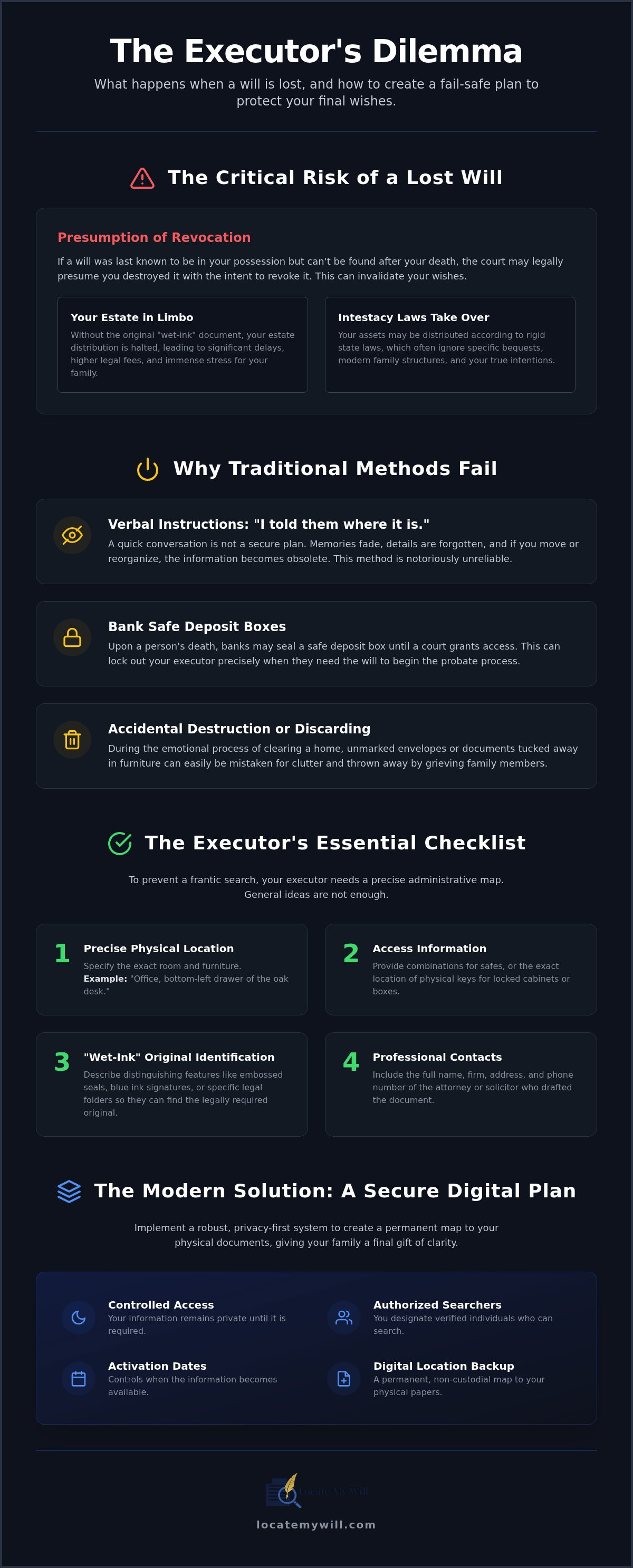
One of the most difficult hurdles in this scenario is the "presumption of revocation." Under the law, if a will was last known to be in your possession and cannot be found after your passing, the court may assume you destroyed it with the intent to revoke it. Proving otherwise is a complex, expensive process that requires clear evidence of your true intentions. Without this evidence, your estate may be distributed according to intestacy laws. These rigid rules often ignore specific legacies or modern family structures, potentially leaving your chosen heirs without their intended inheritance.
The Problem with "I Told Them Where It Is"
Many people assume a quick conversation is enough to secure their legacy. However, verbal instructions are notoriously fragile. Memory is the first point of failure; a detail shared years ago about a "safe spot" in the attic can easily be misremembered or forgotten entirely. Environmental changes also create gaps in knowledge. If you move house, renovate your home, or simply reorganize your filing system, those old verbal directions become obsolete. There's also the persistent risk of accidental destruction. During the emotional period of clearing out a home, family members might unknowingly discard important papers tucked away in unmarked envelopes or old furniture.
The Executor’s Fiduciary Duty to Locate the Will
An executor has a strict fiduciary duty to manage the estate with the utmost care and integrity. This responsibility includes performing a "diligent search" for all testamentary documents. When an executor cannot find will locations easily, they must contact banks, solicitors, and professional registries, which consumes significant time and estate resources. This administrative burden adds immense stress to individuals who are already navigating the grieving process. By creating a transparent, structured retrieval plan, you provide a final act of stewardship. It allows your executor to move forward with confidence, knowing they're fulfilling their role without the anxiety of missing critical information.
Essential Location Details Your Executor Must Have
Providing your executor with a general idea of where your documents are is insufficient for modern estate administration. Precision is the standard required for efficient processing. When an executor cannot find will papers immediately, they often lack the specific environmental cues only you possess. This leads to a frantic search through personal belongings during an already difficult time. To prevent this, you must leave a clear, administrative map that removes all guesswork from the retrieval process.
Your records should include the exact room and furniture piece where the document resides, such as a specific desk drawer or a fireproof box. If you use a safe or a locked cabinet, you must document the location of the physical keys or the digital combinations required to open them. Additionally, include the full contact information for the attorney or legal firm that drafted the document. This ensures your executor has a professional point of contact if they encounter hurdles. To organize these details effectively, you may wish to use a structured executor document checklist to ensure no vital record is overlooked.
Identifying the "Wet-Ink" Original
Probate courts operate on the basis of physical evidence. Photocopies or digital scans are rarely accepted as primary evidence without significant legal hurdles and additional court fees. You must ensure your executor knows how to identify the "wet-ink" original. Look for distinguishing features like embossed seals, specialized legal folders, or signatures in blue ink. The original will is the document signed in the presence of witnesses. If this specific paper is missing, the court may presume you intended to revoke it, which complicates the probate process for everyone involved. You can register your will's location today to ensure the original is never mistaken for a mere copy.
Mapping the Physical Retrieval Path
If you utilize a safe deposit box, provide the bank name, the specific branch address, and the box number. Be aware that many executors are frequently locked out of the very boxes they need to access because they lack the proper authorization or keys. You must also detail the location of any codicils, which are formal amendments that must be filed alongside the primary document. Knowing where to find where a will is kept is only the first step. The path to retrieval must be entirely unobstructed. If an executor cannot find will amendments or codicils, the court may distribute your assets based on outdated instructions, failing to honor your most recent wishes.
Traditional vs. Modern Methods for Sharing Will Locations
Historically, individuals relied on paper-based methods to communicate their final wishes. This often involved a "Letter of Instruction" placed in a desk drawer or filed alongside the will itself. However, this method creates a single point of failure. If your executor cannot find will documents because they're stored in the same location as the instructions, the entire administrative process stalls. This traditional approach lacks the redundancy required for a truly secure estate plan.
Another common but problematic method is the safe deposit box. While these boxes offer physical security, they often create a legal catch-22. In many jurisdictions, a bank requires a grant of probate to allow an executor access to a safe deposit box. However, the executor cannot obtain that grant without the original will, which is locked inside the box. This "safe deposit box trap" can lead to months of legal delays and unnecessary court applications, frustrating the very representatives you've chosen to manage your affairs.
The Vulnerability of Physical Lists
Relying on a physical list hidden "in plain sight" is a high-risk strategy. While it may seem convenient, paper records are susceptible to environmental hazards. A localized fire, flood, or even a simple household leak can destroy both your will and the instructions needed to retrieve it. There's also the human element to consider. Paper instructions can be misplaced during a move or, in more sensitive situations, tampered with by disgruntled parties who gain access to your home. A physical list offers no verification of who has viewed it, nor does it provide a record of when the information was accessed, leaving your privacy vulnerable to unauthorized eyes.
Why Digital Location Registries are the Modern Standard
A digital registry serves as a secure, centralized hub that exists independently of your physical residence. By using a professional platform, you ensure that your document's location is recorded in a non-custodial environment that isn't subject to the same risks as a physical home. This modern approach acts as a digital fail-safe. If you move house or change the firm where your will is stored, you can update your location data in minutes without the need to rewrite a Letter of Instruction or amend the will itself.
These platforms prioritize privacy by allowing you to designate specific authorized searchers. You maintain total control over your information through activation dates; your executor only gains access to the location data when it's legally necessary. This system bridges the gap between your current preparations and your family's future needs, ensuring that even if life's circumstances change, your legacy remains organized and accessible. It's a methodical solution that replaces the uncertainty of paper with the stability of a managed, verified system.
Privacy Controls: Managing Who Can Search and When
Many testators hesitate to share the exact location of their will because they value their current privacy. While transparency is necessary for estate administration, you shouldn't have to sacrifice your personal boundaries while you're healthy and active. The risk that an executor cannot find will papers after your passing is real, but it can be managed without allowing authorized snooping during your lifetime. By using a structured management system, you can establish clear parameters for when and by whom your information is accessed.
This balance is achieved through a combination of authorized searchers and notification recipients. You have the authority to designate up to three searchers who are permitted to request your document's location. To ensure the integrity of your data, you also name up to three notification recipients. These individuals receive an alert whenever a search is initiated; this provides a critical layer of verification to confirm the search is legitimate. This redundant system ensures that your privacy is protected by multiple trusted parties, acting as a bridge between your current security and your family's future needs.
Setting Your Activation Triggers
An activation date serves as a digital lock on your location data. By setting a date in the future, you ensure that even your authorized searchers cannot view your instructions until that time arrives. Regular subscription check-ins act as a heartbeat for the system, confirming you're still in control of your affairs. If an executor cannot find will details before the activation date, the information remains secure and hidden. This prevents premature disclosure of sensitive details and allows you to maintain total stewardship over your records until they're truly required.
Vetting Your Searcher List
Choosing your searchers requires careful consideration of both trust and longevity. We recommend designating up to three individuals to provide necessary redundancy. If your primary executor passes away or becomes incapacitated before you, having secondary authorized searchers ensures the retrieval plan remains viable. As family dynamics or professional relationships change, you can update these permissions instantly. This flexibility allows your plan to evolve alongside your life, ensuring your final wishes are always protected by the right people. You can manage your authorized searchers today to ensure your privacy is never compromised.
Locate My Will: A Fail-Safe Retrieval Plan
Implementing a methodical system is the final step in securing your legacy. If an executor cannot find will documents, the legal and emotional burden on your family increases significantly. Locate My Will provides a structured, digital fail-safe to prevent this scenario. By following a clear, four-step process, you can ensure your final wishes are accessible only when they are needed most.
First, create a secure account and record the precise physical location of your original will. This should include granular details like specific drawers, shelf positions, or safe numbers. Second, designate up to three authorized searchers and three notification recipients to provide a verified network of access. Third, set your search activation date to maintain your privacy until the appropriate time. Finally, provide your family with a clear fail-safe retrieval guide so they understand how the system functions.
Why a Professional Registry Beats a Spreadsheet
While a personal spreadsheet or a digital note might seem convenient, these methods lack the permanence and security of administrative-grade digital stewardship. Personal files are easily lost during computer crashes, forgotten passwords, or accidental deletions. Locate My Will records the location of your physical document but never hosts the document itself for maximum security. This ensures that your sensitive legal information remains private while the map to find it is protected by professional-grade encryption that survives life's unpredictable changes.
Finalizing Your Peace of Mind
Once your digital registry is established, perform a final review of your physical storage choices. Ensure the location is safe from environmental hazards and remains accessible to those who will eventually hold the keys or safe combinations. It's a professional courtesy to inform your chosen searchers that you've designated them on a secure platform. This doesn't require sharing the specifics of your will, but it prepares them for their future role. By ensuring the finding phase of your estate plan is as organized as the drafting phase, you remove the risk that an executor cannot find will records, providing your loved ones with a final, orderly gift of clarity.
Securing Your Legacy Through Methodical Planning
Ensuring your estate is handled correctly requires more than just drafting a document; it demands a deliberate system for retrieval. We've explored the legal necessity of original documents and the significant administrative burden created when an executor cannot find will papers during probate. Transitioning from vulnerable paper lists to a professional digital registry allows you to bridge the gap between your current privacy and your family's future needs with quiet authority.
This methodical approach ensures that your representatives aren't left searching through boxes during a time of grief. By implementing a secure, non-custodial registry, you maintain total control over your information until it's required. Locate My Will utilizes a robust authorized searcher verification system and privacy-first activation date controls to protect your data. Register your will’s location today and give your executor a clear path to your wishes with Locate My Will. Finalizing these details today provides a sense of calm efficiency for you and lasting peace of mind for your beneficiaries.
Frequently Asked Questions
How do I tell my executor where my will is without compromising my privacy?
You can maintain your privacy by using a secure registry that employs activation dates and authorized searchers. Instead of handing over a physical map or verbal instructions today, you record the location in a digital environment. This information remains locked until a specific date or event occurs. It allows you to remain in control of your documents while ensuring your chosen representatives have the necessary instructions when they are legally required to act.
What happens if my executor cannot find the original will after I pass?
If an executor cannot find will papers that are original and signed, the court may presume you intended to revoke the document. This legal presumption often triggers the rules of intestacy, which dictate how your assets are distributed regardless of your verbal wishes. This process is frequently expensive and emotionally taxing for your heirs. Establishing a clear, digital map to your physical documents is the most effective way to prevent these administrative hurdles.
Is it safe to store my will’s location in an online registry?
Storing location data in a professional, non-custodial registry is highly secure because the platform never hosts the actual legal document. Only the descriptive location of the physical paper is recorded. This model ensures that even in the unlikely event of a data breach, your sensitive personal wishes remain private. The system utilizes encrypted administrative-grade stewardship and verification protocols to ensure that only your designated searchers can ever view the stored location details.
Should I give my executor a physical key to my home safe?
Providing a physical key to a home safe can pose security risks, such as the key being lost, duplicated, or used prematurely. A more disciplined approach is to record the precise location of the key within your secure online registry. This ensures that your executor has the instructions needed to retrieve the key only when they are authorized to do so. It maintains the integrity of your safe while providing a reliable retrieval path for your representatives.
What is an "authorized searcher" in the context of a will registry?
An authorized searcher is a specific individual, such as your executor or a trusted family member, whom you have formally designated to access your document's location. Locate My Will allows you to name up to three authorized searchers. These individuals must undergo a verification process before any information is released. This structured system ensures that your sensitive instructions are only shared with the specific people you have chosen to manage your final affairs.
Can I change the location of my will in the registry at any time?
You have the authority to update or change the recorded location of your will at any time through your subscription dashboard. Life changes, such as moving to a new home or moving documents to a solicitor's office, shouldn't require a complete redraft of your legal instructions. By updating the registry, you ensure your retrieval plan remains current. This dynamic system provides a permanent, flexible solution that adapts to your circumstances while maintaining administrative order.
What is an activation date and how does it protect me?
An activation date is a specific future date you set to control when your information becomes accessible to others. This trigger acts as a digital lock, preventing any authorized searchers from viewing your location data until that time arrives. Regular subscription check-ins confirm that you are still in control of your account. This mechanism effectively prevents premature disclosure of your plans, allowing you to maintain total personal privacy while you are healthy and active.
What if my primary executor passes away before I do?
Redundancy is a critical component of a robust estate plan. If your primary representative passes away, your retrieval plan could be compromised if they were the only person with the information. To mitigate this risk, you should designate up to three authorized searchers and three notification recipients. This ensures that multiple trusted individuals have the authority to locate your documents, providing a reliable fail-safe that accounts for the unpredictable nature of long-term planning.


