

A will is only as effective as its accessibility; true security requires a verified, proactive notification system rather than just a hidden storage spot. Many people spend years building an estate only to leave its distribution to chance because they fear a loss of privacy or simply don't know the best way to share sensitive details. You likely feel a sense of responsibility to protect your family from the stress of a missing document, yet you shouldn't have to sacrifice your personal boundaries to do so.
This article outlines the methodical steps you can take to guarantee your original document is found without handing over a key today. You'll learn exactly how to notify executor of will location through a structured, secure protocol that maintains your privacy while you're alive. We will examine how to establish a reliable bridge between your current preparations and the eventual needs of your representatives, ensuring the probate process begins with clarity, stability, and order.
Key Takeaways
- Understand why a missing original document triggers complex intestacy laws and how to prevent the emotional toll of a misplaced will.
- Learn exactly how to notify executor of will location through a secure, methodical protocol that doesn't compromise your current privacy.
- Discover the benefit of designating up to three authorized searchers to ensure redundancy and a smooth transition for your estate.
- Establish a Search Activation Date to control exactly when your information becomes accessible, maintaining security during your lifetime.
- See how a professional location registry acts as a digital guardian to bridge the gap between your planning and your family's eventual needs.
The Critical Link Between Will Creation and Will Accessibility
Most estate planning focuses on the legal language within a document. However, even the most robust legal strategy fails if the physical paper is missing. Understanding what is a will in a practical sense involves recognizing it as a set of instructions that must be delivered to the court. If those instructions aren't found, the law assumes they don't exist. Will Accessibility is the logistical bridge between planning and probate. It's the difference between a smooth transition and a chaotic legal search that leaves your family in limbo.
The executor serves as the primary agent in the estate process. They cannot fulfill their legal duties if they're locked out of the necessary information. Establishing a clear protocol on how to notify executor of will location is just as important as the legal drafting of the document itself. Without this link, your final wishes remain a secret that your representatives cannot honor.
The Legal Consequences of a Missing Original
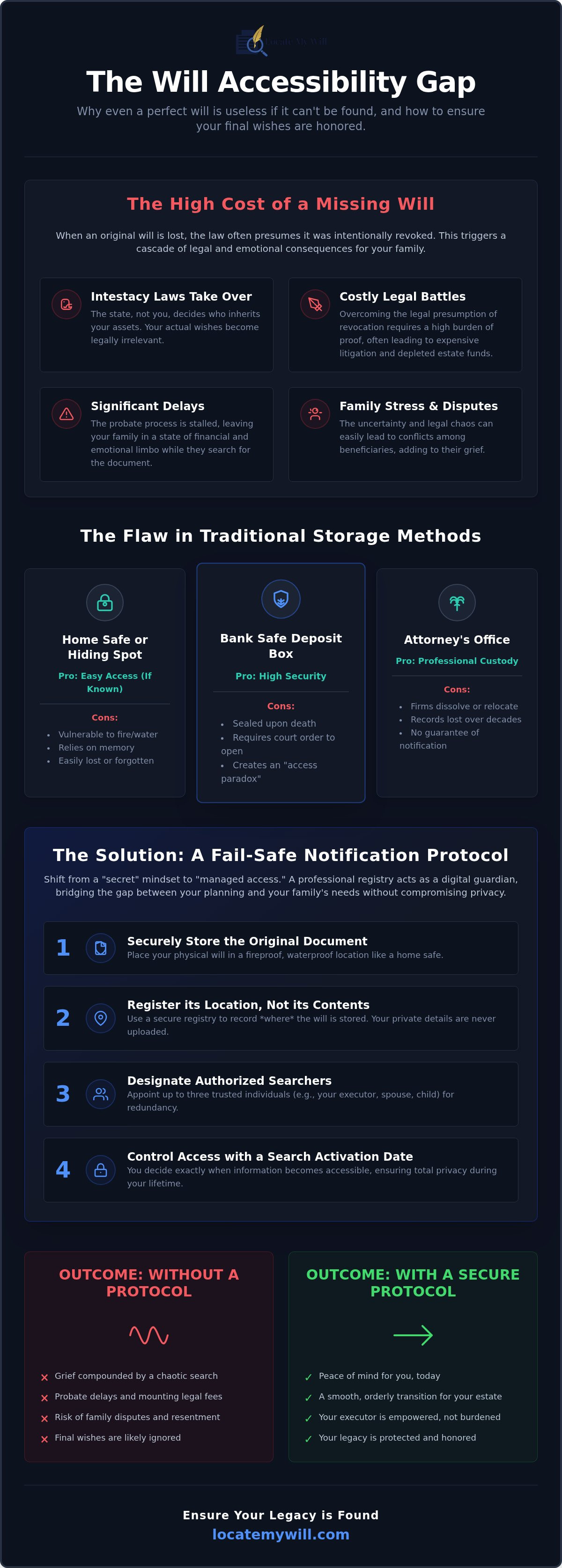
Probate courts generally require the original, wet-ink document to grant authority to an executor. If only a copy exists, the law often presumes the testator destroyed the original with the intent to revoke it. Overcoming this presumption requires a high burden of proof, which often leads to expensive litigation and significant delays. When the document remains lost, the estate falls under intestacy laws. This means the state decides who inherits your assets regardless of your actual wishes. This creates severe consequences of a lost will for beneficiaries, often resulting in family disputes and depleted estate funds.
Why "Hiding" Your Will is a Risky Strategy
Many people treat their will like a buried treasure. They hide it in floorboards, obscure filing cabinets, or safe deposit boxes that require a court order to open after death. Relying on a single person's memory for these details is a fragile strategy. Memories fade, and life moves quickly. If your executor doesn't have a reliable way to confirm the location, they're forced to search through your private papers during a time of grief. Transitioning from a "secret" mindset to a "managed access" mindset allows you to maintain privacy while ensuring your executor isn't left guessing. When you master how to notify executor of will location through a secure, professional system, you remove the burden of memory and the risk of physical loss.
Evaluating Physical Storage Options: Security vs. Accessibility
Choosing a storage location involves balancing protection against accessibility. While a bank vault offers high security, it often creates significant hurdles for heirs. Conversely, a home filing cabinet is easy to find but vulnerable to environmental damage. Planning is incomplete without communicating its location to the right parties. A document that is perfectly preserved but remains undiscovered is effectively useless in the eyes of the probate court.
Home safes provide immediate access for an executor, provided they have the combination or key. Bank safe deposit boxes are robust but legally complex. Attorneys often store originals for clients as a courtesy, yet law firms can dissolve, relocate, or lose track of records over several decades. This makes a centralized method for how to notify executor of will location essential, regardless of where the paper sits. You must ensure that the physical protection of the document doesn't become a barrier to its eventual retrieval.
The Safe Deposit Box Dilemma
State laws vary, but many banks seal a box immediately upon the death of the owner. To open it, an executor often needs a court order. This creates a paradox; the document required to prove authority is locked inside the very box that requires authority to open. Relying solely on a bank box can delay probate for weeks or months while your family navigates bank protocols. It is a secure option, but it requires a secondary plan for access.
Home Storage Best Practices
If you choose home storage, invest in a safe with a UL fire rating of at least one hour. Waterproof seals are equally vital to prevent damage from pipe bursts or floods. Use a "legacy drawer" system where the safe is clearly labeled within a larger organizational structure. Physical security is only half the battle. You must ensure your representative knows the safe exists and where to find the key. A professional registry can act as the final piece of this puzzle. It ensures your physical preparations aren't rendered useless by a lack of information. When you decide on a location, the next step is establishing a reliable system for how to notify executor of will location without compromising your daily privacy.
How to Designate Authorized Searchers and Notification Recipients
Effective estate planning requires you to distinguish between different roles within your support network. While your executor is the person who will eventually manage your assets, they aren't always the best person to hold the primary "key" to your information today. Relying on a single individual creates a point of failure that can lead to the very lost-will scenarios discussed earlier. Redundancy is the hallmark of a disciplined plan. By designating up to three authorized searchers, you ensure that someone is always available to bridge the gap between your physical documents and the probate court.
When you consider how to notify executor of will location, you must select individuals based on their reliability and their likelihood of surviving you. This often means choosing a mix of peers and younger family members. The psychological benefit of this structure is significant. It provides you with the peace of mind that your representatives are "on standby," ready to act only when the time is right, without you having to constantly manage their access or remind them of your wishes.
Defining the Role of an Authorized Searcher
An authorized searcher acts as the verified bridge to your estate documents. This individual doesn't necessarily need to see the contents of your will; they simply need the authority to request its location when the time comes. This role is protected by a strict verification process to ensure that sensitive information only reaches the people you have explicitly chosen. To maintain this level of security, you should register will location online through a dedicated platform. This creates a formal record that exists independently of anyone's memory, ensuring the location is never truly "lost."
Automated Notifications vs. Manual Conversations
Verbal instructions often fail during the high-stress period following a death. Important details are easily forgotten or misinterpreted when emotions are high. Automated notification triggers solve this problem by taking the burden of communication off the grieving family. These triggers ensure that when a search is initiated, the right people are alerted immediately and accurately. This system allows you to balance transparency with privacy. Your recipients don't need to know every detail of your estate today. Instead, they only receive the information they need at the exact moment they need it. This methodical approach to how to notify executor of will location replaces awkward or repetitive conversations with a reliable, automated protocol.
Creating a Fail-Safe Notification Protocol for Your Executor
A successful estate plan depends on more than just legal signatures; it requires a reliable method for delivery. Establishing a clear protocol for how to notify executor of will location ensures that your preparations aren't lost in the shuffle of administrative transitions. The 2026 standard for modern estate document organization requires a dual-layer strategy that pairs a secure physical original with a verified, externally managed location record. This methodical approach protects your privacy today while providing a clear path for your representatives tomorrow.
Privacy remains a priority throughout this process. You don't need to share the contents of your will to ensure its retrieval. By using a "Search Activation Date," you control exactly when your information becomes accessible. This prevents premature disclosure and maintains your boundaries. Reviewing these records annually, or immediately following a move, keeps your protocol robust and accurate. This disciplined maintenance is the hallmark of a responsible estate owner.
Step 1: Secure the Physical Document
Your first priority is protecting the wet-ink original. While digital scans are helpful for reference, most US probate courts still require the physical paper to initiate the estate process. Choose a storage spot that balances protection from environmental hazards with eventual accessibility. Alongside your will, you should organize a "supporting cast" of documents, including property deeds, vehicle titles, and life insurance policies. Keeping these items in a single, organized location prevents your executor from having to conduct multiple searches during a difficult time.
Step 2: Register the Location Externally
Relying on a single person's memory is a known point of failure in estate planning. Registering your document's location with an independent registry provides a robust backup that exists outside your home. When you record these details, be as granular as possible. Instead of simply noting "the basement," specify "the blue fireproof folder in the basement safe." This level of detail removes all guesswork for your authorized searchers. To maintain this protection, ensure your registration remains active and updated as your circumstances change.
Step 3: Formalize the Notification
The final step is informing your executor that a registry exists. You can share this information without revealing the specific contents of your will or even its exact location. Simply let them know they are a designated searcher on a secure platform. This formalizes the relationship and gives them a clear starting point. If they ever need to know how to find a deceased person’s will, the registry acts as their primary guide. You can secure your legacy by starting your registration today, ensuring your family has the clarity they need when it matters most.
Locate My Will: Bridging the Gap Between Planning and Execution
Locate My Will serves as a national, US-based digital guardian for your physical documents. It addresses the final, often overlooked stage of estate planning: the precise moment your family needs to act. By maintaining a professional registry, you solve the problem of how to notify executor of will location without relying on fragile verbal promises or hidden notes. Our paid subscription model is designed for permanence, ensuring that your records remain secure and accessible over the long term. This service acts as the final, essential step in a complete estate plan, providing the structure needed to bridge the gap between your current preparations and the eventual needs of your representatives.
Redundancy is a core principle of our platform. You can designate up to three authorized searchers and three notification recipients. This ensures that if one person is unavailable or forgets their role, a backup is always ready. This methodical facilitator approach provides a level of certainty that simple home filing systems cannot match. When you establish this system, you are not just storing a location; you are creating a reliable pathway for your estate's execution.
Security and Privacy Protocols
Our commitment to digital stewardship focuses on the integrity of information. Unlike services that host digital copies of sensitive legal papers, Locate My Will only records the physical location of your original document. This distinction is vital for your privacy; we do not store the contents of your will or any other legal instrument. We use rigorous verification processes to prevent unauthorized searches, ensuring that only the individuals you have vetted gain access. A unique feature of our platform is the Search Activation Date control. This allows you to set a specific date before which no one can access the location data, protecting your privacy during your lifetime. This neutral, professional registry offers the quiet authority and security that family members need during a period of transition.
Getting Started with Your Registry
Establishing your registry is a straightforward, administrative process that can be completed in under ten minutes. Once you create an account, you record the granular details of your document's location and manage searcher permissions. You have full control over the activation dates and notification triggers, allowing you to tailor the service to your specific family dynamics. This structured approach removes the anxiety of future uncertainty and replaces it with a reliable protocol. You can ensure your family can find your will today by formalizing your document retrieval plan. By mastering how to notify executor of will location through a professional platform, you fulfill your responsibility to your heirs and provide them with lasting peace of mind.
Securing Your Legacy Through Methodical Organization
Completing your will is a significant milestone; however, its value depends entirely on its discoverability. You've learned that relying on a single hiding spot or a single person's memory creates unnecessary risks for your heirs. By balancing physical security with a professional location registry, you ensure that your final wishes aren't lost to administrative hurdles or family uncertainty. Establishing a protocol for how to notify executor of will location is the final, essential step in a disciplined estate plan.
Locate My Will provides a national, US-based platform that prioritizes both security and transparency. Our system allows you to designate up to three trusted individuals through our Authorized Searcher Management, ensuring redundancy if one representative is unavailable. Additionally, our Activation Date Control guarantees that your privacy is never compromised during your lifetime. You can take control of this process today to prevent the emotional and financial toll of a misplaced document.
Register your will location and protect your family’s future with Locate My Will. Your family deserves the clarity of a smooth transition; start building your fail-safe retrieval plan now.
Frequently Asked Questions
Is it enough to just tell my executor where my will is kept?
Simply telling your executor is rarely sufficient because verbal instructions are easily forgotten or misinterpreted during a crisis. Memory is a fragile storage medium, and life circumstances often change over several decades. You need a formal system for how to notify executor of will location that exists independently of a single person's memory. Establishing a professional registry ensures that the information is permanent and remains accessible even if your executor is unavailable or passes away before you.
What happens if my executor cannot find the original copy of my will?
If the original document is missing, the probate court may presume you intended to revoke it. This often forces the estate into intestacy, where state laws determine asset distribution regardless of your actual wishes. Family members may face significant legal fees and months of delays while attempting to prove the validity of a copy. Ensuring your original paper is findable protects your beneficiaries from the emotional and financial strain of a contested or failed probate process.
Can I store my will in a bank safe deposit box safely?
A bank safe deposit box is physically secure but poses significant accessibility challenges for your representatives. Many states seal these boxes upon the owner's death, requiring a court order for an executor to gain entry. This creates a difficult cycle where the document needed for legal authority is locked inside the box. If you use a bank box, it's critical to have a secondary notification protocol so your heirs know exactly where to start the legal process.
How does a will location registry differ from a digital will service?
A will location registry like Locate My Will focuses solely on recording where your physical, wet-ink document is stored. Digital will services often attempt to host electronic copies of the document itself, which many courts still don't recognize as valid for probate. Our registry acts as a digital guardian for your physical records through a paid subscription model. It manages searcher permissions and notification triggers without requiring you to share the sensitive contents of the legal document.
Who should I designate as an authorized searcher for my will location?
You should select up to three individuals who are responsible, organized, and likely to survive you. This often includes your named executor, a trusted younger family member, or a professional advisor. Redundancy is vital to a fail-safe plan. By choosing multiple searchers, you guarantee that at least one person can bridge the gap between your storage spot and the probate court if the primary executor is unable to fulfill their duties at that time.
What is a search activation date and why does it matter for my privacy?
A search activation date is a specific control that prevents anyone from accessing your stored location data before a time you designate. This ensures your privacy is never compromised while you're alive. Even authorized searchers cannot see where your will is kept until the activation date passes or a specific trigger occurs. This methodical approach allows you to plan for the future with total confidence that your current boundaries remain respected and secure.
Does Locate My Will keep a digital copy of my actual will?
No, Locate My Will does not host digital copies of wills or any other legal documents. We are a location registry service, not a document storage or hosting platform. Our role is to securely manage the metadata regarding where your physical original is kept. This commitment to digital stewardship ensures that your private legal instructions remain entirely in your possession while we facilitate the logistical connection your executor needs to find them later.
How often should I update the location information in my registry?
You should review and update your registry information at least once a year or immediately following any major life event, such as a move. Accuracy is the foundation of a reliable retrieval plan. Even small changes, like moving a safe to a different room, can create confusion if the registry isn't updated. Regular maintenance ensures that the process of how to notify executor of will location remains seamless and that your searchers have the most current instructions.


