

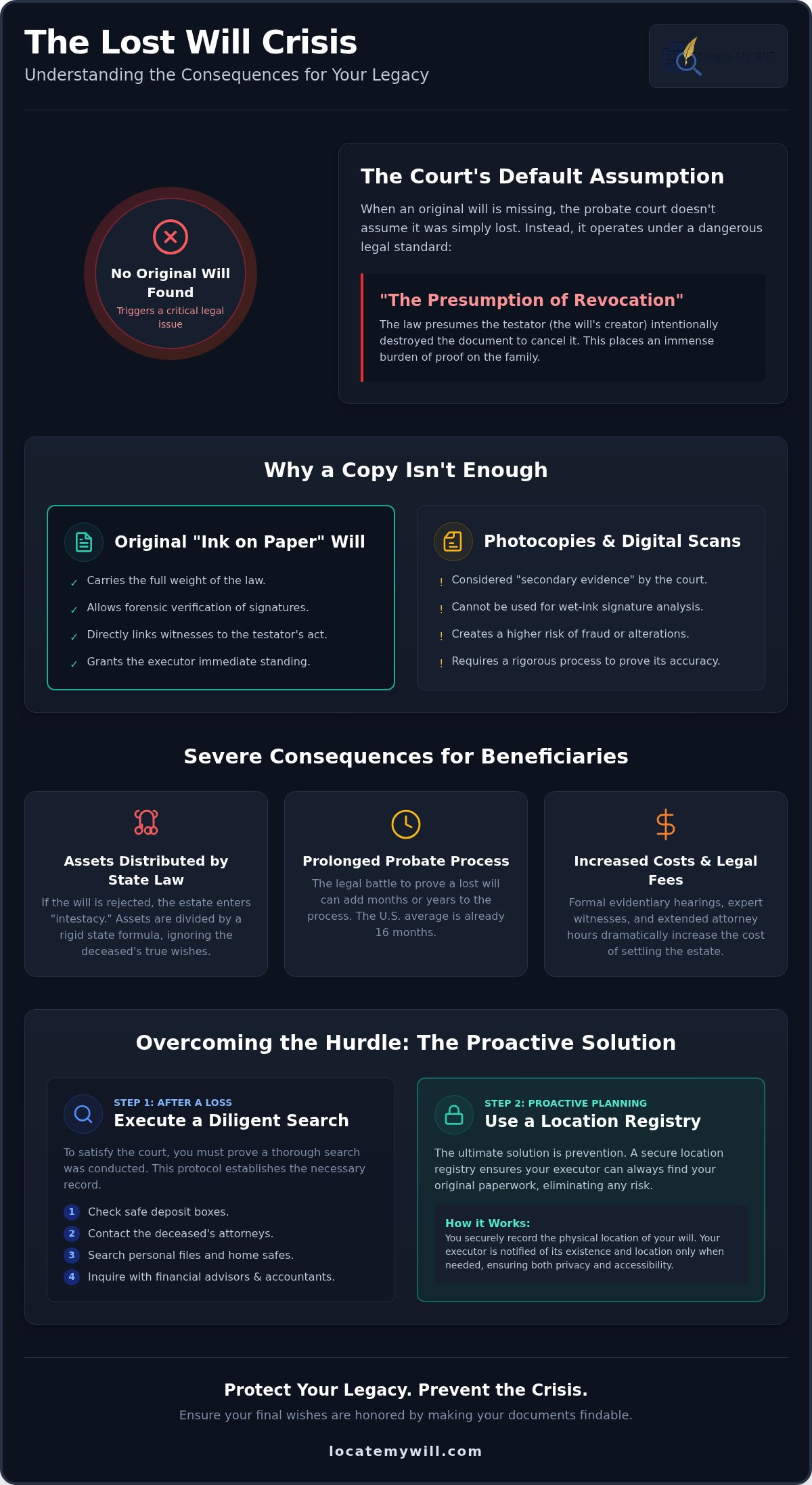
In the eyes of the probate court, a missing original will is frequently treated as if it were intentionally destroyed. This legal standard, known as the "presumption of revocation," places an immense burden of proof on grieving families who are already struggling with the loss of a loved one. It's a distressing situation that can leave you feeling vulnerable and uncertain about the future of your family's legacy. Understanding the consequences of a lost will for beneficiaries is the first step in managing the legal and financial risks that follow such a discovery.
You likely believe that a digital copy or a clear memory of the testator's wishes should be enough to satisfy the court. However, the legal reality is often much more rigid and demanding. This guide provides a professional overview of the hurdles you'll face, including the complexities of rebutting legal presumptions and the rigid hierarchy of state intestacy laws. We'll explore the financial impact of prolonged probate, which averages 16 months in the United States, and outline how you can establish a secure, methodical plan to ensure your own documents are never lost to time. By the end of this article, you'll have a clear framework for protecting your inheritance and your peace of mind.
Key Takeaways
- Learn why the legal "presumption of revocation" creates a significant barrier for families when an original document cannot be produced in court.
- Understand the severe consequences of a lost will for beneficiaries, including the risk of assets being distributed according to rigid state intestacy laws rather than the testator's true intentions.
- Identify the financial risks associated with missing documents, such as increased probate costs and the high expense of formal evidentiary hearings.
- Discover how to execute a systematic search protocol to establish the "diligent search" record required to satisfy probate court standards.
- Establish a proactive strategy for document discovery by using a secure location registry to ensure your executor can always find your original paperwork.
What Constitutes a "Lost Will" in the Eyes of the Court?
A "Lost Will" is a document that triggers the presumption of revocation when the original is missing. Understanding the consequences of a lost will for beneficiaries begins with how the legal system views the absence of physical evidence. In a legal context, a lost will is defined as a document known to have existed but cannot be physically located after the testator’s death. This isn't merely a matter of a misplaced folder; it's a specific legal status that changes the entire trajectory of an estate's administration.
The court maintains a strict distinction between a missing original and a photocopy. While you might have a clear digital scan, the law prioritizes "ink on paper" to prevent fraud and unauthorized alterations. A foundational look at what is a will shows that the document's validity relies on meeting specific statutory requirements. Without the physical original, the court cannot verify the texture of the paper, the pressure of the pen, or the consistency of the ink, all of which are markers of authenticity.
The Legal Primacy of the Original Document
Digital scans and photocopies are considered secondary evidence in probate court. The original physical document is the only version that carries the full weight of the law because it contains the actual signatures of the testator and the witnesses. This physical presence is vital for several reasons:
- Verification of Signatures: Forensic experts can only truly verify wet-ink signatures on an original document.
- Witness Credibility: The original document links the witnesses' signatures directly to the testator's final act.
- Executor Standing: Without the original, an executor's authority is not automatically recognized, complicating their ability to manage bank accounts or sell property.
When the original is missing, the executor must undergo a much more rigorous process to prove that the copy they possess is an accurate representation of the deceased's final wishes. This adds layers of administrative burden and increases the risk of the document being rejected entirely.
Distinguishing Between Lost and Revoked Wills
There's a fine line between a document that's misplaced and one that was intentionally destroyed. If a will was last known to be in the testator's possession and cannot be found after their death, the court doesn't assume it was lost in a move. Instead, it assumes the testator destroyed it with the intent to revoke it. This assumption is one of the most difficult consequences of a lost will for beneficiaries to navigate. It shifts the burden of proof to the family, requiring "clear and convincing evidence" that the document wasn't revoked. If this evidence isn't found, the court may refuse to open the probate case, forcing the estate into a state of intestacy.
The Presumption of Revocation: The Greatest Legal Hurdle
The law operates on a specific assumption when an original will cannot be found: it assumes the person who wrote it decided to cancel it. This presumption of revocation exists to protect the privacy and autonomy of the testator. If someone changes their mind about their legacy, they shouldn't have to explain that decision to their heirs while they're still alive. They can simply destroy the document. However, for those left behind, this creates a significant barrier. One of the primary consequences of a lost will for beneficiaries is that the law starts from a place of skepticism. You aren't just looking for a document; you're fighting a legal conclusion that the document no longer exists by choice.
Rebutting this presumption is incredibly difficult without physical evidence. The court's primary concern is ensuring the integrity of the probate process. If the original cannot be produced, the law assumes the worst-case scenario to prevent fraudulent documents from being presented as valid. This leaves beneficiaries with the heavy burden of proof to show that the document was lost accidentally rather than destroyed with intent.
Proving Accidental Destruction
To win a case involving a missing original, beneficiaries must provide evidence that the document was lost or destroyed by accident. Common examples include house fires, floods, or natural disasters where the destruction of property was widespread and documented. Witness testimony also plays a vital role. If an attorney or a close friend can testify that the deceased spoke about the will with favor just days before passing, it may help the case. Most probate courts require a "Clear and Convincing Evidence" standard. This is a higher bar than the standard used in many other civil cases. It requires the court to be substantially certain that the will was indeed lost rather than revoked.
When a Copy Might Be Accepted
While courts prefer the original, they may accept a photocopy under very narrow and strictly monitored circumstances. You must prove "Due Execution," which involves showing the original was signed and witnessed correctly according to specific state laws. This process often involves locating the original witnesses and having them sign affidavits or testify in court. Relying on a copy almost always leads to significantly higher legal fees and intense court oversight. To avoid these complications, many families choose to use a location registry to ensure the original is always accessible to authorized searchers. This proactive step removes the uncertainty that often defines the consequences of a lost will for beneficiaries.
Financial and Personal Consequences for Beneficiaries
When an original will is missing, the estate doesn't just stop; it defaults to a state-mandated process. This shift from private wishes to public law represents one of the most severe consequences of a lost will for beneficiaries. Instead of following the specific instructions left by the deceased, the probate court must apply intestacy statutes. These laws are rigid. They don't account for modern family dynamics, longtime companions, or charitable intentions. The result is a distribution of assets that may look nothing like what the testator intended.
The financial impact is equally significant. Average probate costs in the U.S. range between 3% and 8% of the total estate value, but these figures often climb higher when documents are missing. Every hour an attorney spends searching for evidence or drafting petitions to prove a lost will is an hour billed against the inheritance. This depletion of the estate's value is a direct financial loss for those named in the missing document.
Intestacy vs. Testacy: A Comparison
Intestacy laws follow a strict hierarchy based on blood or legal relation. If a will is lost, non-relatives and charities are typically excluded from the distribution entirely. This means that a lifelong friend or a dedicated local charity will receive nothing, regardless of what the deceased intended. The loss of "Special Bequests" is equally painful. Sentimental items, such as family heirlooms or specific sums of money meant for a grandchild's education, are often absorbed back into the general estate. Perhaps most critically, guardianship instructions for minor children are lost. Without these written directives, the court must decide who will raise the children based on state standards, which might not align with the parents' preferences.
The "Cost of Discovery" for Executors
Finding a missing document isn't free. Executors often face a high "cost of discovery" that depletes the estate's value before any beneficiary receives a dime. This includes legal fees for filing a petition to prove a lost will and the expense of hiring professional searchers or investigators to conduct a "diligent search." These costs are compounded by the following factors:
- Formal Probate Expenses: In many states, a lost will requires "Formal Probate," which involves more court hearings and higher filing fees than informal proceedings.
- Evidentiary Hearings: Lawyers must spend billable hours gathering witness testimony to rebut the presumption of revocation.
- Contested Estates: Uncertainty breeds conflict. When no original document exists, the estate is much more likely to be contested by individuals who would benefit more under intestacy laws.
These financial drains are coupled with significant delays. While the average probate case takes about 16 months, a lost will can extend this timeline by months or even years. The emotional strain on beneficiaries during this period is immense. Uncertainty over the will's existence often triggers family disputes, turning a time of mourning into a season of litigation. These avoidable consequences of a lost will for beneficiaries highlight why the location of the original document must be clearly recorded and accessible.
Executing a Systematic Search Protocol
To mitigate the severe consequences of a lost will for beneficiaries, an executor must perform a "diligent search" that meets the probate court's specific standards. This is a formal, documented process. It isn't enough to simply state that the document wasn't in the deceased's desk drawer. You must prove to a judge that every reasonable location was exhausted. This methodical approach is the only way to potentially move forward with a photocopy or other secondary evidence. For a detailed, step-by-step guide on this process, you can refer to our instructions on How to Find a Deceased Person's Will: A Systematic Search Protocol.
The search should begin with the most obvious locations, such as home safes, fireproof boxes, and personal filing cabinets. If these efforts are unsuccessful, the scope must expand to local institutions. Contact the local probate court to check for "Wills for Safekeeping" filings. In many jurisdictions, individuals can file their original documents with the court clerk during their lifetime to ensure they are preserved and easily located after death. Documenting each of these inquiries is essential for your legal standing.
Where to Look Beyond the Home
Checking with former attorneys and estate planning professionals is a critical step. Law firms frequently keep the original document in a vault or maintain a record of exactly where the original was sent. Banks are another vital resource, though accessing a safe deposit box after a death can be legally complex. Most states allow an executor to open a box specifically to search for a will, but this often requires a court order or the presence of a bank official. You should also search digital records for clues. Emails or computer files containing terms like "estate planning" or "safe deposit box" can provide the necessary map to the physical paper.
Documenting the Search for the Court
Once the search is finished, the executor must file an affidavit of search. This legal document lists every location visited, every person contacted, and the specific dates these actions occurred. If you're attempting to probate a copy, the court will often require testimony from the executor or family members about these efforts. This testimony is used to confirm that the original is truly lost and was not intentionally revoked. This process is expensive and adds significant time to the probate timeline. You can prevent these hurdles by using a will location registry to ensure your authorized searchers have immediate access to your document's physical location. A centralized record protects your family from the legal and financial consequences of a lost will for beneficiaries.
Preventing the Lost Will Crisis with a Location Registry
Most estate planning advice concludes with a simple instruction: tell your executor where your documents are stored. While well intentioned, this advice relies entirely on human memory during a period of acute emotional stress. A location registry bridges the gap between the attorney’s vault and the executor’s hands, providing a reliable, methodical system for document discovery. By recording exactly where your original document resides, you prevent the severe consequences of a lost will for beneficiaries and ensure your final wishes are executed exactly as you intended. For a deeper look at this process, you can read our Register Will Location Online: Estate Security Guide.
Locate My Will functions as a secure, administrative map for your representatives. It doesn't host your private documents or draft legal language. Instead, it provides a structured platform for recording the physical location of your original will. This approach prioritizes security and authorization, ensuring that your private information is only accessible when it is truly required for the administration of your estate.
The Locate My Will Security Framework
Our system is designed with multiple layers of verification and privacy protection. Through Search Activation Date Control, you decide exactly when your information becomes available to your representatives. This ensures your privacy remains intact during your lifetime. Additionally, the Authorized Searcher Management feature allows you to designate up to three individuals who can request access to the location record. This redundancy is vital. If one searcher is unavailable or incapacitated, your other designated representatives can still fulfill their duties without delay.
Recording a location is fundamentally safer than hosting a digital copy of the document. As established in previous sections, probate courts prioritize the physical "ink on paper" original. A digital scan does not carry the same legal weight and can introduce unnecessary security risks. By focusing on location discovery, we help your executor find the only document that truly matters in a court of law.
Ensuring Your Legacy is Found
Using a registry significantly reduces the administrative burden on your loved ones during their time of grief. They won't have to spend weeks searching through home safes or contacting every law firm in the county. Instead, they can follow a clear, professional path to the original document. This methodical approach effectively helps manage the risk of a "Presumption of Revocation" because the existence of a registered location provides a clear record that the testator intended for the document to be found and followed.
The consequences of a lost will for beneficiaries are often permanent and financially devastating. You've spent a lifetime building your legacy and significant resources drafting the documents to protect it. Securing your document’s location today through a Will Owner Registration Subscription is the final, essential step in protecting your beneficiaries tomorrow.
Securing Your Legacy Through Methodical Planning
Navigating the legal system without an original document is a burden no family should bear. As we've explored, the consequences of a lost will for beneficiaries include rigid intestacy laws, depleted inheritances, and the high emotional cost of uncertainty. The law assumes the worst when paper is missing; however, you have the power to ensure your intentions remain clear and accessible to those who need them most.
By establishing a structured record today, you provide your representatives with a reliable map to your final wishes. You can ensure your family can find your original will with Locate My Will. This service allows you to securely record the physical location of your original estate documents. You may designate up to three authorized searchers to access your records when the time comes, while privacy-first activation dates control when your information is released. Protecting your legacy is about more than just drafting a document; it's about ensuring it is found. Take this methodical step today to provide your loved ones with the security and peace of mind they deserve.
Frequently Asked Questions
Can a lawyer testify that a photocopy of a will is valid?
A lawyer can testify to the original document's execution and confirm that a photocopy is a true representation of the testator's wishes. However, this testimony alone does not automatically override the presumption of revocation. The court requires additional evidence to prove the original wasn't intentionally destroyed. This process is one of the more expensive consequences of a lost will for beneficiaries because it involves extensive billable hours for legal preparation and formal court appearances.
What happens if I only have a digital scan of my original will?
A digital scan is treated as secondary evidence, much like a photocopy. While it provides a visual record, it lacks the physical markers of authenticity found on the original paper. Most probate courts won't accept a scan unless you can rebut the presumption that the original was revoked. Relying on digital records often leads to a formal probate process, which can take significantly longer than the national average of 16 months.
Do all states follow the presumption of revocation for missing wills?
The presumption of revocation is a standard legal principle applied across the United States. While specific evidentiary requirements vary by state, the core logic remains the same. If an original will was last seen in the testator's possession and is now missing, the court assumes it was destroyed on purpose. This universal hurdle is why location discovery is just as vital as the drafting process itself for protecting your family's inheritance.
How do I prove that a will was lost in a fire or flood?
You can prove accidental loss by providing official documentation of the disaster, such as fire department incident reports or insurance claim summaries. Witness testimony from individuals who saw the document in the home shortly before the event also strengthens the case. This evidence helps rebut the presumption of revocation by showing the court that the destruction was unintentional. Without such proof, the estate may default to state intestacy laws, excluding your chosen heirs.
Is a "duplicate original" the same as a photocopy?
No, a duplicate original is distinct from a photocopy. It's a second version of the document that was signed and witnessed at the same time as the first original. While a photocopy is merely a picture of a document, a duplicate original carries the same legal weight as the primary copy. Many attorneys advise against creating them. If one is found and the other is missing, it can still trigger significant legal complications and delays.
What is the most common reason a court rejects a copy of a will?
The most common reason for rejection is the failure to provide clear and convincing evidence that the testator didn't intentionally destroy the original. If the family cannot prove the document was lost by accident, the court must follow the legal assumption that the will was revoked. This failure often forces the estate into intestacy, which is one of the most common consequences of a lost will for beneficiaries who were expecting a specific inheritance.
Does Locate My Will store a digital version of my document?
Locate My Will doesn't host digital versions of your documents or offer digital will hosting. Our service is a dedicated location registry designed to bridge the gap between your storage choice and your executor's search. We focus purely on recording the physical location of your original, ink on paper document. This ensures your privacy is protected while providing authorized searchers with a secure map to the only version the probate court accepts.
Can an executor sign a copy of the will if the original is missing?
An executor cannot sign a copy of the will to make it valid. Only the testator, the person who created the will, has the legal authority to sign the document in the presence of witnesses. If the original is missing, the executor's role is to conduct a diligent search and present evidence to the court. They can't rectify the absence of an original signature by adding their own to a photocopy or a digital printout.


