

A missing original will is often legally equivalent to a revoked one in the eyes of many probate courts, creating a high-stakes race against time for grieving families. If you're currently researching how to find a lost will, you likely feel the weight of this responsibility alongside the anxiety of potential estate disputes or the fear of a loved one's wishes being ignored. It's a heavy burden to carry while navigating the complexities of loss, but a structured approach can alleviate the uncertainty and provide a clear path forward.
This guide provides a methodical protocol for 2026, designed to guide you through every phase of the recovery process with professional discipline. You'll discover the systematic steps to locate a missing will, moving from exhaustive physical audits of a decedent's residence to the use of modern digital registries and formal institutional inquiries. By following this search hierarchy, you can establish the necessary due diligence required by the legal system and find the peace of mind that comes from knowing you've exhausted every professional resource available to secure the estate's future.
Key Takeaways
- Establish a systematic search hierarchy by distinguishing between a mere photocopy and the paper original required for formal probate.
- Audit both logical storage areas and unconventional household locations to ensure you have met the legal standard for a diligent search.
- Learn how to find a lost will by utilizing national registries and digital stewardship platforms that record the precise location of physical documents.
- Track the institutional trail by contacting drafting attorneys and checking probate court records for "safekeeping" deposits.
- Understand your legal options if the search fails, including the specific requirements for petitioning the court to accept a validated copy.
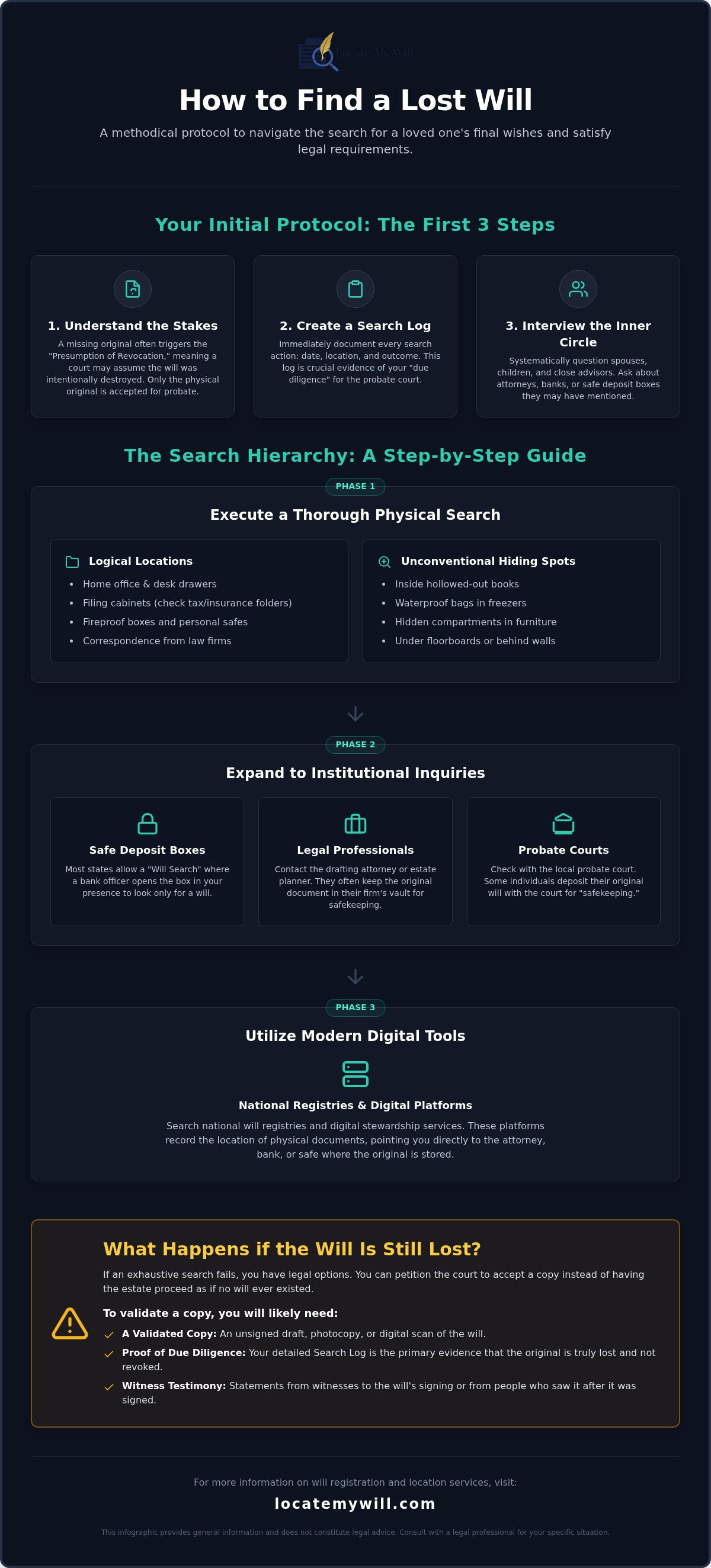
Protocol: What to Do First When a Will is Missing
Finding a missing document is a critical administrative task that requires a disciplined approach. When researching how to find a lost will, you must understand that the search must be exhaustive. A "lost will" scenario exists when survivors are certain a document was created but cannot physically produce the paper original. A court will not accept a secondary document until you prove that every reasonable effort was made to find the primary one.
To manage this process effectively, establish a Search Log immediately. Record the date, the specific location searched, and the contact person for every inquiry. This log creates a verified trail of your due diligence. If the search eventually fails, this record will be your primary evidence when explaining to a probate judge why you're seeking alternative legal remedies. It transforms a chaotic hunt into an organized, professional investigation.
The Legal Significance of the Original Document
Courts maintain a strict hierarchy of evidence. While many assume a digital scan or a photocopy is sufficient, the legal system prioritize the physical paper original. This original document formally establishes what is a will and provides the necessary proof of the decedent's final intentions. Without it, the "Presumption of Revocation" often applies. This legal principle suggests that if an original cannot be found, the creator likely destroyed it with the intent to revoke it. Failing to produce the original can lead to complex litigation and probate delays due to lost will, which often drains estate assets through increased statutory fees.
Initial Inquiries with the Inner Circle
Your first practical step in learning how to find a lost will is to interview the decedent's inner circle. This group typically includes a surviving spouse, adult children, or a long-term executive assistant. Approach these conversations with professional clarity rather than urgency. Ask about recent visits to safe deposit boxes or meetings with financial advisors. Trusted confidants may not realize they hold a piece of the puzzle until you ask about specific administrative habits. Determine if the decedent mentioned a specific registry where they might have recorded the location of their documents. These early conversations often reveal the name of a drafting attorney or a specific bank branch that narrows your search parameters significantly.
Executing the Physical Search: Where Wills are Commonly Stored
A systematic physical search is the foundation of your due diligence protocol. When you're determining how to find a lost will, start with the most logical administrative hubs before moving to more obscure corners of the home. This process requires patience and a keen eye for detail. You aren't just looking for the document itself; you're looking for clues that point to its ultimate resting place.
The Home Office and Personal Filing Systems
Begin with a thorough audit of the home office. Filing cabinets, desk drawers, and fireproof boxes are the most frequent storage sites. Don't simply look for a folder labeled "Will." Instead, sort through tax records and insurance policies. These documents often contain the names of attorneys or estate planners who may have the original in their vault. Check for business cards tucked into planners or address books. If you find a fireproof box, ensure you check under the lining or in side pockets. Personal correspondence, including letters from law firms, can provide a timeline of when the document was last updated or moved.
It's also necessary to check unconventional locations. Some individuals prioritize fire protection over logical organization. It's not uncommon to find important papers in waterproof bags inside the freezer or hidden within hollowed-out books. Check for "hidden" compartments in desks or floorboards if the decedent was known for being particularly private. Every room should be cleared methodically to satisfy the court's requirement for an exhaustive search.
Accessing Safe Deposit Boxes and Private Safes
The safe deposit box presents a significant administrative paradox. In many jurisdictions, you need the original will to be appointed as an executor, but the bank won't grant access to the box without those appointment papers. However, most states allow a "Will Search" where a bank officer opens the box in your presence to look specifically for testamentary documents. If you find a safe deposit key but don't know which bank it belongs to, start with branches where the decedent maintained active accounts. You may also need to check private safes in the home. If the combination is unknown, a professional locksmith may be required. To avoid these complex hurdles in the future, many people choose to register the location of their physical will with a secure national service.
How to Search for a Will Online: Digital Registries and Databases
In the modern estate planning landscape, the search for a missing document often begins with a digital audit. While the paper original remains the legal gold standard, its location is frequently recorded in secure online databases. Understanding how to find a lost will in 2026 requires you to distinguish between public probate records and private location registries. Public records only exist after a will has been filed with the court; however, private registries serve as a bridge, guiding authorized individuals to the physical document before the probate process officially begins.
A methodical digital search involves identifying where a decedent might have registered their intentions. These platforms don't typically host digital versions of the will itself, as most jurisdictions still require the physical paper for verification. Instead, they act as a secure signpost. By performing an "Authorized Search," you can determine if a record exists that specifies exactly which law firm, bank vault, or home safe contains the original document.
Utilizing Private Will Location Registries
Private platforms like Locate My Will provide a disciplined solution for document discovery. These registries prioritize privacy by storing only the physical location of a document rather than the sensitive contents of the will. This approach mitigates the risk of unauthorized access or digital tampering. For those planning ahead, the process of registering a will location online ensures that heirs aren't left guessing during a time of grief. To access this information, you'll typically need to meet specific verification requirements, such as providing a death certificate or proving your status as a named representative. This ensures that the information is only released to those with a legitimate legal right to see it.
Digital Forensics for the Layperson
If you don't have immediate access to registry logins, you can perform basic digital forensics to find clues. Start by searching the decedent's email inboxes for keywords such as "Registry," "Subscription," "Estate," or "Vault." You're looking for confirmation emails or digital receipts that indicate a service was used to manage estate details. Check browser bookmarks and password managers for saved logins related to estate planning or legal services. These digital "paper trails" often lead to the specific registry where the location was recorded. Additionally, review bank statements for recurring fees or one-time payments to national will registries, which can confirm that a registration exists and provide a starting point for your formal inquiry.
Institutional Inquiries: Contacting Attorneys, Courts, and Banks
When physical and digital searches do not yield the original document, you must extend your investigation to the professional institutions the decedent interacted with during their lifetime. This phase of the search is administrative and requires persistent, methodical follow-up. Banks, law firms, and local courts often serve as the final repositories for testamentary documents, acting as secure guardians for their clients' most sensitive information. Your goal is to trace the "institutional trail" left by the decedent's professional relationships.
Tracking Down the Drafting Attorney
The most common location for an original will, outside of a home safe, is the office of the attorney who drafted it. If you have a copy of the document or an old business card, contact that firm directly to ask if they hold the original in their vault. However, many people struggle with how to find a lost will when the original lawyer has retired or passed away. In these instances, your first resource should be the State Bar registry in the jurisdiction where the decedent lived. These organizations maintain records of successor firms that take over the files of departing attorneys. If you find yourself finding a will without a lawyer because the firm has dissolved without a clear successor, you may need to contact the local county bar association to see if files were deposited with a court-appointed trustee.
Public Records and Court Deposits
It is a common but overlooked practice for individuals to deposit their original wills with the county clerk or probate court for safekeeping while they're still alive. This is often referred to as a "Will for Safekeeping" or a "Court Deposit." While not a universal requirement, it is a standard protocol in many jurisdictions to ensure the document is immediately available to the court upon death. You should contact the probate court in the county where the decedent resided and any counties where they owned real estate. Learning how to find a will in public records involves checking these specific safekeeping indices, which are separate from active probate files. Keep in mind that court searches are typically local; there is no single national database for court-deposited wills.
Beyond law firms and courts, check with financial institutions and wealth management firms. If the decedent had a dedicated financial advisor, that professional likely has a record of the estate plan's existence and the location of the original document. Professional associations or former employers may also have records if the decedent utilized a group legal plan as part of their benefits. To ensure your own representatives never face this institutional maze, you can register your will's location today to provide them with a clear, direct path to your documents.
What Happens if the Will Cannot Be Found?
When every avenue for how to find a lost will has been exhausted without success, the estate typically enters a state of intestacy. This transition marks a significant shift in the administration process, as the authority moves from the decedent's personal wishes to the rigid framework of state law. While it's a common misconception that the state seizes all assets, the reality is a standardized distribution process that often overlooks specific family dynamics, charitable intentions, or the needs of minor children.
In some cases, the court may allow a photocopy of the will to be probated, but this requires a formal petition. You must provide clear and convincing evidence that the original document was not intentionally destroyed or revoked. This often involves testimony from the drafting attorney or witnesses who can confirm the document's existence and validity. If the court rejects the copy, it will issue "Letters of Administration" rather than "Letters Testamentary." This document grants a representative the authority to manage the estate according to state-mandated heirship rules, which prioritize spouses and direct descendants in a predetermined sequence.
The Consequences of Intestacy
Intestacy statutes act as a default "will" created by the legislature. These laws provide a predictable structure, but they are impersonal. For example, if a decedent intended to leave a specific heirloom to a close friend or a significant portion of their estate to a charity, those wishes are legally void without a valid will. More critically, intestacy can complicate the appointment of guardians for minor children. Instead of the parent's chosen guardian taking immediate responsibility, the court must intervene to determine who is best suited for the role, a process that can lead to family disputes and increased legal fees.
Preventing a Future Search Crisis
The anxiety associated with a missing document serves as a powerful reminder of the importance of disciplined estate organization. Protecting your own family from this administrative burden requires more than just drafting a document; it requires ensuring that the document can be found when it is needed most. A centralized location registry acts as a secure bridge between your current preparations and your representatives' future needs. By utilizing a platform like Locate My Will, you ensure that your authorized searchers have immediate access to the physical location of your original papers, bypassing the need for an exhaustive search.
Proactive planning is the only definitive way to avoid the complications of intestacy. Following a how to find a deceased person’s will protocol is a necessary step for those currently in a crisis, but for those looking forward, registration offers permanent peace of mind. By recording where your physical original is stored, you maintain control over your legacy and ensure your final wishes are executed with the precision and order they deserve.
Securing Your Legacy Through Methodical Organization
Locating a missing document is a significant administrative challenge, yet following a disciplined search protocol ensures you meet the rigorous standards required by probate courts. By auditing physical storage hubs, utilizing digital registries, and contacting professional institutions, you provide the thorough due diligence necessary to honor a decedent's final wishes. While it's helpful to understand how to find a lost will, the most effective strategy is to ensure your own representatives never have to perform such an exhaustive search.
You can protect your family's future and prevent a "lost will" probate crisis by utilizing a national US registry. Locate My Will provides a secure platform for recording the physical location of your original papers, featuring authorized-only searcher access to maintain your privacy. It's a professional way to bridge the gap between your current preparations and your heirs' eventual needs. Ensure your family can always find your will by registering its location today.
Moving forward with an organized plan provides permanent peace of mind for you and your loved ones.
Frequently Asked Questions
How can I find out if someone has a will for free?
You can check for free by searching the decedent's home, personal files, and email accounts. You might also contact the local probate court to see if a will was deposited for safekeeping, as some jurisdictions offer this service for a nominal or zero fee. However, formal searches through national registries or law firms may involve administrative costs. Proactive family communication remains the most cost-effective way to identify a will's existence.
Can I search for a will online using just a Social Security number?
No, you cannot typically search for a will online using only a Social Security number. Wills are private legal documents rather than government-indexed records tied to tax IDs. To find a document's location, you usually need the decedent's full legal name, date of birth, and last known residence. Secure registries prioritize privacy and require verification of your identity and authority before releasing any information regarding a document's physical location.
Is a will public record before the person dies?
A will is not a public record while the creator is still alive. It is a private document that only becomes public once it's filed with the probate court after the person passes away. Even if a will was deposited with a county clerk for safekeeping, the court keeps it sealed and confidential. This privacy ensures the owner can change or revoke their wishes at any time without external interference or public scrutiny.
What happens if I find a copy of the will but not the original?
Finding a copy without the original creates a legal challenge known as the "Presumption of Revocation." Courts generally require the physical paper original to prevent fraud. If you only have a copy, you must petition the court and prove that the original was lost or destroyed accidentally rather than intentionally revoked. Learning how to find a lost will in its original form is essential to avoiding these complex and expensive legal hurdles.
How long do I have to find a will after someone passes away?
While there's no universal deadline to find a will, most states require the probate process to begin within a reasonable timeframe, often ranging from thirty days to several years. Delays can lead to the estate being handled under intestacy laws or cause assets to be frozen. Acting quickly is vital, especially since some financial institutions only hold records for a limited period before administrative files are archived or destroyed.
Can a lawyer refuse to give me a copy of a loved one’s will?
A lawyer has a duty of confidentiality to their client, the decedent. They can refuse to provide a copy to anyone who isn't the named executor or a verified beneficiary. If you aren't an authorized party, the attorney cannot legally disclose the document's contents. Once the will is filed in probate, however, it becomes a public record that anyone can view by visiting the courthouse or using their online portal.
Does a safe deposit box always require a court order to open for a will search?
Not always. Many states allow a "Will Search" where a bank officer can open a box in the presence of an interested party specifically to look for testamentary documents. If a will is found, the bank typically sends it directly to the probate court. If no will is found, the box is resealed until a formal executor is appointed by the court. This protocol balances the need for document recovery with strict asset security.
Is there a national database that stores the actual contents of every will?
There's no national database that stores the actual contents or digital files of every will. Instead, services like Locate My Will act as a national registry for recording the physical location of the paper original. This approach maintains maximum security and privacy for the document owner. Understanding how to find a lost will involves using these location-based registries to identify which specific vault, office, or safe contains the necessary legal paperwork.


