

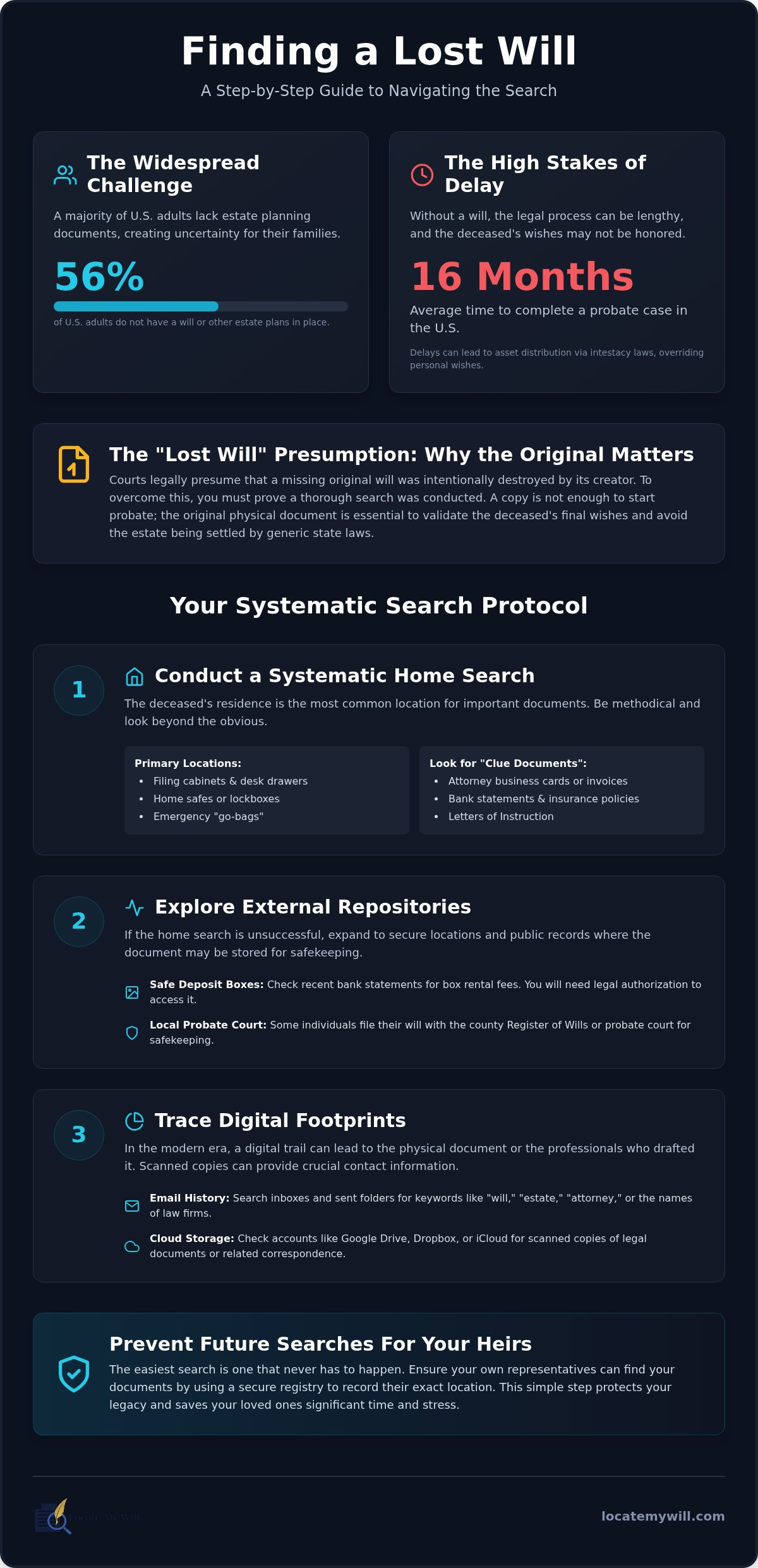
Approximately 56% of U.S. adults don't have any estate planning documents in place. For families of those who did prepare, the immediate challenge is often locating the original paperwork to begin the legal process. The pressure is significant because the average probate case in the U.S. takes about 16 months to complete. Delays in finding a will without a lawyer can lead to the estate being settled via intestacy laws, which might contradict the deceased's actual wishes. It's natural to feel anxious about potential court delays or the lack of organization left behind.
Locating the original document doesn't always require professional legal intervention. This guide provides a systematic, tiered search protocol to help you navigate the process independently. You'll learn the practical steps to find a will, from searching home files and safe deposit boxes to accessing public records. By following this structured approach, you can secure the necessary authorization to manage the estate and protect your loved one's legacy with confidence and professional order.
Key Takeaways
- Understand why the original physical document is essential to satisfy probate requirements and avoid the legal presumption that a missing will was intentionally destroyed.
- Execute a methodical search of the home for "clue documents" like attorney business cards or invoices, which are vital for finding a will without a lawyer.
- Learn the protocols for accessing external repositories, such as safe deposit boxes and local probate courts, to recover documents kept for safekeeping.
- Trace digital footprints through email history and cloud storage accounts to uncover scanned copies or contact information for the original estate planner.
- Prevent future search difficulties for your own representatives by utilizing a secure registry to record the exact location of your essential documents.
Understanding the Search for a Deceased Person’s Will
Locating the original document is the first critical step in settling an estate. To understand the gravity of this search, it helps to first define What is a Last Will and Testament? effectively. It's the legal expression of a person's wishes regarding their property after death. Without this original document, the probate court faces a significant challenge. Most jurisdictions operate under the "lost will" presumption. This principle assumes that if an original will cannot be found, the deceased person likely destroyed it with the intent to revoke it. This legal hurdle requires a systematic and documented search to prove the document simply isn't where it was expected to be.
Wills often go missing for practical reasons rather than intentional destruction. A person might've moved to a new home and misplaced their files, or they may have kept the document's location secret to maintain privacy. Sometimes, storage methods simply become outdated or disorganized over decades. While the search is inherently stressful, many documents are recovered through disciplined effort. Finding a will without a lawyer is a matter of following a logical path through the deceased's personal and professional history with a calm and methodical mindset.
The Legal Implications of a Missing Will
If the original document remains missing, the estate typically falls under intestacy laws. These state-mandated rules dictate how assets are distributed, often ignoring the specific wishes of the deceased. This transition can cause significant probate delays due to lost will, as the court must verify that no other documents exist before proceeding. There's a vital distinction between a lost will and a revoked will. A lost will is a valid document that's simply misplaced, whereas a revoked will has been intentionally canceled by the creator. Proving the difference requires a thorough, verifiable search process that satisfies the court's requirements.
Why Finding a Will Without a Lawyer is Possible
Many people assume they need legal counsel to begin this process, but finding a will without a lawyer is often the most efficient route for an executor. Lawyers frequently charge high hourly rates to perform the exact same administrative steps you can take yourself. Most individuals store their documents in a handful of predictable locations, such as home safes, filing cabinets, or safe deposit boxes. By acting as the primary detective for the estate, you maintain control over the timeline and ensure that every possible repository is checked with personal care. Empowering yourself to lead this search reduces immediate costs and provides a sense of agency during a period of uncertainty.
Conducting a Systematic Home Search for Legal Documents
The process of finding a will without a lawyer often begins with a thorough audit of the primary residence. Start with the most logical administrative hubs: filing cabinets, home safes, and desk drawers. These areas typically hold the highest concentration of vital records. During this initial sweep, don't just look for the will itself. Look for "clue documents" such as attorney business cards, invoices from estate planning firms, or old bank statements. These items act as a breadcrumb trail, pointing you toward the professionals who may have assisted in the document's creation.
If the obvious locations yield no results, expand your search to unconventional hiding spots. Many individuals store important papers in "fireproof" containers kept in surprising places, such as the freezer or under a mattress. Emergency "go-bags" or disaster kits are also common repositories for original estate documents. Additionally, audit the deceased's mail carefully. Look for recent communications from banks, insurance companies, or law firms. While finding a will without a lawyer is feasible, it requires a high degree of patience and a willingness to look beyond the surface level of domestic organization.
The "Paper Trail" Strategy
A successful search often involves cross-referencing other financial records. Tax returns and life insurance policies are excellent starting points, as they frequently list an executor or reference the existence of a trust. You should also search for "Letters of Instruction." These informal documents are not legally binding but often contain specific directions on where the original will is stored. Check old address books or holiday card lists for the names of legal professionals or financial advisors who might hold a copy or know the location of the original.
Securing Physical Assets and Containers
When you encounter locked containers, resist the urge to use force immediately. Look for keys in jewelry boxes, small desk drawers, or even attached to the underside of furniture. It's also vital that you don't discard any "junk" mail during the first 30 days of your search. Some legal notices or correspondence from small law firms can appear like marketing material at first glance. Identify and set aside any fireproof boxes or heavy-duty pouches. These are often mistaken for old storage bins or trash, yet they frequently house the most critical documents an estate possesses. To prevent your own family from facing this difficult search, you might consider using a will location registry to record where your essential documents are kept.
Exploring External Repositories and Public Records
When a domestic search proves unsuccessful, your efforts must shift toward professional and governmental repositories. Finding a will without a lawyer is a process that often leads to the local probate court or the deceased's primary financial institution. While most people don't file their wills with the court during their lifetime, some jurisdictions allow for "safekeeping" deposits. Contacting the clerk of the probate court in the county where the individual resided is a necessary step to ensure no such filing exists. You should also check with any banks where the deceased held accounts, as they may have recorded specific "disposition of assets" instructions that point toward the location of a formal document.
Accessing the Safe Deposit Box
The search often encounters a complex administrative hurdle when dealing with safe deposit boxes. Many families face a specific obstacle where the bank requires the will to grant access to the box, yet the document is stored inside that very box. To resolve this, you must understand your state's laws regarding "search orders." Many states allow a potential executor or a close relative to petition the court for a limited order. This authorization permits you to open the box solely to search for a will and life insurance policies. The bank usually requires a death certificate and will mandate that a bank officer witnesses the opening to verify the contents. If you don't have the key, the bank will likely charge a fee to drill the lock, which can range from $150 to $300 depending on the institution's policies.
Public Record Searches and Court Filings
A thorough investigation includes reviewing public filings that may have been initiated by other parties. You should perform a how to find a deceased person’s will search through the county's Register of Wills or probate clerk. It's possible that a "Small Estate Affidavit" has already been filed if the assets are below a certain threshold. In 2026, the median court filing fee for probate matters remains approximately $233, though this varies by jurisdiction. You should also consult national and state-level will registries. For instance, the U.S. Will Registry offers a national database search for a fee of $19.95, which covers up to three separate searches. These external resources provide a secondary layer of verification that ensures you haven't overlooked any formal legal registrations.
Tracing Digital Footprints and Professional Referrals
While physical searches often yield results, finding a will without a lawyer in the modern age necessitates a thorough audit of digital assets. Many people now maintain scanned copies of their legal documents or engage in significant email correspondence with estate planners. Start by searching the deceased's primary email accounts. Use specific keywords like "Last Will," "Estate," "Codicil," or the name of a known "Attorney." These searches can reveal draft versions of documents or contact information for the firm that holds the original.
Review bank statements from the last 24 months. Look for recurring payments or one-time fees paid to "Will Registry" or "Estate Planning" services. These financial transactions are definitive proof that a professional service was utilized, even if the physical paperwork is not immediately visible. Successfully finding a will without a lawyer is increasingly a digital endeavor that requires methodical patience.
The Digital Search Protocol
A computer-wide file search is a vital step. Use the search bar to look for file extensions like PDF or DOCX combined with terms like "Will" or "Testament." You should also check for "Digital Legacy" settings. Major providers like Apple and Google allow users to designate a legacy contact who can access specific data after death. If files are password-protected, look for a physical "password bible" or a notebook in a desk drawer. Browser-saved passwords can also provide entry into cloud storage accounts like Dropbox or iCloud where scanned copies might be stored. If you don't find files on the desktop, check the "Downloads" folder for recently saved attachments.
Leveraging Professional Networks
The family accountant often possesses more current information than a lawyer. They typically require copies of estate documents for tax planning and asset valuation. Accountants maintain detailed records of asset transfers and trust funding; they are often the first professionals to receive notice of a client's death and may already have the necessary documentation on file. If you suspect an attorney was involved but can't find their name, contact the local bar association. They can track whether a specific lawyer's practice was transferred or closed. It's possible that an active subscription to a will location registry exists, which would bridge the gap between preparation and discovery. To ensure your own family avoids this complex digital detective work, you can register your will's location with an authorized searcher today.
Preventing Future Lost Wills with a Secure Location Registry
The exhaustive process of finding a will without a lawyer highlights a significant flaw in traditional estate planning: the gap between document creation and document discovery. While you might take every precaution to secure your physical paperwork, those efforts are undermined if your representatives cannot locate them during a crisis. Most families lose weeks or months to the "detective work" described in previous sections because they lack a centralized roadmap. Transitioning from a reactive search to a proactive estate management plan is the most effective way to protect your legacy and your family's peace of mind.
The distinction between storing a document and registering will location online is fundamental to a modern strategy. Storage is about physical protection, while registration is about accessibility and verification. By recording the exact coordinates of your documents, you ensure that the search for a will without a lawyer never has to happen for your own heirs. This methodical approach replaces uncertainty with a structured, reliable solution that bridges the gap between your current preparations and the future needs of your representatives.
The Locate My Will Solution
Our Will Owner Registration Subscription provides a robust framework for long-term data integrity. We act as a methodical facilitator, maintaining a permanent record of where your essential documents are kept without ever hosting the documents themselves. Through Authorized Searcher Management, you maintain total control over who can access this information. You designate verified individuals, such as your executor or close family members, ensuring that only those you trust can retrieve the location data. This system eliminates the stress of a "lost" document and guarantees that your personal wishes are fulfilled with professional efficiency.
Best Practices for Document Security
Security should never come at the expense of accessibility for your authorized representatives. Hiding your document location from your executor often leads to the probate complications and delays you intended to avoid. A disciplined plan combines physical security, such as a fireproof safe, with digital location accessibility. To maintain your privacy during your lifetime, you can utilize Search Activation Date Control. This feature ensures that your location data remains private until a specific date you define, preventing premature discovery. By implementing these professional standards, you provide your loved ones with a clear, authorized path to your documents, ensuring that your estate is managed with the same care and order you applied to its creation.
Securing Your Legacy Through Methodical Organization
Finding a will without a lawyer is a demanding task that requires a disciplined audit of physical, digital, and professional records. By following a tiered search protocol, you can navigate the complexities of probate requirements and ensure a loved one's final wishes are honored. This process, while challenging, protects the estate from the significant delays and legal costs associated with intestacy laws.
The most effective way to prevent these difficulties for your own heirs is through proactive planning. You can ensure your family never has to search—Register your will’s location today. Our subscription-based security model provides long-term integrity for your estate information. Features like Authorized Searcher Management ensure verified access, while Search Activation Date Control protects your privacy during your lifetime. Establishing this organized foundation today provides a reliable bridge to the future and offers your representatives the clarity they deserve.
Frequently Asked Questions
How to find out if a will exists for free?
You can find out if a will exists for free by performing a thorough search of the deceased person's residence and personal correspondence. Check filing cabinets, desk drawers, and digital files for any "Letters of Instruction" or attorney invoices. You may also contact the local probate court clerk to see if a document was filed for safekeeping. While some national registries charge a fee for searches, these initial domestic steps cost nothing but your time and methodical effort.
Can I find a will online by searching the deceased’s name?
You cannot typically find the contents of a will online by a simple name search unless the document has already entered the public probate process. However, you can search online registries to see if a location record exists. Finding a will without a lawyer often involves checking centralized databases like the U.S. Will Registry. If the deceased used a location registry, verified searchers can access specific storage details through a secure, authorized protocol.
What happens if a will is found after the estate has been settled?
If a valid will is discovered after an estate is settled, it may be necessary to reopen the probate case to redistribute assets according to the new instructions. This process is legally complex and often results in significant financial and emotional strain for the heirs. Because the average probate case takes about 16 months, finding the document early is vital to ensure the deceased person's actual wishes are the ones the court follows.
Does every will have to be filed with a lawyer?
No, a will doesn't have to be filed with a lawyer or even drafted by one to be legally valid. Many individuals choose to store their original documents in home safes, bank boxes, or with trusted family members. This independence is exactly why finding a will without a lawyer is a common challenge for executors. The lack of a central legal repository makes a systematic search of the deceased's personal and digital files essential.
Is a will public record before the person dies?
A will is not a public record while the person who wrote it is still alive. It remains a private document that the owner can change or revoke at any time. It only becomes a public record after the individual passes away and the document is filed with the local probate court to begin the estate settlement process. Until that filing occurs, the location and contents are strictly between the owner and their chosen representatives.
How long do I have to find a will before it is too late?
There isn't a universal deadline that applies to every state, but you should aim to find the document within weeks of the death. If a will isn't presented to the court promptly, the estate may be settled via intestacy laws. While some jurisdictions allow a will to be filed several years later, the assets may have already been distributed to heirs who weren't intended to receive them, making recovery difficult.
Can I use a copy of a will if the original is lost?
Using a copy of a will is difficult because courts generally operate under the "lost will" presumption. This principle assumes that if the original cannot be found, the deceased person intentionally destroyed it to revoke their wishes. To use a photocopy, you must provide clear and convincing evidence to the probate judge that the original was lost or accidentally destroyed. This legal hurdle is why locating the original physical document is always the priority.
What if the lawyer who wrote the will is no longer in business?
If the drafting attorney is no longer in business, you should contact the state or local bar association to find out where their records were transferred. Often, when a lawyer retires or a firm closes, another practice acquires their active files and original documents. You can also search for the attorney's name in recent court filings or professional directories to identify any successor firms that might be holding the original will in their archives.


