

A person’s last will and testament is not a public document until the moment it enters the formal probate process. This distinction often creates a significant hurdle for family members who are searching for answers during an already stressful time. You might feel a deep sense of anxiety about missing important inheritance details or feel frustrated by fragmented county systems that don't seem to talk to one another. It's natural to feel confused when you're caught between a private family matter and a complex legal filing system.
This guide explains exactly how to find a will in public records by navigating the specific archives of the probate court. You'll learn how to bridge the gap between a private document and a public filing, ensuring you have the tools to confirm a will's existence or obtain a legal copy for estate settlement. We will examine the step by step process of searching court databases, identify why some records remain hidden, and outline the necessary actions to take if your initial search comes up empty. By understanding these administrative layers, you can move forward with the quiet confidence that no detail has been overlooked.
Key Takeaways
- Understand the transition of a will from a private, confidential document to a public filing during the probate process.
- Learn the methodical steps for how to find a will in public records by targeting the correct county jurisdiction and utilizing court search portals.
- Recognize the inherent limitations of public archives, such as filing delays and the absence of a centralized national database.
- Identify the risks of a "lost will" and the specific locations you should search to find the original document before probate begins.
- Discover how a professional registry provides a reliable bridge between your private preparations and the eventual needs of your representatives.
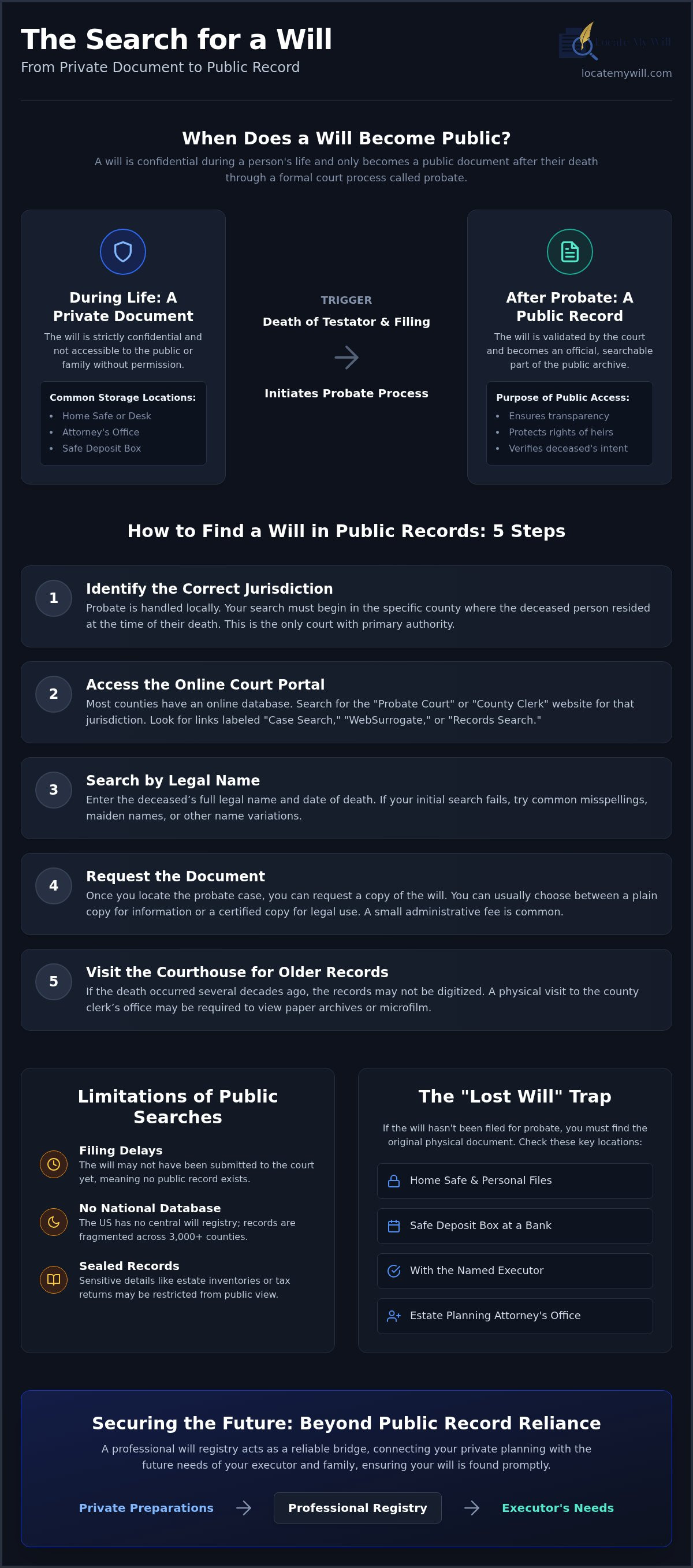
Understanding When a Will Becomes a Public Record
A last will and testament is a deeply personal document. Throughout a person's life, it remains a private and confidential record, often stored in a home safe, a desk drawer, or an attorney's office. It's not accessible to the general public or even to family members without the testator's permission. This privacy is a fundamental right. It allows individuals to change their minds and update their wishes without external pressure. Understanding the timing of this transition is the first step in learning how to find a will in public records.
The transition to public status only occurs after the testator passes away and the executor presents the document to the court. This filing initiates the formal probate process. A probated will is a court-validated public document that establishes the legal distribution of a deceased person's estate. This public access isn't meant to be intrusive. Instead, it ensures transparency. It protects the rights of heirs, beneficiaries, and creditors by making the intentions of the deceased clear and verifiable. If the document hasn't been filed with the court, it simply doesn't exist in the public domain.
The Legal Transition: Private Document to Public Archive
The probate court serves as the official bridge between a private wish and a public record. When an executor files the document, the court reviews its validity. If the court accepts it, the will is formally admitted to probate. At this point, the original paper document moves into the court's permanent archives. It's helpful to distinguish between the last will and testament and the broader probate file. The will is just one piece of a larger collection of documents; the probate file contains the petition for probate, the death certificate, and the court's letters of administration. You're searching for a specific filing within a larger administrative case.
Privacy Limits: What Stays Confidential?
While the will itself becomes public, the court often balances transparency with a family's right to privacy. In many jurisdictions, specific sensitive documents like estate inventories, tax returns, or detailed appraisals may remain sealed or restricted. These aren't always part of the public search results. Before probate is fully initiated, access is typically restricted to authorized searchers. These are individuals, such as named executors or legal representatives, who have a verified right to handle the document. Only after the court officially opens the file does the information become available to the general public. This structure ensures that sensitive financial data isn't exposed prematurely or unnecessarily.
Step-by-Step: How to Search Public Records for a Will
Finding a legal document requires a methodical strategy. Many people mistakenly look for a centralized government database, but the reality of how to find a will in public records is rooted in local geography. Because the United States manages probate at the local level, your search must begin in the specific county where the deceased person last resided. Following a structured process helps eliminate confusion and ensures you're looking in the right place.
- Step 1: Identify the Jurisdiction. Pinpoint the county where the individual lived at the time of their passing. This is the only court with the primary authority to open the probate file.
- Step 2: Access the Online Portal. Search for the Probate Court or County Clerk website for that jurisdiction. These portals are often labeled as "WebSurrogate," "Case Search," or "Records Search."
- Step 3: Search by Legal Name. Enter the deceased’s full legal name and their date of death. Be sure to check for common misspellings or maiden names if the initial search is unsuccessful.
- Step 4: Request the Document. Once you locate the case, you can request a copy of the will. You'll typically choose between a plain copy for your personal records or a certified copy for legal purposes; both usually require a nominal administrative fee.
- Step 5: Visit the Courthouse. If the records are several decades old, they may not be digitized. In these cases, a physical visit to the clerk’s office is necessary to view microfilm or paper archives.
Identifying the Correct Probate Court
A common hurdle is the fragmented nature of the American court system. There is no singular "National Will Registry" managed by the government. If the deceased person owned property in multiple states, you might need to check the records in each relevant county. To simplify this, you can use national directories to find the contact information for specific court clerks. Starting with the primary residence is usually the most efficient path, as ancillary probate filings in other states typically follow the initial home-state filing.
Using Online Probate Search Tools
Most modern courts offer digital access, but the quality of these tools varies significantly. If an online search returns "no records found," it doesn't necessarily mean a will doesn't exist. It might simply mean the executor hasn't initiated probate yet or the filing is too recent to appear in the system. To prevent your own heirs from facing this uncertainty, consider how you can register your will's location to provide a clear roadmap for your representatives. This proactive step ensures that your documents are found and filed without a complex scavenger hunt through county archives.
The Limitations of Public Record Searches
While public records are essential for legal verification, they're often a reactive tool. If you're researching how to find a will in public records, it's vital to recognize that these systems don't update in real time. There's frequently a significant administrative delay, often lasting weeks or even months, between a person's passing and the moment their will appears in a court's searchable index. This gap can cause considerable stress for family members who need immediate answers about an estate's direction during the early stages of grief.
Public records also have a hard limit: they cannot help you find a document that was never filed. If the original paper will is sitting in a forgotten safe deposit box or a home office, the court has no knowledge of its existence. Until an executor physically delivers that document to the clerk, the public record remains empty. This creates a circular problem where you need the will to start probate, but you're looking at probate records to find the will.
The Lack of a Centralized National Database
A common misconception is that a federal agency or national archive tracks every estate document in the United States. In reality, no such "National Will Registry" exists at the government level. Record-keeping remains fragmented across thousands of individual county jurisdictions. This decentralization makes it difficult for executors to verify if they have the most recent version of a document. If a testator moved frequently or owned property in different regions, an authorized searcher might have to query multiple county clerks just to piece together a complete picture. Bridging these gaps requires a methodical, county-by-county approach.
Wills That Never Reach the Court
Many estate plans are designed specifically to avoid the public probate process. For example, assets held in a living trust or under joint ownership transfer directly to beneficiaries without court intervention. In these cases, the document may never become a public record. Additionally, most states have "Small Estate" exceptions. If the total value of assets falls below a specific dollar threshold, the family can often settle the estate using simplified procedures that don't require filing the full will in the public archive. This ensures privacy for the family but makes it impossible for outside parties to locate the document through traditional court searches.
Relying solely on court archives is a reactive strategy. It often fails during the critical first days after a loss when decisions must be made quickly. If the original document is lost, the public record system provides no remedy. Without a proactive way to bridge the gap between a private document and the public filing, an estate might be settled under intestacy laws, which ignore the deceased person’s actual wishes. Understanding these boundaries helps you manage expectations and highlights the importance of organized document location management.
The "Lost Will" Trap: Finding a Will Before Probate
Searching for how to find a will in public records is a logical step, but it often assumes the document has already reached the courthouse. If the executor hasn't filed the paperwork yet, your search in the public archive will inevitably return no results. This creates a dangerous "lost will" trap. Without the original document, the court cannot validate the deceased person’s wishes, and the estate may be settled under state intestacy laws, which distribute assets based on rigid legal formulas rather than personal intent. This outcome often ignores the specific plans the deceased worked hard to establish.
The Critical Gap Between Death and Filing
The period immediately following a death is the most critical time for document recovery. An executor needs the original will to obtain the legal authority required to manage bank accounts, pay final bills, and secure property. While many families worry about the eventual public record status, that is a secondary concern compared to the physical location of the original document. If the location is unknown, family disputes often arise, leading to costly litigation and delayed closures. To manage this uncertainty, use a checklist to avoid probate delays to ensure every potential storage area is examined systematically.
Searching Without Professional Legal Help
You don't always need a legal team to begin your search. Following a methodical process for how to find a deceased person’s will can yield results through simple persistence. Start by searching the deceased’s home office, filing cabinets, and any fireproof safes. Contact local banks to inquire about safe deposit boxes, and reach out to any attorneys the deceased may have consulted. If you are finding a will without a lawyer, be prepared to provide a death certificate and proof of your relationship to the deceased to gain access to these private files. The court clerk’s office generally cannot assist in finding a "lost" document that was never filed with them; they only manage what has already been submitted to the public record.
To prevent your own family from falling into this trap, you can register the precise location of your will today, ensuring your representatives have an immediate roadmap when they need it most. This proactive step bridges the gap between your private preparations and the public probate process.
Securing the Future: Moving Beyond Public Record Reliance
Searching for how to find a will in public records is often a task born of necessity during a difficult time. While the steps outlined in this guide provide a clear path through county archives, they also highlight a fundamental truth: public records are a reactive solution. They only exist once the document has been found, validated, and filed. Relying on this system means hoping that an executor discovers your original paperwork without a clear roadmap. A secure document location registry changes this dynamic by moving your estate management from a reactive search to a proactive plan.
Locate My Will serves as a vital bridge between your private documents and the public probate filing. It doesn't host the document itself, which maintains your privacy and security. Instead, it records the exact physical location of the will. This simple piece of data significantly reduces the administrative burden on your executor. They no longer have to guess which attorney you used or which safe deposit box holds your final wishes. By providing this clarity, you ensure that the transition from a private document to a public record happens seamlessly and without delay.
Proactive vs. Reactive Estate Management
Waiting for the probate process to "find" a will is a high-risk strategy. If the original document is lost, the public record remains empty, and your assets may be distributed according to state laws you didn't choose. A subscription-based registry offers a modern alternative for thorough estate planning. One of the most important features is the "Search Activation Date." This control allows you to set a specific date in the future when your location data becomes accessible. It ensures your privacy remains intact during your lifetime while guaranteeing that the information is available exactly when it's needed.
Empowering Your Inner Circle
Security is maintained through the management of "Authorized Searchers." You have the authority to designate exactly who can perform a search for your document's location. Additionally, you can name notification recipients who will be alerted the moment a search is initiated. This transparency protects your interests and provides your family with a clear, verified roadmap. Knowing that your representatives have the tools they need brings a level of peace of mind that public archives simply cannot offer. This organized approach removes the anxiety of the unknown and replaces it with a structured, reliable solution.
Ensure your family can find your will by registering its location with Locate My Will today. Taking this step now removes the guesswork for your loved ones and guarantees your wishes are honored through the proper legal channels.
Establishing Permanent Clarity for Your Estate
Understanding the administrative layers of probate is essential for anyone researching how to find a will in public records. While county archives provide a necessary legal trail, they only function effectively once a document is physically located and submitted to the court. By recognizing the limitations of these reactive systems, you can take steps to ensure your own wishes never fall into the "lost will" trap. A proactive approach transforms a potentially stressful search into a disciplined, orderly transition.
You have the power to bridge the gap between your private preparations and the public record. Register your will’s location with Locate My Will to protect your family’s future. This national US registry provides verified authorized searcher management and privacy-controlled activation dates; this ensures your sensitive data remains secure until it's required. Taking this methodical step today provides your representatives with a reliable roadmap, replacing potential anxiety with a sense of organized efficiency.
Frequently Asked Questions
Are wills public record before someone dies?
No, a will remains a private and confidential document during the testator's lifetime. It isn't filed with any court or government agency until the formal probate process begins after death. This privacy allows individuals to update their wishes without public scrutiny. If you're wondering how to find a will in public records before someone passes, the answer is that it's impossible; the document only enters the public domain once it's presented to the court.
Can I look up a will online for free?
Many county courts provide free online dockets that allow you to confirm a probate case exists. However, viewing or downloading the actual document usually requires a nominal administrative fee. These systems vary significantly by jurisdiction, so while the initial search is often free, obtaining a full copy for your records typically involves a payment to the court clerk. Some older records aren't digitized and require a physical visit to the courthouse.
How do I find out which county holds a probated will?
The correct jurisdiction is almost always the county where the deceased person last resided. If the individual owned real estate in multiple areas, there might be ancillary probate filings in those counties as well. You can start by checking the probate court website for their primary residence. If you don't find a record there, you may need to search the archives of any county where they maintained a permanent home or significant property.
What information do I need to search public probate records?
To perform an accurate search, you'll need the deceased person’s full legal name and their approximate date of death. Having the case number is helpful but not mandatory for an initial query. Most court databases allow you to search by name, though providing a specific year of death helps narrow down the results in larger counties. If the name is common, knowing their middle name or last known address can help verify you've found the correct file.
What happens if a will is never filed with the court?
If a will is never filed, it remains a private document and never enters the public record. This often occurs when a document is lost or when the estate is settled through alternative means like living trusts. Without a filed will, the probate court cannot authorize the distribution of assets according to the deceased's specific wishes. Instead, the estate is typically settled under state intestacy laws, which follow a generic formula for heirs.
Can someone hide a will to keep it from becoming public record?
While it's legally required for an executor to file a will they possess, documents are sometimes intentionally or accidentally withheld. This prevents the document from becoming a public record and can lead to significant legal disputes among heirs. Because the court doesn't know a will exists until it's filed, families often struggle when a document is hidden. This risk highlights the importance of using a secure registry to record a document’s physical location for authorized searchers.
Is there a national database for all wills in the United States?
No, the United States does not maintain a centralized government database for all wills. Probate records are managed at the county level, resulting in a fragmented system of thousands of independent archives. This lack of a national registry makes it difficult for families to know how to find a will in public records if they aren't sure where the deceased lived. Private registries help fill this gap by providing a national platform for recording document locations.
How much does it cost to get a certified copy of a public will?
The cost for a certified copy varies by county but typically ranges from $1.00 to $2.00 per page, plus a flat certification fee that often falls between $5.00 and $15.00. These fees cover the administrative cost of the clerk verifying that the copy is a true and accurate representation of the original filed document. Plain copies are usually less expensive, but legal institutions often require the certified version to authorize the transfer of estate assets.


