

The law often assumes that if an original will cannot be found, the deceased intentionally destroyed it to revoke their wishes. This legal hurdle is a primary driver of probate delays due to lost will, often extending an already lengthy 20-month national average timeline. You likely feel a heavy burden of responsibility right now, perhaps mixed with the anxiety of seeing estate bills pile up while bank accounts remain frozen. It's a difficult position to be in, but you don't have to navigate this uncertainty without a clear, disciplined plan.
We understand that the pressure to honor a loved one's final intentions is immense, especially when the physical paperwork remains elusive. This guide provides a systematic checklist to help you locate the original document and explains the specific legal steps required to validate a copy if the original is truly lost. You'll learn how to minimize court interference and move through the estate administration process with organized efficiency and peace of mind.
Key Takeaways
- Execute a methodical search using a 12-point protocol to uncover the original document in hidden residential locations or through professional gatekeepers.
- Understand how the legal "presumption of revocation" triggers extensive probate delays due to lost will, and learn the high evidentiary standard required to overcome it.
- Identify the specific types of secondary evidence, such as photocopies or witness testimony, that courts require to validate the contents of a missing document.
- Establish a secure location registry to provide a permanent safeguard, ensuring your representatives can access document locations without administrative friction.
The Hidden Impact: Why a Missing Will Causes Major Probate Delays
The moment a loved one passes away, the legal system requires a clear mandate to transfer ownership of assets. Without a validated original document, the probate process cannot proceed in its standard, streamlined fashion. Instead, the court enters a holding pattern. This "freeze" occurs because an executor lacks the legal standing to manage accounts, pay creditors, or sell property until they are formally appointed. When the original document is missing, the court must first determine if a valid will even exists. This administrative hurdle is a primary driver of probate delays due to lost will.
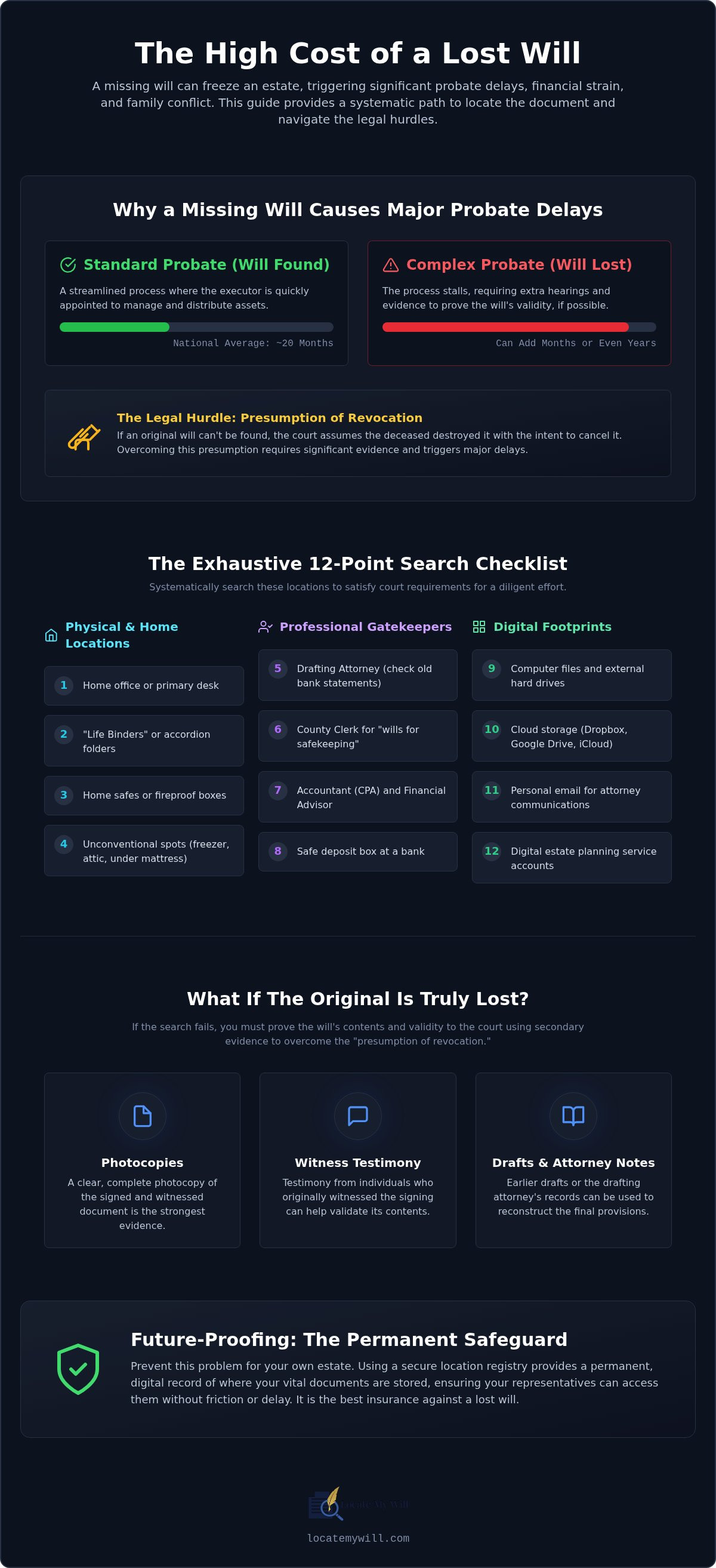
The legal system operates on a specific principle called the "Presumption of Revocation." If an original will was last known to be in the testator's possession but cannot be found after their death, the court typically presumes the individual destroyed it with the intent to revoke it. Overcoming this presumption requires significant evidence and additional hearings. This shifts the case from a "Simple Probate" into a "Complex Probate" category, often adding months or even years to the timeline. Proactive organization, such as using a secure registry for document location, acts as digital insurance against these preventable complications.
Financial Consequences of Estate Stagnation
While the search for the document continues, the estate's financial obligations do not stop. Recurring liabilities such as mortgages, property insurance, and taxes continue to accrue. Without the authority to access estate funds, these bills may go unpaid, leading to late fees or even foreclosure risks. Additionally, the legal costs of proving the contents of a lost will are substantially higher than standard filing fees. Surviving spouses face immediate and severe hardship when bank accounts are frozen and they cannot access the capital needed for daily living expenses.
Emotional and Family Strain
The absence of a physical document often creates a vacuum filled by speculation and disagreement. When the original intentions are not clearly documented and accessible, it opens the door for beneficiary disputes and "heir-at-law" challenges. Family members who might have been excluded or given a smaller share in the missing will may argue for intestacy laws to take over. This creates a high-stress environment for the executor, who often feels a profound sense of guilt for not knowing the document's location. Achieving clarity through a methodical search is the only way to dissolve this tension and ensure the estate is settled with integrity. Without a clear location for the original document, the resulting probate delays due to lost will can lead to unnecessary conflict and legal expenses.
The Exhaustive Search Checklist: 12 Places to Look for a Missing Will
Locating a missing document requires more than a casual glance through a desk drawer. It demands a disciplined, room-by-room protocol to satisfy the court and avoid significant probate delays due to lost will. If the original document remains missing, the estate may be forced into a lengthy administrative pause. We recommend treating this search as a formal investigation, documenting each step to prove to the court that a diligent effort was made. This structured approach helps alleviate the anxiety of the search by providing a clear path forward.
Physical and Home Search Locations
Begin in the home office or any area where financial records are kept. Look for "life binders" or accordion folders labeled with the names of law firms or estate planning organizers. Check home safes and fireproof boxes. Don't overlook unconventional locations. Some individuals store important papers in the freezer for fire protection, while others use locked trunks in the attic or hidden compartments under mattresses. Methodically clearing these spaces ensures that no stone is left unturned before moving to legal alternatives.
Professional and Third-Party Outreach
If the home search is unsuccessful, contact the gatekeepers of the deceased's professional life. Review old checkbooks or bank statements to identify payments made to law firms. This often reveals the drafting attorney who may hold the original. You should also contact the local county clerk; many jurisdictions allow individuals to file "wills for safekeeping" during their lifetime. Accountants and financial advisors frequently maintain copies of estate plans for tax purposes. Understanding the requirements for probating a lost or destroyed will is essential if these professionals only possess photocopies rather than the original.
The Digital Search Protocol
Digital breadcrumbs often lead to the physical original. Search the deceased’s email inboxes for terms like "Estate Plan," "Attorney," or "Final Wishes." Check cloud storage platforms like Dropbox or Google Drive for scanned documents or notes regarding a safe deposit box key. Accessing a safe deposit box is a critical step, but it often requires a specific court order if the executor is not a joint owner. To prevent your own family from facing these probate delays due to lost will, consider registering the location of your will in a secure, central registry. This simple step ensures authorized searchers find the original document exactly when it is needed.
Navigating the 'Presumption of Revocation' in Probate Court
The Presumption of Revocation is a legal principle where a court assumes a missing original will was intentionally destroyed by the testator to cancel its terms. This doctrine exists because the law prioritizes the most recent intentions of the deceased. If an original document was last known to be in the testator's possession but cannot be located after their death, the court naturally concludes that the individual chose to revoke it. This legal starting point is a significant contributor to probate delays due to lost will, as the burden of proof shifts entirely to the executor to prove otherwise.
To overcome this assumption, you must meet a rigorous legal threshold known as the "clear and convincing evidence" standard. This is a much higher bar than the typical "preponderance of evidence" used in most civil litigation. While a photocopy of the will is not a substitute for the original, it serves as an essential roadmap. A copy allows the court to see the specific distribution of assets and identifies the intended beneficiaries, providing a foundation for the legal arguments that follow. Without at least a copy, the path to validating a lost will becomes exponentially more difficult.
Rebutting the Presumption with Evidence
Proving that a will was lost accidentally rather than revoked requires a methodical collection of facts. You may need to present the following types of evidence to the court:
- Witness Testimony: Statements from individuals who heard the deceased discuss the will as a valid, existing document shortly before their passing.
- Evidence of Unintentional Loss: Documentation of a house fire, flood, or a disorganized relocation where files were likely discarded by mistake.
- Stable Relationships: Proof that the deceased maintained a positive and consistent relationship with the named beneficiaries, suggesting no motive for a sudden revocation.
These details help convince a judge that the document's absence is a matter of physical loss rather than a change of heart.
The Role of Intestacy Laws
If the evidence fails to satisfy the court, the estate will likely be settled according to state intestacy laws. These are "default" regulations that distribute assets to a fixed hierarchy of heirs-at-law, such as a spouse, children, or siblings. This transition from "Lost Will Probate" to "Intestate Administration" often results in additional probate delays due to lost will. Intestacy ignores the personal wishes of the deceased, potentially leaving assets to relatives they intended to disinherit while excluding close friends or charitable organizations. This outcome underscores the necessity of a disciplined search and the value of maintaining a clear record of a document's physical location.
How to Prove a Lost Will and Minimize Administration Delays
When the original document cannot be located, the executor must initiate the specific legal process of "probating a lost will." This procedure is designed to bypass the usual requirement for an original physical document by substituting it with secondary evidence. While this path is more complex than standard administration, following a methodical protocol helps mitigate the most severe probate delays due to lost will. Before proceeding in court, you should exhaust all search options by following our guide on how to find a deceased person's will to ensure no original exists in an overlooked location.
Submitting a Copy for Probate
A court typically requires a clear photocopy of the signed document to verify its contents. It is important to distinguish between a standard photocopy and a certified copy; in most lost will cases, a standard copy is the only starting point. To validate this copy, the drafting attorney can provide an affidavit confirming the document’s execution and its original terms. If the original included a "Self-Proving Affidavit," the court may accept the copy more readily. This specific legal instrument serves as a verification of validity. It significantly reduces the need for live testimony and accelerates the timeline. This is a rigorous standard.
Witness and Notary Testimony
If a self-proving affidavit is absent, the court may require the original witnesses to testify in person or via written statement. These individuals must confirm they saw the testator sign the document and that the testator appeared to be of sound mind. Locating these individuals years after a signing can be difficult. If a witness is deceased or cannot be found, the court may allow for "secondary evidence of signatures," such as comparing the witness's signature on the will to other verified documents. A notary public also plays a vital role here. Their seal provides a layer of administrative authorization that reassures the court of the document's authenticity.
Navigating these requirements is a heavy administrative burden that often leads to extended probate delays due to lost will. You can prevent this future complication for your own heirs by starting a Will Owner Registration Subscription today. This service ensures that the exact location of your original document is recorded and accessible to your authorized searchers when the time comes. Maintaining this level of organization is the best way to protect your family from the legal hurdles of a missing will.
Future-Proofing Your Estate: Using a Will Location Registry
A physical will is only as effective as its accessibility. If your executor cannot produce the original document, the court's presumption of revocation triggers the very probate delays due to lost will that we have discussed throughout this guide. A secure registry acts as a bridge between your current preparations and the future needs of your representatives. By making the roadmap clear, you eliminate the "detective work" that often complicates estate administration during an already difficult time.
The Locate My Will Solution
Locate My Will provides a methodical platform to register will location online without compromising the privacy of the document itself. Our service does not host digital copies or draft legal papers. Instead, it allows you to record precisely where the physical original is stored, such as a specific safe deposit box or a trusted attorney's office. You maintain full control through Search Activation Dates, ensuring that your location data remains confidential until a time you designate.
You also utilize Authorized Searcher Management to specify exactly who has the right to request this information. When the activation date arrives, automated notification triggers alert your family or legal representatives. This structured approach ensures that the original document is found immediately. It prevents the estate from falling into the stagnant "intestate" status that often leads to increased legal fees and administrative friction. Clarity is the most effective tool for preventing a legal "freeze" on your assets.
Peace of Mind for the Next Generation
The final act of responsible estate planning is ensuring your instructions can be followed. Registration is a simple, disciplined step that protects your heirs from the psychological toll of a missing document. It removes the uncertainty that fuels beneficiary disputes and "heir-at-law" challenges. By providing a verified location, you ensure that your assets are distributed according to your specific wishes rather than default state laws. This fulfills your personal responsibility to your loved ones.
Choosing to use a location registry is an act of foresight. It transforms a potentially chaotic search into an orderly, professional process. Your representatives can move forward with confidence, knowing they have the authorization and information required to settle your affairs. This level of organization is the ultimate safeguard against probate delays due to lost will, offering a sense of calm efficiency to those you leave behind. It is a permanent solution for a modern world.
Protect Your Legacy Through Organization
A missing will is more than a clerical error; it is a legal obstacle that forces families into a lengthy administrative pause. We have explored how the "presumption of revocation" creates significant probate delays due to lost will, often resulting in frozen assets and unnecessary disputes. By following a methodical search protocol and understanding the evidentiary standards required by the court, you can navigate these hurdles with greater certainty. However, the most effective strategy is to eliminate the search entirely through proactive planning.
Locate My Will offers a structured solution to safeguard your final intentions. Our national registry security ensures your information remains protected, while activation date privacy controls maintain your confidentiality during your lifetime. By utilizing authorized searcher management, you provide your representatives with a clear, verified roadmap exactly when they need it. Ensure your family never faces a lost will crisis; register your will's location today with Locate My Will.
Taking this simple, disciplined step today ensures that your legacy is preserved and your loved ones are protected from preventable legal friction. You've worked hard to build your estate, and we're here to help you secure its future.
Frequently Asked Questions
Can you probate a copy of a will if the original is lost?
Yes, you can probate a copy if you meet the "clear and convincing evidence" standard required by the court. This process involves proving that the original was not intentionally revoked and confirming its contents through witnesses or the drafting attorney. Because this requires additional hearings and verification, it is a frequent cause of probate delays due to lost will. It's a rigorous path but often the only way to honor a loved one's true intentions.
How long does a probate delay typically last due to a missing will?
Standard probate in the United States averages approximately 20 months. When a will is missing, this timeline often extends by several months or even years. The exact duration depends on the complexity of the evidentiary search and the court's schedule for hearing testimony to rebut the presumption of revocation. These administrative hurdles make the process significantly more expensive and time-consuming for the grieving family.
What happens to the estate if the will is never found?
If the document remains missing, the court will declare the estate intestate. Assets are then distributed based on fixed state hierarchy laws rather than the deceased's personal wishes. This transition often triggers disputes among heirs-at-law and significantly increases the administrative burden on the representative. It effectively removes the testator's voice from the process, potentially benefiting relatives they intended to disinherit.
Is a safe deposit box the best place to keep a will?
While secure, a safe deposit box can be problematic because banks often freeze access upon the owner's death. Unless a co-owner is listed, the family may need a specific court order just to open the box to look for the will. This creates an immediate administrative roadblock during the initial weeks of grief. We recommend keeping the original in a place that is both secure and accessible to authorized representatives.
Who is responsible for searching for the will after someone dies?
The responsibility typically falls on the person named as the executor in the document or the next of kin if no executor is known. This individual must perform a diligent and exhaustive search of the deceased’s residence, digital files, and professional contacts. They must satisfy the court's requirement for a "good faith" effort before the court will even consider accepting a photocopy or moving to intestate administration.
Can an attorney keep the original will in their office?
Many drafting attorneys offer to keep the original document in their firm's fireproof vault. This is a secure option, but it only works if the family knows which attorney handled the estate planning. Without this information, the document remains effectively lost. This lack of communication is a common trigger for probate delays due to lost will, making it essential to record the law firm’s name in a central location.
What is a 'lost will' petition in probate court?
This is a formal legal filing that asks the probate court to accept a photocopy or other evidence as the valid last will and testament. The petition must include proof of the will’s existence, evidence that it was not revoked, and testimony regarding its original execution. It is a more rigorous process than standard filing, requiring the executor to meet a high standard of proof to satisfy the judge.
How do I find out if a will was registered in a national database?
You can check national registries like Locate My Will to see if the deceased recorded their document's location. If they were a subscriber, verified authorized searchers can access this information after a specific activation date. This service provides a centralized way to find the physical document without searching through multiple law firms or banks. It ensures that the roadmap to the estate is clear and accessible when it is needed most.


