

Did you know that the average probate case in the United States now takes approximately 16 months to conclude? For an executor, those 16 months are often defined by a relentless stream of administrative requests and the constant anxiety that missing a single item from your executor document checklist could stall the entire process. It's common to feel buried under a mountain of paperwork while fearing that the most critical records remain hidden in an unknown location. You aren't alone in this confusion; the responsibility of estate stewardship is as demanding as it is significant.
We understand that your primary goal is to honor the deceased's wishes while minimizing family conflict. To help you achieve this, we've developed a professional framework designed to bring order to the chaos. This guide will show you exactly how to locate, verify, and organize every essential record required for a smooth estate settlement. By following this disciplined approach, you can move forward with the certainty that no vital detail has been overlooked. We will walk through the specific categories of records you need, from traditional property deeds to modern digital assets, ensuring your transition into the role of a methodical facilitator is seamless and secure.
Key Takeaways
- Establish a methodical executor document checklist to avoid the high costs of probate delays and protect yourself from potential administrative liability.
- Secure the foundation of the settlement process by obtaining multiple certified death certificates and locating immediate funeral instructions that may be stored separately from the will.
- Differentiate between original legal documents and copies to meet strict probate court requirements for the primary, physical will.
- Build a comprehensive estate map by aggregating real estate deeds, mortgage statements, and all relevant bank and investment account records.
- Address the inherent limitations of traditional storage, such as home safes, by utilizing modern registries to ensure the document's physical location is discoverable by authorized searchers.
Why an Organized Executor Document Checklist is Your Most Vital Asset
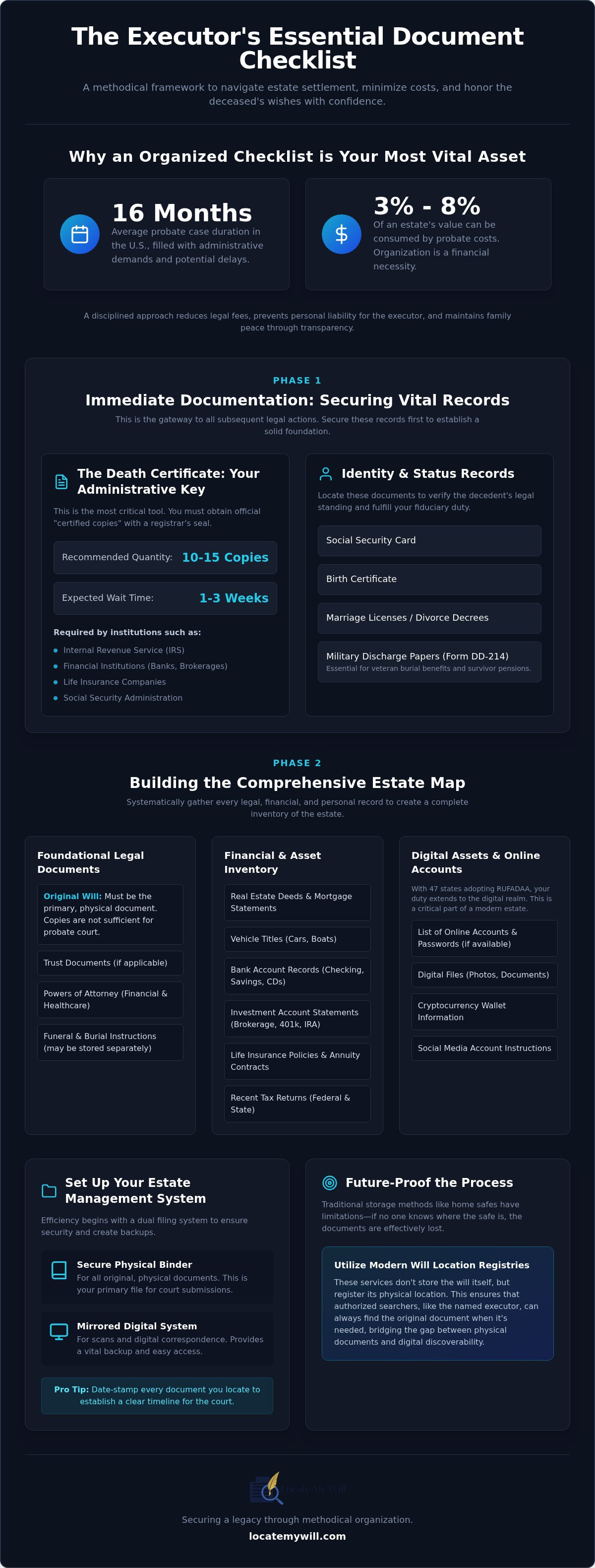
An executor document checklist is far more than a simple list of papers. It is a comprehensive inventory of every legal, financial, and personal record required to settle an estate. Without this structured framework, the probate process often descends into a series of expensive delays. Disorganization doesn't just waste time; it increases legal fees and can even lead to personal liability for the executor if assets are mismanaged or deadlines are missed. Given that probate can consume 3% to 8% of an estate's value, maintaining order is a financial necessity.
Fulfilling the duties of an executor requires meticulous record-keeping from the very first day. The probate court expects a transparent trail of every action taken and every asset identified. This level of organization also serves as a vital tool for maintaining family peace. When beneficiaries can see a documented, orderly progression of the estate settlement, it reduces the suspicion and friction that often arise during times of grief. Transparency is the most effective antidote to conflict.
The Role of the Executor in 2026
In 2026, an executor must act as a methodical facilitator rather than a mere gatherer of documents. You're stepping into the role of a Reliable Guardian, which requires a disciplined mindset focused on the integrity of information. This role now spans two distinct territories: the retrieval of physical documents like original wills and the management of digital assets. With 47 states having adopted the Revised Uniform Fiduciary Access to Digital Assets Act (RUFADAA), your executor document checklist must account for online accounts and digital stewardship alongside traditional paperwork. You aren't just filing papers; you're securing a legacy.
Setting Up Your Estate Management System
Efficiency begins with a dual filing system. We recommend creating a secure physical binder for original documents and a mirrored digital system for scans and correspondence. To ensure your digital records are handled with the highest level of security, you can visit byNow - Bezpieczna platforma wymiany dokumentów i wysyłki dokumentów to explore modern alternatives to traditional mail for sensitive documents. This ensures you have a backup if physical records are damaged. Every document you locate should be date-stamped immediately to establish a clear timeline for the court. When you attend your first consultation with an estate attorney, bring your organized binder. Having your death certificates, the original will, and a preliminary asset list ready will significantly reduce the billable hours required to initiate the probate process.
The first phase of estate administration focuses on stabilization and authentication. Before you can begin the formal distribution of assets, your executor document checklist must prioritize the acquisition of records that prove identity and legal status. This immediate documentation phase acts as the gateway to all subsequent legal actions. It's a time for quiet, methodical action to ensure the estate's foundation is secure.
The Death Certificate: Your Administrative Key
The death certificate is the most critical tool in your possession. You must distinguish between "certified copies" and standard photocopies. A certified copy bears an official registrar's seal and is legally required by most institutions to authorize the release of assets. You should expect to wait approximately one to three weeks for the registrar to issue these certificates. Most executors find that ordering 10 to 15 copies is necessary to satisfy various administrative requirements.
Major institutions will demand an original certified copy rather than a digital scan:
- The Internal Revenue Service (IRS) for final federal tax filings.
- Financial institutions for checking, savings, and brokerage accounts.
- Life insurance companies to process beneficiary claims.
- The Social Security Administration to stop payments and manage survivor benefits.
Identity and Status Records
Verifying the decedent's legal standing is a mandatory step in fulfilling your fiduciary duty. You must locate the Social Security card, birth certificate, and marriage licenses. If the decedent was a veteran, the military discharge papers (Form DD-214) are essential for accessing burial benefits and survivor pensions. These records are often the "missing link" that prevents administrative gridlock.
Other vital records include:
- Divorce decrees and prenuptial agreements, which directly impact the legal distribution of the estate.
- Citizenship or naturalization papers, which are required for estates involving international assets.
- Current funeral and burial instructions, which are frequently kept in a separate letter of instruction rather than the will itself.
Locating these instructions quickly is vital, as the average cost of a funeral with burial in 2026 is estimated between $7,848 and $9,170. If you are struggling to find these foundational records, using a secure registry search can help you identify where the decedent stored their most sensitive planning documents. Finally, secure the decedent's residence and immediate personal effects. This involves changing the locks and securing valuable jewelry. These actions protect the estate from loss and provide you with the controlled environment needed to complete your inventory.
Locating the Foundational Legal Documents: The Will and Beyond
Securing the original will is the most critical task on your executor document checklist. While digital scans are helpful for your personal records, probate courts typically demand the physical, original document to grant the "letters testamentary" that authorize you to act. If you only possess a photocopy, the court may legally presume the decedent intended to revoke the will by destroying the original. This creates a significant hurdle that can stall the entire probate process before it truly begins.
Your physical search should start at the decedent's residence. Focus on fireproof home safes, filing cabinets, and home offices. If the document isn't there, check for a safety deposit box key. Accessing a bank box often requires a court order or a specific co-signer, so prepare for a potential delay at the branch. As you search, keep an eye out for codicils, which are formal amendments that change specific parts of the will. You must also identify any "Living Trust" documents. Assets held in a trust often bypass the probate court entirely, which can significantly reduce the administrative burden on the estate.
What to Do if You Can't Find the Will
If the document isn't in the home, you must initiate a systematic search protocol. Contact the decedent's previous attorneys; even if a lawyer has retired, their files are usually transferred to a successor firm. You should also check with the local probate court to see if the will was filed for safekeeping during the decedent's lifetime. Reviewing bank statements for payments to law firms or storage facilities often provides the necessary lead. For a step-by-step search strategy, refer to our guide on how to find a deceased person's will. Modern registries now serve as a vital bridge in these situations, ensuring that "lost" documents don't lead to intestate distribution.
Validating the Document's Location
Verification is essential to maintaining the integrity of the estate. Professional registries utilize the concept of an "Authorized Searcher" to ensure that sensitive location data is only released to those with a legal right to know. This system protects the owner's privacy through search activation dates, which prevent any unauthorized access while the owner is still alive. Failing to locate the document quickly can have devastating consequences of a lost will for beneficiaries, potentially resulting in asset distribution that contradicts the decedent's final wishes. Use your executor document checklist to track these search efforts meticulously, providing the court with a clear record of your due diligence.
Financial and Asset Inventory: Building a Comprehensive Estate Map
Building a comprehensive map of the decedent's wealth is a high-stakes requirement of your role. Your executor document checklist must now expand to include every instrument of ownership and every obligation of debt. Start with real estate holdings; you'll need the most recent property deeds, mortgage statements, and property tax assessments to establish a baseline value. Move next to liquid and invested assets. Gather the last three months of statements for all checking and savings accounts, along with 401(k) and IRA documentation. Life insurance policies are equally vital. Locating the specific policy number and current beneficiary designations ensures these funds are directed correctly without unnecessary delays. Finally, document the estate's liabilities by collecting credit card statements, utility bills, and personal loan agreements to determine the estate's net value.
Tangible Personal Property
Physical assets require a different level of scrutiny than financial accounts. You must secure titles for all vehicles, including cars, boats, and RVs, along with their current registrations. For high-value items like jewelry, fine art, or rare collectibles, professional appraisals are mandatory if they're specifically mentioned in the will or if their value exceeds local probate thresholds. Creating a detailed inventory of household items helps facilitate an equitable distribution among heirs and prevents the informal removal of items that can lead to family friction. This inventory provides the court with a clear picture of the estate's physical contents.
Digital Assets and Access
The modern executor document checklist is incomplete without a plan for digital stewardship. You're responsible for identifying digital wills or login credentials for cryptocurrency wallets, social media profiles, and cloud storage accounts. Subscription management is also a priority; you must identify and cancel recurring payments for streaming services or software to prevent the depletion of estate funds. The Revised Uniform Fiduciary Access to Digital Assets Act (RUFADAA) provides the legal framework in 47 states that allows an executor to manage these online accounts if the decedent granted specific authority. This law ensures you have the legal right to access digital records while maintaining the decedent's privacy.
If you're finding it difficult to locate where these financial records or digital access keys are stored, register as an authorized searcher to access any location data the decedent secured within our registry. This step can save weeks of searching through physical files and provides a structured path to discovering hidden or forgotten accounts.
Future-Proofing the Process: Digital Organization and Will Location Registries
Traditional storage methods often create a procedural deadlock during the initial stages of probate. Home safes and bank safety deposit boxes are designed for security, but they frequently fail executors who lack the necessary access codes or legal authority to open them without the very will contained inside. This "catch-22" can delay the estate settlement by weeks. Relying solely on a physical hiding spot or a specific attorney's memory introduces a single point of failure into your estate plan. If a lawyer retires or a firm merges, the trail to the original document often goes cold, leaving heirs in a state of administrative limbo.
Modern estate stewardship requires a more robust solution. Utilizing an online will registry service bridges the gap between traditional paperwork and digital accessibility. These registries don't host the document itself; instead, they serve as a secure, permanent record of the document's physical location. By integrating this into your executor document checklist, you ensure that the path to the original will is always discoverable by those you've chosen to lead the process. This approach moves beyond the "treasure hunt" mentality and establishes a disciplined system of information integrity.
The "Authorized Searcher" advantage is central to this modern framework. It allows a will owner to designate specific individuals who have the right to search for the document's location. To protect privacy during the owner's lifetime, search activation dates ensure that this sensitive information is only released when it's truly necessary. This controlled transparency provides peace of mind for the owner while granting the executor the certainty they need to act decisively when the time comes. It's a professional safeguard that prioritizes both security and accessibility.
The Benefits of a Centralized Location Record
A centralized record eliminates the confusion that often follows a death. When the location of foundational documents is recorded in a national registry, the executor doesn't need to guess which law firm or which drawer holds the key to the estate. This system remains effective even if the family moves or changes legal representation. It's a vital step to notify your executor of the will's location through a secure, third-party platform that acts as a neutral guardian of that information.
Final Checklist for the Successor Executor
As you conclude the organizational phase, perform a brief audit of your records. If you're using a registry, verify that the subscription is current and that the recorded location matches the physical reality. A five-minute annual review ensures that your executor document checklist remains accurate. Once you've confirmed that your authorized searchers are correctly identified and your asset map is complete, you can confidently transition from the role of a document gatherer to a formal court petitioner. This methodical preparation is the foundation of a smooth probate and a lasting legacy.
Securing a Methodical Legacy
Managing an estate is a significant responsibility that requires a high degree of integrity and administrative precision. By establishing a methodical executor document checklist, you've moved beyond the anxiety of the unknown and into a position of organized efficiency. You now understand that the true value of estate planning lies not just in the documents themselves, but in the ability of your representatives to find them when they're most needed. Whether it's securing certified death certificates or mapping out digital assets, your disciplined preparation today will prevent unnecessary conflict and costly probate delays for your heirs tomorrow.
Don't leave your executor searching in the dark for these vital records. Our secure registry provides a permanent record for physical document locations while allowing you to designate up to three authorized searchers. You remain in control of your privacy through search activation dates that define exactly when information can be released. Register your will's location with Locate My Will today and provide your family with the certainty of a well-ordered future. Your commitment to transparency is a lasting gift that ensures your final wishes are fulfilled with the calm authority they deserve.
Frequently Asked Questions
What are the most important documents for an executor to find first?
The most critical documents to secure immediately are the original physical will and multiple certified copies of the death certificate. These items form the legal basis for your authority to manage the estate. Without the original will, the probate court may assume the decedent revoked it. Additionally, locating immediate funeral and burial instructions is essential to ensure the deceased's final wishes regarding their remains are honored without any unnecessary delay.
How do I find out if a deceased person had a will for free?
You can search for a will for free by conducting a thorough physical inspection of the deceased person's residence and personal files. Check with the local probate court to see if a will was filed for safekeeping during their lifetime. Contacting the decedent's previous attorneys or checking their bank statements for payments to legal firms can also provide leads. While these manual searches are free, they require significant time and methodical effort.
What happens if I can only find a photocopy of the will, not the original?
Finding only a photocopy creates a significant legal challenge because probate courts generally require the original document to grant authority. In many jurisdictions, the absence of the original will creates a legal presumption that the decedent intended to revoke it by destruction. You'll likely need to hire an estate attorney to petition the court and provide clear evidence that the original was lost or destroyed accidentally rather than intentionally revoked.
Do I need to find the decedent's tax returns from previous years?
Yes, you should locate the decedent's federal and state tax returns for at least the last three years. These records are vital for filing the final personal income tax return and any necessary estate tax returns. They also help you identify assets, such as brokerage accounts or real estate holdings, that might not be immediately obvious. Reviewing previous returns ensures you don't overlook potential tax liabilities that the estate must settle before distribution.
Is an executor responsible for finding digital assets like cryptocurrency?
An executor is legally responsible for identifying and managing all estate assets, including digital property like cryptocurrency and online accounts. Under the Revised Uniform Fiduciary Access to Digital Assets Act (RUFADAA), which 47 states have adopted, you have the authority to manage these assets if the will provides specific permission. Your executor document checklist must include locating login credentials, private keys, or "digital wills" to prevent these high-value assets from being permanently lost.
What is a will location registry and how does it help an executor?
A will location registry is a secure platform, such as Locate My Will, that records the physical location of a will without hosting the document itself. It helps an executor by providing a definitive answer to where the original document is stored, eliminating the need for a stressful search. The registry uses authorized searcher management and activation dates to ensure privacy while guaranteeing that the right people can find the document when needed.
Can I be held liable if I can't find all the estate documents?
You can be held personally liable if your failure to find documents leads to financial loss for the estate or its beneficiaries. As an executor, you have a fiduciary duty to act with reasonable care and due diligence. If the court determines that your disorganization or negligence caused missed deadlines or lost assets, you may be required to compensate the estate. Maintaining a meticulous executor document checklist is your best defense against such claims.
How many copies of the death certificate should an executor order?
Most executors should order between 10 and 15 certified copies of the death certificate. Many institutions, including the IRS, banks, life insurance companies, and the Social Security Administration, require an original certified copy with an official seal rather than a photocopy. Ordering an ample supply at the beginning of the probate process prevents administrative delays later on. It's more efficient to have extra copies than to wait for the registrar to issue more.


