

A legally valid will is entirely worthless if your family cannot find it when it matters most. You've likely spent significant time ensuring your assets are distributed according to your wishes, yet the persistent fear that your representatives won't know how to find where a will is kept is a common source of anxiety. It's understandable to feel conflicted about sharing sensitive details too early, especially when you value your current privacy and want to avoid unnecessary interference while you're still healthy and active.
This guide provides a structured, professional plan for managing your document's location data to ensure your family can retrieve essential records without delay. We'll explore the most secure methods for recording storage details, including the critical differences between physical and digital records, and how to establish a verification process that only grants access to authorized searchers. By following these steps, you'll act as a methodical facilitator for your estate, providing your loved ones with the certainty and protection they deserve during a difficult transition.
Key Takeaways
- Identify the accessibility risks associated with traditional storage methods, such as home safes or law firm archives, to prevent retrieval delays.
- Learn how to find where a will is kept by creating a secure Master Location Record that remains independent of your physical estate documents.
- Discover the benefits of recording precise physical coordinates for your documents within a digital registry to guide your executor effectively.
- Establish a controlled authorization process that ensures only verified representatives can access location data when it is necessary.
- Adopt a methodical framework for document management to protect your family from the administrative burdens and costs of probate disputes.
Common Physical Locations Where Legal Wills Are Traditionally Kept
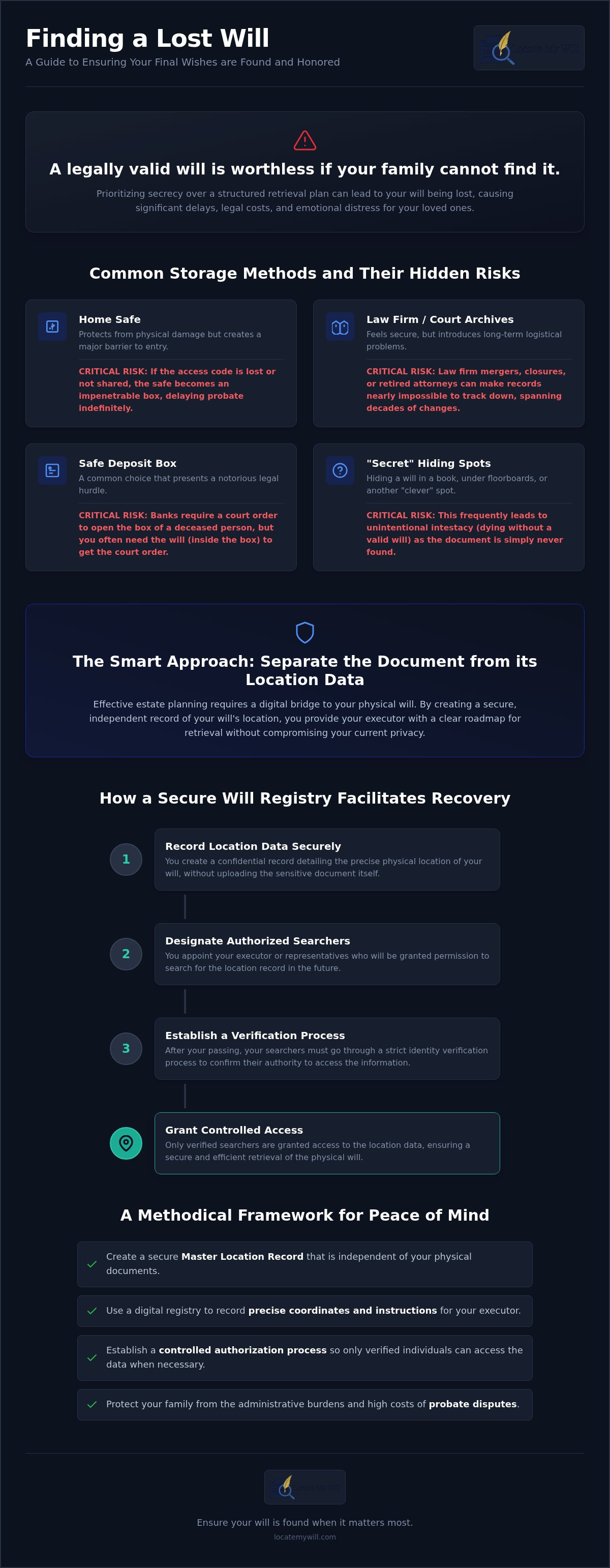
Traditional estate planning often emphasizes the physical security of the document over its eventual accessibility. To understand the gravity of these choices, it's helpful to review what is a will and why the original, physical copy remains the primary legal requirement in most jurisdictions. While a fireproof home safe provides immediate protection against environmental disasters, it creates a significant barrier if the access code isn't shared. Family members often struggle with how to find where a will is kept when the owner has prioritized secrecy over a structured retrieval plan.
Law firms and court archives were once the gold standard for storage, yet they carry their own logistical risks. Attorney archives feel secure, but law firm mergers and closures create a "lost document" risk that can span decades. Tracking down a retired attorney's records can take months, which unnecessarily delays the probate process. Similarly, safe deposit boxes present a notorious legal hurdle. Banks typically require a court order to open a box if the only person authorized to enter it has passed away. This creates a frustrating "circular logic" where you need the will to get into the box, but the will is locked inside. Some individuals choose to file their documents with a county clerk or probate court, but this isn't available in every jurisdiction and can become a burden if you move to a different state.
The Risks of Informal Storage Solutions
Hiding a will in an "unobvious" place, such as inside a book or under floorboards, frequently leads to unintentional intestacy. This occurs when the state distributes assets because no valid document could be found. Relying on a single person's memory is equally precarious. If the document owner experiences cognitive decline or a sudden medical emergency, the location of the will may be lost forever. Physical lists of locations are also vulnerable. A flood might not destroy a safe, but it can easily destroy a handwritten note explaining where the safe key is hidden.
Why Physical Storage Needs a Digital Backup
Effective document management requires separating the physical paper from the information about where it sits. You should maintain a clear executor document checklist to ensure your representatives have a roadmap. Digital redundancy acts as a bridge. It ensures that even if a physical list is destroyed, your authorized searchers can still determine how to find where a will is kept through a secure, verified channel. This dual approach provides the highest level of security for your family's future while maintaining the integrity of the original document.
Comparing Storage Methods for Will Location Records
The method you choose to record your document's location is just as important as the storage of the document itself. Informal strategies often lack the permanence required for long-term estate planning. For example, relying on verbal communication creates a single point of failure. If your designated contact suffers from cognitive decline or passes away before you, the vital information disappears. This leaves your heirs searching for clues on how to find where a will is kept during an already stressful period. Memory is fallible. Informal strategies fail.
Subscription-based models prioritize data integrity. They provide ongoing verification and support, ensuring the registry remains a reliable guardian for decades. One-time registration services often lack the robust infrastructure needed to manage authorized searchers effectively over a lifetime. A professional, managed approach ensures that your data remains accurate even as your life circumstances or storage locations change.
Digital Spreadsheets and Cloud Storage
Many individuals use password-protected spreadsheets or cloud folders to store location data. While these are modern, they present significant hurdles during estate settlement. If an executor cannot access your primary computer or master password list, the location data remains locked away. Similarly, spreadsheets lack a trigger mechanism. They cannot automatically notify your family that the information is available. This often results in the document being overlooked entirely. Privacy is also a concern. Sharing cloud folder access prematurely can expose sensitive asset lists before you are ready for your heirs to see them.
The Secure Registry Advantage
A third-party digital registry offers a neutral and permanent solution. It acts as a bridge between your private records and your family's future needs. By using a registry, you ensure that authorized searchers can access location data without seeing the contents of the will itself. This maintains your privacy while preventing the severe consequences of a lost will for beneficiaries. Secure verification protocols ensure that only the people you trust can learn how to find where a will is kept, and only when the timing is appropriate. For those seeking long-term peace of mind, registering your document location through a professional platform provides a disciplined framework that informal lists cannot match.
How Digital Will Registries Facilitate Secure Document Recovery
Digital registries function as a sophisticated bridge between your current privacy and your family's future requirements. Unlike a simple note, these platforms allow you to record precise physical coordinates for your estate documents. You can specify exactly how to find where a will is kept by providing granular details, such as "in the fireproof box under the guest bed, key is in the blue vase." This level of detail removes all ambiguity for an executor, ensuring they don't waste precious time during the probate process. It's a methodical approach that prioritizes clarity and efficiency.
A registry also allows you to designate up to three authorized searchers. These individuals are the only ones permitted to initiate a formal search for your data. By naming these representatives in advance, you maintain strict control over your information's stewardship. This system replaces the "lost will" scenario with a predictable, verified process. Automated notification systems further enhance this security by alerting up to three secondary recipients whenever a search is triggered, providing a transparent record of who is accessing your information.
Understanding Authorized Searcher Roles
Identifying who has the right to access your location data is a critical step in estate organization. An authorized searcher is a trusted individual, often an executor or a spouse, who has the formal permission to request your document's coordinates. This role is distinct from a notification recipient. While a searcher receives the location data, a recipient simply receives an alert that a search has occurred. By separating these roles, you create a system of checks and balances. It ensures that your most sensitive instructions are managed with professional discipline and transparency.
Search Activation and Privacy Controls
Anxiety about privacy while you're still healthy and active is completely normal. You likely don't want family members viewing your storage details prematurely. Activation dates solve this problem by ensuring that data is only released when it's truly necessary. You can set a specific date in the future before which no information can be released, allowing the registry to act as a reliable guardian of your secrets. This verification process is the cornerstone of how to find where a will is kept securely; it balances the need for future accessibility with your current right to privacy. If a search is attempted before your chosen activation date, the system maintains its professional distance and denies the request.
Best Practices for Organizing Your Estate Document Location Data
Organizing your estate data requires a disciplined approach to ensure your family's future security. A successful plan starts with a comprehensive inventory of every physical document you possess. It's not enough to simply have a copy; you must verify the location of the original signed document. This physical paper is the legal priority in probate proceedings. Once you've identified these records, you should create a Master Location Record. This record should exist independently of the documents themselves. If you change your home safe or move to a new residence, you must update this information immediately to prevent any confusion.
Proper organization acts as a safeguard against administrative delays. You should ensure your fail-safe retrieval guide is accessible to the right people at the right time. This methodical preparation removes the burden from your executor, providing them with a clear path on how to find where a will is kept without guesswork. Consistency is the key to maintaining a reliable system over many years.
Step 1: Document Inventory and Verification
Locate the original signed version of your will. A photocopy is rarely sufficient for legal validation. While you're conducting this audit, identify other essential records such as living trusts, power of attorney documents, and healthcare directives. For each item, write a self-contained sentence that defines its exact location. For example, "The original will is in the top drawer of the oak desk in the home office." This level of specificity is vital. It provides the precise coordinates your family will need to navigate the retrieval process successfully.
Step 2: Implementing a Redundant Notification System
A single point of contact is a vulnerability. To ensure long-term reliability, you should select at least three authorized searchers. This redundancy covers contingencies such as illness or the relocation of your representatives. Take the time to set clear expectations with these individuals. Explain their role as searchers and how they'll eventually learn how to find where a will is kept through a secure verification process. Finally, verify that your chosen platform adheres to national standards for data protection. This ensures your sensitive information remains secure from unauthorized access. To begin organizing your records with professional discipline, set up your secure registry today.
Ensuring Future Access with Locate My Will’s Secure Registry
Locate My Will provides a disciplined framework for managing the most critical piece of your estate plan: the location of your physical documents. While traditional methods rely on fallible memory or informal lists, a dedicated registry ensures that your executors aren't left wondering how to find where a will is kept. By utilizing a paid subscription model, you secure long-term data integrity. This commitment to permanence means that the platform remains a steady, dependable presence, even if your life circumstances change over several decades. It's a professional solution for a serious responsibility.
A structured registry streamlines the search process for executors during an emotionally difficult time. It removes the stress of a manual search, replacing it with a verified, automated system. This methodical approach ensures that your original physical document, which remains the legal priority, is retrieved without unnecessary delay. By centralizing this information, you act as a methodical facilitator for your heirs, protecting them from the administrative burdens that often follow a lost or misplaced will.
Professional Stewardship of Your Information
The platform acts as a reliable guardian between your current preparations and your family's future needs. Every step of the registration process is designed with transparency and security in mind. You aren't just storing a note; you're establishing a verified protocol for information release. This professional stewardship builds a bridge that protects your privacy while you're healthy and active, ensuring your wishes are fulfilled only when appropriate. It provides a level of certainty and quiet authority that informal methods simply cannot match.
Getting Started with a Location Registry
Setting up your account is a straightforward, step-by-step process. You'll begin by recording your first location entry, providing the precise physical coordinates for your original will. Next, you'll manage your authorized searchers by designating up to three trusted representatives. These individuals will have the right to request this information through a secure verification process. You also have the option to set notification triggers for additional recipients, ensuring a transparent record of all search activity. This system guarantees that the right people receive the right information at the right time.
Registering your will's location online is the final, essential piece of a modern estate plan. It prevents the legal hurdles and probate delays discussed in earlier sections. You'll gain peace of mind knowing that you've provided your family with a clear, secure answer on how to find where a will is kept. This proactive step ensures your estate is handled with the order and respect you intend, fulfilling your responsibilities to your loved ones.
Securing Your Legacy with Professional Precision
Ensuring your family understands how to find where a will is kept is the final, essential step in a responsible estate plan. You've learned that while physical storage provides environmental protection, it often creates a "locked box" scenario that delays probate and causes unnecessary stress. By separating your document's physical location from its retrieval instructions, you provide your heirs with a clear, verified path to follow. This methodical approach replaces anxiety with organized efficiency, ensuring your representatives have the tools they need to honor your wishes without delay.
Locate My Will acts as a reliable guardian for your location data, offering national US coverage and a secure framework for document recovery. Our platform utilizes search activation date control to protect your current privacy, alongside a robust authorized searcher verification process to manage access. Secure your family's future by registering your will's location with Locate My Will today. By taking this proactive step, you provide your loved ones with the certainty and peace of mind they deserve.
Frequently Asked Questions
Where do most people usually keep their original will?
Most individuals store their original documents in a home safe, a filing cabinet, or with the attorney who drafted the document. While some choose safe deposit boxes, this often creates legal hurdles for executors who cannot access the box without the document inside. It's critical to ensure that your chosen location is secure yet accessible to your authorized representatives when the time is appropriate.
Is there a national central registry for all wills in the US?
There is no mandatory government-operated central registry for all wills in the United States. While some states allow you to file a will with the local probate court for safekeeping, this is not a national requirement. Private platforms like Locate My Will offer a methodical way to record your document's physical coordinates, acting as a bridge between your storage choice and your family's eventual needs.
Can an executor find a will online for free?
It is highly unlikely that an executor can find a private will online for free. Wills are private documents and only become public records after they are filed with a probate court following a death. Most professional registries require a fee for searches or a subscription for management. These costs support the secure verification processes and data integrity required to manage sensitive estate information over many years.
How do I find out where my deceased parents' will is kept?
To discover how to find where a will is kept for a deceased parent, start by searching their home office, personal safes, and digital files. You should also contact their primary attorney or the probate court in the county where they resided. If they utilized a professional registry, you may need to initiate a verified search through that platform to retrieve the recorded physical coordinates of the document.
What happens if a will is found but it's only a copy?
Probate courts strongly prefer the original signed document. If only a copy is found, the court may require a formal hearing to prove that the original was not intentionally destroyed or revoked by the testator. This process can lead to significant delays and increased legal fees for the estate. Maintaining a clear record of the original's location is the best way to prevent these administrative burdens.
Can I search a will registry before the person has passed away?
Most professional registries do not allow unauthorized searches while the owner is still alive. Locate My Will specifically uses search activation date control and a verified searcher management system to protect your current privacy. These protocols ensure that your data remains confidential until the date you have specified, preventing family members or third parties from peeking at your estate plans prematurely.
Is a will a public record while the person is still alive?
A will is not a public record while the owner is still alive. It is a private legal document that only enters the public domain after it has been submitted to the probate court for validation following a death. Professional registries prioritize this confidentiality by acting as a secure guardian, ensuring that your storage details are only shared with authorized individuals at the appropriate time.
What should I do if I can't find my own will that I wrote years ago?
If you cannot locate your own document, you should first contact the attorney who assisted with the drafting process. If the document is truly lost, it's best to execute a new will that explicitly revokes all previous versions. This ensures your current wishes are documented and provides a fresh opportunity to record the new location in a secure registry, solving the problem of how to find where a will is kept.


