

Imagine your loved ones gathered in your home, not to share memories, but to sift through dusty filing cabinets and unmarked digital folders in a frantic search for your final wishes. Even with a signed document, the fear that a will might remain lost is a significant source of anxiety for many. Providing comprehensive estate planning information for family members is about more than just legal signatures; it's about ensuring your preparations are actually discoverable when they're needed most. You likely feel that your family deserves a transition marked by clarity rather than the stress of missing paperwork.
We agree that the true value of your estate plan lies in its accessibility. This guide will show you how to build a secure estate information system that acts as a definitive map for your executor and beneficiaries. We'll examine the 2026 federal estate tax exemption of 15 million dollars, explain how to manage your physical and digital records, and provide a disciplined framework for authorized access. By the end of this article, you'll have a clear strategy to ensure your wishes are followed and your family is protected from unnecessary disputes.
Key Takeaways
- Establish a centralized system to prevent the "missing will" problem that often leads to avoidable legal complications and family conflict.
- Organize essential estate planning information for family, such as legal foundations and financial access points, into a clear and accessible checklist.
- Compare the tactile benefits of physical legacy binders against the security of digital registries to create a robust, disaster-proof framework.
- Designate authorized searchers to ensure your executor has a reliable path to your documents without enduring an overwhelming scavenger hunt.
- Secure your records by registering their physical locations rather than uploading sensitive document contents to unverified digital platforms.
What is an Estate Information Map and Why Does Your Family Need One?
An Estate Information Map is a centralized, methodical system designed to guide your representatives toward vital legal and financial records. While many people understand What is Estate Planning? in terms of drafting a will, they often overlook the logistical challenge of document discovery. A map isn't the legal document itself; it's the precise set of instructions that ensures your representatives aren't left guessing during a crisis. It acts as the bridge between your private preparations and your family's eventual need for clarity.
The "Missing Will" problem is a silent crisis in probate. If an original will cannot be located, a court may presume it was revoked, forcing the estate into intestate probate. This leads to rigid legal formulas for asset distribution that might contradict your actual wishes. Relying on a casual comment like "it's in the desk" is a high-risk strategy for long-term planning. Desks are moved, papers are discarded during household cleanouts, and memories fade over time. Successful preparation requires a transition from simple storage to a formal registry system that prioritizes discovery.
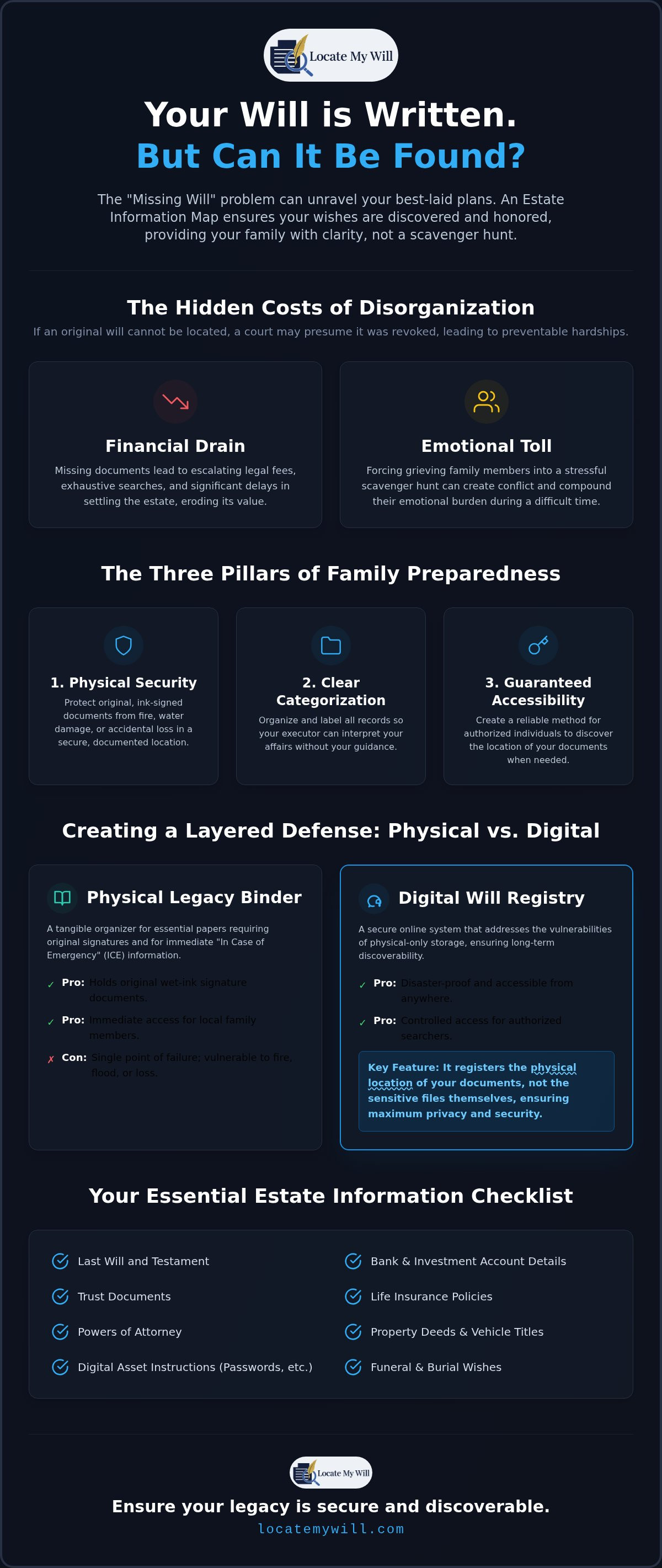
The Hidden Costs of Disorganization
Disorganization creates more than just confusion; it generates measurable financial and emotional burdens. When original documents are missing, legal fees often escalate because attorneys must file additional motions or conduct exhaustive searches to satisfy probate requirements. You can read more about the Cost of a lost will to understand these specific risks. Beyond the money, the emotional toll on grieving family members is significant. Forcing them to conduct a scavenger hunt through a lifetime of records during a period of mourning is a preventable hardship. Providing organized estate planning information for family members is an act of stewardship that preserves both your legacy and their peace of mind.
The Three Pillars of Family Preparedness
Ensuring your family is truly prepared requires a structured approach based on three primary pillars:
- Physical Security: You must protect original, ink-signed documents from environmental damage or accidental loss. While a safe or a solicitor's office is a standard choice, the specific location must be documented in a way that survives you.
- Categorization: Records should be organized so an executor can interpret them without your immediate guidance. This involves clearly labeling folders for life insurance, property deeds, and digital asset instructions.
- Accessibility: Security is only effective if it can be accessed by the right people at the right time. You need a verified method for authorized searchers to find the location of your estate planning information for family use after a specific activation date.
By addressing these pillars, you move beyond the mere existence of a will. You create a robust framework that ensures your intentions are fulfilled with the same discipline you used to create them.
Physical Binders vs. Digital Registries: Choosing the Right Framework
Selecting the right framework for your records isn't a choice between physical and digital formats. It's about creating a layered defense system. A physical organizer provides immediate, tactile access for household needs, while a digital registry ensures that your estate planning information for family remains discoverable even if the physical object is lost. Relying solely on one method creates a single point of failure that could jeopardize your entire legacy.
When to Use a Physical Organizer
Physical binders, often called "Legacy Binders," are essential for documents that require original signatures. Courts and financial institutions frequently demand original papers with wet-ink signatures for verification purposes. These binders also serve as an excellent repository for "In Case of Emergency" (ICE) contacts, providing a spouse or local family member with immediate access to doctors, neighbors, and close relatives. To protect these assets, use fireproof safes and waterproof document sleeves. You must remember that a safe is only useful if an authorized person knows where to find the key or the combination.
The Digital Registry Advantage
A digital registry addresses the inherent vulnerabilities of physical systems. Physical items can be destroyed in natural disasters, misplaced during a residential move, or simply forgotten over decades. By registering the location of your documents, you create a dynamic map. If you move your will from a home safe to a solicitor's vault, you can update the registry instantly without reprinting your entire estate plan. This system allows for a controlled release of information; location data is only shared after a verified activation date, maintaining your privacy during your lifetime. This is particularly vital for out-of-state executors who cannot physically search your home on short notice.
Effective organization requires balancing high security with practical accessibility. Keeping all your estate planning information for family in a single, undisclosed location is a high-risk strategy. If that secret spot is compromised or forgotten, your entire plan is effectively voided. A methodical approach involves keeping the physical documents secure while using a will owner registration subscription to manage who can find them and when. This ensures that your privacy is protected today while guaranteeing your family's access when it matters most.
Checklist: Essential Estate Planning Information for Your Family
A disciplined inventory is the cornerstone of an effective transition. Simply having a will isn't enough; your executor needs a comprehensive set of estate planning information for family use to manage your affairs without delay. This checklist serves as the master record of your physical and digital existence, ensuring that no asset is overlooked and no account is abandoned. When you organize these records, you're providing a structured path for your representatives to follow during a difficult time.
Your inventory should include these four primary categories:
- Legal Foundations: Keep the original Last Will and Testament, Living Wills, and Healthcare Proxy documents in a known, secure location.
- Financial Access: Maintain a current list of bank accounts, safe deposit box keys (and their corresponding box numbers), and all active life insurance policies.
- Property Records: Centralize real estate deeds, vehicle titles, and any legal papers related to business ownership or partnership agreements.
- Digital Legacy: Provide clear instructions for accessing password managers. You should also include directives for the management or memorialization of social media accounts.
The "First 48 Hours" Documents
Some information is required long before a will is formally read or probate begins. These "First 48 Hours" documents are critical for immediate administrative needs. Funeral and burial instructions should be kept outside of a safe deposit box, as those boxes are often sealed upon death and may not be accessible in time. You should also include immediate life insurance details that can be used to cover funeral expenses. Finally, provide an updated contact list for your estate attorney, CPA, and primary physician to ensure your family can notify the necessary professionals immediately.
Maintaining Your Inventory
An outdated inventory can be as confusing as no inventory at all. We recommend an "Annual Review" protocol where you update the locations and details of your records after significant life changes, such as a move or the opening of a new account. When you register will location online, you create a permanent reference point that survives these changes. This process also allows you to identify and dispose of expired documents, such as voided wills or lapsed insurance policies, ensuring they don't clutter your family organizer. By organizing estate planning information for family members with this level of precision, you guarantee that your legacy remains orderly and accessible.
Closing the "Searcher Gap": Designating Your Estate Representatives
The "Discovery Gap" occurs when legal documents exist but remain inaccessible to those tasked with executing them. Closing this gap requires more than just a secure storage location; it requires a designated team of representatives who understand their specific roles. An executor's responsibilities are inherently stressful. Forcing them to conduct a scavenger hunt for estate planning information for family records adds an unnecessary layer of anxiety to an already difficult period. By formalizing who can search for your records, you ensure a disciplined and respectful transition.
Choosing Your Authorized Searchers
Selecting your authorized searchers is a strategic decision that prioritizes redundancy and reliability. While your primary executor is the logical first choice, designating secondary notification recipients is essential. Life is unpredictable. A single point of failure in your representative chain can render your entire registry ineffective. We recommend designating up to three authorized searchers to guarantee that someone is always available to activate the search. When you discuss your estate organization with these individuals, focus on the process of discovery rather than the specific contents of your will. They don't need to know your private financial details today. They only need to know how to access that information when the time is right.
Privacy Controls and Activation Dates
Security is maintained through rigorous identity verification and the use of search activation dates. A professional registry does not simply release data upon request. Instead, it follows a strict verification protocol to ensure the searcher is authorized and the request is legitimate. This balance allows you to maintain absolute privacy during your lifetime. You define the activation date, which is the point at which your location data becomes visible to your searchers. This distinction manages the "Need to Know" versus "Want to Know" dynamic often found in families. It protects your current rights while facilitating the eventual needs of your beneficiaries.
Establishing these roles now prevents future disputes and ensures your methodical planning isn't wasted. You can begin this process today by setting up authorized searcher management to protect your legacy. Automating the notification trigger means your family won't have to guess where to start. The system will guide them exactly where they need to go.
Locate My Will: A Modern Layer of Security for Family Estates
Locate My Will acts as the essential digital map for your physical estate binders. It bridges the critical gap between secure document storage and the eventual moment of family discovery. While previous sections highlighted the need for organization, this service provides the technical infrastructure to manage that organization effectively. By recording the precise location of your records rather than the records themselves, you ensure that your estate planning information for family remains discoverable without compromising your digital privacy.
A subscription-based model is fundamental to this security layer. Unlike "set and forget" tools, a managed registry ensures that your authorized searcher permissions and contact details remain active and verified over the long term. This disciplined approach provides a reliable bridge between your current preparations and the future needs of your representatives, maintaining the integrity of your information through every life change.
Location Registry vs. Digital Hosting
We've designed our system to prioritize security by recording locations rather than hosting digital copies of sensitive documents. Hosting a PDF of a will on a central server creates a significant risk; a single security breach could expose your most private legal and financial details. By only storing the "map" to the physical original, we eliminate the risk of a central server hack exposing your actual will contents. This method also protects the legal integrity of your documents. Courts often require the original ink-signed version to grant probate, and our registry ensures your family finds that specific physical original. This approach adheres to national privacy standards for digital estate stewardship, keeping you in control of your data at all times.
Getting Started with Your Family Registry
Securing your legacy doesn't have to be a complex or time-consuming project. You can set up your registry in under 10 minutes, providing you with lifelong peace of mind. The process follows a methodical, three-step progression:
- Step 1: Securely record the physical location of your will and other vital papers within the registry. Be specific, noting if they're in a home safe, a solicitor's office, or a specific filing cabinet.
- Step 2: Designate your authorized searchers and notification recipients. These are the individuals you trust to access your estate planning information for family use when the time comes.
- Step 3: Set your search activation date. This control ensures that your information remains private until a specific date or event, at which point it becomes searchable by your verified representatives.
Taking these steps today removes the burden of uncertainty from your loved ones. You can protect your family with a Locate My Will subscription today and ensure your meticulous planning is never lost to disorganization.
Securing Your Legacy Through Methodical Organization
Effective preparation is a commitment to your family's future peace of mind. By establishing a clear Estate Information Map, you eliminate the discovery gap that often leaves executors overwhelmed and original documents lost. You've learned how a disciplined approach to estate planning information for family requires both physical security and a verifiable digital registry. This combination ensures your wishes are followed without the stress of a scavenger hunt during a period of mourning.
Locate My Will provides the professional infrastructure needed to manage this transition. Through our Secure Authorized Searcher Verification and National Will Location Registry, we act as a steady guardian for your legacy. Our automated notification system ensures that your representatives receive the information they need exactly when they need it. It's a structured solution that prioritizes the integrity of your information above all else.
Ensure your family can find your will; register its location with Locate My Will today.
Taking these final steps transforms your intentions into a reliable reality. You can rest assured that your family is protected and your meticulous planning is secure for the years to come.
Frequently Asked Questions
What is the difference between a will registry and a digital vault?
A will registry records the physical location of your document, while a digital vault stores the actual file. Our service functions as a registry, acting as a digital map to your physical records. This distinction is vital for security. By recording only where the document is kept, you eliminate the risk of sensitive information being exposed in a server hack. It ensures your family knows where to look without compromising your privacy during your lifetime.
Do I need to upload a PDF of my will to use an estate organizer?
You don't need to upload any digital copies of your legal documents. We specifically don't offer digital will hosting to ensure maximum security. Instead, you simply describe the physical location of your original papers. This approach protects the legal integrity of your wet-ink signatures, which are often required for probate. It provides a secure way to manage estate planning information for family members without creating a digital trail of your private wishes.
Who is the best person to choose as an authorized searcher?
Your primary executor is the most logical choice for an authorized searcher. However, we recommend designating up to three individuals to ensure redundancy. Choose people who are reliable, organized, and likely to be reachable during a crisis. By selecting multiple searchers, you guarantee that your family can access the location of your will even if your primary representative is unavailable. This methodical approach closes the discovery gap and prevents unnecessary administrative delays.
What happens if my family loses the key to my physical safe?
If a key is lost, the registry still serves its purpose by confirming the exact location of the documents. Knowing that the will is definitely inside a specific safe allows your family to take the necessary steps, such as hiring a professional locksmith. Without this information, they might assume the document is missing entirely. The registry provides the certainty required to move forward with the probate process rather than guessing where records might be stored.
How often should I update my estate document location registry?
We recommend updating your registry at least once a year or immediately following a significant life event. If you move to a new home or change your solicitor, your document location might change. Regular updates ensure that the map your family follows remains accurate. A disciplined annual review protocol prevents the confusion caused by outdated instructions and ensures that your estate planning information for family members is always current and reliable.
Is an online will registry legally binding for probate?
An online registry is a discovery tool rather than a legal document. It's not a substitute for a will, but it's a critical administrative resource for the probate process. Courts require the original physical document to settle an estate. The registry's role is to ensure your executor can find that original document quickly. By bridging the gap between storage and discovery, the registry facilitates the legal transition of your assets to your beneficiaries.
Can I change my notification recipients after I sign up?
You can update your authorized searchers and notification recipients at any time through your account. As family circumstances or professional relationships evolve, you may need to adjust who has permission to search for your records. Our platform allows for flexible management of these roles, ensuring that your instructions always reflect your current wishes. This control is essential for maintaining a secure and accurate estate information system throughout your life.
How does a search activation date protect my privacy?
The search activation date acts as a secure privacy shield. It ensures that your document location remains hidden from your authorized searchers until a specific time that you define. This control prevents premature searches and maintains your confidentiality while you're actively managing your estate. It allows you to prepare for the future with confidence, knowing that your private information is only released when it's truly necessary for your family's eventual needs.


