

What if the most sophisticated digital will in the world is the one your family never finds? As we move through 2026, the gap between creating a document and ensuring its discovery is widening. You might feel a lingering anxiety that your final wishes could be lost in a sea of cloud storage or locked behind a password your heirs don't possess. This is why registering location of digital estate documents is now a vital part of a disciplined plan. You want the efficiency of new technology but require the certainty that your original documents remain legally enforceable and accessible when they're needed most.
This guide clarifies the vital distinction between simply storing a file and the proactive management of document records. You'll learn how to bridge the gap between digital convenience and the strict requirements of the probate court. We will outline a methodical approach to document findability that prioritizes your privacy while eliminating the risk of a contested estate. By the end of this article, you'll have a disciplined plan to ensure your legacy is both secure and discoverable.
Key Takeaways
- Understand why most probate courts in 2026 still require a physical, wet-ink original will to prevent the legal presumption of document revocation.
- Learn how registering location of digital estate documents provides a secure discovery system that protects your privacy better than cloud storage hosting.
- Discover the importance of using metadata and authorized searcher controls to manage who can access your document information and when.
- Identify the copy problem associated with digital will hosting and why a location registry is the safer choice for long-term planning.
- Master a simple, two-step implementation plan to secure your physical original while creating a reliable digital roadmap for your heirs.
Defining the Will Location Record: More Than Just a Note
A will location record is a secure digital entry that specifies the exact physical coordinates of your original legal documents. It isn't a simple note or a casual email left for a family member. It's a formal administrative tool designed for precision. This record includes essential metadata, such as exactly who is authorized to view the information and the specific conditions under which it can be released. For an executor, this serves as a definitive map. Without this guidance, they might spend weeks searching through dusty filing cabinets or expensive safe deposit boxes. A will location record is the bridge between your physical estate planning and your family’s ability to execute it.
When you focus on registering location of digital estate documents, you aren't just making a list. You're creating a verifiable trail. This process ensures that the "where" of your estate plan is just as secure as the "what." It provides a structured way to communicate sensitive data without exposing the documents themselves to unnecessary risks. This disciplined approach is what separates a professional estate plan from a disorganized collection of papers.
The Role of the Testator in Location Management
The testator, or the person creating the will, must take charge of the discovery process. In the past, people often hid their wills in "safe" places that were so secret even their heirs couldn't find them. Modern estate planning has shifted away from hiding and toward managed access. By registering location of digital estate documents, you ensure that your security measures don't become an obstacle for your family. This proactive step prevents the common cost of a lost will, which often involves thousands of dollars in legal fees and months of probate delays. You have the responsibility to ensure your intentions are reachable.
Why Findability is the New Security
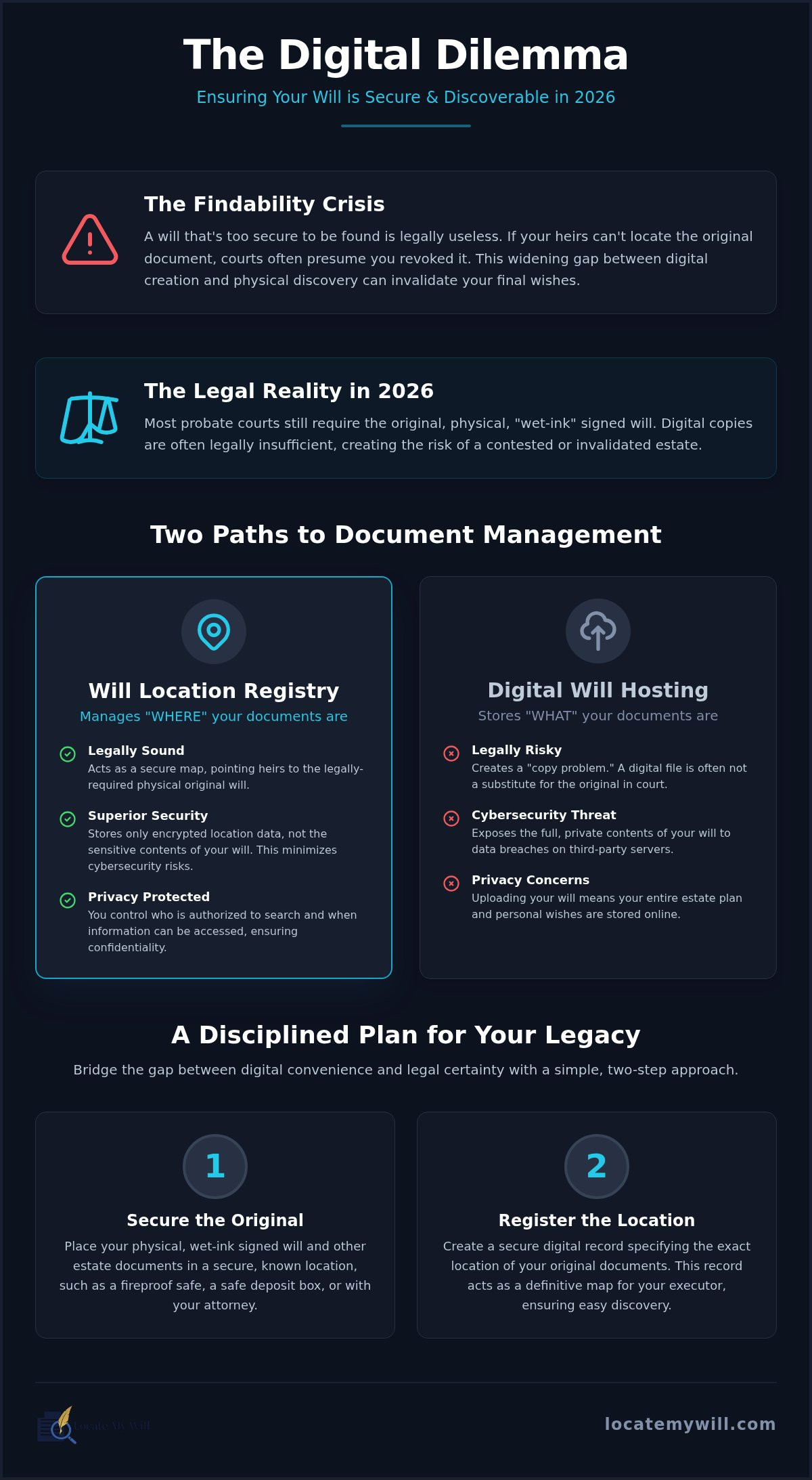
There's a significant danger in a will that's too secure to be found. If your beneficiaries can't locate the original document, the law often assumes you destroyed it with the intent to revoke it. A location record maintains your privacy while ensuring eventual discovery. It's different from a Digital will, which refers to the document itself. Instead, the record acts as a pointer. It keeps the details of your estate private while providing a clear path for your representatives. Unlike public records that anyone can access, a private registry entry is only released to verified individuals at the appropriate time. This methodical approach balances the need for confidentiality with the absolute necessity of being found when the time is right.
Will Registry vs. Digital Will Hosting: Key Differences Explained
Choosing between a will registry and digital will hosting is a decision between managing "where" your documents are and "what" they contain. A registry acts as a secure pointer to your physical original, whereas hosting services store a digital copy of the document itself. While hosting may seem modern, it creates a significant "copy problem." In the eyes of many probate courts, a digital file is often viewed as a reproduction rather than the legally binding instrument. By focusing on registering location of digital estate documents, you solve the "original problem" by ensuring heirs can find the physical, wet-ink document required for legal validity.
A location registry is often the safer choice for individuals with high-value physical assets. Hosting a full legal document on a server introduces unnecessary cybersecurity risks. If a server is breached, the contents of your entire estate plan are exposed. In contrast, a registry uses database encryption to protect location coordinates without ever possessing the sensitive details of your assets. This methodical separation of location and content provides a robust layer of security that digital hosting cannot match.
Digital Will Hosting: The Pros and Cons
Cloud access offers the convenience of sharing information with family members instantly. It's helpful for quick reference or reviewing terms from any device. However, the originality challenge remains a major drawback. Even in 2026, most U.S. courts still reject digital copies if the physical paper is missing. There's also the risk of data breaches. Uploading a full PDF of your will means your private wishes are sitting on a third-party server. For many, this level of exposure feels contrary to the goal of disciplined, private planning.
Secure Document Location Registry: The Modern Alternative
A document location registry protects the privacy of your document's contents while securing its physical position. It's a structured way to manage access without the liability of hosting sensitive files. You can see this model in action with a state-managed will registry, which focuses on record-keeping rather than document storage. Integrating this approach into an essential 2026 estate planning guide for families ensures that your plan remains both private and functional. If you value an organized approach to security, you might consider how a will owner registration can bridge the gap between digital management and legal requirements. By registering location of digital estate documents, you maintain control over who sees your information and when they see it.
The Legal Reality: Why Physical Originals Still Rule in 2026
While the world has embraced digital convenience, the legal system remains anchored in physical evidence. In 2026, most U.S. probate courts still require the physical, wet-ink original will to proceed with estate settlement. This isn't just a matter of tradition; it's a matter of legal verification. If an original document cannot be produced, courts often apply the "Presumption of Revocation." This legal doctrine assumes that if the document is missing, you intentionally destroyed it to cancel your wishes. A lost original will is legally treated as if it never existed, potentially leaving your estate to be distributed according to state laws rather than your personal choices.
By registering location of digital estate documents, you provide the necessary evidence to prove you intended for your will to be found. A location record acts as a formal declaration of where the physical document is held. This proactive step helps executors navigate the probate process with confidence. It transforms a potential legal hurdle into a manageable administrative task, ensuring that your final wishes are respected and enforced by the court.
Understanding Probate Court Requirements
Judges expect the executor to present the physical paper. Having a scan on your phone or a PDF in a cloud folder is rarely sufficient to satisfy the court's evidentiary standards. Understanding the nuance of a digital will vs. online will is vital, as a digitally created document still usually needs a physical counterpart to be probated. When you register will location online, you satisfy the court's need for a clear chain of custody. It shows you took deliberate, professional steps to ensure the document was findable, which counters the assumption that it was lost or destroyed.
The Risk of Digital-Only Estate Plans
Relying solely on digital files introduces the risk of technological obsolescence. Consider whether an executor twenty years from now will have the hardware or software to open a proprietary file format from today. There is also the significant authentication hurdle. Proving that a digital file hasn't been tampered with is far more complex than verifying a physical signature on paper. This is why registering location of digital estate documents alongside a physical original is considered the gold standard of modern planning. It combines the ease of modern discovery with the undeniable legal weight of a physical document. This methodical approach ensures your legacy isn't derailed by a technicality or a missing piece of paper.
How to Implement a Secure Document Location Registry
Transitioning from a traditional "hide and hope" strategy to a disciplined location registry requires a methodical approach. It's not enough to simply mention a location in passing; you need a structured system that survives the test of time. By registering location of digital estate documents, you create a fail-safe mechanism that bridges the gap between your private preparations and your executor's eventual needs.
- Step 1: Secure the Original. Store your physical, wet-ink will in a fireproof safe or with a trusted legal representative. This ensures the document itself is protected from environmental damage or loss.
- Step 2: Create the Digital Record. Log the exact coordinates of the document in a secure registry. Be granular; instead of "in the safe," specify "in the black fireproof box in the master bedroom closet."
- Step 3: Designate Searchers. Identify the specific individuals permitted to request this location data. These are your authorized searchers.
- Step 4: Set an Activation Date. Establish a future date before which no information can be released. This preserves your privacy during your active life.
- Step 5: Assign Notification Recipients. Choose secondary contacts who will be alerted if anyone attempts to search for your records.
Managing Authorized Searchers
An authorized searcher is a specific role that differs from an executor. While an executor handles the legal distribution of assets, a searcher is the person you trust to initiate the discovery process. You should limit these permissions to two or three individuals to maintain tight control. A professional registry requires a verification process to confirm a searcher's identity before any data is released. This prevents unauthorized parties from gaining access to your private information. If you're ready to secure your plan, you can start by managing your authorized searchers through a dedicated platform.
Using Activation Dates for Privacy
The primary fear many people have is that family members will "snoop" through their plans prematurely. Static lists or spreadsheets fail because they're always "on." An activation date solves this by locking the data until a specific point in time. This is why a subscription-based model is superior; it acts as an active guardian that monitors these dates and permissions. Registering location of digital estate documents with an activation date ensures that your privacy remains absolute until the moment the information is truly required. It provides a level of organized efficiency that a simple note to a lawyer cannot replicate.
Locate My Will: The Secure Solution for Location Management
Locate My Will offers a specialized platform dedicated exclusively to the "where" of your estate plan. While many services focus on document drafting or cloud storage, we prioritize the findability of your physical originals. Our Will Owner Registration Subscription provides the professional discipline required to maintain a secure discovery path for your heirs. We bridge the gap between traditional legal requirements and modern digital management. By registering location of digital estate documents within our system, you provide executors with the systematic search protocol they need to fulfill their duties without unnecessary delays or legal complications.
Subscription-Based Peace of Mind
A static note or a one-time file upload often fails because it lacks active management over long periods. Our subscription model ensures that your information remains current and protected by ongoing security protocols. We manage all search requests through a secure portal, verifying the identity of every authorized searcher before any data is released. This "Reliable Guardian" approach means your most sensitive information isn't just sitting on a server; it's actively monitored and guarded according to your specific instructions. You retain full control over search activation dates and notification recipients, ensuring your privacy is never compromised during your lifetime.
Getting Started with Your Registry
Setting up your account is a straightforward process designed for maximum clarity. You begin by defining the exact location of your physical documents and designating your trusted searchers. This methodical setup replaces the anxiety of uncertainty with the certainty of a professional record. Now is the time to organize this critical piece of your legacy for your family’s future. Organizing your document location is the final, essential step in a complete estate plan. Registering location of digital estate documents ensures that your hard work in planning is never undone by a simple lack of discovery. Ensure your family never has to guess. Secure your will location record with Locate My Will today.
Securing Your Legacy Through Methodical Organization
Estate planning in 2026 requires a balance between traditional legal validity and modern accessibility. You've learned that while digital tools offer convenience, the physical, wet-ink original remains the cornerstone of a successful probate process. By registering location of digital estate documents, you ensure that your heirs don't face the "Presumption of Revocation" or costly legal delays. This methodical approach protects your privacy while guaranteeing that your final wishes are reachable.
Choosing a dedicated registry over simple cloud hosting provides a layer of security that static files cannot match. With features like Authorized Searcher Verification and Search Activation Date Control, you maintain absolute authority over your information. Notification Alerts provide further peace of mind, ensuring you're informed of any search attempts. It's time to bridge the gap between your current preparations and your family's future needs.
Register your will location securely with Locate My Will and provide your loved ones with a clear, disciplined roadmap.
Frequently Asked Questions
Is a digital will legally binding in the United States?
Most states still require a physical, signed, and witnessed document to be considered legally binding. While some jurisdictions have begun to recognize electronic wills, the "wet-ink" original remains the safest standard for probate. Without a physical copy, your estate could face significant legal challenges. This is why maintaining a physical document while registering its location is the most reliable strategy for 2026.
What is the difference between a will registry and a digital vault?
A will registry focuses on recording the physical location of your original documents, whereas a digital vault typically hosts a digital copy or scan of the document itself. Registries prioritize the findability of the legally required paper original. Vaults focus on digital access but often fail to meet the "originality" requirements of probate courts. Choosing a registry avoids the cybersecurity risks associated with storing sensitive legal PDFs on a server.
Does Locate My Will store a copy of my actual document?
No, Locate My Will doesn't store copies of your legal documents. We specialize in managing the metadata regarding where your physical documents are kept. This approach ensures maximum privacy, as your sensitive personal wishes are never uploaded to our platform. Instead, we act as a secure pointer that guides your authorized searchers to the physical original when the time is right.
Who should I name as an authorized searcher for my will location record?
You should name individuals you trust implicitly, such as your executor, a spouse, or a long-term legal representative. Locate My Will allows you to designate up to three authorized searchers. It's best to choose people who are likely to be responsible for your final arrangements. By registering location of digital estate documents with these specific individuals in mind, you ensure that only verified parties can initiate a search.
Can I change the location of my will in the registry later?
Yes, you can update your document location at any time through your secure account portal. If you move your physical will from a home safe to a lawyer's office, you simply log in and edit the coordinates. This flexibility is a core benefit of our subscription model. It ensures that your executor always has access to the most current information, preventing the confusion of an outdated or inaccurate record.
What happens if my authorized searcher loses their access?
If an authorized searcher loses their access, they must go through our formal identity verification process to regain entry. We maintain strict protocols to ensure that location data is never released to unverified individuals. As the account owner, you also have the authority to manage and reset searcher permissions at any time. This disciplined approach maintains the integrity of your estate plan and protects your information from unauthorized access.
How does an activation date protect my privacy?
An activation date acts as a digital lock that prevents any search from being performed before a specific point in time. This feature ensures that family members can't "snoop" or view your document location during your active life. It provides a layer of privacy that a simple list or note can't offer. Your information remains strictly confidential until the date you've predetermined, balancing transparency with personal boundary control.
Is an online will registry safer than a safe deposit box?
An online registry and a safe deposit box serve different purposes. A safe deposit box provides physical protection, but it can be difficult for heirs to access without a court order. Registering location of digital estate documents ensures that your family knows exactly which bank or box to target. The registry doesn't replace physical security; it provides the "discovery map" that makes that security functional for your executor.


