

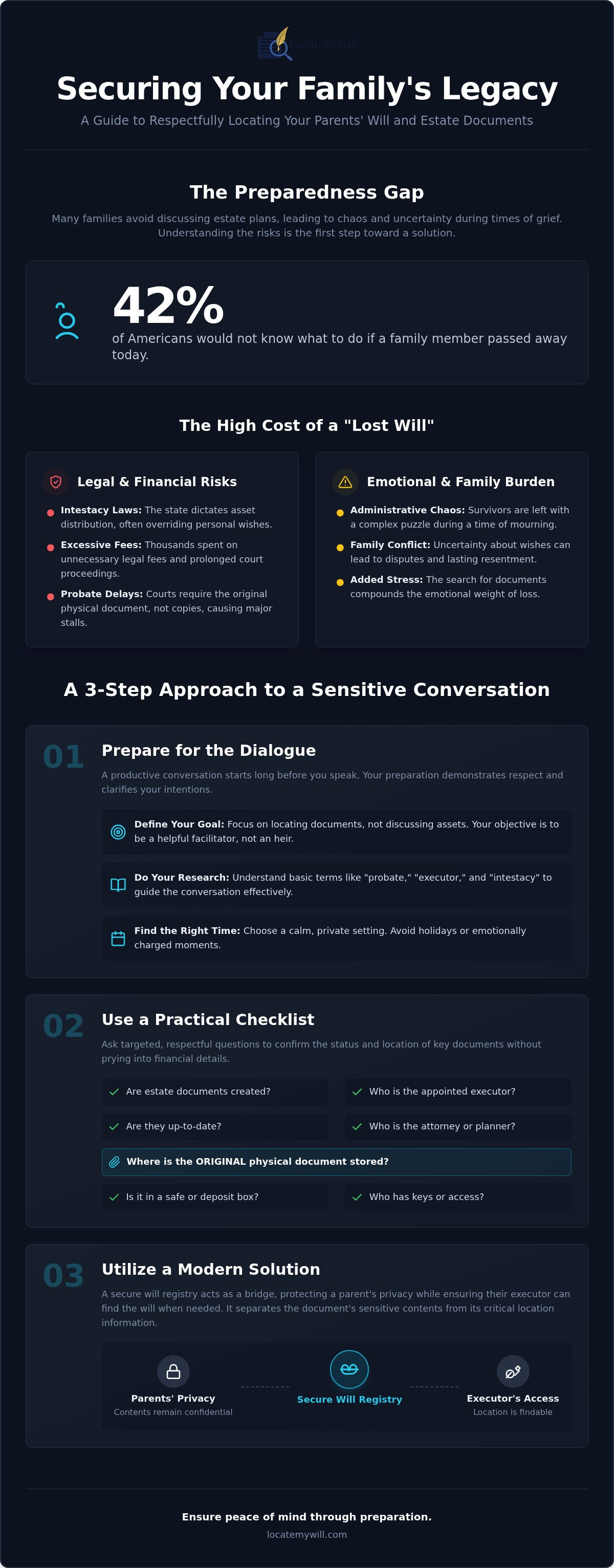
42% of Americans would not know what to do if a family member passed away today. This statistic highlights a growing gap between our intentions and our actual preparedness. Many adult children delay talking to parents about their will because they fear appearing greedy or insensitive. It's a difficult bridge to cross, but avoiding the conversation often leads to family conflict and legal uncertainty later. You aren't just asking about money; you're ensuring that a lifetime of hard work and specific wishes won't be lost to administrative chaos.
We understand that you value both your parents' privacy and the security of their legacy. This guide provides a clear, respectful script to help you initiate this essential dialogue without causing friction. You'll learn how to verify that their estate documents are safe and accessible, giving your family the peace of mind that comes with an orderly settlement process. We'll outline a methodical approach to ensure you can act as a reliable guardian for your parents' final instructions, focusing on the verification and authorization steps required for a seamless transition.
Key Takeaways
- Understand the "lost will" crisis and how identifying a document's exact location prevents significant administrative burdens for executors during probate.
- Discover effective strategies for talking to parents about their will, balancing the emotional weight of family legacy with the practical requirements of estate settlement.
- Learn to define your goals before the conversation, focusing on the verification of document locations rather than just the distribution of financial assets.
- Access a structured checklist of questions designed to confirm that estate documents are current, executed, and stored in a reachable physical location.
- Explore how a secure, subscription-based registry acts as a bridge between your parents' need for privacy and your future requirement for authorized access.
Why Discussing Estate Document Locations is a Family Necessity
The "Lost Will" crisis occurs when a valid legal document exists but cannot be located by survivors after a death. In these instances, the document is effectively non-existent in the eyes of the probate court. This situation creates an immense administrative burden for executors, who must then navigate a complex legal landscape without a roadmap. When you begin talking to parents about their will, you are addressing more than just assets; you are preventing a logistical failure that can stall the settlement of an estate for months or even years. This conversation acts as a form of organizational stewardship, ensuring that a parent's final intentions are honored rather than lost to a misplaced folder or an unidentified safe deposit box.
The Legal and Financial Risks of a Lost Will
If an original will cannot be produced, the estate may be subject to intestacy laws. These state-mandated rules dictate how assets are distributed, often ignoring the specific personal wishes of the deceased. The cost of a lost will is frequently measured in thousands of dollars of unnecessary legal fees and prolonged court proceedings. It is a critical detail that most courts require the original physical document to grant probate. Digital scans or photocopies are often insufficient or require a high burden of proof to be accepted. Without the physical original, the estate settlement process becomes significantly more expensive and adversarial.
The Emotional Barrier to Estate Planning
Cultural taboos often make the topic of mortality feel off-limits within families. Parents may feel a natural instinct to protect their privacy or worry that their children are focused on an inheritance. This "greed" misconception can be dismantled by pivoting the narrative toward safety and order. When talking to parents about their will, frame the discussion as a way to protect the family from unnecessary stress during a time of grief. Explain that your goal is not to monitor their finances, but to ensure you can fulfill your responsibilities as a representative without facing legal hurdles. Most parents find comfort in knowing their children won't be left with a chaotic administrative mess to solve while they are mourning.
By treating the location of the will as a vital piece of family security, you remove the emotional weight of the "death talk." You are simply verifying that the tools needed to manage their legacy are accessible and protected. This proactive approach transforms a sensitive subject into a shared project of family organization and mutual respect.
Preparing for the Conversation: Research and Timing
Preparation is the foundation of a productive dialogue. Before talking to parents about their will, you should familiarize yourself with estate planning information for family to understand the basic procedural requirements. This knowledge allows you to guide the conversation with confidence and clarity. You must decide whether you are seeking a detailed review of their assets or simply need to verify the document's physical location. For most families, confirming the location is the most critical first step to ensure the estate settlement remains orderly.
Identifying Your Own Objectives
It's vital to distinguish between financial curiosity and your future fiduciary responsibility. Your primary role is to ensure their wishes are honored, not to influence the distribution of their estate. Clarify this intent early to prevent defensiveness or misunderstandings. Prepare a clear "why" statement, such as: "I want to ensure I have the information needed to help when the time comes." This positions you as a helpful facilitator rather than a beneficiary. Focusing on the administrative aspect of the transition reinforces your commitment to their legacy and their privacy.
Selecting the Optimal Setting and Time
Timing and environment significantly impact the outcome of these discussions. Select a neutral, private setting where you won't be interrupted by phone calls or other family members. Avoid high-stress periods like major holidays or family celebrations. These events are often emotionally charged and aren't the right time for serious logistical planning. Instead, schedule a dedicated meeting. This signals that the topic is important and deserves undivided attention.
You might use a "third-party" trigger to open the door. For example, you could mention a news report about the record $124 trillion wealth transfer expected through 2048. Mentioning a friend's difficult experience with a lost document can also make the subject feel less personal and more like a standard safety precaution. A successful conversation requires this methodical approach. By establishing a calm and organized environment, you reduce anxiety for everyone involved.
Once you have identified where the documents are kept, you can suggest a secure registry for will location data to ensure that information is never lost again. This structured preparation ensures that when you are talking to parents about their will, the discussion remains focused, respectful, and results-oriented.
Choosing the Right Approach: Soft vs. Direct Strategies
Every family dynamic is unique, so the method you use for talking to parents about their will must be tailored to their specific personality. Some parents respond better to emotional framing, while others prefer a methodical, business-like discussion. By identifying which approach aligns with their values, you can reduce friction and ensure the conversation remains productive. The goal is to move from a place of uncertainty to a structured plan that respects their boundaries while ensuring your future readiness.
The Legacy-Based Approach
This strategy is ideal for parents who view their estate as a culmination of their life's work and values. You might start the dialogue by saying: "You’ve worked hard to build this life; I want to make sure your legacy is handled exactly as you want." This frames the discussion as an act of profound respect. It positions the organization of their documents as a final gift they are giving to their children, sparing the family from administrative confusion during a time of grief. By framing it as an evolution of their lifelong role as providers and protectors, you validate their authority rather than challenging it. This approach emphasizes that their wishes are the priority, and your only role is to ensure those wishes are fulfilled.
The Administrative-Based Approach
For parents who value logic, efficiency, and clear instructions, a direct strategy often proves most effective. You can open the dialogue by stating: "I was reading about probate requirements in 2026 and realized I wouldn’t know where to find your original will." This shifts the focus from personal curiosity to technical necessity. Because courts typically require the physical original document for probate, knowing its exact location is a basic requirement for any executor or representative. Discussing the modern standard of registering location of digital estate documents can help bridge the gap between traditional paper files and modern security needs. It highlights that being prepared is a professional responsibility rather than a morbid obsession.
Regardless of the approach you choose, it's helpful to transition your language from "if" to "when." Using "if" implies that the event is a distant possibility, which often leads to procrastination. Using "when" acknowledges the reality of the situation without being alarmist. It grounds the conversation in practical planning. If your parents are particularly private, remind them that they can maintain full control over their documents today while still ensuring an authorized searcher can find them later. This balance of current privacy and future accessibility is often the key to securing their cooperation.
A Practical Checklist of Questions for Aging Parents
A successful outcome when talking to parents about their will depends on obtaining precise, actionable data. It isn't enough to know a document exists. You must know exactly how to retrieve it during a crisis. This checklist shifts the focus from abstract intentions to logistical reality, ensuring that you have the specific details required to fulfill your future responsibilities. Use these questions to move beyond generalities and secure the information needed for an orderly transition.
- "Do you have a current, executed will that reflects your current wishes?" This confirms the document is legally binding and up to date.
- "Is the original document stored in a safe, a desk, or a safety deposit box?" Specificity here prevents hours of searching through unrelated files.
- "Do I have the physical key, the digital code, or the legal authorization to access that storage unit?" Knowing the location is useless if the container is inaccessible.
- "Which attorney or law firm drafted the document, and do they hold a copy?" Professional contacts provide a vital backup if the original is damaged or lost.
- "Have you designated me as an authorized searcher for your document location data?" This ensures you can verify the location through official channels when the time comes.
Essential Location Questions to Ask
Ask for the specific room and the exact container where the original is kept. A general answer like "in the office" often leads to significant delays. You should also ask about a "Letter of Instruction" or a list of digital assets. These documents provide guidance on personal items and online accounts that a standard will might not cover. In probate law, courts generally require the original physical document to begin the estate settlement process. A photocopy is rarely sufficient to initiate probate without a difficult and expensive legal hurdle.
Identifying Key Roles and Authorized Parties
Confirm who is named as the executor and verify if that person has been informed. An executor who is surprised by their appointment may struggle to manage the estate effectively. While talking to parents about their will, you should also identify who the designated notification recipients are in their plan. Many families fall into the "safety deposit box trap," where the original will is stored in a bank box that is automatically sealed upon the owner's death. This creates a legal paradox because the bank requires the will to grant access to the box, but the will is locked inside. To avoid this administrative deadlock, you can register your parents' will location today to ensure authorized access is never blocked by a bank vault.
Modern Solutions: Utilizing a Will Registry for Aging Parents
Once you've finished talking to parents about their will, the final step is ensuring that the information you gathered remains accessible over the long term. A register will location online service provides a methodical solution to the problem of document retrieval. This subscription-based registry acts as a secure bridge between a parent's current need for privacy and a representative's future need for information. It doesn't involve digital will hosting or physical document storage; instead, it records the precise physical location of the original document. This distinction is critical for maintaining security while ensuring that the "where" is never lost to time or misplacement.
Why Physical Storage Alone is a Vulnerability
Relying solely on physical storage carries inherent risks. Over a decade or more, documents can be affected by fire, flood, or simple forgetfulness. Even in a secure home, there is the "hidden in plain sight" problem. An executor might search a desk or filing cabinet but miss a specific unmarked folder or a hidden compartment. Without a digital pointer to act as a backup, the physical record is only as good as the memory of the person who stored it. A registry provides a permanent, verifiable instruction that survives even if the family's internal knowledge fades or the original filing system is disrupted.
How a Will Registry Subscription Secures the Future
A professional registry utilizes Authorized Searcher Management to ensure that data is only released to verified individuals. When talking to parents about their will, you can explain that they maintain total control through features like Search Activation Date Control. This ensures their privacy is protected during their lifetime, as the location information remains locked until a specific date or event occurs. Parents can designate their children as authorized searchers today, but those searchers won't have access to the data until it is actually required for estate settlement. This creates a disciplined environment where information is protected yet available when the need arises.
The process also involves designating notification recipients who can trigger the search protocol when necessary. This structured approach removes the burden of "remembering" from the family and places it into a professional, administrative system. By moving from a verbal agreement to a formal registry, you provide your parents with the peace of mind that their final wishes are protected by a reliable guardian. This modern approach to traditional planning ensures that the integrity of their information is preserved for the next generation without compromising their current independence.
Securing a Legacy Through Organized Stewardship
Successfully talking to parents about their will is a significant milestone in family planning. By moving from the uncertainty of "if" to the clarity of "when," you ensure that their final wishes are protected and accessible. You've identified the physical location of their documents and established a respectful dialogue. Now, the final step is to formalize that location data within a secure system. It's a proactive way to act as a reliable guardian for their legacy.
A national US registry provides the structural support needed to manage this transition with professional discipline. You can secure your family’s future by registering your will’s location with Locate My Will today. Our platform utilizes Authorized Searcher Management and Activation Date Privacy Controls to safeguard data until it is required. This methodical approach ensures that your parents' hard work is never lost to administrative oversight. Taking this final step provides lasting peace of mind for every generation involved.
Frequently Asked Questions
How do I start the conversation about a will without sounding greedy?
Start by framing the discussion around organizational stewardship and your future responsibility as a helper. Explain that your goal is to ensure their wishes are honored without legal delays or administrative chaos. You can use a third-party trigger, like a news report on estate laws, to make the topic feel less personal. This shift in narrative ensures you're seen as a reliable guardian of their legacy rather than a curious beneficiary. Focus on the administrative burden you hope to avoid.
What if my parents refuse to disclose where their will is kept?
Respect their boundaries while calmly explaining the legal consequences of a lost document. Mention that without the original, the court may apply intestacy laws that ignore their specific wishes. If privacy is the primary concern, suggest using a secure registry. This allows them to keep the location private today while granting you "Authorized Searcher" status that only activates when the information is actually required for estate settlement. This balance protects their privacy and your future needs.
Is a photocopy of a will valid if the original cannot be found?
Most probate courts require the original physical document to grant probate. While some jurisdictions allow photocopies under exceptional circumstances, the burden of proof is high and the legal fees are significantly higher. A missing original often creates a legal presumption that the will was intentionally revoked. Ensuring the physical location of the original is known is the only reliable way to avoid a prolonged and expensive court battle. A photocopy is a risk, not a solution.
Should I know the contents of my parents’ will or just the location?
Your primary duty as a representative is to know the location of the document so it can be produced for the court. While knowing the contents can help with long-term planning, it isn't strictly necessary for the immediate settlement of the estate. Focusing on the location when talking to parents about their will respects their financial privacy while still fulfilling your administrative responsibility. This approach often reduces the emotional friction associated with the conversation and simplifies the request.
What is a will registry for aging parents and how does it work?
A will registry is a secure, subscription-based platform designed to record the physical location of estate documents. It doesn't host digital copies or provide physical storage. Instead, it acts as a digital pointer for authorized individuals. Users designate searchers who can only access the location data after a specific activation date. This system ensures that the "where" is never lost, even if the family's internal knowledge of the filing system fades over time. It provides a permanent record.
How often should we update the information about the will’s location?
You should update the location data whenever the physical document is moved or if the drafting attorney changes firms. It's a best practice to review this information annually or during major life events, such as a move to a new residence. Maintaining an accurate record ensures that the "Authorized Searcher" has the most current data available. Regular verification is a simple but effective way to maintain the integrity of the estate's organizational structure and prevent future errors.
Can an executor search for a will online in 2026?
Yes, an executor can search for a document's location online if the owner has registered it with a national registry. In 2026, many families use these digital tools to bridge the gap between traditional paper documents and modern accessibility. The searcher must be verified through an "Authorized Searcher Management" system to ensure privacy. This digital search protocol provides a reliable way to find the original will without searching through every drawer or safe in a house.
What happens if a parent dies without a will (intestate)?
When an individual dies intestate, state laws determine how the estate is distributed among heirs. This rigid legal framework often excludes specific personal wishes or non-traditional family structures. The probate process for an intestate estate is typically more complex and time-consuming for the survivors. Talking to parents about their will early helps prevent this outcome, ensuring that their assets are handled according to their personal values rather than a generic state formula. It protects the family from legal uncertainty.


