
What if the most legally perfect document you ever sign becomes completely invisible the moment it's actually needed? Many people assume that a simple spreadsheet or a shared folder is sufficient for their family's needs. However, relying on DIY will location tracking often creates a false sense of security that disappears when a crisis hits. You've worked hard to protect your legacy; it's only natural to want a system that's as disciplined and reliable as your planning.
You likely feel a deep responsibility to ensure your executors aren't left searching through dusty boxes or expired digital links during an already difficult time. It's a common concern, especially since a lost document can lead to probate fees consuming up to 7% of an estate's value. In this guide, you'll discover why traditional home-grown methods fail and how a professional registry provides a structured bridge to your representatives. We'll clarify the vital difference between digital will hosting and location registries, showing you how to ensure your family finds your final wishes with quiet, organized efficiency.
Key Takeaways
- Understand why traditional DIY will location tracking through spreadsheets or physical notes often fails during a crisis due to a lack of dynamic accessibility.
- Learn the critical distinction between digital document hosting and a location registry, ensuring your privacy is maintained without sacrificing document findability.
- Evaluate the long-term security of professional registries compared to the significant financial and legal hurdles families face when a will cannot be located.
- Discover how to implement a secure protocol by designating authorized searchers and setting specific activation dates for the release of information.
- Transition from a passive estate plan to an active stewardship model that ensures your executors have a clear, verified path to your final wishes.
The DIY Will Location Myth: Why Simple Notes Often Fail
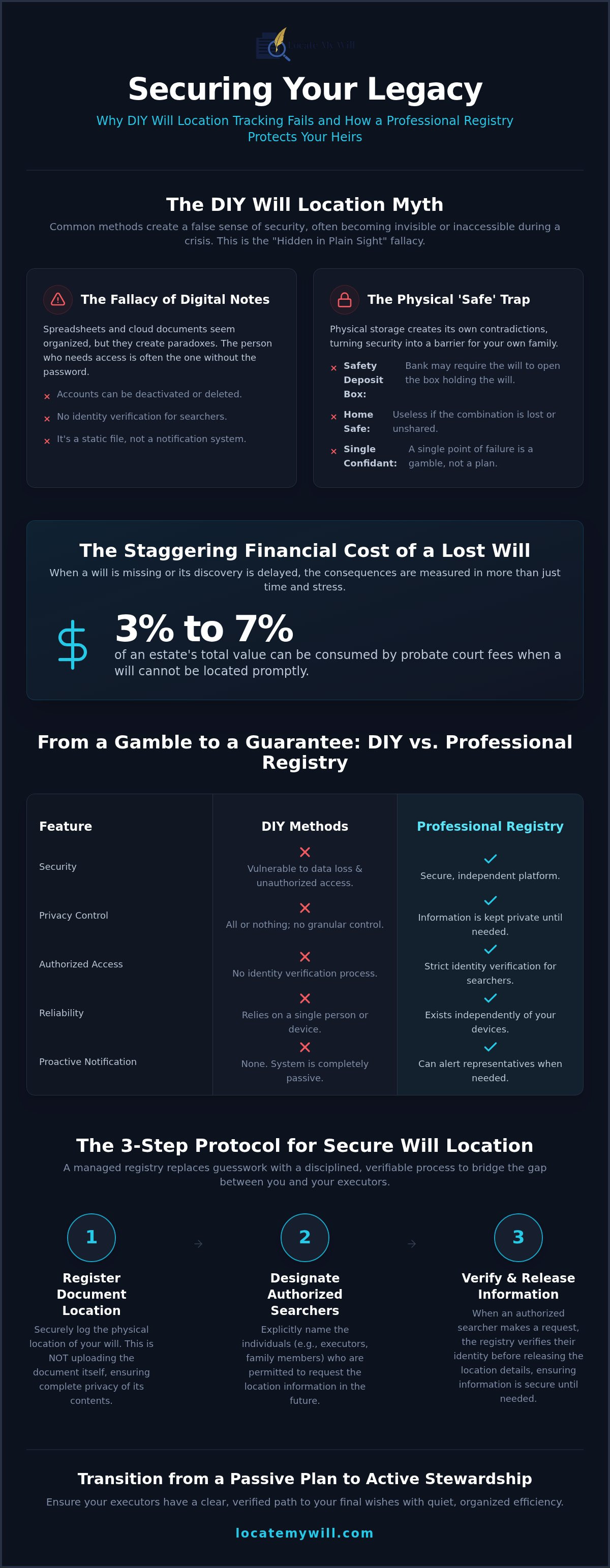
Many planners believe a password-protected spreadsheet or a simple email draft is the height of organization. This approach to DIY will location tracking creates a fragile bridge between your intentions and your family's reality. While these methods feel productive in the moment, they often rely on the assumption that your executors will know exactly where to look, which passwords to use, and which files are current. This is known as the "Hidden in Plain Sight" fallacy. What seems obvious to you as the creator is often invisible to a grieving family member who lacks your specific mental map of your home or digital life.
The consequences of these informal systems are measurable and severe. In 2026, research indicates that probate court fees can consume between 3% and 7% of an estate's total value when a will is missing or delayed. Beyond the financial impact, there is a significant psychological barrier to overcome. Families often avoid discussing the specifics of a legal document until it is too late, assuming the information will somehow reveal itself when needed. This silence, combined with a disorganized DIY system, creates a vacuum that leads to legal hurdles and emotional distress.
The Fragility of Digital DIY Notes
Digital notes are deceptively convenient but lack the permanence required for estate stewardship. If you store your document's location in a password-protected file, you've created a paradox; the person who needs the information is the only one without the key. Digital accounts also face the risk of deactivation due to inactivity or accidental deletion. A Google Doc is not a notification system. It cannot verify the identity of a searcher or alert your representatives when the time for action has arrived. It is a static file in a dynamic world.
Physical Notes and The 'Safe' Trap
Physical storage solutions often present their own set of contradictions. Consider these common pitfalls:
- Safety Deposit Boxes: These create a legal paradox where the bank may require the original will to grant access to the box where the will is stored.
- Home Safes: While they protect against fire or theft, they are useless if the combination is forgotten or never shared.
- The Single Confidant: Telling one person where your will is located is a high-risk strategy. People move, memories fade, and circumstances change.
Relying on a single point of failure is not a plan; it's a gamble. A methodical approach requires a system that exists independently of your personal devices or the memory of a single individual.
Will Location Management vs. GPS Tracking: Clearing the Confusion
In a world where we can track a package or a family member's smartphone in real-time, it is easy to misinterpret the term "tracking" when applied to estate planning. Unlike GPS technology that monitors movement through physical sensors, document location management is a disciplined administrative process. It focuses on maintaining a verified record of where a physical document resides. In 2026, the standard for this service is defined by authorized access control rather than live coordinates. You don't need to know where your will is moving; you need to ensure the right people can find it when it stays still.
The core conflict of DIY will location tracking is the tension between privacy and accessibility. If you make your document too easy to find, you risk compromising your privacy during your lifetime. Conversely, if you hide it too well, you risk it remaining lost forever. A managed registry resolves this by acting as a methodical facilitator. It creates a secure, neutral environment where information is stored safely but remains accessible to the specific individuals you have vetted and authorized. This structured approach removes the guesswork that often plagues home-grown estate systems.
The Role of Authorized Searchers
An authorized searcher is a person you have explicitly designated to request the location of your will. This role is distinct from simply knowing where a document is. A managed system requires identity verification before any data is released, a security layer that a spreadsheet or a shared folder cannot provide. Without this verification, your sensitive information is vulnerable to unauthorized access. For a deeper look at selecting these individuals, you may find it helpful to read about Managing Authorized Searchers for Your Estate Documents. This ensures that only those with a legitimate need and your prior approval can act on your behalf.
Notification Recipients: The Passive Safety Net
While searchers take active steps, notification recipients serve as a passive safety net for your estate. These individuals receive automated alerts when a search is activated or when specific dates pass without check-ins. This redundancy is vital in a national registry. It ensures that even if one person is unavailable, others are prompted to begin the necessary procedures. By establishing these redundant points of contact, you prevent the "lost will" scenario that frequently occurs when families rely on a single, unverified DIY note. You can register your will's location today to establish this secure network for your representatives.
Registry Subscriptions vs. Free DIY Methods
Choosing between a managed registry and free methods is a decision about the integrity of your information. While DIY will location tracking seems cost-effective, it often lacks the robust verification required for modern estate planning. A professional subscription provides a level of certainty that static notes cannot offer. It transforms a passive list into an active, managed system that prioritizes the security of your legacy.
Verification protocols are the backbone of a professional registry. These systems ensure that only authorized individuals gain access to your document's location. A key feature of this disciplined approach is the Search Activation Date. This allows you to control exactly when your information becomes available, maintaining your privacy until the moment it's truly needed. By 2026, these platforms have become the standard for digital stewardship, prioritizing order and security above all else. They act as a bridge between your current preparations and the future needs of your representatives.
Why 'Free' Often Costs More Later
When a will is lost, the resulting legal hurdles can be exhausting. Families often face thousands of dollars in avoidable probate costs and significant delays in asset distribution. Beyond the financial impact, the emotional burden of searching for missing documents is substantial. You should evaluate the cost of a lost will to understand the risks of informal tracking. A professional service acts as a methodical facilitator, removing the anxiety of "what if" from your planning and replacing it with a structured solution.
The Myth of Digital Will Hosting
Many users confuse location registries with digital hosting services. It's essential to remember that a registry does not store the document itself. In many regions, the physical original is still the only version recognized by probate courts. A location registry simply tells your executors exactly where that physical original is kept. To better understand which solution fits your needs, read our guide on Will Registry vs. Digital Will: Choosing the Right Security. This clarity helps you maintain a legally sound and accessible estate plan without the risks associated with unverified DIY methods.
The 3-Step Protocol for Effective Will Location Tracking
Moving beyond the uncertainty of DIY will location tracking requires a disciplined, step-by-step approach. While a spreadsheet is a static list, a professional protocol is a dynamic system designed to withstand the test of time. This process ensures that your intentions remain private during your life but become clear and accessible the moment they are needed. By following a structured three-step method, you replace anxiety with organized efficiency, providing your representatives with a reliable path forward.
Step 1: Precision in Description
The effectiveness of your record depends entirely on the clarity of your instructions. You must describe the physical location of your document with enough detail that a stranger, such as a court-appointed executor or a distant relative, can find it without confusion. If your will is held in an attorney's vault or a third-party storage facility, include their full contact details and any specific file reference numbers. A will location record is a digital roadmap for executors. This record doesn't contain the document itself; it provides the precise coordinates needed to retrieve it. Vague descriptions like "in the study" are insufficient. Instead, specify the exact drawer, the color of the folder, or the specific professional office where the original resides.
Step 2 & 3: The Human Element and Timing
A secure system relies on the roles you assign to the people you trust. You should designate up to three authorized searchers who have the right to request your document's location. These should be individuals with the resilience to handle administrative tasks during a difficult time. Complement these searchers by naming up to three notification recipients. These individuals act as a passive safety net, receiving automated alerts if a search is initiated. This redundancy ensures that your plan is never dependent on a single point of failure.
Timing is the final component of this protocol. By utilizing Search Activation Date Control, you maintain absolute privacy during your lifetime. You can set a specific future date or a trigger-based activation that prevents any information from being released prematurely. This allows you to inform your family that a registry exists without needing to reveal the sensitive contents of the will itself. It is also vital to audit your registry information annually. Moves, changes in legal representation, or the acquisition of a new home safe should all be reflected in your record immediately. To begin establishing your own secure protocol, you can register your document location through our methodical platform.
Securing Your Legacy with Locate My Will
Locate My Will offers a disciplined alternative to the inherent risks of DIY will location tracking. By providing a centralized, national platform, it ensures that your document's location is recorded with the precision required for modern estate management. This "Reliable Guardian" model prioritizes the integrity of your information, acting as a secure bridge between your current privacy and your family's future needs. Regardless of where you reside in the United States, our subscription-based service offers a robust framework that local, unverified methods simply cannot match. It's a structured solution for a dynamic problem, replacing the fragility of home-grown systems with a permanent administrative record.
The core of our service is the Search Activation Date Control. This feature ensures your privacy is maintained during your lifetime, as information is only released at the appropriate time. By choosing a professional registry over DIY will location tracking, you eliminate the "Hidden in Plain Sight" fallacy and replace it with a verified process. This methodical approach provides a level of certainty that spreadsheets and physical notes cannot replicate, ensuring your final wishes are fulfilled without the legal hurdles associated with missing documents.
A Trusted Partner for Your Executor
The transition from paper-only estate planning to a managed digital record is a critical step in 2026. This shift significantly reduces the administrative burden on your loved ones during what is often the most difficult time of their lives. Our interface is designed for simplicity, ensuring that executors across all age groups can navigate the search process without technical frustration. By moving beyond informal notes, you provide your representatives with a professional tool that guides them directly to your final wishes, eliminating the anxiety of a missing document. This clarity isn't just a convenience; it's a fulfillment of your responsibility to those you leave behind.
Peace of Mind Starts Today
The relief of knowing your estate plan is complete is only possible when you know it's also findable. A methodical approach to stewardship means that your will remains secure and private until the specific activation date you designate. You don't have to worry about accidental deletions, lost keys, or the silence that often follows a person's passing. Instead, you can rely on a system built for permanence and stability. To further refine your strategy and understand the broader context of modern planning, you may explore our Essential 2026 Estate Planning Guide for Families.
Your legacy deserves more than a vulnerable spreadsheet or a hidden note. It requires a verified system that honors your commitment to order and transparency. You can take the final step toward a truly organized estate right now. Register your will's location with Locate My Will today and ensure your family has the clarity they need when it matters most.
Protecting Your Legacy with Methodical Precision
Your estate plan is only as effective as your family's ability to execute it. Moving beyond the limitations of DIY will location tracking ensures that your hard work doesn't result in legal delays or avoidable probate costs. By adopting a professional registry, you replace the uncertainty of informal notes with a disciplined system designed for permanence. You've learned how a structured protocol, combined with verified access control, bridges the gap between your private preparations and your executor's eventual needs.
Locate My Will provides the tools necessary for this modern stewardship. With national service coverage for all US residents, our platform allows you to designate up to three authorized searchers and establish automated notification triggers. These layers of security provide the peace of mind that comes from knowing your representatives have a clear, verified roadmap to follow. It's a responsible choice that honors your wishes and protects your loved ones from administrative frustration. Secure your legacy and register your will's location with Locate My Will today. You've planned for the future; now ensure that plan is found.
Frequently Asked Questions
Is DIY will location tracking safe for sensitive information?
No, informal methods like spreadsheets or paper notes are generally not secure. They lack identity verification and audit trails, making them vulnerable to unauthorized access or accidental loss. In contrast, a professional registry uses a disciplined approach to ensure your data remains protected. By moving away from DIY will location tracking, you gain a structured environment where sensitive location details are only disclosed to vetted individuals at the appropriate time.
How does an online will registry verify an authorized searcher's identity?
Our platform uses a methodical verification process to confirm the identity of anyone requesting information. When a search is initiated, the system cross-references the individual's details with your pre-approved list of authorized searchers. This administrative layer prevents unauthorized third parties from accessing your private records. This rigorous approach ensures that only the individuals you trust can fulfill their roles, providing a level of security that informal DIY methods simply cannot offer.
Can I change the location of my will in the registry later?
Yes, you can update your document's physical location at any time through your subscriber dashboard. As life circumstances change, such as moving to a new home or relocating documents to an attorney's office, it's vital to maintain an accurate record. The interface allows for immediate updates, ensuring your executors always have a current roadmap. This flexibility is a key advantage over static DIY will location tracking methods that are easily forgotten or misplaced.
What is a search activation date and why do I need one?
A search activation date is a specific control that determines when your document location information becomes accessible. It acts as a privacy shield, preventing any searches from being performed before your designated date or trigger event. This feature ensures that your estate details remain confidential during your lifetime while providing a clear path for your representatives in the future. It's a critical component of a disciplined and organized long-term estate strategy.
Does Locate My Will store a digital copy of my actual will?
No, Locate My Will doesn't store or host digital copies of your legal documents. Our service is strictly a location registry designed to record where the physical original is kept. This distinction is important because most probate courts still require the original physical document. By focusing on location rather than hosting, we maintain a secure and neutral platform that functions as a methodical facilitator for your executors without the risks of digital document storage.
How many searchers can I designate for my estate documents?
You may designate up to three authorized searchers for your account. These individuals are the only people permitted to request the location of your documents through our platform. In addition to searchers, you can also name up to three notification recipients who will receive automated alerts when a search is activated. This redundancy creates a reliable safety net, ensuring that your representatives are promptly informed even if one individual is unavailable.
What happens if my notification recipients change their email addresses?
You should update their contact information in your dashboard as soon as you are notified of a change. Maintaining current email addresses for your notification recipients is essential for the automated alert system to function effectively. A professional registry relies on the accuracy of this data to provide seamless communication during a crisis. Regular audits of your contact list help ensure that your passive safety net remains robust and ready for future needs.
Is this service available across all 50 states?
Yes, Locate My Will provides national coverage for all residents of the United States. Our platform is designed to function as a centralized, national registry, allowing you to record document locations regardless of where you live or where your assets are located. This broad scope ensures that your executors can find your final wishes even if they reside in a different state, bridging the gap between your current preparations and their future responsibilities.


