

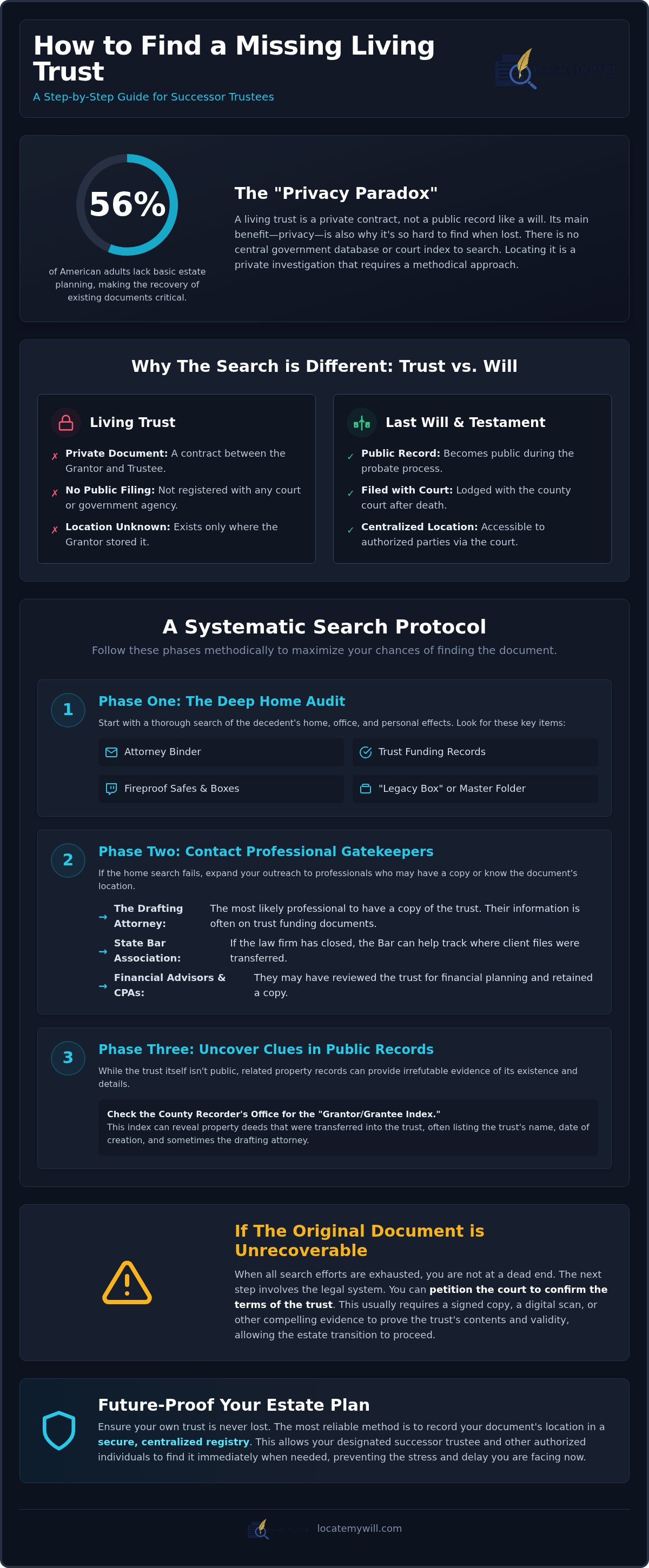
Imagine standing in a quiet home office, surrounded by neatly labeled folders, yet the one document that unlocks the entire estate is nowhere to be found. For many successor trustees, the weight of their new responsibility begins with the high-stakes task of locating a living trust document. It's a stressful position to be in, especially when you're facing the pressure to act quickly while navigating the fog of grief. You aren't alone in this search, as 56% of American adults still lack basic estate planning, making the recovery of existing documents even more critical.
You likely feel a deep sense of urgency to prevent assets from being frozen and to keep family dynamics peaceful. It's common to feel anxious when the document you need is a private trust rather than a public will. This guide will help you replace that confusion with a systematic plan of action. You'll discover the precise steps to find a missing trust and ensure your family’s estate transition remains seamless and secure.
We will walk through professional search tactics, explain how to verify property records for clues, and outline the legal alternatives available if the original document cannot be recovered. By following this methodical approach, you can fulfill your duties with confidence and establish a more reliable system for the future.
Key Takeaways
- Understand the "Privacy Paradox" and why trusts are not part of the public record like traditional wills.
- Execute a multi-phase search protocol for locating a living trust document, ranging from specialized home audits to identifying the drafting attorney.
- Learn how to use the county recorder’s Grantor/Grantee Index to find evidence of the trust's existence through property titles.
- Identify the legal steps required to confirm the terms of a lost trust in court to ensure a seamless family estate transition.
- Discover how to future-proof your own estate by recording document locations in a secure registry for authorized searchers.
Understanding the Challenge of Locating a Living Trust Document
A living trust is fundamentally a private contract between the Grantor, who creates the trust, and the Trustee, who manages the assets. Unlike a last will and testament, which typically enters the public record through the probate court, a trust remains a private matter between the parties involved. This privacy is a primary benefit for modern estate planning; however, it creates what we call the "Privacy Paradox." Because the document is never filed with a government agency, there is no central database or court index to consult when the document goes missing.
The search for a trust differs significantly from the search for a will. When a person passes away, their will is usually lodged with the county court, making it accessible to authorized parties. A trust, however, exists only in the physical or digital spaces where the Grantor chose to keep it. This lack of public footprint means that locating a living trust document becomes a private investigation that relies entirely on the paper trail left behind by the decedent. Successor Trustees often face immediate pressure to manage assets, pay final expenses, or secure property, all of which require the specific authority granted within the missing document.
The Legal Significance of the Original Document
Financial institutions, brokerage firms, and title companies usually require the original document or a certified copy to verify a Trustee's authority. Relying on an unsigned draft or an outdated version found in a home office is a high-risk strategy that can lead to frozen accounts or legal disputes among beneficiaries. Banks are particularly disciplined about verification; they must ensure that the version of the trust they are honoring is the most recent and legally binding iteration. A Successor Trustee is the individual designated to manage trust assets and fulfill the Grantor's instructions once the original Trustee is no longer able to serve. Without the original document, this individual lacks the legal "keys" to the estate, often resulting in a total administrative standstill.
Why Trusts Are Frequently "Lost" by Families
Many families operate under the misconception that a digital scan or a "cloud" backup is sufficient for legal verification. While digital copies are helpful for reference, they rarely satisfy the strict authorization requirements of banks and government agencies (which often demand a physical signature and notary seal). Additionally, Grantors often move physical documents to "extra secure" locations, such as an unregistered safe deposit box or a hidden home safe, without informing their representatives. This tendency, combined with an emotional hesitation to discuss end-of-life logistics, often leads to a crisis when locating a living trust document becomes a matter of necessity. The desire for security inadvertently creates a barrier to accessibility, leaving family members to search blindly during a time of high emotional stress.
A Systematic Search Protocol: Where to Look for a Missing Trust
Locating a living trust document requires a highly disciplined audit of both physical and digital spaces. If the document isn't immediately visible in a home office, you must expand your search to less obvious locations. This process moves through distinct phases, beginning with a deep home audit and progressing to professional gatekeepers who may hold the key to the estate's transition.
The Home Search: Hidden Spots and Security Containers
Start by searching for the "Attorney Binder," a thick, professional folder often provided by law firms upon the completion of an estate plan. This binder usually contains the original trust, along with ancillary documents like powers of attorney. If it's not on a bookshelf, check for fireproof safes or floor safes. Grantors often hide these containers in master bedroom closets or basement storage areas. You should also look for "Trust Funding" records, such as bank statements or property deeds held in the name of the trust. These documents confirm the trust's existence and often list the drafting attorney's contact information. Don't overlook the "Legacy Box" or "Master Folder" that many organized individuals keep to house their most sensitive administrative data.
Professional Contacts and Third-Party Holders
If the home search is unsuccessful, pivot to professional gatekeepers. The drafting attorney is the most logical starting point. If the law firm has closed, contact the state bar association to determine where the firm's records were transferred. Banks are another critical resource, though accessing a safe deposit box after a death can be complex. You'll likely need a court order or proof of successor trusteeship to gain entry. To prevent your own family from facing this administrative hurdle, you might consider registering the location of your estate documents with a secure management service. Additionally, reach out to the decedent's CPA or wealth manager. These professionals typically keep copies of trust documents for tax preparation and asset management purposes.
Finally, audit the decedent’s digital footprint. Search their email accounts for specific keywords that indicate legal activity:
- "Living Trust" or "Revocable Trust"
- "Estate Plan"
- "Schedule A" (often used for asset lists)
- The names of local estate planning law firms
While a digital scan found in an email is helpful, remember that financial institutions often require the physical original or a certified copy to authorize asset transfers. This search protocol ensures that you've exhausted every professional and personal lead before moving toward more complex legal remedies.
Trust vs. Will: Why Locating a Trust is a Different Challenge
A primary reason families struggle with locating a living trust document is the fundamental difference between probate and trust administration. While a will acts as a set of public instructions for the court, a trust functions as a private agreement. This distinction is critical because it dictates where you can-and cannot-look for information. If you're searching for a will, the clerk of the court is your best resource. If you're searching for a trust, you must look for the administrative footprints left in the private sector. Unless the estate is involved in active litigation, the court system will have no record of the trust's existence or its specific terms.
The Public Record Clue: Real Estate Deeds
While the trust document itself is private, the assets it holds often leave a public trail. One of the most effective methods for identifying the existence of a plan is searching the "Grantor/Grantee Index" at the county recorder’s office. If the decedent owned real property, you should look for deeds where the property was transferred from their individual name into a trust. These deeds typically list the formal name of the trust and the date it was established. While the deed won't reveal distribution instructions, it provides a confirmed starting point for your search. You can often use the name of the notary or the law firm listed on the recorded deed to track down the professional office that may hold the original file.
The Privacy Shield: Why Banks Won’t Talk to You
Searching for a trust is often complicated by a legal "Catch-22." Financial institutions have a strict fiduciary duty to protect the privacy of their clients' records. They generally won't disclose information about a trust account unless you can prove you are the authorized Successor Trustee. However, you typically need the original trust document to prove that you hold that authority. This creates a significant barrier for families who aren't sure where the paperwork is stored. Successor Trustees often find themselves in a difficult position; they need the document to prove their identity to the bank, but the bank won't help them find the document without that proof.
A "Certificate of Trust" often serves as the necessary bridge in these situations. This condensed, notarized document summarizes the essential terms of the trust without revealing private distribution details. It identifies the current trustees and outlines their specific powers. If you can find even a copy of this certificate, banks are much more likely to cooperate with your search. Unlike the full trust, these certificates are sometimes recorded with the county to facilitate property transfers, making them a vital piece of the puzzle when the original document is missing. Understanding this mechanism is vital when you are locating a living trust document under pressure.
Legal Steps to Take if the Original Trust Cannot Be Found
When a systematic search fails to yield the original paperwork, the legal system provides specific remedies for establishing the terms of the estate. However, these steps are significantly more complex and costly than standard administration. If the original document remains missing, the estate faces the risk of "Formal Probate." This court-supervised process is often exactly what the Grantor intended to avoid. Without a verifiable trust, assets that weren't properly titled may default to state intestacy laws, which distribute property based on rigid legal hierarchies rather than the decedent's personal wishes.
Working with the Drafting Attorney for a Replacement
Your first legal action should be a formal request to the drafting attorney's office. While law firms are not legally required to hold original documents indefinitely, most maintain digital archives or "true copies" of the files they produce. A certified copy from the firm's records can often satisfy financial institutions if it is accompanied by a "Lost Trust" affidavit. If the Grantor is still alive and competent, they can execute a "Restated Trust," which legally replaces the lost version and provides an opportunity to update beneficiaries. For those also coordinating the search for other estate papers, you may find our guide on how to find a deceased person’s will helpful in organizing your administrative efforts.
Court Intervention and Heggstad Petitions
If no physical copy exists, a Successor Trustee must petition the court to confirm the terms of the lost trust. This requires the presentation of "Secondary Evidence." This evidence may include unsigned drafts, the testimony of the drafting attorney, or the decedent’s personal notes. In specific jurisdictions, a "Heggstad Petition" allows a Successor Trustee to ask the court to "transfer" assets into the trust even if they were never formally retitled, provided there is clear written evidence of the Grantor's intent. This evidence is often found in a "Schedule A" or a general list of assets attached to the trust draft.
The primary challenge in locating a living trust document through the court is the high cost of legal fees and the inevitable delay in asset distribution. These proceedings can take months to resolve, leaving beneficiaries in a state of financial uncertainty. To ensure your own family never faces these administrative hurdles, you should register the location of your trust today. By recording where the original is stored, you provide your Successor Trustee with a clear roadmap, ensuring the estate transition remains secure and private as originally intended.
Future-Proofing Your Estate: Ensuring Your Trust is Never Lost
The crisis of a missing estate plan is entirely preventable through a methodical approach to data stewardship. By adopting the "Reliable Guardian" strategy, you separate the physical document from the record of its location. This ensures that while the trust remains private and secure in its physical home, the path to finding it is clearly mapped for those who will eventually need it. A secure registry bridges the gap between your need for privacy and your Successor Trustee’s need for immediate, authorized access. This proactive step transforms a potential family crisis into a disciplined, orderly transition.
The Role of an Online Will and Trust Registry
Recording a document’s location is fundamentally safer than hosting a digital file on a cloud server. Digital copies are inherently vulnerable to cybersecurity breaches and often lack the legal weight of an original, notarized instrument. By using a registry like Locate My Will, you maintain total control over who sees your information and exactly when they see it. Features like "Activation Dates" ensure that your sensitive data remains hidden while you are healthy, only becoming accessible to your verified searchers when the time is right. This approach solves the dilemma of locating a living trust document without compromising the integrity of the document itself. It's the essential final step in any comprehensive estate plan, acting as the bridge between your preparations and your family's future needs.
Practical Steps for the Modern Grantor
A robust plan requires more than just a secure storage spot; it requires a deliberate communication strategy. We recommend the "Three-Person Rule": designate three reliable searchers who are likely to be present and active during the estate transition. These individuals don't need to know the specific contents of your trust; they only need to know that a secure record of its location exists. It's equally important to update your location records whenever you move, change attorneys, or rotate your physical security containers. Consistency is the foundation of a secure estate.
You can register your estate document location today to create a lasting legacy of organization for your heirs. By providing your Successor Trustee with a clear, verified roadmap, you eliminate the anxiety and high legal costs associated with locating a living trust document during a difficult time. This methodical preparation ensures that your personal wishes are fulfilled with the same quiet authority you exercised when you first created the plan.
Securing a Seamless Estate Transition
Finding a missing trust is a challenge rooted in the very privacy that makes these documents so valuable. While property deeds and professional contacts provide vital clues, the process of locating a living trust document after a loss can be an arduous and expensive journey for your loved ones. You've learned that a methodical search protocol and an understanding of the "Privacy Paradox" are essential tools for any successor trustee facing this responsibility.
The most effective way to protect your legacy is to remove the guesswork entirely. By establishing a clear record of your document's physical location now, you ensure that your family can act with certainty when the time comes. You can secure your family’s future by registering your trust location with Locate My Will. Our platform provides secure Authorized Searcher management and privacy-first activation date control, offering true peace of mind for Successor Trustees. Taking this final administrative step ensures that your wishes are fulfilled without delay or legal complication. You've built a strong foundation for your estate; now is the time to ensure it remains accessible to those who matter most.
Frequently Asked Questions
Where is the most common place people keep a living trust?
Home offices, fireproof safes, and attorney vaults are the most frequent storage spots. Many Grantors use a specialized "Attorney Binder" provided by their legal counsel to house the original instrument. If the document is not in these obvious places, you should search for "Schedule A" asset lists or old tax returns. These documents often point to the professional firm that maintains a duplicate file for administrative purposes.
Can I get a copy of a living trust from the county records office?
No, you cannot obtain a copy of a living trust from a county records office because trusts are private contracts. Unlike a will, which becomes a public court record during probate, a trust remains confidential. You can, however, search the county recorder’s Grantor/Grantee index for property deeds. These public deeds often list the trust’s name and the date it was created, which provides a lead for your search.
What happens if a Successor Trustee cannot find the original trust document?
If a Successor Trustee is unsuccessful in locating a living trust document, the estate may be forced into formal probate. This court-supervised process often involves high legal fees and significant delays. In some states, a trustee can file a petition to confirm the terms of a lost trust using secondary evidence like unsigned drafts or witness testimony. Without this, assets may default to state intestacy laws and public distribution.
Does a photocopy of a living trust hold legal weight in 2026?
While a photocopy provides a helpful reference, most financial institutions and title companies require the original document with a physical notary seal. In 2026, courts may accept a copy as secondary evidence if you can prove the original was not intentionally destroyed. However, relying on a copy often requires a "Petition to Confirm the Terms of a Lost Trust," which adds administrative costs and complexity to the estate transition.
How do I find out which lawyer drafted a loved one’s trust?
Identifying the drafting attorney usually requires a methodical audit of the decedent's financial records. Look for payments to law firms in bank statements or check the notary's name on recorded property deeds. You should also search for the "Attorney Binder" in the home, as it typically contains the firm's contact information. If the firm has closed, the state bar association can often identify where the firm's records were transferred.
Can a bank open a safe deposit box if the trust document is inside?
A bank will generally not open a safe deposit box for a Successor Trustee without a court order or a co-signer's authorization. If the trust document is locked inside, you face a "Catch-22" where you need the document to prove you are the trustee. Most banks require a certified copy of the death certificate and specific legal authorization before they will grant access to a private security container.
Is there a national database for living trusts?
There is no government-managed national database for living trusts. Because these are private agreements, no central registry exists to track their contents or existence. However, private services like Locate My Will allow individuals to record the physical location of their documents. This registry doesn't host the actual document, ensuring your privacy while providing a secure path for authorized searchers to find the original when it's needed.
How can I ensure my children can find my trust without giving them a copy now?
You can ensure your children find your documents by registering the location of your estate plan with a secure online registry. By designating them as "Authorized Searchers," you provide them with the path to the location without revealing the trust's contents prematurely. Using a system with "Activation Dates" allows you to maintain total privacy while you are healthy, ensuring the information is only released during a verified administrative crisis. This is a critical step in locating a living trust document efficiently.


