

The greatest risk to your legacy isn't a poorly drafted document, but a perfect one that no one can find. You've likely invested significant time and thought into your estate plan, yet without a methodical strategy for protecting your will from being lost, those instructions are effectively invisible. It's a heavy burden to worry that your family might face legal confusion or unnecessary conflict simply because a physical document remained hidden in a secure but undisclosed location.
We understand that you want to provide your loved ones with clarity, not a search mission. This guide provides the essential strategies you need to secure your original will and ensure your representatives can locate it when it matters most. We'll examine the most reliable physical storage options and explain how a secure registry for location data creates a foolproof bridge for your executors. By following this structured approach, you'll gain the peace of mind that comes from knowing your wishes are both protected and accessible.
Key Takeaways
- Understand the legal risks associated with a missing original document and why probate courts require the physical copy to honor your final wishes.
- Identify the critical security features for physical storage that shield your documents from environmental damage and unauthorized access.
- Implement a comprehensive strategy for protecting your will from being lost by combining secure storage with a centralized location registry.
- Empower your executors with a verified access protocol that ensures they can locate vital records without compromising your privacy during your lifetime.
- Learn how to utilize automated notification triggers and search activation controls to provide your family with a clear, guided path to your estate documents.
Understanding the Risks of a Lost or Destroyed Will
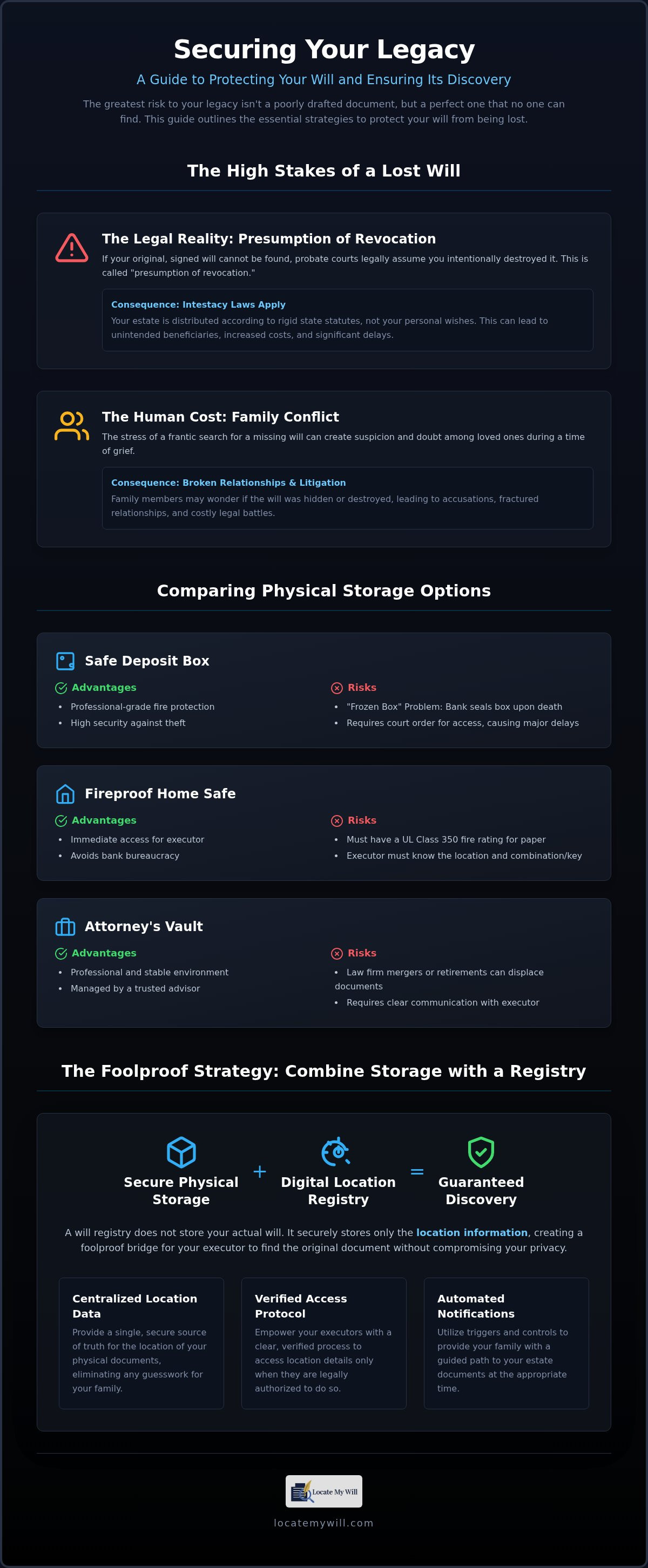
The legal system operates on concrete evidence. If your original will is missing at the time of your passing, most probate courts apply what's known as a "presumption of revocation." This means the law assumes you intentionally destroyed the document because you no longer agreed with its terms. Proving the contrary is a difficult legal hurdle that requires clear and convincing evidence, which is often impossible to produce without the physical paper. Without that original document, your carefully constructed estate plan is effectively paralyzed. This reality makes protecting your will from being lost just as important as the legal advice used to create it.
The Legal Burden of Intestacy
When an original document cannot be located, the estate typically falls under intestacy laws. These are rigid state statutes that dictate exactly how your assets are distributed. They don't account for your personal relationships, charitable goals, or specific family needs. Instead, they follow a generic hierarchy that often leads to results you never intended. The process is also significantly more expensive. The court must appoint an administrator, often requiring them to post a bond, which drains funds that should have gone to your heirs. These administrative hurdles are the primary reason why "lost" wills are the leading cause of multi-year estate delays.
Preserving Family Harmony
The emotional consequences of a lost will for beneficiaries are often more damaging than the financial ones. Grief is a heavy burden, and adding the stress of an exhaustive document search creates a volatile environment for your loved ones. When the location of a will is a mystery, suspicions often take root. Family members might wonder if the document was intentionally hidden or destroyed by someone who stood to gain from its absence. These seeds of doubt can lead to permanent fractures in family relationships and high-cost probate litigation.
Clarity is the best defense against conflict. By ensuring your executor knows exactly where to find your original documents, you remove the opportunity for accusations of tampering. An executor's duty is to maintain order and fulfill your wishes with disciplined efficiency. They can't do that if they are forced to spend weeks searching through safe deposit boxes and home offices. Protecting your will from being lost is a final act of care that ensures your legacy is defined by peace rather than a frantic search for answers.
Choosing the Best Physical Storage for Your Original Will
The probate process is notoriously strict regarding the "Original Document" rule. While digital copies are convenient for your personal records, most courts require the physical, ink-signed original to grant probate. If only a copy is found, the court may conclude the original was intentionally destroyed. Therefore, protecting your will from being lost starts with selecting a storage environment that balances high-level security with reliable accessibility.
Safe Deposit Boxes vs. Fireproof Home Safes
Safe deposit boxes offer professional-grade protection against fire and theft, but they carry a significant risk known as the "frozen box" problem. Upon the owner's death, banks often seal the box until an executor provides court-issued letters of testamentary. This creates a circular dilemma: you need the will to get the letters, but you need the letters to get the will. This can lead to months of legal delays and unnecessary expenses for your heirs.
Fireproof home safes provide immediate access but require specific technical standards. A standard security safe often fails to protect paper during a prolonged fire. Ensure your safe has a UL Class 350 rating, which guarantees the internal temperature remains below 350°F (the point where paper begins to char). While a home safe avoids bank bureaucracy, protecting your will from being lost using this method is only effective if your executor knows the combination or the location of the override key.
The Attorney’s Vault: Reliability and Risks
Many individuals choose to leave their original documents in an attorney’s vault. This remains a professional and stable option, provided you verify the firm's document retention policy. In the current legal landscape of 2026, law firm mergers and retirements are common. If your attorney’s practice changes hands, your documents may be moved to a secondary storage facility without your direct knowledge.
If you opt for professional vaulting, you should maintain a "Location Memorandum" in your home. This simple document identifies the firm's name and contact details. Even with a trusted attorney, the ultimate responsibility for discovery lies with you. You can bridge the gap between secure storage and family awareness by registering the document's precise location in a secure registry. This ensures that even if a law firm moves or a safe combination is forgotten, your heirs have a clear path to the original.
Implementing a Secure Access Protocol for Your Executor
Protecting your will from being lost requires more than just a sturdy safe. It demands a deliberate protocol for access. You must ensure that the individuals responsible for your estate can execute their duties without facing a logistical vacuum. A Master Location List serves as the central nervous system of your estate plan. This document doesn't need to contain the sensitive details of your assets, but it must clearly state where the original, ink-signed documents are held. Without this roadmap, even the most secure storage becomes a barrier rather than a benefit.
Designating Your Authorized Searchers
Selecting your primary executor is a standard step, but a robust security plan includes at least one successor. These individuals act as your authorized searchers. When vetting someone for this role, look for organizational discipline and the ability to act calmly under pressure. They don't necessarily need to be family members; sometimes a professional or a deeply trusted friend is better suited for the administrative rigor required. If your representatives ever find themselves in a position where the location is unclear, they should follow a systematic search protocol to minimize delays and legal complications.
The Danger of Over-Secrecy
A common mistake in estate planning is the impulse to hide documents in unconventional places. Wills tucked into floorboards, taped behind paintings, or placed in unmarked boxes in the attic are frequently lost to history. While the desire for privacy is understandable, over-secrecy creates a single point of failure. If you only tell one person where your will is kept, and that person passes away or loses their memory before you do, your document is effectively gone. This scenario is one of the most common ways that perfectly valid estate plans fail.
Protecting your will from being lost involves finding a psychological balance between current privacy and future discovery. You don't need to hand out copies of your will to every relative. Instead, focus on sharing the "where" rather than the "what." Establish a regular review cycle, perhaps every two years or after any major life event like a move. During this review, verify that your authorized searchers still have access to the necessary keys, codes, or firm contact details. This methodical approach ensures your representatives aren't left guessing during a time of grief, providing them with the certainty they need to honor your wishes.
The Role of a Will Registry in Modern Estate Planning
A will location registry serves as a secure, digital pointer to a physical reality. It's a common misconception that an online registry stores a digital copy of your document. Instead, it functions as a professional management tool that records the precise location of your original, ink-signed will. This distinction is critical because, as previously discussed, probate courts prioritize the physical original over digital reproductions. By maintaining a centralized record of your document's location, you are actively protecting your will from being lost in the gap between your physical storage and your family’s digital lives.
The financial logic of using a registry is clear. When you consider the cost of a lost will, which includes thousands in legal fees and years of probate delays, a structured registry subscription becomes a necessary component of a modern estate plan. It acts as a bridge, ensuring that the security of a physical vault or home safe doesn't become an insurmountable wall for your grieving representatives. This proactive measure ensures that your final intentions are never silenced by a simple lack of information.
Why Spreadsheets and Paper Notes Fail
Many people attempt to manage location data through home-grown methods like Excel spreadsheets or handwritten notes. These methods are inherently fragile. Digital files are subject to corruption, and passwords are often lost over the 20 or 30 years an estate plan might remain in effect. Similarly, physical notes are frequently discarded during the "house clean-out" phase that follows a death. A professional registry offers a permanent, managed environment that outlasts personal hardware and avoids the risk of being mistaken for household clutter.
Privacy and Verification Standards
Security is the foundation of a reliable registry. Modern platforms employ high-level encryption standards to protect your data, but the true value lies in the authorization process. A registry doesn't simply release information to anyone who asks. It utilizes a verification system for authorized searchers, ensuring that only the individuals you have designated can access the location data. Search activation date controls also allow you to determine exactly when this information becomes available, preventing premature access and maintaining your privacy throughout your lifetime.
Taking this step ensures that your careful physical preparations are supported by a robust digital roadmap. You can register your will's location today to provide your family with the clarity they will eventually need.
How Locate My Will Secures Your Document’s Discovery
Locate My Will operates on a disciplined philosophy: the most secure way to manage your estate planning data is to record the "Where" rather than the "What." By documenting the physical coordinates of your original papers without uploading the sensitive contents themselves, you maintain absolute privacy while ensuring accessibility. This methodology is the final piece of the puzzle in protecting your will from being lost, acting as a reliable guardian that connects your current preparations to your family’s future needs. It's a structured solution for those who value both security and transparency.
Setting up your subscription is a methodical process designed for maximum clarity. You'll start by defining the precise location of your documents. Next, you designate your authorized searchers and notification recipients. Finally, you establish your search activation parameters. This step-by-step implementation ensures that you remain in complete control of your information throughout your lifetime, while providing a certain path for your representatives when the time comes. It's about replacing anxiety with a predictable, organized system.
Recording Your Will’s Physical Coordinates
When you register your document's location, specificity is your greatest asset. Instead of vague descriptions, you should provide actionable instructions, such as the specific room, safe model, or the name of the law firm holding the original. If you relocate or change your storage method, updating your data is a simple administrative task that ensures your record remains accurate. This system integrates seamlessly with your broader estate plan, including related tasks like locating a living trust document. By centralizing these location details, you remove the logistical burden from your executor's shoulders.
Activating the Search Protocol
The discovery process is governed by a strict verification protocol. When an authorized searcher attempts to locate your document, our system triggers automated notification alerts to your designated recipients. This serves as a vital security layer, ensuring that no search goes unnoticed. The information is only released after the search activation date you've specified or once the necessary authorization steps are completed. This disciplined sequence allows your executor to transition smoothly from location discovery to the formal probate process. Protecting your will from being lost is ultimately about creating a dependable bridge that honors your legacy with quiet authority and organized efficiency.
Securing Your Legacy for the Next Generation
A perfectly drafted estate plan only fulfills its purpose if it's accessible when your family needs it most. We've examined the strict legal requirements for original documents and the storage criteria needed to safeguard them from environmental damage. By establishing a methodical access protocol, you remove the burden of uncertainty from your executors and prevent the emotional conflict that often arises from missing information. Protecting your will from being lost is a continuous commitment to clarity and organizational discipline.
You can finalize your security strategy by utilizing a professional system designed for document discovery. Locate My Will provides a secure location registry and authorized searcher management to bridge the gap between your private storage and your family's eventual needs. As a national document discovery service, we help ensure your representatives have the roadmap they require without compromising your current privacy. Ensure your family can find your will with Locate My Will today. Taking these structured steps now ensures your intentions are honored and your loved ones are protected.
Frequently Asked Questions
What happens if my family can't find my original will?
If your family cannot locate your original will, the probate court typically presumes you intentionally destroyed it to revoke your wishes. This legal "presumption of revocation" means your estate will likely be distributed according to state intestacy laws rather than your specific intentions. This often leads to significant delays, higher administrative costs, and potential family disputes. Protecting your will from being lost is the only way to ensure your final instructions are legally recognized.
Is a photocopy of a will legally valid in court?
A photocopy of a will is rarely accepted as a primary legal document in probate court. While some jurisdictions allow copies under extreme circumstances, you must provide clear and convincing evidence as to why the original is missing. This process is expensive, time consuming, and often unsuccessful. To avoid these legal hurdles, you should focus on the secure management of your original, ink-signed document and provide your executor with a reliable way to find it.
Should I keep my will in a safe deposit box at the bank?
While bank safe deposit boxes offer high physical security, they often present significant accessibility challenges for your heirs. Many banks seal these boxes immediately upon the owner's death, requiring a court order for the executor to gain access. This creates a circular problem where the will is needed to get the court order, but the order is needed to get the will. If you choose this option, ensure your executor has a verified location record.
What is the difference between a will registry and digital will hosting?
A will registry records the precise physical location of your document, whereas digital hosting involves uploading the actual document to a server. Locate My Will provides a location registry because probate courts require the original paper document, not a digital file. By recording the "where" instead of the "what," you maintain higher privacy and ensure your family can find the legally required original rather than just a digital copy that the court might reject.
How do I tell my executor where my will is without compromising my privacy?
You can share the location of your document without revealing its sensitive contents by using a secure location registry. By designating your executor as an authorized searcher, you provide them with the coordinates they need only when it becomes necessary. Our system allows you to set search activation dates, which prevents premature access to your location data. This methodical approach balances your current need for privacy with your executor's future need for discovery and document retrieval.
Can I change the recorded location of my will after I've registered it?
Yes, you can update the recorded location of your documents at any time through your subscription dashboard. If you move house, change law firms, or purchase a new fireproof safe, it's essential to update these details immediately. Maintaining an accurate record is a key part of protecting your will from being lost. These updates are handled through a secure administrative interface, ensuring that your authorized searchers always have the most current instructions.
Who should I designate as an authorized searcher for my estate documents?
You should designate individuals who are responsible, organized, and likely to be available when needed. This typically includes your primary executor and at least one successor executor. Locate My Will allows you to manage up to three authorized searchers and three notification recipients. Choosing multiple searchers provides a layer of redundancy, ensuring that if one person is unavailable, another verified individual can still access the location data and fulfill their administrative duties.
Does an online will registry store the actual contents of my will?
No, a professional will location registry does not store the contents or a digital copy of your document. Our service is designed specifically to manage the metadata of your estate plan, which is the physical location of the papers. This approach maximizes your privacy and security by ensuring that your personal wishes remain confidential. The registry acts solely as a secure bridge, guiding your authorized representatives to the physical location where the original is stored.


