

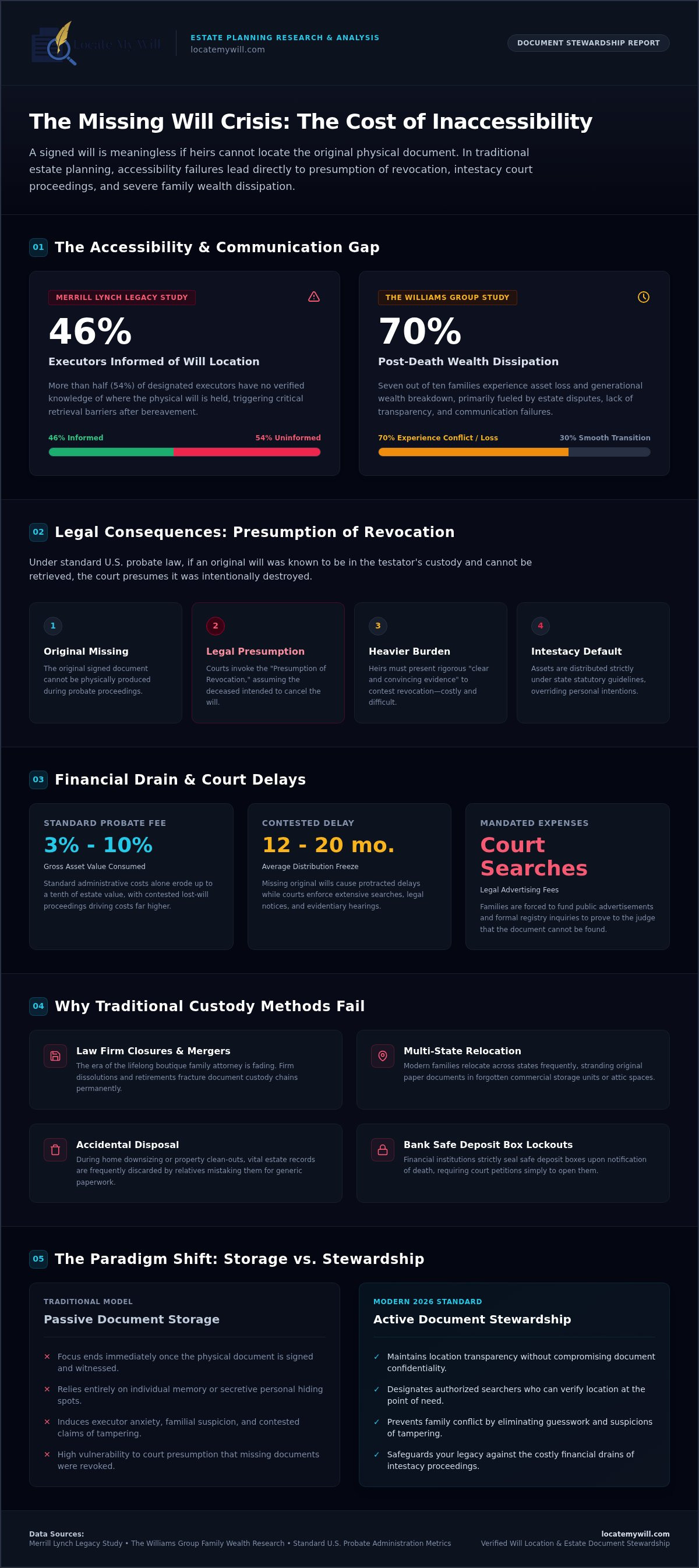
Did you know that only 46% of designated executors report being informed of where a will is actually kept? It's a startling figure that highlights a critical flaw in traditional estate planning. You likely spent hours ensuring your assets are distributed fairly, yet the primary obstacle to your wishes is often a simple lack of accessibility. Many families find themselves in a painful "Catch-22" where they cannot prove a will exists because the original is locked away or lost. This uncertainty is a leading cause of family infighting and probate court delays. By focusing on preventing lost will disputes through better organization, you can protect your loved ones from unnecessary emotional and financial burdens.
Estate planning in 2026 is shifting away from mere document creation toward total location transparency. It's no longer enough to have a secure plan; your representatives must also have a reliable way to find it when the time comes. This article explores how a disciplined approach to document registration ensures your family avoids the legal presumption that a missing will was intentionally destroyed. We'll examine the risks of traditional storage methods, such as bank safe deposit boxes, and outline a methodical process for establishing a fail-safe communication bridge for your heirs. You will learn how to secure your legacy and achieve true peace of mind through verified location management.
Key Takeaways
- Understand the legal risks associated with missing documents and how location transparency is essential for preventing lost will disputes.
- Learn why modern estate planning has shifted from passive storage to active document stewardship to ensure heirs can actually access your final wishes.
- Identify the hidden dangers of using bank safe deposit boxes, which often become inaccessible to executors without a lengthy court process.
- Discover the methodical process for designating authorized searchers who can verify the physical location of your will without compromising its privacy.
- Explore how a secure, subscription-based registry acts as a reliable guardian between your current preparations and your family's future requirements.
The Rising Crisis of Missing Estate Documents in 2026
A lost will dispute is a specific legal challenge that arises when an original document cannot be located after a person's passing. As we move through 2026, we're seeing a significant rise in these disputes as families struggle to manage increasingly disorganized physical and digital records. Without the physical original, the probate administration process becomes significantly more complex. Under standard U.S. probate law, if an original will was last known to be in the testator’s possession and cannot be found, courts apply a "presumption of revocation." This means the law assumes you destroyed the document because you intended to cancel it. Overcoming this presumption requires clear and convincing evidence, which is often difficult and expensive to produce. The emotional toll on heirs is immense. They may know exactly what you wanted, yet they're legally barred from fulfilling those wishes. Preventing lost will disputes isn't just about security; it’s about ensuring your voice is heard when you can no longer speak.
Why Traditional Storage Methods are Failing Modern Families
The days of the local "family lawyer" holding the only copy of a will are largely over. Many boutique firms have closed or merged, leaving document chains broken. Families are also more mobile than ever, frequently relocating across state lines and leaving physical paperwork in forgotten storage units or attic corners. During home clean-outs or downsizing, original wills are often accidentally discarded by well-meaning relatives who mistake them for old administrative files. These failures in physical custody create the very gaps that lead to litigation. Preventing lost will disputes requires a more modern, transparent approach to document location that doesn't rely on a single person's memory.
The Financial Impact of Probate Delays
When a will is missing, the estate often defaults to "intestacy" proceedings. In this scenario, state law dictates who inherits your assets regardless of your personal relationships. This shift forces families to pay for court-ordered searches and legal advertisements to prove the document is truly lost. According to research by The Williams Group, approximately 70% of families experience wealth breakdown or dissipation due to estate conflict and communication failures. Standard probate administration can consume between 3% and 10% of an estate’s gross asset value, but contested cases often push these costs even higher while delaying asset distribution for 12 to 20 months. A missing original document is the most common catalyst for these expensive, avoidable delays.
Shifting the Paradigm: Accessibility as the New Estate Planning Standard
Traditional estate planning often concludes once a document is signed and witnessed. However, true estate planning peace of mind is only achieved when those you leave behind can actually retrieve that document. In 2026, the industry has moved beyond mere document creation toward robust retrieval protocols. We define this as "Document Stewardship." Unlike simple storage, stewardship is an active, managed process that ensures your instructions are accessible to the right people at the right time. This transition is essential for preventing lost will disputes that frequently lead to complex will contest proceedings in probate court. By acting as a methodical facilitator, you bridge the communication gap between your current preparations and your family's future needs.
The Psychology of Preparedness
Executor anxiety is a significant yet often overlooked burden. When a designated representative is left searching for a document during a time of grief, the stress can be overwhelming. Research from the Merrill Lynch Legacy Study indicates that only 46% of executors are informed of a will's location before the testator passes. This lack of transparency doesn't just cause stress; it breeds suspicion among siblings and other heirs. If the location of a will remains a secret, its eventual discovery can be met with skepticism or claims of tampering. Moving from secretive planning to managed disclosure provides a clear roadmap for your family. It replaces confusion with certainty and prevents the seeds of litigation from being sown.
Verification and Authorization: The Security Pillars
While transparency is vital, it must be balanced with absolute security. Simply emailing a location or leaving a note in a desk drawer is a significant risk. Emails can be intercepted, and physical notes can be lost or moved. A professional registry provides a secure alternative by using verified search protocols. This ensures that your private information is only released after a rigorous identity check. You can maintain your privacy during your lifetime by setting specific search activation dates. These controls ensure that authorized searchers can only access location details when they are actually needed. This structured approach is the most effective way of managing your document registry while protecting your current privacy. It ensures that the right people have the right information at the exact moment it becomes necessary.
Comparing Storage Strategies: Safe Deposit Boxes vs. Online Registries
Choosing where to keep your original will is a decision that carries significant legal weight. Many people instinctively turn to a bank safe deposit box, believing it to be the most secure option. However, this often leads to the "Safe Deposit Box Trap." When a sole renter passes away, banks typically seal the box immediately. To open it, an executor usually needs Letters of Administration, but the court won't issue those letters without the original will that is locked inside the box. This paradox forces families into expensive, time-consuming court petitions just to search for the document. While home safes and fireproof boxes offer easier accessibility, they are vulnerable to theft, misplacement, or being overlooked during a chaotic move. A secure document location registry solves this by acting as a digital breadcrumb. It doesn't replace physical storage; instead, it ensures that the path to your physical paper is clear and verified, which is essential for preventing lost will disputes.
The Myth of the Digital Will
There's a common misconception that a digital scan of a will is just as valid as the physical document. In reality, most U.S. jurisdictions still strictly require the physical, wet-ink original for probate. While some states have begun adopting electronic will statutes, the vast majority of courts view a digital copy as secondary evidence at best. Relying on a scan can trigger a "presumption of revocation" hearing, where your family must prove you didn't intentionally destroy the original. This is why a methodical registry should never host the legal file itself. Its primary role is to point authorized searchers to the exact coordinates of the physical original. This distinction maintains the legal integrity of your estate plan while ensuring the document remains findable.
National Standards for Document Security
When you use a location registry, privacy and data integrity are paramount. You should look for a service that follows a metadata-only model, meaning they record where the document is, not what it says. This approach is a cornerstone of preventing lost will disputes without exposing your sensitive financial or personal wishes to the cloud. A disciplined registry will have clear protocols against selling user data and should offer redundancy in its records. This ensures that even if one method of notification fails, your authorized searchers have a reliable, verified path to follow. By separating content privacy from location transparency, you create a robust safety net that respects your confidentiality while prioritizing your family's eventual need for clarity.
Best Practices for Designating Authorized Searchers
Designating the right individuals to act as your authorized searchers is a critical step in preventing lost will disputes. These individuals serve as the vetted fiduciaries who bridge the gap between your current preparations and your family's future need for clarity. Ideally, you should select candidates who hold a legal or emotional stake in the orderly administration of your estate, such as your named executor, a spouse, or adult children. By choosing people who are already integrated into your estate plan, you ensure that the retrieval process remains in trusted hands.
To establish a reliable search protocol, follow this methodical four-step process:
- Step 1: Select Your Searchers. Choose up to three individuals you trust implicitly. Designating multiple searchers creates necessary redundancy, ensuring that if one person is unavailable, others can still fulfill the responsibility.
- Step 2: Define Activation Dates. Use specific activation controls to determine exactly when these individuals can perform a search. This prevents premature access and keeps your data secure until it is required.
- Step 3: Provide Granular Retrieval Instructions. A registry entry should include precise physical details. For example, noting that "the key is in the blue folder in the master bedroom safe" removes any ambiguity during a high-stress search.
- Step 4: Maintain the Record. Update your registry immediately if your document moves. Whether you change law firms or buy a new home safe, keeping the record current is essential for document stewardship.
Managing Notification Recipients
It is important to distinguish between an authorized searcher and a notification recipient. An authorized searcher is someone vetted to actively trigger a search request to find your document. In contrast, a notification recipient is simply informed that a search has been initiated or completed. Automating this "need-to-know" process prevents your documents from being forgotten by ensuring your inner circle is aware that a registry exists. This structured communication reinforces the integrity of your plan and ensures that no one is left in the dark when the probate process begins.
The Role of the Search Activation Date
The search activation date acts as a vital security measure. It prevents premature searches while you are still healthy and active. By using a registry that locks location data until a specific date, you ensure that your information is only available when it is legally necessary for estate administration. These activation dates provide a robust privacy shield for the testator by ensuring that no one can access your storage secrets without proper authorization and timing. You can manage your authorized searchers today to ensure your document is findable only when the time is right.
Securing Your Legacy with Locate My Will
Locate My Will serves as the methodical facilitator between your current estate preparations and the future needs of your representatives. By recording the verified coordinates of your original documents, the platform provides a robust framework for preventing lost will disputes. This approach prioritizes location transparency while maintaining the absolute privacy of your document's contents. Unlike law firms that may dissolve or family members who might misplace files, a dedicated registry acts as a permanent, neutral bridge. It ensures that your intent is not just recorded, but findable when it matters most.
To secure your legacy today, consider this final checklist for document stewardship:
- Confirm the physical location of your original, wet-ink will and any accompanying trusts.
- Identify up to three authorized searchers who will be responsible for document retrieval.
- Define your search activation dates to maintain your privacy during your lifetime.
- Register your document's location through a secure, subscription-based registry.
- Communicate the existence of this registry to your inner circle to ensure they know where to start.
Why a Subscription Model Ensures Longevity
A "set and forget" approach is rarely sufficient for something as critical as estate planning. Free services often lack the necessary infrastructure to provide government-level identity verification or long-term data integrity. A subscription model ensures that the registry remains technologically current and secure for decades. This active management is essential for preventing lost will disputes by ensuring that notification protocols are audited and updated as your life circumstances change. It provides the stability required for a truly permanent record. This is the "Reliable Guardian" approach: combining security and verification to deliver lasting peace of mind.
Take the Next Step Toward Estate Certainty
Achieving estate planning peace of mind requires moving beyond document creation toward active stewardship. By registering your will's location, you remove the emotional and legal burden from your heirs. You provide them with a clear, verified roadmap that eliminates guesswork and prevents the suspicion that often leads to litigation. This disciplined action ensures that your final wishes are fulfilled exactly as you intended. Starting a will owner registration is a simple, methodical step that yields lifelong security for you and your loved ones. Protect your family from future disputes by registering your will’s location today.
Ensuring Your Intent Becomes Your Legacy
Transitioning from passive storage to active document stewardship is the most effective method for preventing lost will disputes. You've learned that relying on a secretive location or a sealed safe deposit box often creates a legal barrier for your heirs. By choosing a methodical approach to location transparency, you ensure your original, wet-ink document is findable exactly when it's needed.
Locate My Will provides a structured, national US registry service designed to bridge the gap between your current planning and your family's future needs. With verified authorized searcher protocols and search activation date privacy controls, you maintain absolute authority over your information. Secure your family’s future by registering your will location with Locate My Will today. Taking this small, disciplined step today provides lasting estate planning peace of mind for the years to come.
Frequently Asked Questions
What happens to my estate if my family cannot find my original will?
If an original will is missing, the court typically assumes you intended to revoke it, leading the estate into intestacy. This means state laws, rather than your personal wishes, will determine who receives your assets. Your family would then face the heavy burden of proving the will’s existence through a formal evidentiary hearing. This legal hurdle often results in asset freezes and long delays, making the task of preventing lost will disputes a vital part of modern planning.
Can I just tell my executor where my will is instead of using a registry?
You can tell your executor, but relying solely on verbal instructions is a significant risk for your estate. People often forget specific details, lose their personal notes, or may even pass away before the testator. A subscription-based registry provides a permanent, verified record that doesn't depend on anyone’s memory. It acts as a methodical facilitator that ensures your instructions are preserved and accessible to your inner circle, even if your primary executor is unavailable later.
Is a digital scan of my will legally sufficient if the original is lost?
Most U.S. courts don't consider a digital scan to be a legally sufficient replacement for an original, wet-ink will. If the physical original is lost, the court assumes it was destroyed with the intent to revoke it. Proving otherwise requires a complex legal hearing that a digital copy rarely satisfies on its own. This is why a registry focuses on the physical location of the paper document, ensuring the legally required original is always findable.
How does an authorized searcher verify they have the right to see my will location?
Verification is managed through government-level digital identity checks and biometric protocols. When an individual initiates a search, they must prove their identity through a secure system before any information is released. This audited process ensures that only the specific people you have designated can access your instructions. These security pillars are essential for maintaining the integrity of your information and ensuring that your document's location is only disclosed to authorized, verified searchers.
What is a search activation date and why do I need one?
A search activation date is a security setting that controls exactly when your authorized searchers can request your document's location. You need this feature to act as a privacy shield during your lifetime. It ensures that your storage details remain locked until a time when they are legally required for estate administration. This methodical control allows you to prepare for the future without compromising your current confidentiality or inviting premature searches by your representatives.
Does a will registry store a copy of my actual legal document?
No, the registry doesn't store the legal text or a digital copy of your document. It functions as a secure record of the physical location coordinates where your original will is kept. This approach maintains your content privacy while ensuring that the path to the physical paper is clear for your heirs. By recording custody trails rather than the document itself, the service avoids the cybersecurity risks associated with hosting sensitive legal files in the cloud.
Can I change my authorized searchers after I have registered?
Yes, you can update your designated searchers at any time through your subscription account. As your family dynamics or professional relationships evolve, you may need to adjust who has the authority to find your documents. The platform allows you to add or remove up to three authorized searchers to ensure your retrieval plan remains current. This active management is a core component of document stewardship, allowing you to maintain a reliable path for your heirs over many years.
How much does a lost will dispute typically cost a family in legal fees?
A lost will dispute often forces an estate into protracted litigation, which can significantly deplete the inheritance. While standard probate consumes a portion of assets, contested proceedings involving missing documents often push legal expenses to the higher end of statutory fee scales. These cases typically span 12 to 20 months, preventing heirs from accessing funds. Proactively preventing lost will disputes ensures that your estate's value is preserved for your family rather than lost to court costs.


