

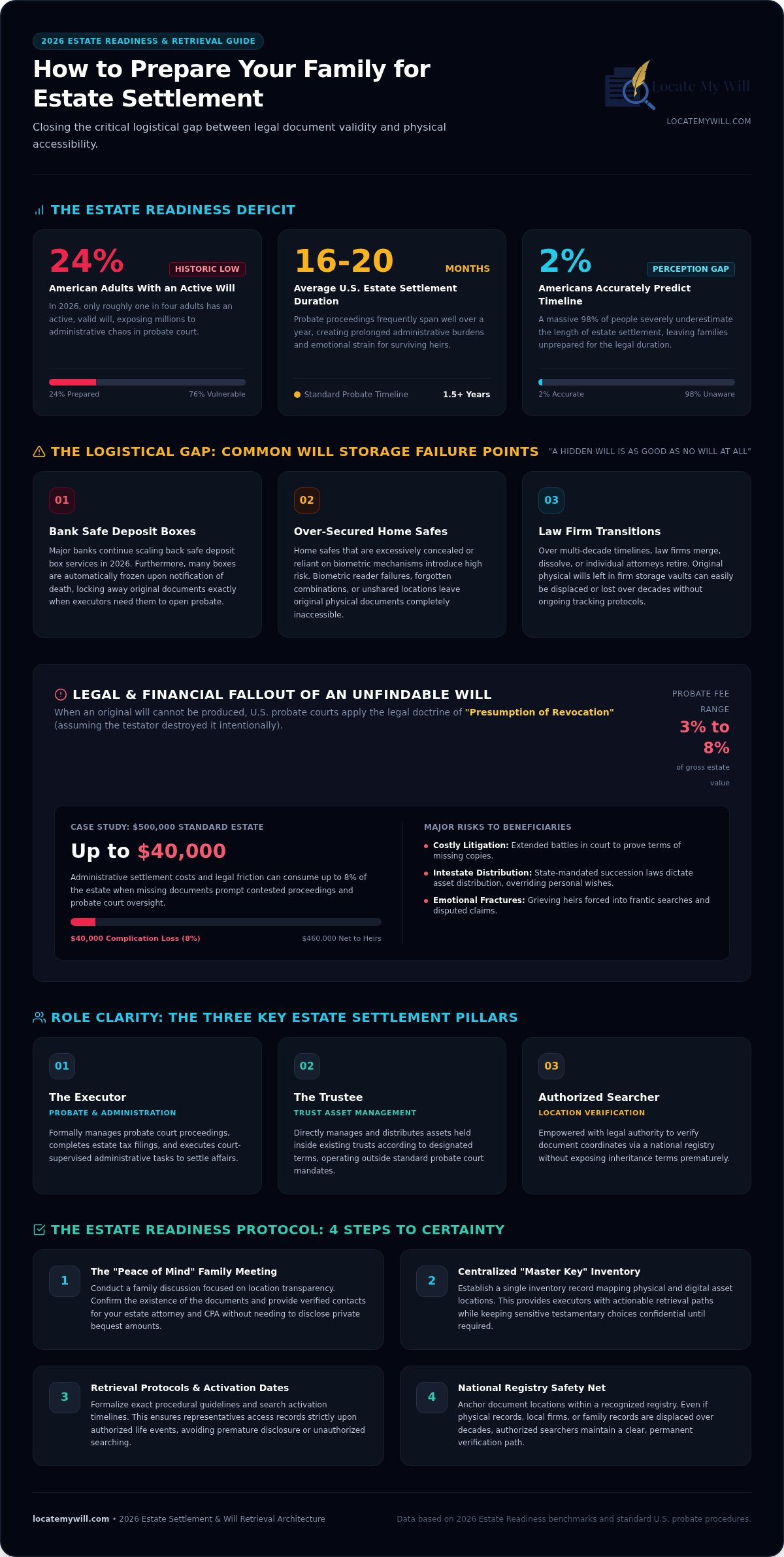
Did you know that in 2026, only 24% of American adults possess an active, valid will? This represents a historic low in estate readiness, leaving millions of families vulnerable to the complexities of the probate process. You likely understand the gravity of this situation and want to learn how to prepare family for estate settlement to protect your heirs from administrative chaos. It’s natural to worry that a missing document could spark a family dispute or that your executor won't be able to locate your original will within the strict filing windows required by law.
Mastering this process is the most effective way to replace anxiety with a sense of organized efficiency. This guide offers a methodical checklist to help you organize your records and empower your family to handle your affairs with absolute clarity. We will cover the latest 2026 tax exemption updates, the growing risks of relying on bank safe deposit boxes, and a structured communication plan that ensures your documents are retrievable exactly when they are needed. By following these steps, you can minimize legal fees and provide your loved ones with a reliable roadmap for the future. In addition, you can discover The Probate & Estate Planning Co. for professional support with drafting and administering your estate plan.
Key Takeaways
- Closing the logistical gap between a document’s legal validity and its physical accessibility is the first essential step in learning how to prepare family for estate settlement.
- Conducting a "Peace of Mind" meeting allows you to clearly define roles for executors and authorized searchers, preventing confusion during the probate process.
- A centralized estate inventory should act as a "Master Key," providing location data for assets and records without exposing private inheritance terms prematurely.
- Formalizing retrieval protocols with search activation dates ensures that your representatives can access necessary information only when it is authorized and appropriate.
- Utilizing a national registry provides a permanent safety net, ensuring your family can locate your original documents even if physical records are misplaced or forgotten.
The Logistical Gap in Estate Planning: Why Documents Get Lost
Estate settlement often stalls because of a simple logistical oversight. While legal professionals focus on the estate planning framework to ensure a document is legally valid, the physical accessibility of that document is frequently ignored. This oversight creates a "lost will" crisis. Thousands of estates enter intestate probate every year simply because families cannot find the original paperwork. Understanding how to prepare family for estate settlement requires recognizing that a hidden will is as good as no will at all.
The emotional toll of a document search on grieving family members is significant. Instead of mourning, heirs are forced into a frantic search through desks, filing cabinets, and safe deposit boxes. This chaos can be avoided through transparency. Effective planning for protecting your will from being lost starts with ensuring your representatives know exactly where to look when the time comes.
Common Failure Points in Will Storage
Many individuals rely on storage methods that actually hinder the settlement process. Bank safe deposit boxes are a primary example. As of 2026, major banks continue to scale back these operations, and many boxes are frozen immediately upon notification of a death. This leaves executors unable to access the very document they need to open the estate. Home safes present a different challenge. If a safe is too well hidden or the biometric access fails, the document remains unreachable. Even law firms are not immune to risk. Attorney retirements or firm closures can lead to the misplacement of original records over several decades.
The Consequences of an Unfindable Will
If an original will cannot be located, probate courts in most U.S. jurisdictions operate under a "presumption of revocation." The court assumes the testator destroyed the document with the intent to cancel it. The consequences of a lost will for beneficiaries are severe and often include:
- Costly legal battles to prove the terms of a missing document.
- Increased probate fees, which typically consume 3% to 8% of an estate's gross value.
- State-mandated asset distribution that may contradict your personal wishes.
In a standard $500,000 estate, administrative settlement costs can reach up to $40,000 when complications arise. You can prevent these financial leaks by formalizing a clear retrieval protocol today. Clarity is the greatest gift you can leave your family.
Family Communication: A Checklist for Estate Readiness
Effective communication is the cornerstone of a successful transition. While many people avoid the topic of mortality, learning how to prepare family for estate settlement requires a proactive approach to dialogue. You don't need to disclose every financial detail today. Instead, focus on establishing a clear roadmap that your loved ones can follow with confidence. This shift toward location transparency is a key element in preventing lost will disputes; it ensures that your intentions are honored without unnecessary legal friction or second-guessing.
During this process, it's vital to define specific roles clearly. An Executor handles the probate court proceedings and administrative tasks. A Trustee manages assets held within a trust for the benefit of heirs. A third, equally important role is the Authorized Searcher. This individual is granted the authority to verify the location of your original documents through a formal registry. By assigning these responsibilities early, you provide a structured environment that minimizes confusion. This is particularly important given that the average U.S. estate now takes 16 to 20 months to settle, a timeline that only 2% of Americans accurately predict.
The Family Meeting Agenda
A structured "Peace of Mind" meeting ensures no detail is overlooked. Start by confirming that your will and trust documents exist and are stored securely. Provide the contact information for your professional advisors, such as your attorney and CPA. It's also helpful to walk through a checklist for getting your affairs in order to ensure your family understands the breadth of your preparations. Explaining the reasoning behind your decisions can prevent future resentment among heirs. You should focus on the "where" and "who" rather than just the "how much."
Managing Emotional Expectations
The goal of this conversation is to provide reassurance. Your family should feel protected by your foresight rather than burdened by it. Address sensitive questions about inheritance or long-term care with calm authority. If you aren't ready to share specific asset values, simply confirm that the instructions are recorded and retrievable. You can designate your authorized searchers now to ensure they have a clear path forward without compromising your current privacy. This methodical approach acts as a bridge between your current preparations and the future needs of your representatives.
Creating a Centralized Estate Document Inventory
Once roles are defined and the initial conversation has occurred, the next phase in how to prepare family for estate settlement is the creation of a comprehensive document inventory. This inventory serves as the "Master Key" to your estate. It doesn't require you to expose the private contents of your will or trust today; rather, it provides the precise location metadata your representatives will need. You might consider using the National Institute on Aging's affairs in order checklist as a foundational structure for this catalog.
Mapping both the physical and digital landscape of your life ensures that no asset is overlooked. This is a critical step because a missing document often leads to the "presumption of revocation" in probate court, where a judge assumes a missing will was intentionally destroyed. By centralizing this information, you remove the "search friction" that often leads to family conflict and increased legal fees. It is a disciplined approach that prioritizes the integrity of your information over the long term.
Physical Document Locations
The core of your inventory must focus on original, wet-signature documents. In most jurisdictions, probate courts require the physical original will to initiate proceedings. Photocopies or digital scans are often insufficient to prevent intestate succession. Your inventory should clearly list the location of:
- Original Wills and Codicils (e.g., a specific fireproof home safe or a law firm vault).
- Property deeds, vehicle titles, and stock certificates.
- Life insurance policies and annuity contracts, which pass outside of probate but require prompt notification.
It's also essential to include instructions for locating a living trust document. Since trusts avoid probate, your successor trustee needs immediate access to manage assets without waiting for a court order. This ensures a seamless transition of responsibility.
Digital and Administrative Access
As we move further into 2026, the digital component of an estate is just as vital as the physical one. Your inventory must account for the Revised Uniform Fiduciary Access to Digital Assets Act (RUFADAA) by providing a clear path for your representatives to manage your online life. This includes login protocols for financial accounts and utilities, as well as specific instructions for social media and digital legacy settings. Additionally, ensure you've provided the necessary authorization for your designated searchers to access registry data when the time comes. Establishing a routine for annual inventory updates ensures that your plan remains robust and accurate as your life evolves.
How to Formalize Will Retrieval Protocols
Knowing a will exists is only half the battle. The other half is ensuring your family can physically retrieve it without a frantic search. Moving from a casual verbal instruction to a verifiable system is a key step in how to prepare family for estate settlement. Verbal promises often fade over time, and memory can be unreliable during times of grief. If your original document remains unfindable, the estate may face significant financial penalties and legal delays. Proactive registration is the most effective way to ensure the cost of a lost will, which includes court-appointed administrators and potential litigation, doesn't deplete your heirs' inheritance.
A formal protocol replaces "search friction" with a clear, administrative path. It acts as a bridge between your current security and your family's future needs. By establishing these protocols now, you remove the burden of guesswork from your executor's shoulders, allowing them to focus on the legal requirements of probate rather than a physical search. This disciplined approach ensures that your final wishes aren't just recorded, but are actually actionable.
Steps to Designate Authorized Searchers
A robust protocol relies on designated individuals who are authorized to verify your document's location. We recommend selecting up to three separate searchers to ensure redundancy. These individuals should be chosen based on their reliability and their ability to act decisively when required. You must provide these searchers with the necessary verification credentials; these act as their formal authorization to access the registry. It's also helpful to designate a Notification Recipient. This person is alerted whenever a search is initiated, providing an extra layer of security and oversight for your records. You can register your authorized searchers today to establish this secure chain of information and ensure your family is ready to act.
Privacy Controls and Activation
Privacy is a common concern when sharing estate details during your lifetime. To address this, you can utilize Search Activation Dates. This feature allows you to set a specific future date before which no searches can be performed, protecting your mid-life privacy. It prevents premature or unauthorized access to your location data while you are still managing your own affairs. As family dynamics change or life stages evolve, you should update your searcher list to reflect your current wishes. This adaptability is essential for modern, mobile families who may move across state lines. A centralized, national registry ensures that no matter where you or your heirs reside, the map to your original documents remains secure, verified, and retrievable.
Locate My Will: The Final Step in Your Settlement Plan
Even the most thorough estate plan can fail if the original documents remain hidden from those who need them. While communication and inventories are vital components of how to prepare family for estate settlement, a national registry provides the final layer of security. It acts as a safety net for traditional estate planning, ensuring that your logistical preparations are never rendered obsolete by a simple change in location or a lapse in memory. By formalizing the location of your records, you provide your family with a clear, administrative path that bypasses the stress of a document search.
This structured solution addresses the anxiety many feel about the future by offering a disciplined and reliable framework. It transforms a potentially chaotic situation into an organized transition, acting as a bridge between your current preparations and the eventual needs of your representatives. By prioritizing the integrity of your information, you ensure that your personal wishes are fulfilled exactly as you intended.
How the Registry Works
The registry operates as a secure, neutral platform designed to manage location metadata rather than the legal content of your documents. You securely record the specific physical location of your will, such as a specific fireproof safe or a trusted law firm vault, without ever uploading or hosting the document itself. This distinction is important for maintaining the integrity of your private legal wishes. The system allows you to:
- Designate and manage up to three authorized searchers who are granted the ability to verify your document's location.
- Assign notification recipients who receive alerts whenever a search is initiated.
- Utilize the Search Activation Date feature to ensure that information is only accessible after a predetermined time.
This methodical approach ensures that security meets administrative foresight. It provides your representatives with the exact coordinates they need to fulfill their duties without compromising your privacy while you're still managing your own affairs.
Starting Your Registry Today
Your will is only useful if it can be found. Integrating a Will Owner Registration Subscription into your broader estate checklist is a straightforward process that yields long-term peace of mind. Creating your account is a 10-minute task that establishes a lifetime of security for your heirs. It bridges the gap between a hidden document and a ready family, ensuring that your methodical planning translates into a seamless settlement process. Once your account is active, you can provide your authorized searchers with their credentials, completing the final step in your readiness plan. Ensure your family can find your will when it matters most.
Securing Your Family's Future Through Methodical Planning
The transition from effective estate planning to successful estate settlement depends entirely on the physical accessibility of your original documents. By addressing the logistical gap today, you ensure that your heirs aren't burdened by a frantic search during a time of grief. Establishing a clear communication plan and a centralized document inventory is a vital part of how to prepare family for estate settlement with absolute confidence. This disciplined approach protects your legacy from the unnecessary legal costs and delays associated with missing records.
You can formalize these preparations by utilizing a secure national registry for your document location data. This system allows you to designate up to three authorized searchers, providing redundant security and administrative foresight for your representatives. Taking this final step transforms your intentions into an actionable roadmap for your loved ones. It replaces uncertainty with a structured solution that stands the test of time.
Register your will location and protect your family today to ensure your estate plan remains robust, verifiable, and retrievable. Your foresight is the greatest gift you can provide for their future peace of mind and security.
Frequently Asked Questions
How do I tell my family where my will is without giving them a copy?
You can securely record the physical location of your document through a dedicated registry without sharing the legal contents. This methodical approach allows you to provide your heirs with the exact coordinates of your will while maintaining complete privacy regarding your inheritance decisions. It is a critical part of how to prepare family for estate settlement, as it ensures the document is retrievable without exposing sensitive information prematurely to beneficiaries or external parties.
What is an authorized will searcher and how do I choose one?
An authorized searcher is a verified individual you designate to access your document's location metadata when the time is right. We recommend selecting up to three individuals based on their reliability and geographical proximity. This redundancy ensures that at least one person is always available to initiate the retrieval process. Common choices include your named executor, a trusted family member, or a professional advisor who understands the gravity of their administrative responsibility.
Can my family search for my will location while I am still alive?
Your family cannot perform a search during your lifetime if you utilize Search Activation Date Control. This feature allows you to set a specific future date before which all search attempts are blocked. It acts as a privacy shield, ensuring that your logistical preparations remain confidential while you are still managing your own affairs. This administrative foresight allows you to plan for the future without compromising your current need for security and discretion.
What happens if my executor cannot find the original physical will?
If the original physical will is unfindable, the probate court typically operates under a "presumption of revocation." This means the judge assumes you destroyed the document with the intent to cancel it. Consequently, the estate may enter intestate probate, where state laws dictate asset distribution. This outcome often results in higher legal fees and may contradict your personal wishes. Learning how to prepare family for estate settlement involves ensuring the original document is always findable.
Is an online will registry the same as digital will hosting?
No, these services are fundamentally different. Locate My Will provides a location registry and does not offer digital will hosting or physical document storage. The platform securely records the specific location of your original, wet-signature document without ingesting the legal text itself. This distinction is vital for security, as it avoids the risks associated with storing sensitive legal language on third-party servers while ensuring that the physical original remains accessible to your representatives.
How often should I update my will location records?
You should update your records whenever you move your original will to a new physical location or if you execute a new version of the document. A methodical annual review is recommended to ensure your authorized searcher list and contact details remain accurate. Keeping these records current is a simple task that takes less than ten minutes but provides a permanent safety net for your family's eventual settlement needs.
What is a search activation date in estate planning?
A search activation date is a disciplined security control that defines exactly when your authorized searchers are permitted to access your location data. By setting this date, you prevent premature searches and protect your privacy throughout your active life. It ensures that the information is only released when it is administratively necessary. This feature is a key component of a privacy-first planning strategy, acting as a bridge between your current preparations and future needs.
Can I designate someone who is not a beneficiary as a searcher?
Yes, you have full authority to designate any trusted individual as an authorized searcher, regardless of their status as a beneficiary. Selecting a neutral party, such as a professional advisor or a reliable friend, can sometimes reduce friction among family members during the settlement process. The primary requirement is that the individual is someone you trust to act with integrity and follow the established retrieval protocols when the activation date is reached.


