

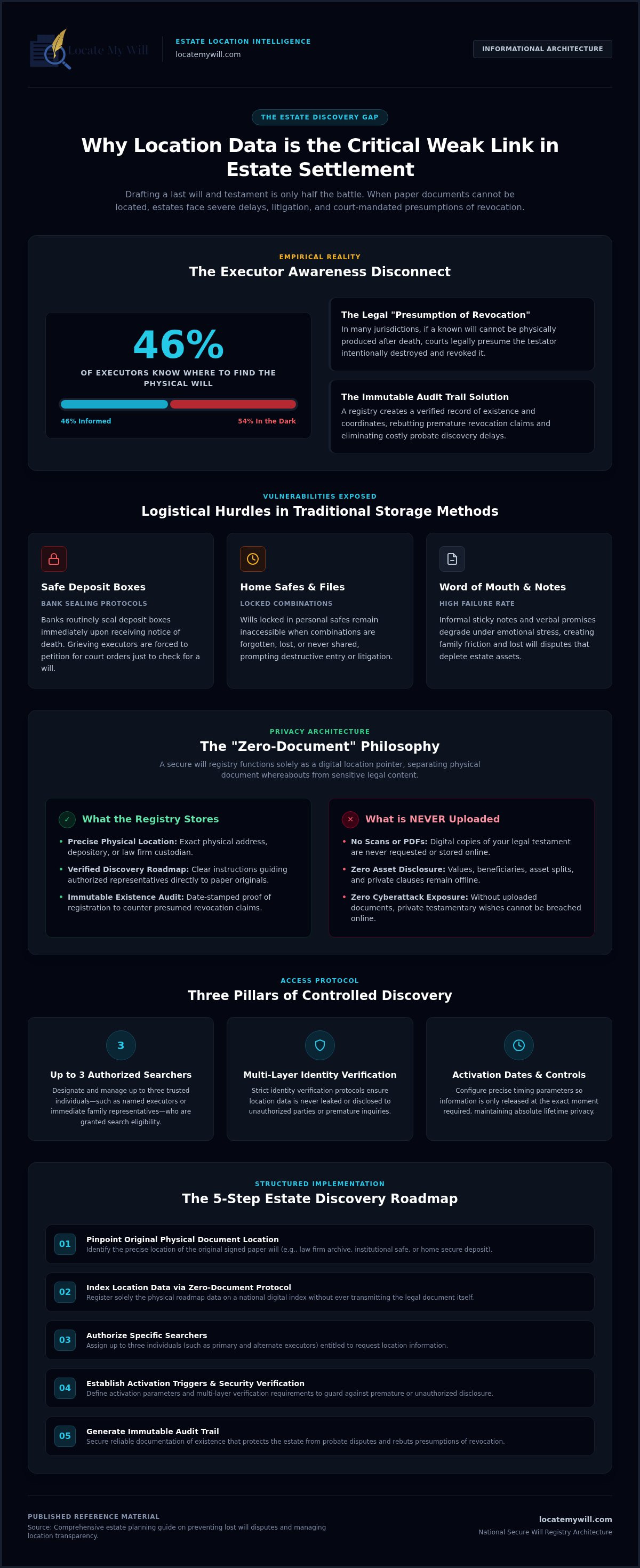
Did you know that only 46% of designated executors actually know where to find the physical will they're tasked with managing? It's a sobering statistic that highlights a common gap in even the most thorough estate plans. You likely feel a deep responsibility to ensure your final wishes are honored, yet the fear of a "lost" document causing family disputes or probate delays is a persistent source of anxiety. It's natural to worry about who can access your information while you're still here and whether your executors will know where to look when the time comes.
This guide explains how a secure will registry functions as a methodical facilitator for your estate, bridging the gap between your current preparations and your family's future needs. By using a registry that focuses on location data rather than document hosting, you can maintain absolute privacy while providing a clear roadmap for your representatives. You'll learn how to manage authorized searchers, set specific activation controls, and gain the peace of mind that comes with a structured, reliable solution for estate discovery. We'll outline the essential steps to protect your legacy and ensure a smooth settlement process for those you leave behind.
Key Takeaways
- Understand why identifying the physical location of your original documents is the most critical step in preventing estate settlement failures.
- Discover how a secure will registry protects your privacy through a zero-document policy that never stores your sensitive legal files online.
- Learn about the logistical hurdles of traditional storage, such as safe deposit box access, and how modern registries offer a more reliable alternative.
- Explore how to manage authorized searchers and set precise activation dates to ensure your information is only released to the right people at the right time.
- Gain a step-by-step roadmap for using a national platform to provide your family with a clear, verified path to your estate documents.
The Role of a Secure Will Registry in Modern Estate Planning
A secure will registry functions as a centralized, digital index that records the exact physical location of your estate documents. It's vital to understand that this service doesn't host or store the documents themselves. Instead, it acts as a reliable pointer for your executors. While many focus on the legal drafting of a last will and testament, the process often fails because the original paper document cannot be located after death. In many jurisdictions, if a known will is missing, the court applies a legal "presumption of revocation," assuming you destroyed it intentionally. A registry record provides an immutable audit trail that can help rebut this claim and ensure your wishes are followed.
Why Document Location is the Weakest Link
Hidden wills often sit in home safes with unknown combinations or in safe deposit boxes that banks seal immediately upon a holder's death. This creates a significant administrative burden for grieving families who must search through personal effects or seek court orders just to begin the probate process. According to research, only 46% of executors are even aware of a will's location. A secure will registry solves the 'discovery gap' in estate law by providing a verified roadmap for authorized representatives. This proactive step is essential for preventing lost will disputes that can deplete an estate's value through litigation.
Defining the Secure Will Registry Service
Professional digital stewardship replaces the unreliable "hope-based" system of leaving notes for family members with a structured database. Access is strictly controlled, ensuring that only identity-verified individuals can see where your documents are kept. This transition from paper-only records to a managed registry is a key part of protecting your will from being lost. By separating the location data from the document itself, you maintain absolute privacy during your lifetime while guaranteeing transparency for your executors when it matters most. It's a methodical approach that prioritizes the integrity of your information and the eventual needs of your estate representatives.
By establishing a clear record now, you remove the guesswork from the estate settlement process. This disciplined approach ensures that your executors aren't left searching through boxes or filing expensive court petitions. Instead, they can proceed with confidence, knowing exactly where to find the documents required to fulfill your final wishes. Organizing this information today is an act of responsibility that provides long-term stability for your family.
How Security and Privacy Protocols Protect Your Information
The "Zero-Document" philosophy is the foundation of a privacy-first registry. By choosing not to host the actual legal document, the platform eliminates the risk of cyberattacks targeting your private testamentary wishes. This approach honors the Legal Information Institute's overview of wills, which details the strict statutory execution formalities required for a will to be valid. Since the registry only stores the physical location and not a digital copy, your privacy remains absolute. It's a robust way to prevent unauthorized access while maintaining a permanent record of where your original documents are kept.
Relying on informal methods like "word of mouth" or "sticky notes" often creates unnecessary stress for families during the estate settlement process. These informal systems are prone to failure, especially when executors are under significant pressure. A secure will registry provides a disciplined framework that removes these vulnerabilities. You'll experience a significant psychological benefit knowing your privacy is maintained during your lifetime. This methodical approach ensures your records are organized and accessible only to those you've specifically authorized.
The Importance of Authorized Searcher Verification
You have the authority to manage up to three specific individuals who have the right to search the registry. They're typically your executors or trusted family members who will handle your affairs. When a search is initiated, the platform employs multi-layered identity verification protocols to confirm the searcher's identity. This prevents unauthorized "fishing" for information by individuals who aren't part of your estate plan. By using strict identity protocols, the secure will registry acts as a reliable guardian of your data and ensures your private information remains in the right hands.
Activation Dates: Controlling Information Release
An activation date acts as a precise security gatekeeper for your information release. By setting a future date, you maintain complete control over when your location data becomes visible to your authorized searchers. This feature protects your current privacy while guaranteeing that the information is accessible exactly when it's required for probate. You can easily adjust these dates as your life circumstances evolve, providing a flexible yet secure solution for long-term planning. If you want to establish these professional safeguards for your own estate, you can set up your secure registry profile to begin the process today.
Comparing Will Registries to Alternative Storage Methods
Traditional methods of document storage often create a difficult paradox for estate owners. You want your will to be safe from prying eyes, yet you need it to be easily discoverable when it's required. A secure will registry acts as the essential bridge in this scenario. By adopting a hybrid approach, you keep your original paper document in a protected physical location while registering its coordinates digitally. This ensures that your protection doesn't come at the cost of accessibility for your heirs, providing a balanced solution that prioritizes both safety and discovery.
Registry vs. Digital Cloud Storage
Many people mistakenly rely on personal email accounts or generic cloud drives to store digital copies of their estate plans. These platforms are frequent targets for cybercriminals, and storing a sensitive PDF there exposes your entire estate plan to the risk of identity theft. Beyond security, these consumer-grade services lack a formal mechanism for transferring access to your executors. If you lose your password or fail to share it, your digital records become effectively invisible. A purpose-built secure will registry operates differently. It focuses on digital stewardship rather than hosting, providing a permanent record that remains accessible to your authorized searchers regardless of personal technology failures.
Registry vs. Physical Safe Deposit Boxes
Safe deposit boxes are a traditional choice, but they present a significant "bank access" hurdle after death. In many cases, a bank won't open a box without the very will that is locked inside it. This circular legal difficulty can stall probate for months while your family seeks court orders. While a safe deposit box provides physical security, it lacks the transparency needed for a smooth transition. A registry provides the "map" that allows executors to identify the correct bank branch and box number immediately. You ensure location transparency without sacrificing physical document security, allowing your representatives to act with confidence and avoid unnecessary administrative delays.
Integrating a registry into your plan is a critical part of how to prepare family for estate settlement. It removes the guesswork from a high-stakes situation and provides your loved ones with a clear path forward. By separating the "where" from the "what," you maintain the integrity of your original documents while providing your family with the clarity they need to honor your wishes. This methodical separation of data and physical assets is the hallmark of modern, disciplined estate planning that protects your legacy for the long term.
Key Criteria for Selecting a National Will Registry
Selecting the right platform to record your document's location requires a focus on long-term reliability and administrative discipline. Modern families are increasingly mobile, often living in different states or moving multiple times over several decades. A secure will registry must offer a national scope to remain effective as your life circumstances evolve. This geographic flexibility ensures that your executors can locate your documents regardless of where you or your beneficiaries reside at the time of your passing. Without this national reach, your estate plan remains vulnerable to the limitations of local record-keeping.
Verification and Subscription Security
A professional registry operates on a subscription-based model to ensure ongoing data integrity and high-level security infrastructure. While "free" services may seem appealing, they often lack the robust protocols required to safeguard sensitive metadata over many years. A paid subscription provides the resources necessary for regular data verification and the maintenance of modern encryption standards. This model also guarantees that your record remains independent of any single law firm's lifespan. By choosing a professional service, you establish a permanent record that outlasts local administrative changes or firm closures, providing a steady and dependable presence for your estate representatives.
Notification Systems for Heirs and Executors
Proactive communication is a vital feature that distinguishes professional platforms from generic government databases. You should prioritize a registry that allows you to designate up to three notification recipients. These automated systems act as a bridge between your current preparations and the eventual needs of your executors. When the time is right, the platform can alert your designated representatives, ensuring they're never left in the dark about where to find your original documents. This methodical approach removes the risk of your will remaining "lost" simply because a family member didn't know a registry existed. It provides a structured, automated path toward a smooth settlement process.
User-controlled search permissions are a non-negotiable security feature for any legitimate registry. You must have the authority to define exactly who is authorized to search and manage the activation dates for when that information becomes visible. This granular control protects your privacy during your lifetime while establishing a verified roadmap for the future. If you're ready to secure your estate's discoverability, you can start your will registration today and designate your authorized searchers within a professional national framework.
Implementing Your Estate Security with Locate My Will
Implementing a secure will registry with Locate My Will is a deliberate step toward organizational excellence in your estate planning. The platform acts as a methodical facilitator, ensuring your preparations are accessible without compromising your current privacy. By following a logical, step-by-step progression, you can establish a reliable backup for your physical documents in minutes. This process transforms abstract planning into a concrete, manageable system for your representatives. It's an act of responsibility that provides a clear bridge between your current wishes and their eventual fulfillment, offering the quiet authority of a well-organized estate.
Setting Up Your Secure Location Record
Start by gathering specific details about where your physical will is stored, such as a home safe, a specific law firm's vault, or a safe deposit box. The online dashboard provides a simple interface for recording these coordinates without ever uploading the sensitive document itself. This zero-document policy is a core pillar of the platform's security model, prioritizing the integrity of your information above all else. It's designed for ongoing management, allowing you to update your record immediately if you move house or change storage methods. This ensures your location data remains accurate and verified over the long term, regardless of how many times your physical circumstances change.
Managing Your Designated Searchers
You can designate up to three specific individuals as authorized searchers to mirror the roles defined in your estate plan. These are typically your executors or close family members who require authorization to access your location data after an activation event. Each searcher undergoes a verification process to ensure only identity-confirmed individuals gain access. You may also appoint up to three notification recipients who'll be alerted when the registry is searched. The platform allows you to add or remove these searchers as your personal relationships or legal representatives evolve. This flexibility is essential for maintaining an accurate reflection of your current estate structure.
Setting precise activation dates is the final step in aligning your registry with your long-term goals. These dates function as a security gatekeeper, ensuring information is only released when it's appropriate and necessary. This methodical approach also complements other essential tasks, such as locating a living trust document, by providing a central reference point for your family. By integrating a secure will registry into your broader strategy, you provide your loved ones with the calm, organized efficiency they'll need to navigate the estate settlement process. You're not just storing data; you're creating a roadmap for a smooth transition that honors your life's work.
Securing the Future of Your Estate Plan
A well-prepared estate plan is only effective if your representatives can find the original documents when they're needed most. By establishing a secure will registry, you provide your family with a clear, verified roadmap while maintaining your current privacy through a zero-document policy. You've learned how a professional national registry overcomes the limitations of safe deposit boxes and generic cloud storage by offering a disciplined system for information discovery. This proactive step ensures that your executors aren't left searching through boxes or facing administrative delays during a sensitive time.
Maintaining a professional subscription ensures your data remains secure and accessible for the long term, providing a stable foundation that outlasts local law firms. You can designate up to three authorized searchers for controlled access and set custom activation dates to ensure your privacy remains intact until the appropriate time. Taking this final step in your planning process demonstrates a profound sense of responsibility toward your legacy and your loved ones. Secure your legacy today by registering your will's location with Locate My Will. You've done the hard work of planning; now ensure those plans are fulfilled with confidence and clarity.
Frequently Asked Questions
What is a secure will registry and how does it work?
A secure will registry is a digital platform that records the precise physical location of your estate documents without storing the documents themselves. You create an account, enter storage details, such as a specific home safe or law firm vault, and designate authorized searchers. This system ensures that when the time is right, your family can identify exactly where your original will is located, eliminating the risk of it being lost or overlooked.
Do I need to upload a copy of my will to the registry?
No, you don't upload any part of your legal document to the registry. The platform operates on a metadata-only architecture, meaning it only stores information about the location and existence of your will. This zero-document policy is a core security feature designed to protect your sensitive personal information from digital theft. By keeping the document offline, you maintain absolute privacy while ensuring your executors have a clear roadmap to the physical original.
Who can see the information I put in a will registry?
Only individuals you specifically designate as authorized searchers can access your location information, and only after they pass identity verification. You can manage up to three searchers within your profile. These representatives cannot view any details until the activation date you've set has passed. This multi-layered approach ensures that your private data remains hidden from unauthorized parties, including other family members or the public, during your lifetime and beyond.
What happens if my family doesn't know I used a registry service?
You can designate up to three notification recipients who'll be alerted when the registry is searched or when specific triggers are met. This feature bridges the communication gap between you and your heirs. It's helpful to inform your executor that you've used a secure will registry as part of your estate plan. These automated notifications ensure that your family isn't left in the dark and knows exactly where to turn for guidance.
Can I change my authorized searchers after I sign up?
Yes, you have full control to update your authorized searchers at any time through your secure dashboard. As your personal relationships or professional representatives change, you can easily add or remove individuals to reflect your current wishes. This flexibility is a standard part of the secure will registry subscription service, allowing you to maintain an accurate and disciplined record of who has permission to locate your essential estate documents when the time comes.
How does an activation date protect my privacy while I am alive?
An activation date serves as a digital gatekeeper that prevents any searches or information release before a specific time. By setting this date into the future, you ensure that your location data remains completely private while you're alive. You can adjust this date as needed, providing a layer of protection against premature discovery. This control allows you to organize your affairs today without worrying about unauthorized access to your storage details tomorrow.
Is a will registry the same as a digital will?
No, a will registry is fundamentally different from a digital will. A digital will is an electronic version of the legal document itself, which many jurisdictions still view with scrutiny regarding original signatures. In contrast, a registry is a secure index that points to the physical, paper-based original. The registry doesn't host files or draft legal language; it simply facilitates the discovery of the physical documents required for the formal probate process.
What should an executor do if they cannot find the original will?
If an executor cannot locate the original document, they should first perform an authorized search through a national registry. Without the physical original, probate courts often apply a legal presumption that the will was intentionally revoked. Finding the original is critical for fulfilling the testator's wishes. A registry provides the verified location data needed to avoid expensive court petitions or family disputes that typically arise when an estate plan is deemed lost or missing.


