

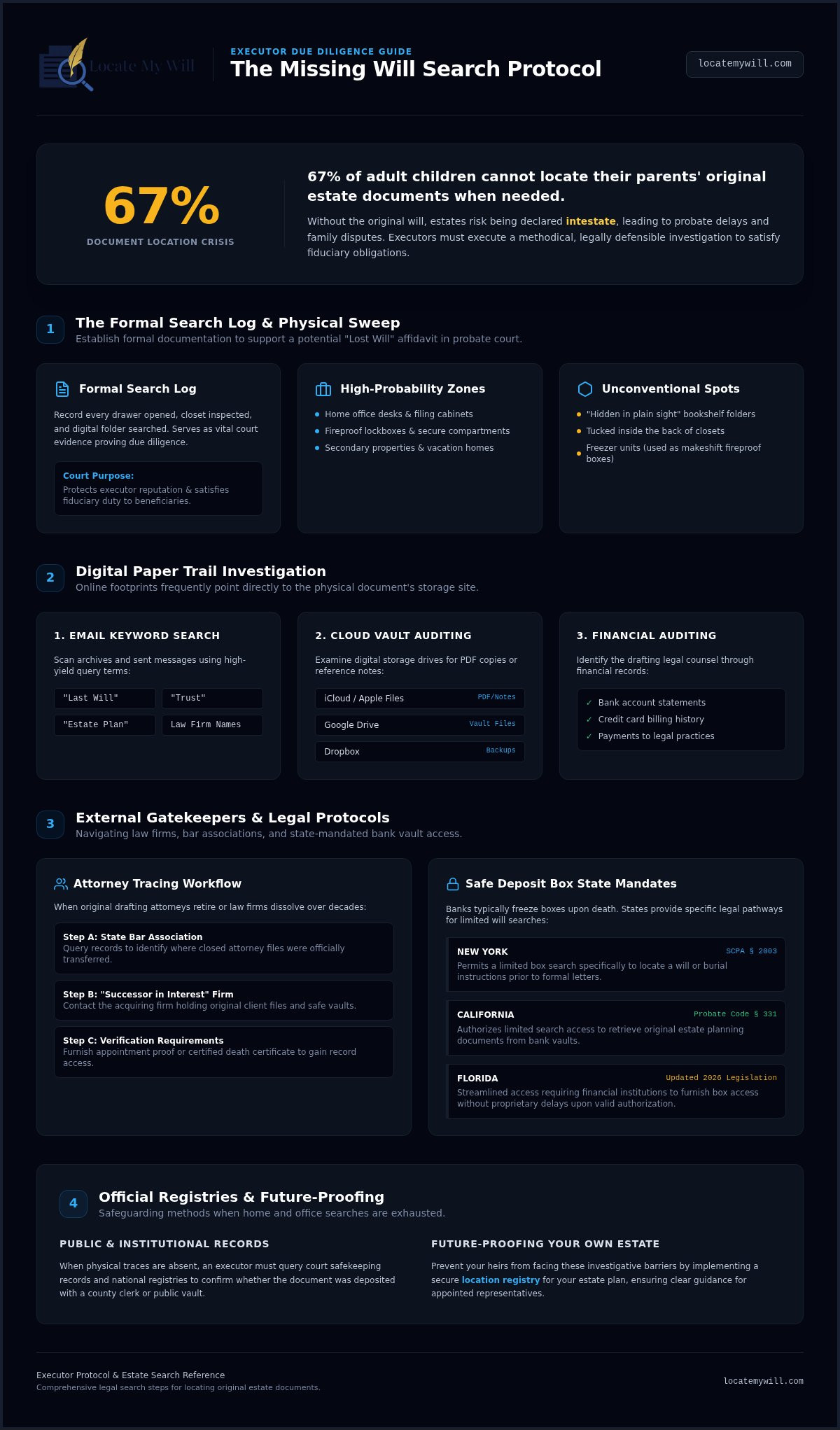
Did you know that 67% of adult children are unable to locate their parents' original estate documents when the need arises? It's a staggering figure that highlights a common crisis for many families. If you're an executor finding the will, you're likely feeling the weight of this responsibility alongside the fear of the estate being declared intestate. The pressure to produce an original document for probate can be overwhelming, especially when family members are anxious for answers and legal deadlines are approaching.
We understand that this process feels like a high-stakes investigation during an already difficult time. You deserve a clear, methodical path forward to alleviate uncertainty and prevent potential family disputes. This article provides a professional, step-by-step protocol to help you conduct a thorough search for the deceased person's will with complete confidence. We'll examine physical hiding spots, digital storage environments, and the institutional layers where documents are often kept. You'll also learn the necessary legal steps to take if the original remains lost, ensuring you fulfill your fiduciary duties with the quiet authority of a reliable guardian.
Key Takeaways
- Establish a formal search log to document every location checked, providing essential evidence should you need to file a "lost will" affidavit later.
- Follow a structured "home office" sweep to prioritize high-probability locations like fireproof boxes, filing cabinets, and secure desk compartments.
- Navigate the professional protocols required to coordinate with drafting attorneys and access safe deposit boxes according to state-specific mandates.
- Utilize national registries and court safekeeping records to assist an executor finding the will when physical searches at home prove unsuccessful.
- Implement a secure location registry for your own estate planning to ensure your chosen representatives don't face these same investigative hurdles.
The Executor’s Initial Search Protocol: Where to Start Looking
The search for a last will is a methodical investigation. It isn't a scavenger hunt. Your first task is to establish a formal search log. This document records every drawer opened, every closet inspected, and every digital folder searched. If the original document isn't found, this log serves as vital evidence for the probate court to prove you've exhausted all reasonable efforts. As an executor finding the will, your organized approach protects the estate's integrity and your professional reputation. Documenting these steps ensures that you can justify your actions to both beneficiaries and legal authorities.
Immediate Physical Locations and 'The Safe' Dilemma
Begin with a comprehensive "home office" sweep. Focus on desks, filing cabinets, and fireproof boxes. Many individuals store their most sensitive documents in "hidden in plain sight" folders within bookshelves or tucked inside the back of closets. You might even find documents in unconventional spots like the freezer, which some use as a makeshift fireproof container. If you encounter a locked safe with an unknown combination, don't attempt to force it open immediately. Instead, look for a written code in a password manager or a key hidden in a desk drawer. Maintaining a detailed record of your efforts is a core part of the fiduciary responsibilities of an executor, as it demonstrates due diligence to the court. Remember to check secondary properties or vacation homes, as documents are sometimes moved during seasonal transitions.
The Digital Paper Trail: Emails and Cloud Storage
In our modern environment, the paper trail often begins online. Use a targeted keyword search strategy within the deceased's email archives. Search for terms like "Last Will," "Trust," "Estate Plan," or the names of local law firms. If you can access their computer, check for digital "vaults" or cloud storage accounts like iCloud, Google Drive, or Dropbox. Testators often leave a simple text file or a PDF copy that identifies where the physical original is stored. You can also identify the drafting attorney by reviewing digital bank statements or credit card histories for payments made to legal professionals. This digital footprint often provides the "map" needed to locate the physical document. If you find a mention of a location registry, it will significantly simplify your role as the executor finding the will by providing a direct path to the original paperwork.
Professional Inquiries: Contacting External Gatekeepers
If your initial sweep of the home proves unsuccessful, your next step involves engaging with the professional network the deceased maintained. This phase requires persistence. Many individuals rely on their drafting attorney or financial advisor to safeguard their original documents. For an executor finding the will, these external gatekeepers are often the most reliable source for locating the physical original or, at the very least, a certified copy that can point you toward the vault's location.
Tracing Retired Attorneys and Closed Law Firms
The drafting attorney is the logical starting point. However, law firms often merge, close, or reorganize over several decades. If the attorney listed on old documents is no longer practicing, contact the state bar association. They maintain records of where a retired attorney's files were transferred. Often, a "Successor in Interest" firm will have acquired the original files and vaults of a defunct practice. You'll need to provide proof of your appointment or a death certificate to verify your authorization to receive these records. This search is a mandatory part of the court probate process, as it demonstrates you've sought the document from its primary creator.
Financial Institutions and Safe Deposit Box Access
The bank vault is a common destination. It's also one of the most difficult to access. Banks typically freeze safe deposit boxes immediately upon learning of a holder's death. To conduct a search, you'll need a certified death certificate and proof of identity. Some states, such as New York under SCPA § 2003 or California under Probate Code § 331, allow for a limited search of a box specifically to locate a will or burial instructions before formal letters are issued. In Florida, updated 2026 legislation has streamlined this, requiring institutions to furnish access without proprietary delays once valid authorization is presented. Be prepared for the "Catch-22" where the bank requires letters testamentary to open the box, but the court requires the will inside the box to issue those letters. A court order for a "will search" is the standard solution to this hurdle.
Don't overlook other professional contacts. Reach out to the deceased's accountant, financial advisor, or even former employers. Many companies keep records of estate planning benefits or beneficiary designations that might lead you to the current version of the will. If this professional search feels overwhelming, it's a reminder of why many families now use a secure location registry to ensure their representatives have immediate, authorized access to document locations. This methodical outreach ensures that as the executor finding the will, you've left no professional stone unturned before moving to public records.
Official and Public Search Methods: Beyond the Home
When private searches of the home and professional networks don't yield results, an executor finding the will must turn to official public records and national databases. It's a common misconception that wills are only accessible after probate begins. In reality, many proactive testators utilize court storage services or commercial registries to ensure their final wishes are discoverable. This phase of the search protocol requires a transition from physical investigation to administrative inquiry. You'll need to coordinate with government clerks and verify your status as an authorized representative to access these secure records.
Searching Probate Court Records
Many jurisdictions offer a "will lodging" service where individuals can file their original documents for safekeeping with the local Probate Court or Surrogate’s Court before death. This is an administrative storage process, not a public disclosure of assets. To request a search, you must typically present a certified death certificate and valid identification to the clerk of the court in the county where the deceased resided. If you're unsure about the local requirements, reviewing a detailed protocol on how to find a deceased person's will can help you distinguish between a document "lodged" for safekeeping and one that has already been entered into the formal probate record. Some courts charge a nominal fee for this search, but it provides a definitive answer regarding any documents held in state custody.
Commercial Will Registries and Databases
Modern estate planning has moved toward centralized digital solutions that bridge the gap between a private residence and a law firm's vault. Commercial registries act as a secure "map" for the estate. These platforms don't usually host a digital version of the will. Instead, they record the exact physical location of the original document and the contact details of the drafting attorney. For an executor finding the will, checking these databases is a critical step in a professional search protocol. These registries utilize an "Authorized Searcher" verification system. This security layer ensures that location data is only released to the designated executor after a specific activation date or upon proof of the testator's passing. This methodical approach protects the owner's privacy while providing a clear path for their representatives when the time comes.
If these methods fail, consider reaching out to local bar associations. Many associations allow you to place a "lost will" advertisement in their weekly or monthly legal publications. This reaches thousands of local practitioners who may have the original file in their firm's archives. Additionally, don't overlook the County Clerk’s office. While they primarily handle property deeds, older estate records or historical property transfers sometimes include references to testamentary documents that were recorded alongside real estate transactions. Each of these public methods adds a layer of due diligence to your search, ensuring you've exhausted every official avenue available.
Overcoming Barriers: What to Do if the Will Remains Missing
When a thorough investigation yields no original document, the legal landscape shifts from search to substantiation. An executor finding the will often faces a significant hurdle known as the presumption of revocation. In most jurisdictions, such as under California Probate Code § 6124 or New York SCPA § 1407, the court assumes that if an original will was last in the deceased's possession and cannot be found, they destroyed it with the intent to revoke it. To move forward, you must present clear and convincing evidence to the court that the document was accidentally lost, destroyed by disaster, or still treated as active by the decedent until their passing.
The Legal Doctrine of Lost Wills
The Lost Will doctrine is the legal process of proving a missing document's validity through testimony and copies. This procedure requires more than just a photocopy of the signed document. You must typically provide affidavits from the original witnesses or the drafting attorney to verify the will's execution and contents. The court will scrutinize these statements to ensure the "lost" version accurately reflects the testator's final wishes. Understanding the consequences of a lost will for beneficiaries is vital during this stage, as a failed petition can lead to significant financial and emotional strain for the family. If the court isn't satisfied with the evidence, it will dismiss the petition to probate the copy.
Intestacy Proceedings: The Default Path
If the original document remains missing and a copy cannot be proven valid, the estate enters intestacy. This means state law determines asset distribution based strictly on statutory lineage rather than the deceased's personal intentions. Intestacy often disregards unproven verbal wishes, charitable bequests, or specific heirlooms intended for friends. This default path typically involves:
- Increased legal costs due to additional court oversight and bonding requirements.
- Extended timelines as the court identifies all legal heirs according to state succession laws.
- Potential family disputes when the statutory distribution differs from what the family expected.
Managing these family expectations requires a high degree of transparency and professional distance. Without a valid document, your role may shift from executor to a court-appointed administrator. To prevent these legal hurdles for your own family, you can record your will's location today. Ensuring your own representatives have a clear map to your original documents is the most effective way to avoid the complexities of the lost will doctrine and the rigidity of intestate succession.
Future-Proofing for Your Own Estate: Ensuring Your Executor Succeeds
The investigative journey described in this guide highlights a critical reality in modern estate planning. Having a valid will is only half the battle. If your representatives cannot locate the physical original, your carefully drafted wishes may never be fulfilled. For an executor finding the will, the difference between a seamless probate and a years-long legal struggle often comes down to the existence of a clear, verifiable map. By taking proactive steps now, you ensure that your own executor isn't left guessing where your documents are stored. You have the opportunity to transform a potentially chaotic search into a structured, efficient process.
The Role of a Secure Will Location Registry
A secure location registry acts as the essential bridge between your private preparations and your executor's future needs. Recording the physical location of your document is just as important as the drafting process itself. These registries don't host a digital version of the document, which maintains your privacy and ensures the integrity of the physical original. Instead, they provide authorized access to location data only when the need arises. You can control this access through activation dates, ensuring your data remains locked until a specific time or event. For a complete walkthrough on setting this up, you should consult the register will location online guide. This systematic approach effectively eliminates the "lost will" crisis for the next generation.
Managing Your Authorized Searchers
The security of your estate plan depends on the individuals you designate to access your information. When you select your Authorized Searchers, choose responsible representatives who understand the gravity of their role. These individuals will be the ones responsible for an executor finding the will when the time comes. It's your responsibility to keep this registry information current as your life changes. If you move to a new residence, change law firms, or rent a new safe deposit box, update your registry entry immediately. In a society where people frequently change addresses, a static note in a desk drawer isn't a reliable solution. A subscription-based registry provides a persistent, centralized resource that moves with you. It acts as a permanent anchor for your estate plan, ensuring that your executor has a reliable point of contact regardless of how many times you change addresses or legal counsel.
Take control of your legacy and provide your family with the peace of mind they deserve. Your proactive planning today prevents the legal hurdles of tomorrow. Register your will's location today with Locate My Will to ensure your final wishes are never lost to time or disorganization.
Securing the Path for Your Future Representatives
Administering an estate requires a disciplined investigation. You've learned that a systematic protocol, starting with a meticulous home sweep and extending to professional gatekeepers, is the most reliable way to fulfill your duties. While legal doctrines for lost documents provide a fallback, they're often costly and complex. As an executor finding the will, your primary objective is to secure the original document to ensure the probate process moves forward without unnecessary delay.
The most effective way to protect your own legacy is to provide your representatives with a clear map. By using a national US-wide registry, you can record the exact location of your documents and manage an Authorized Searcher verification system. This proactive step offers lasting peace of mind for family members and ensures your final wishes are never left to chance. Ensure your executor can find your will—register its location now at LocateMyWill.com. Your careful planning today is the greatest gift of security you can leave for the people you trust.
Frequently Asked Questions
Can an executor be held liable if they cannot find the original will?
An executor or custodian can be held personally liable for court costs and attorney fees if they fail to deposit an original will within the statutory deadlines. States like Florida require delivery within 10 days of notice of death, while California grants 30 days. While you aren't responsible for the document being lost before you were appointed, you must demonstrate that you performed a diligent search to avoid claims of fiduciary negligence.
Is a photocopy of a will legally valid in court?
A photocopy is not automatically valid in probate court because its presence often triggers a legal presumption that the original was intentionally destroyed. To use a copy, you must prove the original was lost or accidentally destroyed through a "lost will" proceeding. This requires testimony or affidavits from witnesses and the drafting attorney. Without this clear evidence, the court will likely distribute the estate according to state intestacy laws.
How much does it cost to have a professional search for a lost will?
Costs for a professional search vary depending on the depth of the investigation and the tools used. Some commercial registries charge a one-time fee for a national database search, while others include search capabilities within a broader subscription service. You may also face court fees for filing a search petition or fees for legal notices in bar association journals. These costs are generally treated as administrative expenses and are reimbursable from the estate's assets.
What happens if the executor finds the will after probate has already started?
If you discover a will after probate has already started, you must immediately notify the court and all interested parties. The court has the authority to admit the newly discovered document and revoke the previous administration if the document is proven valid. This often leads to a redistribution of assets and increased legal fees. An executor finding the will after the initial filing must act decisively to ensure the deceased's actual wishes are honored.
How do I find out if a will exists for free using public records?
You can search for a will for free by contacting the clerk of the Probate Court or Surrogate’s Court in the county where the deceased lived. Many courts allow testators to lodge their wills for safekeeping during their lifetime. While the search itself is usually free, you'll need to provide a certified death certificate to prove your authority. Additionally, you can check the County Clerk’s office for references to testamentary documents in property records.
Can I open a deceased person's safe deposit box without a will?
Most states allow for a limited opening of a safe deposit box specifically to search for a will or burial instructions before probate is opened. In jurisdictions like California or Florida, you can access the box by providing a death certificate and proof of identity to the bank. If the bank refuses, you may need to petition the court for a "will search" order. This allows a bank officer to inventory the box in your presence.
How long should an executor search for a will before giving up?
You should search for a will as long as necessary to meet the "diligent search" standard required by the court, typically within the first 30 days. Once you have followed a systematic protocol, checked all physical and digital locations, and queried professional gatekeepers, you can document these efforts in your search log. If the document remains missing after these exhaustive steps, you can then move forward with a lost will petition or intestate administration.
Does an online will registry actually hold the digital file of the will?
No, a professional registry like Locate My Will does not host digital files or copies of the document itself. It functions as a secure location registry that provides a "map" to the physical original. This structure protects the owner's privacy while ensuring that an executor finding the will has a verified point of contact. By recording the exact storage location, you prevent the administrative hurdles that arise when original documents cannot be found.


