

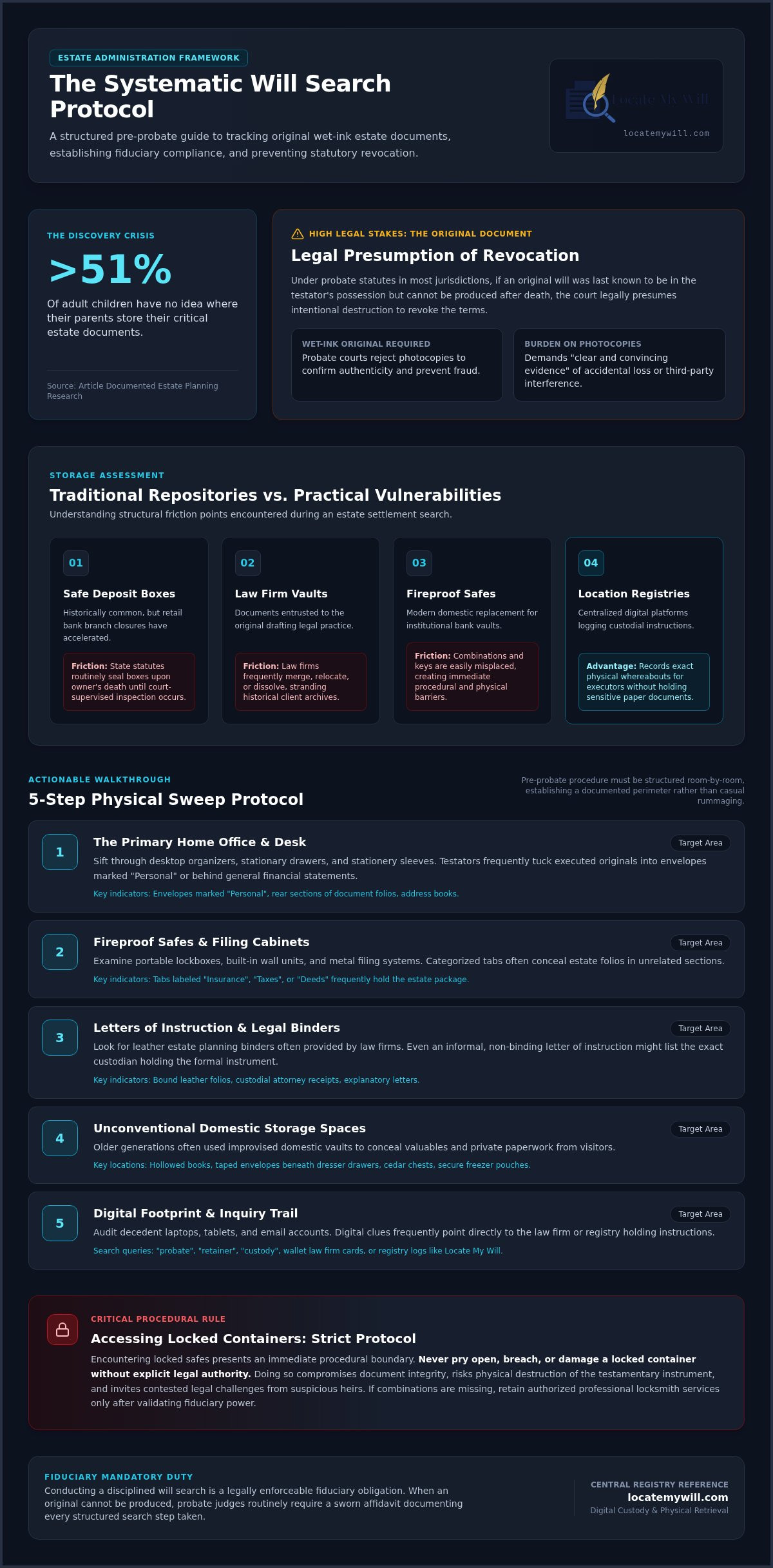
More than 51% of adult children have no idea where their parents store their estate documents. If you open a desk drawer and find empty folders, you aren't alone. Wondering whether a document even exists, or staring at a locked safe without a key, creates immediate anxiety for grieving families. Knowing how to search for a will through a disciplined, methodical process is the only reliable way to cut through that uncertainty and protect the estate from administrative chaos.
You shouldn't have to guess where critical paperwork ended up or worry about court complications from a misplaced original. Follow this professional protocol to locate a last will and testament, tracing an orderly path from personal property and safe deposit boxes to custodial attorney vaults and national registries. Ahead, you'll find a clear checklist and a step-by-step hierarchy of searches designed to locate the verified document so you can begin probate without delay.
Key Takeaways
- Understand why probate courts require the wet-ink original document and how relying on photocopies can delay estate settlement.
- Learn how to search for a will systematically across personal property, targeting concealed lockboxes, desks, and home filing systems.
- Trace professional legal connections by auditing financial records, bank statements, and bar association inquiries to identify the drafting attorney.
- Distinguish between documents deposited with court clerks for pre-death safekeeping and instruments formally lodged after death for probate.
- Discover how secure national registry platforms bridge the gap between physical paper storage and modern digital location retrieval.
Understanding Common Will Storage Locations
A formal will search is the structured administrative process of locating the original, signed testamentary instrument required to initiate estate settlement. Probate courts generally reject photocopies, demanding the wet-ink document to confirm authenticity and prevent fraudulent claims. For a nominated executor, conducting a diligent search is not simply a practical task; it is a mandatory fiduciary duty. When an executor cannot produce the document, probate judges frequently require a sworn affidavit detailing every step taken to locate it. Mastering how to search for a will requires unraveling the tension between security and accessibility. To safeguard personal privacy, testators often hide paperwork in obscure places, unwittingly creating severe obstacles for their representatives.
Traditional Storage vs. Modern Solutions
Estate planning storage practices have shifted significantly. For decades, testators routinely deposited documents in bank safe deposit boxes or entrusted them to their drafting lawyer. In 2026, these options introduce practical friction. Retail bank closures have accelerated, and state statutes routinely seal boxes upon the owner's death until court-supervised inspections can occur. Law firms also merge, relocate, or dissolve, leaving archived client papers difficult to track down. While fireproof home lockboxes have largely replaced institutional vaults, combinations and keys are easily misplaced. These vulnerabilities have fueled the adoption of centralized digital location registries, which record the exact physical whereabouts of documents without holding the paper itself.
The Legal Significance of the Original Document
The stakes of this physical search are legally decisive. Under probate statutes across most jurisdictions, if an original document was last known to be in the testator's possession but cannot be found after death, courts apply a legal presumption of revocation. The law assumes the testator intentionally destroyed the document to revoke its terms. While some states permit petitions to probate a copy, doing so requires clear and convincing evidence proving accidental loss or third-party interference.
The original will serves as the exclusive instrument carrying the testamentary seal recognized by the court to grant probate. Learning how to search for a will methodically helps executors locate the verified last will and testament, protecting the estate from contested hearings and unwanted statutory distribution.
A Systematic Protocol for Searching Personal Property
Most public guides assume estate paperwork has already reached the courthouse. In reality, executors must execute an exhaustive pre-probate physical search before any legal filing can occur. Knowing how to search for a will across personal effects requires a structured room-by-room sweep rather than casual rummaging. Begin by establishing a documented perimeter, moving through the property methodically:
- Step 1: The Primary Home Office and Desk. Sift through desktop organizers, stationary drawers, and stationery sleeves. Testators frequently tuck executed originals into envelopes marked "Personal" or behind general financial statements.
- Step 2: Fireproof Safes and Filing Cabinets. Examine portable lockboxes, built-in wall units, and metal filing systems. Categorized tabs labeled "Insurance," "Taxes," or "Deeds" often conceal estate folios.
- Step 3: Letters of Instruction and Binders. Look for leather estate planning binders often provided by law firms. Even an informal, non-binding letter of instruction might list the exact custodian holding the formal instrument.
- Step 4: Unconventional Storage Spaces. Older generations often used improvised domestic vaults. Search hollowed books, taped envelopes beneath dresser drawers, cedar chests, and secure freezer pouches.
- Step 5: Digital Inquiries. Review personal laptops, tablets, and email archives for exchanges referencing legal appointments or custodial repositories.
Searching the Home Office and Digital Footprint
A testator's workspace often yields navigational clues rather than the document itself. Audit browser history, password vaults, and email search bars for queries like "probate," "retainer," or "custody." Check physical address books and wallets for law firm business cards. If the decedent maintained forward-looking arrangements, check whether they utilized an online tool like Locate My Will to log custodial instructions for designated representatives.
Accessing Locked or Secured Containers
Encountering locked safes presents an immediate procedural boundary. Never pry open, breach, or damage a locked container without explicit legal authority; doing so can compromise document integrity and invite challenges from suspicious heirs. If a home safe lacks an accessible combination, a professional locksmith will require proof of death and evidence of your executor nomination before providing safe cracking assistance.
Bank safe deposit boxes carry even stricter statutory protocols. Most jurisdictions seal sole-lessee boxes immediately upon receiving death notices. Many state statutes permit nominated executors limited, supervised access to inspect the interior solely for testamentary instruments. If an original document is found, bank officers typically mail it directly to the local court clerk. While individuals in the UK can easily search official probate records through central government services after filing, managing unprobated private boxes in the United States requires navigating these precise institutional steps first.
Searching Professional and Legal Channels
When domestic searches come up empty, executors must shift their focus to the professional advisory circle. Legal and financial professionals routinely assist with document creation, making their archives prime ground for recovery. Finding the specific professional who drafted the instrument takes targeted investigative work. If you don't know who prepared the documents, audit five to seven years of cancelled checks, bank statements, or credit card ledgers for disbursements to law firms or legal service groups.
Reach out to the decedent's Certified Public Accountant (CPA), bookkeeper, or wealth management advisor. These professionals often retain copies of estate planning instruments for annual tax planning, gift structuring, or beneficiary alignment. If you locate a signed copy among accountant workpapers, it can provide two vital breakthroughs: identifying the drafting firm named on the cover page and serving as evidence if court proceedings for a lost original become unavoidable. You can also contact local or county bar associations to publish a formal "Will Search Notice" in their regional member bulletins to alert practicing local attorneys.
Contacting the Drafting Attorney
Once you identify a law firm, establish direct contact with a specific, direct inquiry: "Did your office prepare the estate plan for the decedent, and do you retain the wet-ink original document or merely an office reference copy?" Law firms often hold client originals in secure fireproof vaults. If the drafting practitioner has retired or died, request contact details for the successor firm that inherited their custodial files and safe-deposit records. Releasing the original requires providing a certified copy of the death certificate and valid government identification proving your status as the nominated personal representative.
Financial Institutions and Safe Deposit Boxes
Locating a safe deposit box key without associated account paperwork requires requesting institutional balance and asset confirmations from banks where the decedent held checking or savings accounts. State banking regulations strictly forbid tellers from releasing general contents before formal court appointment. However, most jurisdictions permit a specific "Search for Will" proceeding.
Under this statutory procedure, the probate court issues an order granting an interested party supervised access to examine the box. A bank officer attends the opening, inspects the compartment exclusively for testamentary documents, and delivers any found will directly to the court clerk. If you need step-by-step guidance on organizing these inquiries, consult The Executor's Guide to Finding the Will: A Systematic Search Protocol. Executing these formal steps protects you from procedural missteps while mastering how to search for a will across institutional channels.
Accessing Public Records and Private Registries
A widespread misconception among families is that an unprobated will is already part of the public record. In reality, a testamentary instrument remains an entirely private document until someone formally submits it to the court clerk. Understanding how to search for a will across institutional databases requires distinguishing between two separate court filings: documents lodged for post-death probate and those deposited for pre-death safekeeping. If an estate hasn't been opened yet, checking general public archives won't yield results.
Probate Court and Public Archives
Some county probate courts allow residents to deposit an original will with the court clerk for confidential safekeeping during their lifetime. These instruments remain sealed in secure court vaults until the testator dies or formally withdraws them. To search these archives, an executor must contact the probate or surrogate court clerk in the specific county where the decedent resided. You must provide a certified death certificate and government-issued identification to unseal any existing safekeeping record. State-managed repositories are fragmented across thousands of local jurisdictions, meaning a search in one county will not reveal records deposited in a neighboring district.
Private Registries: The First Digital Stop
Because government records rarely centralize private estate documents before probate begins, modern executors prioritize national private registries as their first administrative inquiry. A private location registry maintains critical metadata, identifying the exact physical repository of a document without storing the legal instrument itself. This structure avoids digital security risks while eliminating the blind domestic searches that exhaust grieving families.
Platforms like Locate My Will solve the visibility problem while strictly guarding client privacy during life. Through authorized searcher management and search activation date controls, access to location records remains restricted until specified conditions are met. This controlled protocol prevents premature inquiries while ensuring nominated personal representatives can locate vital documents without delay.
Checking a centralized registry saves weeks of administrative friction. It prevents the costly legal petitions, court appearances, and bank coordination fees required to conduct supervised safe deposit box searches. If you are stepping into estate management duties, search the Locate My Will national registry to confirm whether the decedent recorded their custodial instructions before initiating costly court motions.
Preventing a Lost Will: The Modern Registry Solution
When an original will goes missing, the fallout ripples far beyond delayed court calendars. Families face administrative gridlock, escalating legal fees, and the emotional distress of watching an estate fall into statutory intestacy. Relatives are left to question whether genuine wishes were disregarded simply because a physical folder could not be retrieved. The root cause is rarely that an estate plan was never created; rather, physical paperwork remains isolated from modern communication channels. Locate My Will resolves this vulnerability by functioning as a centralized custodial directory that connects physical storage with verified personal representatives.
How Locate My Will Protects Your Legacy
Rather than uploading digital copies or hosting electronic documents, the platform records only the precise physical repository of the original instrument. This distinct boundary protects family privacy while creating a permanent roadmap for representatives.
- Search Activation Date Control: Testators establish specific activation dates, ensuring custodial coordinates remain strictly confidential throughout life and become accessible only when appropriate.
- Authorized Searcher Management: Account owners designate vetted individuals, such as nominated executors, permitting only authorized parties to retrieve storage directions.
This disciplined structure ensures procedural transparency without exposing personal files to premature review. For detailed implementation advice, read our Register Will Location Online: Estate Security Guide.
Next Steps for Executors and Owners
For an executor, mastering how to search for a will begins by checking centralized registries to determine whether the decedent recorded their custodial instructions. If an account exists and your access is active, querying the platform immediately reveals where the wet-ink document resides, bypassing the stress of locked safes or uncommunicative institutions.
For estate owners, a Will Owner Registration Subscription completes your planning responsibilities. Executing a comprehensive document protects your heirs only if they can find the paper original. Take the definitive step to safeguard your estate: Register your will's location today to protect your family's future.
Bring Certainty to Your Family's Estate Planning
Locating an original testamentary document doesn't have to devolve into an overwhelming ordeal. Following a disciplined search hierarchy, from domestic files and legal advisors to institutional records, ensures you fulfill your fiduciary duties while honoring a loved one's true intent. Understanding how to search for a will with an organized protocol eliminates costly guesswork, protects the estate from probate delays, and provides clarity during a difficult season.
The best way to ease this future burden is preparation today. As a dedicated national registry for US estate documents, Locate My Will connects physical paper storage with modern digital oversight. With strict authorized searcher protocols and secure search activation date controls, your private instructions remain protected until your designated representative needs them. Take control of your legacy now: Ensure your family can find your will with Locate My Will and give your heirs lasting peace of mind.
Frequently Asked Questions
How do I find out if a will exists for free?
You can find out if a will exists for free by conducting a methodical audit of the decedent's home office, tax binders, email accounts, and check registers. Speak directly with family accountants, financial planners, and trusted relatives, as contacting these individuals costs nothing. You can also contact the clerk of the local probate court to ask if a document was deposited for pre-death safekeeping.
Can I search for a will online using a social security number?
No, there is no centralized government database or public lookup tool where you can enter a Social Security number to view a will. Privacy laws strictly prevent testamentary records from being indexed by Social Security numbers. Instead, learning how to search for a will requires querying private location registries by legal name or checking local county court archives directly.
What happens if a will is lost and no one can find the original?
If the original document cannot be located, probate courts apply a legal presumption that the testator intentionally destroyed and revoked it. Without the wet-ink original, the estate typically passes under state intestacy laws, distributing property to statutory heirs. Probating a photocopy requires filing a formal lost-will petition supported by clear evidence that the original was lost accidentally.
Is a will a public record that anyone can search for?
A will is never a public record during a person's lifetime, nor immediately upon their death. It only becomes an accessible public record after an executor formally delivers the document to the court clerk to initiate probate. Prior to that court filing, estate plans remain private, accessible only to designated custodians, named personal representatives, or court-ordered investigators.
How do I find my parents' will if they never told me where it was?
Begin by checking home workspaces, fireproof lockboxes, and financial statements for recurring bank safe deposit box fees or disbursements to law firms. Contact their accountant or financial advisor, who often retains copies or knows the drafting attorney. Finally, check whether they logged their custodial coordinates on an online location registry like Locate My Will before starting probate.
How long does a 'diligent search' for a will usually take?
A thorough diligent search typically takes two to four weeks. This timeframe accommodates sweeping personal real estate, contacting financial institutions, requesting attorney vault verifications, and waiting for local bar association member notices to run. Keep an organized administrative log of every inquiry, because probate courts often require a sworn affidavit of diligent search before allowing alternative proceedings.
Can a lawyer tell me if they have a copy of a loved one's will?
An attorney can confirm whether they hold estate documents, but strict confidentiality rules dictate when and to whom they release information. Before death, an attorney cannot disclose details without the client's consent. After death, the law firm will release the original document or discuss its terms only after you provide a certified death certificate and prove you are the nominated executor.
What is a will registry and how does it help in a search?
A will registry is a secure directory that records the physical location of an estate document without hosting the legal instrument itself. When determining how to search for a will, checking a national registry like Locate My Will connects designated searchers with exact storage details once preset activation dates pass, eliminating domestic guesswork while keeping private family records secure.


