

The most expensive estate plan is often the one your family cannot locate. When evaluating your baseline will registration cost, it's easy to wonder whether paying to record your document's physical whereabouts is truly necessary, especially if you assume probate courts automatically maintain these records. In reality, public authorities rarely operate mandatory registries for living testators, which leaves executors vulnerable to searching blind if your original wet-ink paperwork cannot be found.
It's completely natural to feel confused about the practical distinction between submitting a will for probate after death and actively recording its storage location during your lifetime. This guide outlines what will registration costs across court safekeeping depositories and modern location registries, showing you how to protect your estate cost-effectively. We'll compare traditional court deposit fees with dedicated location platforms, evaluate the financial risks of missing paperwork, and outline clear steps to ensure your designated representatives access your directives without costly delays or legal overhead.
Key Takeaways
- Distinguish between post-death probate filings and lifetime location recording to prevent procedural confusion and ensure your documents remain accessible.
- Evaluating your overall will registration cost requires balancing nominal statutory court deposit fees against the flexible privacy controls offered by modern location registries.
- Understand why physical court safekeeping often introduces administrative hurdles for executors, whereas subscription location platforms provide controlled searcher permissions and specified activation dates.
- Uncover the severe financial liabilities of an unrecorded estate plan, including the high legal costs and bond requirements triggered by lost document presumptions.
- Establish a practical, multi-layered safekeeping strategy that pairs secure physical storage with confidential digital location tracking without ongoing legal expenses.
Understanding Will Registration Cost: Public Filings vs. Location Registries
Evaluating your potential will registration cost begins with distinguishing between two completely separate legal procedures: recording information during your lifetime and submitting documents for probate after death. Many individuals mistakenly believe that executing a will requires immediate filing with a government agency. In practice, public probate filing occurs only after a testator passes away, initiating the formal court supervision of an estate. Lifetime registration, by contrast, focuses entirely on ensuring that authorized representatives can pinpoint the physical original when that time comes.
What Does Registering a Will Actually Mean?
Registering a will doesn't mean publishing private family directives or uploading document text to a searchable public archive. Instead, it serves as an administrative safeguard. A registry records the physical coordinates of your original paperwork, such as a secure home safe or an attorney's repository. Reviewing last will and testament fundamentals reveals that formal legal validity depends strictly on statutory signing and witnessing requirements, not on whether the document is recorded with an official registry. An unregistered will remains completely valid, yet unindexed documents face a high risk of being misplaced or overlooked entirely.
Court Safekeeping vs. Independent Location Registries
To understand what your overall will registration cost covers, you must choose between two distinct approaches: physical court safekeeping and independent digital location indexing.
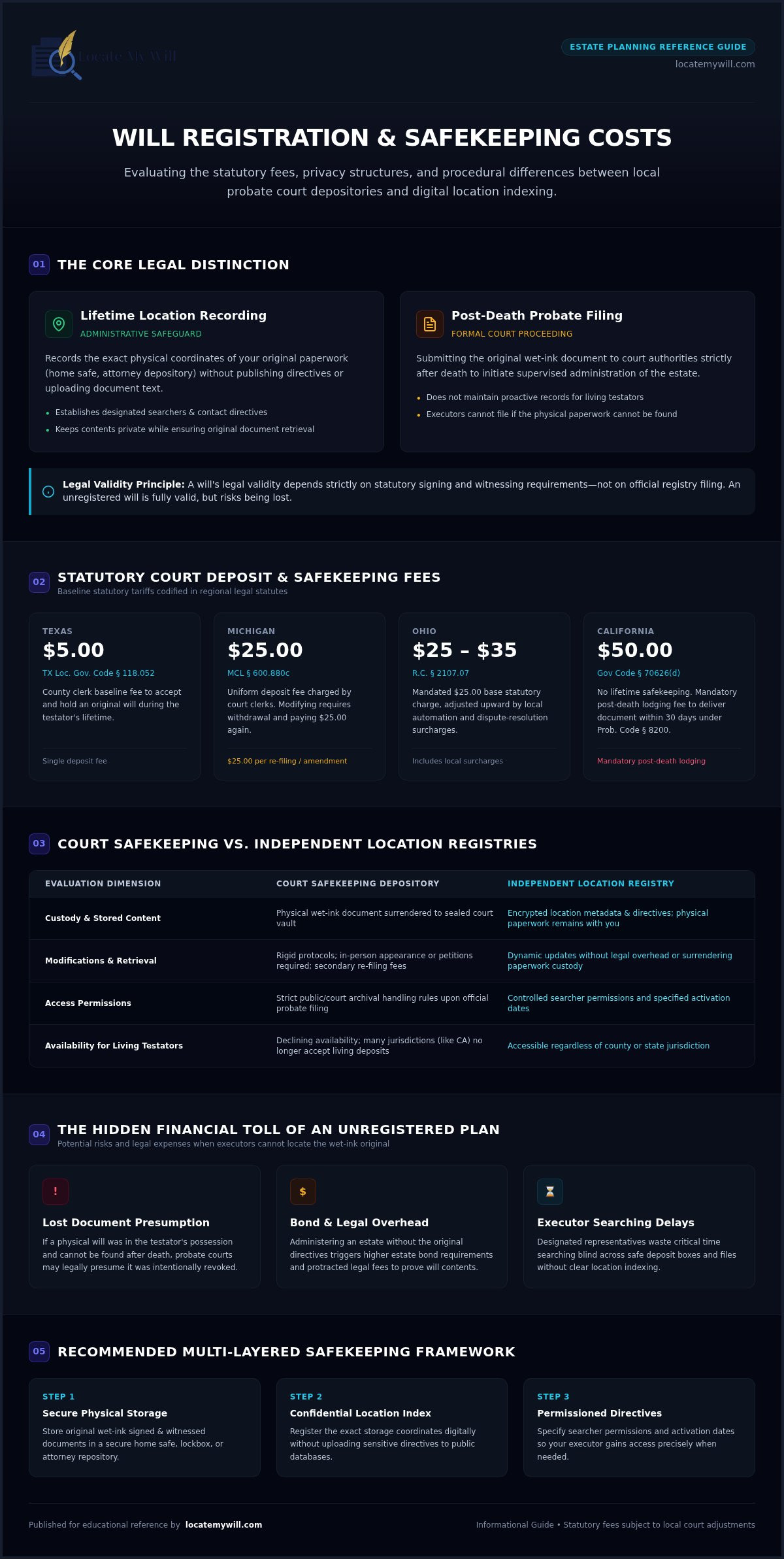
- Court Safekeeping Depository: Certain regional probate courts allow living testators to deposit their physical wet-ink document into a sealed vault. While this secures the paper from domestic hazards, retrieval protocols are exceptionally rigid, often requiring in-person appearances or formal court petitions just to execute minor updates.
- Independent Location Registries: Modern location platforms don't accept physical paperwork or host digital document copies. Instead, they store encrypted location records and contact directives. This framework allows you to manage designated searchers and dynamic access permissions privately, without surrendering physical custody of your paperwork or placing details in public view.
Distinguishing between these models ensures you select a process that aligns with your family's organizational needs without paying for redundant services.
Breakdown of Official Will Registration and Court Safekeeping Fees
Statutory fee schedules establish baseline expenses when depositing an estate document with local authorities. While many jurisdictions no longer maintain repositories for living individuals, those that do set modest administrative tariffs. A realistic assessment of your total will registration cost requires looking past the initial intake charge to identify the secondary administrative fees that arise over the document's lifespan.
Probate Court Will Deposit and Safekeeping Charges
Court clerks charge handling fees to log, catalog, and secure physical paper inside archival facilities. Several states codified these charges directly into their legal statutes:
- Direct Deposit Fees: Statutory charges typically remain nominal. In Texas, county clerks collect a $5.00 fee to hold an original will under Texas Local Government Code § 118.052. Michigan sets a uniform $25.00 deposit fee under MCL § 600.880c. In Ohio, R.C. 2107.07 mandates a $25.00 base charge, though local automation and dispute-resolution surcharges frequently adjust the final clerk receipt between $25.00 and $35.00.
- Re-Filing and Withdrawal Costs: Modifying an estate plan deposited with a court requires formal procedural steps. In Michigan, retrieving a will to add an amendment and subsequently re-depositing it requires paying the $25.00 statutory fee a second time.
- Mandatory Post-Death Lodging: California does not accept wills for lifetime safekeeping. Instead, California Probate Code § 8200 requires custodians to deliver original documents to the superior court within 30 days of death, which triggers a mandatory $50.00 lodging fee under California Government Code § 70626(d).
Incidental Expenses: Notarization, Copies, and Legal Delivery
Administrative safekeeping carries distinct logistical costs beyond clerk filing counters. You must retain personal copies for reference, as clerks strictly seal originals inside envelopes that remain unopened until death. Notarized receipts, certified true copies, and physical transportation add up. Transmitting paper records to court clerks via tracked priority mail or bonded courier services introduces routine shipping expenses.
These clerk deposits only store physical paper; they do not verify where ancillary records reside or notify family members when life changes occur. To preserve complete confidentiality and maintain granular control over who receives your storage instructions, a private will owner registration subscription offers an adaptable alternative to rigid court vaults.
Comparing the Value: Court Safekeeping vs. Online Location Subscriptions
Weighing lifetime safekeeping options means looking at more than just the baseline will registration cost. A one-time clerk filing might seem economical initially, but physical court storage introduces procedural friction that complicates probate administration for your loved ones. Evaluating subscription location registries against court deposits requires examining access protocols, ongoing privacy protections, and overall update flexibility.
Accessibility and Flexibility Differences
Probate courts operate under formal docketing constraints. If you deposit an original will with a local court clerk, your designated executor cannot simply walk in and claim it upon your passing. The court requires certified documentation, formal verification, and procedural delay before releasing the paper. If you relocate to another state, your estate plan remains physically sequestered in the previous court's archives. That separation often forces family members to open ancillary proceedings across jurisdictions.
Dedicated online registries manage location metadata rather than the physical paper itself. You maintain physical custody of the wet-ink document, storing it in an accessible home fireproof safe or with legal counsel. If you move, change safety deposit boxes, or execute an updated codicil, updating your location notes online requires no clerk fees or docket withdrawals. Refer to our guide to registering your will location online to evaluate practical setups for distributed estate assets.
Privacy, Verification, and Access Protections
Privacy concerns also distinguish modern registry services from traditional court repositories:
- Search Activation Date Control: Court clerk depositories log documents under permanent administrative dockets. A subscription registry allows you to set specific calendar activation dates, ensuring designated parties cannot conduct premature searches during your active lifetime.
- Authorized Searcher Management: Online platforms let you appoint up to three verified searchers alongside three distinct notification contacts. Access credentials remain strictly separated from document contents.
- Confidential Indexing: Court filings eventually enter public record channels once probate opens. A location-only subscription never stores digital copies or document text, preserving complete confidentiality while directing verified executors directly to the physical original.
Subscription models treat estate coordination as an active, evolving safeguard rather than an archival dead end.
The Hidden Financial Toll of an Unregistered or Missing Will
Focusing strictly on nominal will registration cost obscures the far steeper price of unrecorded estate paperwork. When family members cannot find an original document, probate law introduces severe legal friction. Courts presume that a missing original will was intentionally destroyed or revoked by the testator. Rebutting that legal presumption requires extensive procedural maneuvering, which drains significant estate capital before assets reach your heirs. Review the cost of a lost will overview to evaluate the direct monetary liabilities created by missing documentation.
Intestacy Costs and Forfeited Testamentary Control
When an original will remains undiscovered, the probate court classifies the estate as intestate, distributing assets according to rigid statutory formulas rather than your private intentions:
- Surety Bond Mandates: Standard wills typically waive the fiduciary bond requirement for the named personal representative. In intestate proceedings, however, judges routinely require an annual surety bond, typically costing 0.5% to 1.0% of the estate's liquid assets until probate formally closes.
- Tax Inefficiencies: Intestacy strips away bespoke testamentary trusts, generation-skipping tax planning, and charitable allocations, resulting in immediate, preventable tax assessments.
- Administrative Depletion: Formal administration in contested or intestate estates extends across 12 to 16 months, consuming between 3% and 8% of the gross estate value in administrative overhead.
Litigation Fees and Searching for Lost Documents
Proving the validity of an unlocated copy demands complex probate litigation. Counsel must draft formal petitions, gather affidavits from subscribing witnesses, and present clear and convincing evidence during contested hearings. Contested lost-will proceedings frequently incur between $3,000 and $15,000 in upfront legal fees. These retainer disbursements deplete liquid estate accounts before distribution.
Executors forced to search blind face compounding administrative bills. They must consult resources like the executor's guide to finding the will to manage tedious courthouse searches, secure court orders to drill bank safe deposit boxes, and issue formal inquiries to regional law firms. Recording your physical storage coordinates eliminates this investigative overhead. Take control of your estate logistics by choosing to register your will location today.
How to Secure Your Will Location Without High Legal or Storage Expenses
Managing your estate paperwork effectively doesn't require recurring legal retainers or cumbersome bank vaults. Pairing dependable home protection with an independent location record keeps your overall will registration cost manageable while establishing absolute clarity for your personal representative. A methodical, three-tier framework bridges the gap between preserving physical custody and enabling seamless discovery.
Step 1: Organize and Safeguard the Physical Original
Store your wet-ink document in an accessible home fireproof safe rather than a bank safe deposit box, which institutions quickly seal following an owner's passing. Maintain the document in its pristine legal form. Don't remove staples, unstitch bindings, or add handwritten margin notes, as probate clerks scrutinize any physical alterations. Document the safe's combination, key placement, or specific room coordinates with meticulous precision. Review our complementary steps in how to find a will to structure an orderly handoff for your representatives.
Step 2: Designate Verified Searchers and Control Activation Dates
Security depends on establishing clear administrative boundaries around who can request your storage coordinates. Utilizing authorized searcher management allows you to designate up to three trusted individuals who possess permission to initiate a location search. Pair this with up to three distinct notification contacts who receive alerts whenever an inquiry occurs. Configure search activation date control to establish a future calendar milestone, ensuring that search privileges remain completely dormant until that threshold passes. This safeguard prevents premature discovery and preserves your privacy throughout your active lifetime.
Step 3: Establish a Low-Cost Digital Location Record
Finalize your setup by linking your physical storage instructions to a secure digital profile. A will owner registration subscription allows you to record exact coordinate notes without surrendering physical paper custody or uploading confidential document text. Keep these directional details updated if you purchase a new safe, move to a different home, or appoint a new personal representative. This organized method delivers lasting peace of mind, keeping your will registration cost low while ensuring your executor finds the original document without expensive delays.
Protect Your Legacy With Confident Document Stewardship
A well-drafted estate plan only fulfills its purpose if your personal representative can locate the original document when the moment arrives. Evaluating your overall will registration cost isn't merely about comparing clerk filing fees; it's an investment in shielding your family from the severe delays, bond expenses, and litigation fees of lost-will proceedings. Maintaining physical custody of your wet-ink paper while indexing its location independently provides an orderly, reliable alternative to rigid court vaults.
Modern location management puts you in complete control. You can name up to three authorized searchers alongside three automated notification recipients, establishing clear lines of administrative communication. Built-in search activation dates ensure your records remain entirely confidential until you decide they should be accessible. Take the final step in protecting your personal directives. Secure your will location today with Locate My Will and provide your loved ones with enduring certainty when it matters most.
Frequently Asked Questions
Is will registration mandatory by law?
No, registering a will is entirely voluntary under statutory probate law across the United States. Your executed estate planning documents remain legally valid as long as they meet standard signing and witnessing thresholds. However, while registration isn't required, failing to record where the physical document is stored introduces severe risks. If your executor cannot locate the original wet-ink document, probate courts presume you revoked it, which triggers costly intestate proceedings.
Can I register my will with the county probate court for free?
No, county probate courts that accept original wills for lifetime safekeeping almost universally charge a statutory administrative deposit fee. These clerk charges cover cataloging and archival storage in court vaults. Additionally, many jurisdictions have eliminated pre-death document depositories entirely due to administrative overhead. Even where nominal deposit services exist, you must pay in-person filing fees or postal tracking expenses to establish the court record.
What is the difference between a will registry fee and probate court costs?
A will registration cost covers recording your document's physical location or storing the paper during your active lifetime. In contrast, probate court costs refer to post-death administrative fees required to open an estate docket, issue letters of administration, and supervise asset distribution. Lifetime registry fees represent an upfront organizational measure, whereas probate costs are statutory expenses deducted directly from gross estate assets after a decedent passes away.
Does paying for a will location registry keep my document contents private?
Yes, a dedicated location registry preserves total document confidentiality because it doesn't host digital copies or record the distribution terms of your estate. The service stores only the physical coordinates of where you keep the original paperwork. Privacy controls let you designate specific authorized searchers and set search activation dates, preventing family members or third parties from initiating location inquiries prematurely during your lifetime.
How much does it cost to retrieve or update a registered will?
Retrieving or updating a will deposited with a probate court clerk often triggers additional statutory docket fees each time an amendment is added and re-filed. Conversely, managing your setup through an online will owner registration subscription allows you to update storage coordinates, combinations, or designated searchers anytime without paying repetitive clerk fees. This dynamic flexibility keeps your long-term will registration cost predictable and low as your life circumstances evolve.
Is an online will location registry more cost-effective than a safe deposit box?
Yes, pairing a secure home fireproof safe with an online location registry is significantly more practical and cost-effective than renting a bank safe deposit box. Bank boxes require ongoing annual rental charges and create major legal obstacles upon death, as financial institutions freeze boxes until executors secure formal court inspection orders. Online location records direct representatives to accessible home storage without recurring vault rental costs or procedural delays.
Can an executor find out where a will is kept without paying expensive search fees?
Yes, an executor can readily retrieve physical storage details if you configure their permissions in advance. By naming your executor as one of your authorized searchers on a location registry, they can verify their credentials and request access once your designated search activation date arrives. This structured handoff prevents your representative from hiring private investigators, filing courthouse search petitions, or incurring unnecessary legal expenses just to locate your original paperwork.


