

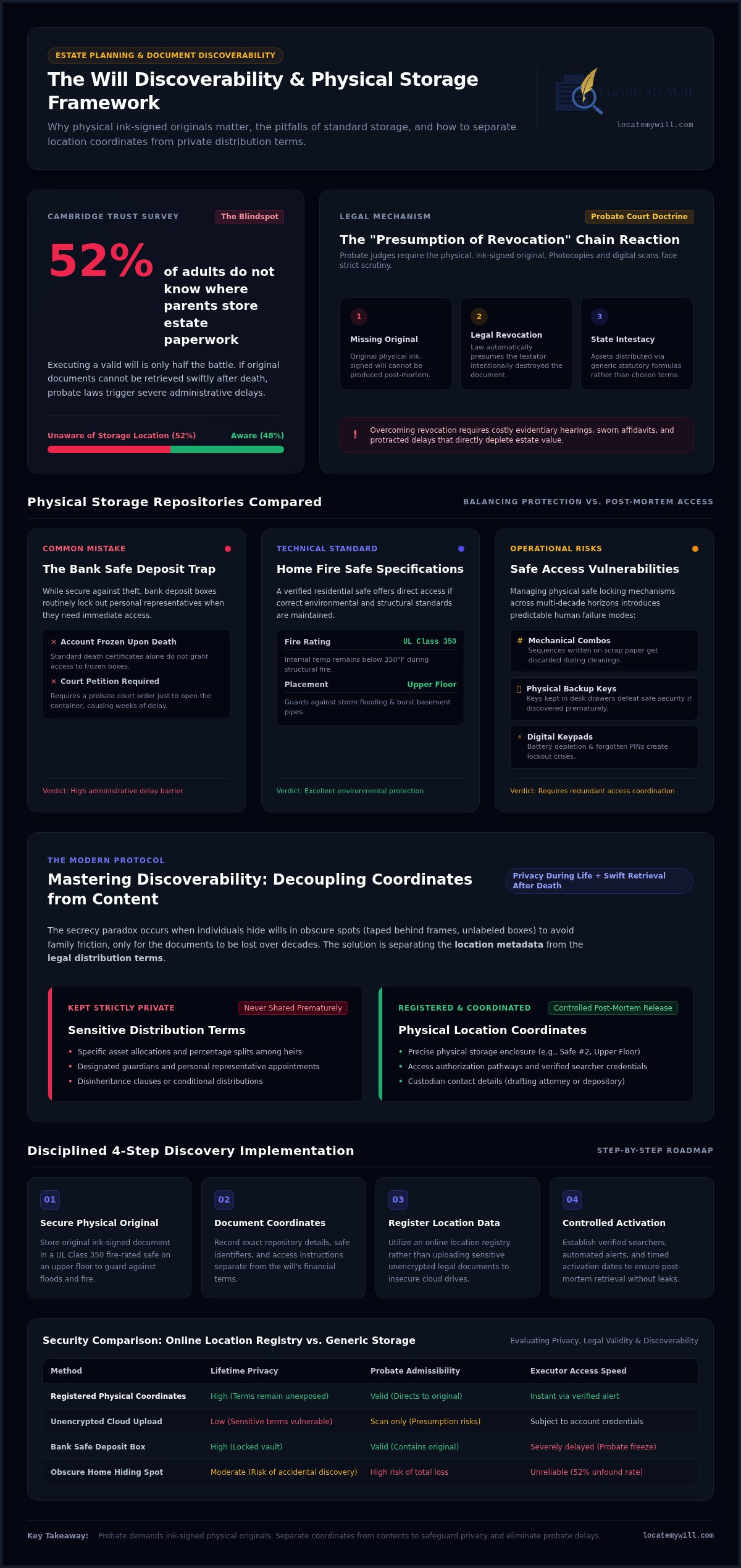
According to a survey by Cambridge Trust, 52% of adults have no idea where their parents store their estate planning paperwork. If you've finalized your estate plans, understanding how to make your will easy to find is just as essential as signing the document itself. Most people face an uncomfortable dilemma: they want to keep sensitive asset distributions private during their lifetime, yet hiding an original document too well can trigger severe probate delays, family disputes, or even state intestacy if a court presumes an unfound will was intentionally destroyed.
You shouldn't have to compromise your personal privacy today just to protect your family tomorrow. In this guide, you'll discover how to systematically store, document, and register your original will so your executor can locate it instantly when needed. We'll outline practical physical storage protocols, address common discoverability pitfalls, and walk through a disciplined procedure to coordinate access for your authorized representatives without premature disclosure.
Key Takeaways
- Understand why probate courts mandate original physical documents, and how an unlocated will risks an automatic legal presumption of revocation.
- Evaluate the trade-offs of physical home storage against the administrative access traps commonly associated with bank safe deposit boxes.
- Master how to make your will easy to find by separating the coordinates of your document from its private distribution terms.
- Discover why registering physical coordinates provides greater privacy and security than uploading sensitive legal documents to unencrypted cloud storage.
- Implement a disciplined discovery protocol using verified searchers, automated alerts, and controlled activation dates to protect your estate transition.
The Discoverability Dilemma: Why Executed Wills Go Missing
Executing a valid will and testament requires time, legal advice, and careful consideration. Yet, many well-drafted estate plans fail at the exact moment they're needed simply because family members can't locate the physical paperwork. Most people assume that having signed documents is enough. In practice, an estate plan without an accessible retrieval pathway creates an administrative crisis. Learning how to make your will easy to find is critical because probate courts across the country demand the actual, ink-signed physical original to validate your intentions.
The Legal Cost of an Unlocated Original Will
Probate judges don't accept digital scans or photocopies without rigorous verification. If your representative presents a copy instead of the original, courts typically enforce the legal presumption of revocation. Under this doctrine, the law assumes you intentionally destroyed and revoked your will if the original document can't be produced after your death. Overcoming this hurdle requires protracted evidentiary hearings, sworn affidavits, and significant legal expense. When families can't locate the original or persuade a judge to accept a duplicate, the estate defaults to state intestacy laws, distributing your assets by generic statutory formulas rather than your specific choices. Reviewing The Cost of a Lost Will highlights how quickly these administrative hurdles deplete an estate's value.
The Secrecy Paradox in Modern Estate Planning
Why do executed wills disappear so frequently? The primary culprit is intentional concealment. People often worry about premature family conflict, unwanted scrutiny of inheritance distributions, or uncomfortable discussions with relatives. Consequently, they stash paperwork in obscure places: taped behind framed photographs, tucked inside unlabeled filing boxes, or locked in secret home safes without documented combinations.
Over a multi-decade horizon, life inevitably intervenes. Home renovations, unexpected relocations, or natural memory lapses mean that even carefully planned hiding spots fade from memory. Casual verbal hints don't give an executor the precise legal coordinates needed during a crisis. Mastering how to make your will easy to find requires separating the document's sensitive contents from its physical storage location, ensuring verified access without compromising your lifetime privacy.
Evaluating Physical Storage: Where to Keep Your Original Will
Selecting the appropriate repository requires balancing environmental protection against post-mortem access. While an executed original must survive potential disasters, your personal representative must also be able to retrieve it promptly. Deciding how to make your will easy to find begins with evaluating where paper can safely rest for decades without becoming unreachable.
The Safe Deposit Box Trap
Many individuals assume a bank vault represents the safest home for a Last will and testament. In practice, bank deposit boxes routinely create severe administrative hurdles. Upon learning of an account holder's death, institutions immediately freeze box access under standard banking regulations. An executor cannot simply present a standard death certificate to retrieve the contents. Gaining entry usually requires petitioning a probate court for an order to open the container, leading to weeks of procedural delays and unnecessary legal expenses before estate settlement can even start.
Home Fire Safes and Dedicated Storage Enclosures
A residential safe provides an accessible alternative, provided it meets verified manufacturing standards. Effective document protection requires an enclosure with a UL Class 350 fire endurance rating, which prevents internal temperatures from exceeding 350 degrees Fahrenheit during a structural blaze. To guard against water damage from burst pipes or storm flooding, place the safe on an upper floor rather than a basement.
Managing access mechanisms across decades presents its own operational challenges:
- Mechanical combinations: Number sequences written on scrap paper are easily misplaced or discarded during cleaning.
- Physical backup keys: Separate key sets stored in desk drawers defeat the safe's primary defense if discovered by unauthorized visitors.
- Digital keypads: Battery failures and neglected PIN codes can lock out family members during critical moments.
Drafting Attorney Office Retention
Leaving an ink-signed document in your drafting attorney's commercial vault offers robust physical protection and professional neutrality. Legal practices maintain specialized filing systems designed for permanent records retention. Even so, relying solely on an outside firm introduces long-term succession risks. Law partnerships frequently dissolve, solo practitioners retire, and firms merge with larger regional entities. When practices consolidate, older physical files are often transferred to secondary off-site archives, making prompt retrieval difficult.
No matter which physical location you select, keeping the address a complete secret undermines your planning. Pairing sensible physical containment with an active will owner registration ensures that your chosen representative knows exactly which safe, cabinet, or law office holds your original paperwork when the time comes.
Creating a Redundant Information Protocol for Your Executor
Executing your estate documents is an essential milestone, but solving how to make your will easy to find requires bridging the gap between your secure storage and your executor's knowledge. Many testators mistakenly believe that keeping an estate plan accessible requires sharing the entire document during life. In reality, you don't need to disclose sensitive financial figures or specific beneficiary distributions to ensure prompt discovery. Establishing an effective protocol means separating document contents from document coordinates. While services like IronClad Family help households manage vital records and overall family preparedness, an original will still demands a clear physical retrieval pathway.
Preparing the Non-Confidential Location Dossier
A location dossier (often termed a letter of instruction) focuses exclusively on physical retrieval mechanics. This record should detail the exact physical room, container identifier, and key or combination management protocol. While scholars debating the future of electronic wills envision fully automated paperless transfers, traditional ink-and-paper documents remain the legal bedrock for probate across most jurisdictions today. Your memo should document precisely where the physical original lives, without listing account balances or bequest percentages. If you relocate to a new residence or upgrade your home security hardware, update these physical location coordinates immediately.
Formally Briefing Your Nominated Personal Representative
An executor cannot carry out responsibilities they don't know they have. Holding a structured, high-level briefing confirms your nominee's willingness to serve while establishing the administrative steps they should take upon your death. Reviewing How to Find a Will Guide helps representatives understand their legal obligations without exposing your private decisions prematurely.
A reliable communication protocol should always incorporate redundant safeguards:
- Appoint verified alternates: Designate secondary and tertiary representatives in case your primary choice predeceases you or declines to serve.
- Confirm contact records: Ensure all named representatives hold active contact information for your drafting attorney and accounting firm.
- Standardize search procedures: Share The Executor Guide to Finding the Will so your representatives know the exact evidentiary sequence required for retrieval.
Establishing this structured flow provides clear guidance when your family needs it most, ensuring your representative can locate the original document without delay.
Modern Security: Online Will Location Registries vs. Digital Storage
Consumer cloud storage often gives estate planners a false sense of completion. Storing a digital scan in a general folder doesn't satisfy legal probate demands, nor does it guarantee smooth discovery. Figuring out how to make your will easy to find requires understanding the critical boundary between hosting an electronic document and securely registering where the physical original resides.
The Limitations of Consumer Cloud Storage and Scans
Uploading a scanned copy of your estate paperwork to Google Drive, Dropbox, or iCloud creates multiple vulnerabilities. A scanned image cannot replace the executed original in probate court, where judges require ink signatures on original paper. Beyond evidentiary issues, uploading unencrypted legal papers introduces real cybersecurity risks. Full estate documents reveal sensitive identifiers, account numbers, and complete asset lists to potential breaches.
Standard consumer accounts also introduce practical barriers after death:
- Dormant account closures: Platforms often purge inactive profiles before an executor gains legal standing to request access.
- Hardware authentication locks: Two-factor authentication sent to a deceased individual's deactivated phone leaves executors locked out.
- Terms-of-service obstacles: Consumer tech firms frequently refuse third-party access without explicit court orders, stalling retrieval for months.
How Independent Will Location Registries Operate
A specialized location registry solves these retrieval barriers without creating digital vulnerabilities. Instead of storing an electronic duplicate of your legal text, a location registry catalogs only the essential retrieval metadata. It acts as an organized directory that records the precise real-world coordinates where your original document rests, such as a specific fireproof safe, a deposit container, or your drafting counsel's archive.
By registering coordinates rather than document text, you protect your lifetime privacy. Beneficiaries cannot view inheritance terms, yet authorized representatives receive the exact navigation instructions they need when settlement begins. Following the steps in the Register Will Location Online Guide shows how an independent national registry ensures continuity even if legal practices merge or personal executors change addresses. To implement this protective bridge for your own estate, register your will location today and keep your original paperwork discoverable without exposing your private terms.
Implementing a Controlled-Access Discovery Protocol with Locate My Will
Bridging the gap between secure physical storage and executor access requires a methodical system. Locate My Will provides a national online platform designed specifically for this purpose through a dedicated Will Owner Registration Subscription. The service functions strictly as a location registry. It does not draft legal paperwork, host digital wills, or provide physical document storage. Instead, it maintains the precise coordinates of your physical documents behind rigorous access controls, solving how to make your will easy to find without sacrificing personal privacy.
Configuring Authorized Searchers and Notification Contacts
Granular access control prevents unvetted parties from discovering where your documents rest. The platform allows subscribers to implement Authorized Searcher Management by designating up to three verified searchers. These individuals typically include your primary executor, an alternate representative, or your estate attorney. Searchers must undergo identity verification before any location data is released.
To eliminate unauthorized inquiries and maintain complete oversight, subscribers also designate up to three independent notification recipients. Automated alerts immediately notify these contacts whenever an authorized searcher initiates a search request. This two-tier structure guarantees full transparency; no inquiry can proceed quietly without your trusted circle receiving notice.
Setting Search Activation Dates for Total Lifetime Privacy
A primary concern for many testators is that an executor might search for paperwork prematurely. Through Search Activation Date Control, you establish the exact future date when your record becomes searchable. Prior to this predetermined threshold, your physical location coordinates remain entirely locked against all inquiries, including those from authorized searchers.
This control structure delivers practical flexibility over time:
- Predictable lifecycle management: Set the initial activation window into the future, adjusting it periodically during annual reviews.
- Dynamic location updates: If you relocate or purchase a new home safe, update your registered storage instructions instantly without altering your underlying legal will.
- Immediate protocol recalibration: Change named searchers or notification contacts as family relationships or representative availabilities evolve.
Deciding how to make your will easy to find no longer forces you to choose between complete confidentiality and administrative readiness. A disciplined location registry establishes verified discovery protocols while your physical documents remain safely in your possession.
Secure Your Final Intentions with a Disciplined Discovery Protocol
Drafting an estate plan represents a vital act of stewardship, but mastering how to make your will easy to find guarantees those preparations fulfill their purpose. Relying on improvised home hiding spots or sealed safe deposit boxes risks probate friction, evidentiary hearings, and statutory intestacy. True peace of mind comes from separating physical document protection from retrieval instructions.
Locate My Will delivers this protection through a dedicated national registry that catalogs physical coordinates without storing sensitive document text. With Search Activation Date controls ensuring complete privacy during your lifetime, plus granular oversight allowing up to three authorized searchers and three notification recipients, your preparations stay confidential until the exact moment they're needed. Register your will location securely with Locate My Will today and provide your loved ones with an orderly, delay-free path forward.
Frequently Asked Questions
Can my executor settle my estate using a photocopy of my will?
No, probate courts generally require the original physical document bearing wet-ink signatures. While certain jurisdictions permit an executor to petition the court to accept a photocopy, doing so triggers a complex legal hearing. Your representative must present clear evidence overcoming the legal presumption that the missing original was intentionally destroyed and revoked. This petition process adds substantial delays, legal fees, and administrative burdens to estate settlement.
What happens if no one can find my original physical will after I pass away?
If the original document can't be located, the probate court legally presumes you destroyed the will with the intention of revoking it. Unless your family can legally disprove this presumption, your estate will be distributed under statutory intestacy laws. This means state laws dictate who inherits your property regardless of what your unfound documents intended, which is why understanding how to make your will easy to find is critical.
Why shouldn’t I keep my original will inside a bank safe deposit box?
Banks immediately seal safe deposit boxes upon learning of an account holder's death. Because an executor can't access the box without formal letters testamentary, and the court won't issue those letters without the original will inside the box, families become trapped in legal gridlock. Opening the box often requires filing a formal petition and obtaining a specific court order, generating avoidable administrative delays and attorney expenses.
How does an online will location registry differ from digital will storage?
Digital document storage platforms host uploaded scans or PDFs of your actual legal paperwork, exposing your private asset distribution terms to online data breaches. In contrast, an online will location registry never hosts or drafts legal instruments. Instead, it securely records only the real-world coordinates of your physical paper document, keeping your sensitive lifetime distributions private while giving verified representatives an exact retrieval roadmap.
Can my authorized searchers see the location of my will while I am still alive?
Not if you utilize search controls properly. With Locate My Will, you manage access timing using Search Activation Date Control. Your designated searchers can't view storage coordinates before the specific future activation date you select. This protocol protects your lifetime privacy completely, ensuring family members cannot inspect your storage coordinates prematurely while maintaining seamless accessibility if an emergency occurs later.
What information does Locate My Will store about my legal documents?
Locate My Will stores only descriptive metadata regarding where your physical estate documents reside. This includes physical location instructions, safe identifiers, or contact details for your drafting counsel. The platform explicitly does not draft wills, store physical documents, or host digital copies of your legal paperwork. Storing retrieval coordinates alone ensures your sensitive financial terms and beneficiary distributions remain entirely confidential.
How many people can I designate to search for my will location?
You can designate up to three verified individuals through Authorized Searcher Management, such as your primary executor, an alternate executor, or your estate attorney. Additionally, you can assign up to three separate notification recipients. Whenever an authorized searcher performs a query, automated alerts notify your designated contacts immediately, preventing secretive searches and ensuring full transparency as you coordinate how to make your will easy to find.


