

What if a signed will can’t be found when your family needs it? If you’re asking “after the will is signed what next,” the answer is more than putting the document away. Signing is a major step, but follow-through helps protect the original, make its location known to the right people, and address any questions about state-specific signing requirements.
It’s understandable to want certainty, especially when rules can differ by state or you’re unsure whether copies or related estate documents need attention. This checklist covers practical steps that are generally useful after signing, without assuming the same legal requirements apply everywhere. If you’re uncertain whether your will was properly executed, ask a qualified estate-planning attorney in your jurisdiction, such as Flex Legal, PLLC in Florida.
You’ll also learn how to choose a secure, accessible place for the original, tell your executor or another appropriate person where it is, and organize related information for later. A location record can point someone to the physical document, but it doesn’t replace or store the will. Finally, we’ll cover when to revisit your plan and which questions may call for professional guidance.
Key Takeaways
- Wondering “after the will is signed what next”? Check for execution questions, protect the original, and plan when to review your arrangements.
- Signing requirements can depend on state law and individual circumstances. Ask the drafting attorney to clarify anything uncertain.
- Tell appropriate people where the will is kept without necessarily sharing its contents. Consider how each location-recording option handles access and updates.
- Make related records easier to manage by listing important documents, noting where they are, and reviewing contact details when circumstances change.
- Ask a qualified estate-planning attorney for guidance when you’re considering changes or have a state-specific question.
After the will is signed, what next? Start with this checklist
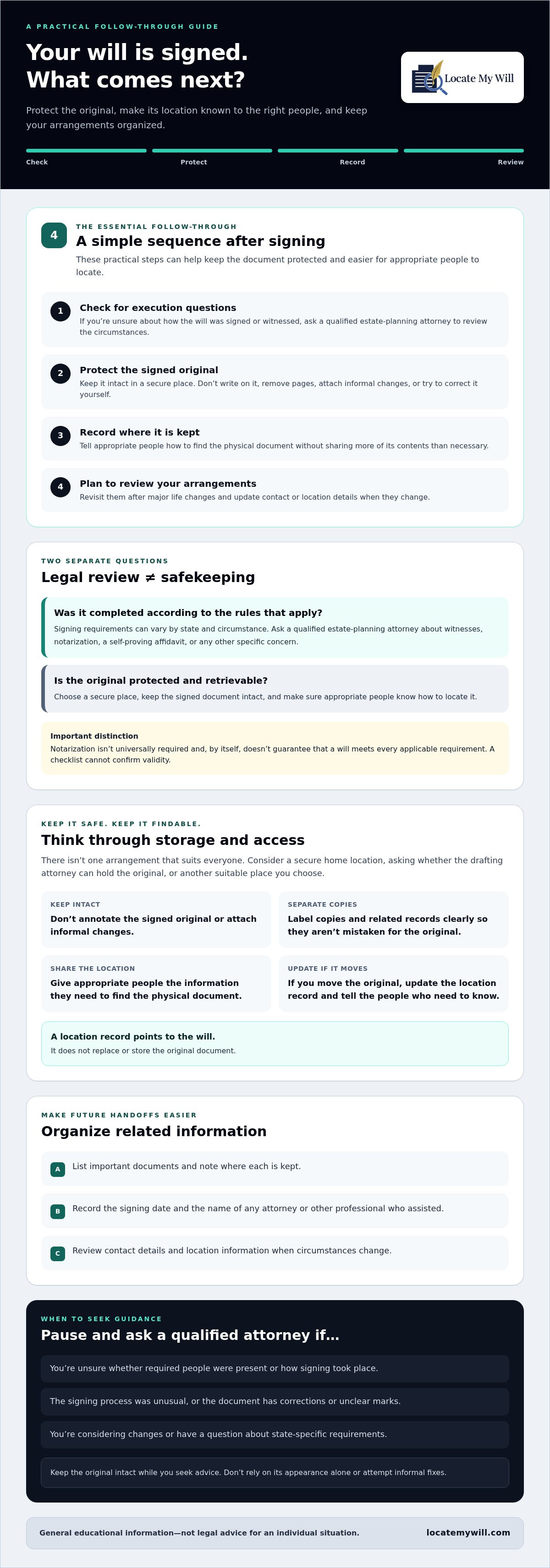
Signing your will is an important milestone. A few organized steps afterward can help protect the document and make it easier for the right people to locate. If you’re asking “after the will is signed what next,” start here:
- Check execution questions: If you’re unsure how the will was signed or witnessed, ask a qualified attorney to review the circumstances.
- Protect the original: Keep the signed document intact and choose a secure place for it.
- Record its location: Make sure appropriate people know where to find the original without sharing more than necessary.
- Plan future reviews: Set a reminder to revisit your arrangements after major life changes or when contact details need updating.
This checklist offers general educational information, not legal advice for your individual situation. A will sets out instructions for what happens to a person’s estate after death. For more background on what is a will, see the general overview. The practical steps below can help you organize the document, but they can’t determine whether it meets legal requirements.
What should you do immediately after signing?
Keep the signed original intact. Don’t write on it, attach informal changes, or assume a photocopy can stand in for the original. Note where you plan to keep it, such as with the attorney who prepared it or in another secure location you’ve chosen.
Keep copies and related records separate, and label them clearly so no one mistakes a copy for the original. Make a brief record of the signing date and the name of any attorney or other professional who assisted. This information can help you find relevant records or direct follow-up questions to the right person.
Next, decide how to communicate the location and keep it current. A written instruction or a private location record can help appropriate people find the physical document. If you move the original, update the location information and tell the people who need to know.
Which steps depend on state law or personal circumstances?
Requirements for witnesses, notarization, and other parts of signing can vary by state and circumstance. Notarization isn’t universally required or, by itself, a guarantee that a will meets every applicable requirement. Ask a qualified estate-planning attorney about your specific questions rather than relying on a general checklist to confirm validity.
Seek prompt legal guidance if the signing process was unusual, you’re unsure whether the required people were present, or the document has corrections or unclear marks. Don’t try informal fixes before getting advice. An attorney can explain what options may apply to your situation and whether further steps are appropriate.
Confirm the signing process and protect the original will
Once you’ve noted where the will is kept, separate two questions: Was it completed according to the requirements that apply to you? Is the original protected and retrievable? The first calls for legal review; the second is a practical safekeeping decision. If you’re still wondering “after the will is signed what next,” don’t rely on the document’s appearance alone to answer either question.
A will records instructions for an estate, but signing formalities can depend on state law and the circumstances. Cornell Law School’s Legal Information Institute provides a helpful legal definition of a will. For advice about your completed document, consult a qualified attorney familiar with the applicable requirements.
How can you check whether the will was properly completed?
Review the document for expected signatures and dates, but treat this as a way to spot questions, not proof of validity. Ask the drafting attorney whether the witnesses, any notarization, a self-proving affidavit, and other state-specific procedures were handled as needed. If there were unusual circumstances, corrections, or uncertainty about how signing took place, request legal review promptly.
Until you receive guidance, don’t annotate the signed original, remove pages, or try to correct it yourself. Keep it intact and note any concerns separately so you can explain them clearly to the attorney.
Where should you keep the signed original?
There isn’t one storage arrangement that suits everyone. You might keep the original in secure home storage, ask whether the drafting attorney can hold it, or consider another suitable arrangement. Compare the practical tradeoffs: the risk of fire or water damage, who can access the document, and whether an appropriate person can retrieve it when needed. If an attorney holds it, confirm how you and others can request access.
A digital copy may help you refer to information, and a location record may tell someone where the physical will is kept. Don’t assume either replaces the original where the original is required. Keep copies clearly identified and separate from the signed document.
For an additional administrative way to record the original’s location and manage access to that information, you can review will location recording. This complements the physical document. It doesn’t store the will or determine whether it meets legal requirements.
Make the will findable without giving up appropriate privacy
A will can be carefully stored and still be difficult to locate if nobody knows where to look. If you’re asking “after the will is signed what next,” decide who should be able to find the original and how you’ll keep that location information current. Sharing where the document is kept isn’t the same as sharing what it says. You can give a trusted person clear retrieval instructions without distributing the will’s contents.
Who should know where the will is kept?
Tell your executor or personal representative how to locate the original, and consider whether another trusted person should know as well. The right contacts depend on your plan and any professional advice you’ve received. Be specific: explain where the document is and what to do if the storage arrangement changes. Don’t assume someone will know, or rely on a single person’s memory.
There are several ways to communicate the location. Each has different upkeep needs:
- Private written instruction: A note is straightforward, but update it if you move the will and make sure the intended recipient can find the note.
- Attorney communication: Your drafting attorney may be able to confirm whether they hold the original or explain how to access it. Check the firm’s process rather than assuming a family member will know.
- Location-recording service: An access-controlled record can help authorized people find the physical will. You’ll need to keep the location details accurate and understand how access is managed.
How can location information remain private and current?
Choose an approach that balances discoverability with the privacy you want. A note kept with personal papers may be easy for a trusted person to find, but it could be visible to others. An attorney may provide a clear point of contact, while a location-recording service can manage access to the information. No option is right for everyone. Give the location details only to appropriate people. You don’t need to disclose the will’s contents just to make it findable.
Locate My Will lets users record where a physical will is kept and manage authorized searchers through an online account. It does not host or physically store the will. Searchers must be verified, and access to location information is subject to the applicable activation date. Users can designate up to three authorized searchers and three notification recipients. The service is subscription-based. Check current procedures before relying on it, and update the location record if you move the original.
For a deeper explanation of registry considerations, see Register Will Location Online: Estate Security Guide. Treat location information as a practical companion to the original, not a substitute for it.
Organize related documents and plan for future changes
After confirming the original will is protected and its location is known, create a simple inventory of other records that may matter to your plan. You don’t need to collect every possible document. The goal is to make relevant records and their locations easier to identify without confusing what each one does.
A will contains instructions for an estate after death. A trust is a separate arrangement with its own document, while a power of attorney generally concerns authority to act on someone’s behalf in specified circumstances. These records aren’t interchangeable, and not everyone will have each one. If you’re asking “after the will is signed what next,” start with the documents you already have and ask a qualified attorney how they work together if you’re unsure.
Which estate-planning records should you keep track of?
Make a short inventory, then note where each original is kept and who to contact with questions. Depending on your circumstances, relevant records might include:
- Your will and any related instructions for locating it.
- A trust document, if you have established a trust.
- Power of attorney documents or other estate-planning records you’ve prepared.
- Contact details for the attorney or professional who assisted with your plan.
Keep this inventory separate from sensitive document contents where appropriate. It can tell an executor or trusted person what exists and where to look without standing in for the documents themselves. For help thinking through trust records, consult a dedicated guide such as Locating a Living Trust Document: A Comprehensive Search Guide.
When should you review the will or its location details?
A major change in family circumstances, finances, or residence can be a useful prompt to ask an attorney whether your will or broader plan should be reviewed. Don’t assume that a life event automatically changes or revokes a will. The effect, if any, depends on applicable law and individual circumstances. Get qualified advice before relying on assumptions or making changes to a signed document.
Set a practical reminder to check that your contact list and document-location notes are accurate. If you move the original, update the location information and tell the appropriate people. This simple maintenance step helps prevent a plan from pointing to an outdated location or contact.
For an optional way to record where your physical will is kept and manage access to that location information, record your will’s location. It complements your document inventory. It doesn’t store the will or replace professional legal guidance.
Choose a practical next step after your will is signed
If you’ve been asking “after the will is signed what next,” follow a simple order: resolve questions about signing, protect the original, tell appropriate people where it is, and keep related records current. You don’t need to complete every administrative task at once. Start with the issue that would be hardest for someone else to work out, such as an unclear signing detail or a location only you know.
Contact a qualified estate-planning attorney—such as Massingill Attorneys & Counselors at Law—if you’re unsure whether the will meets requirements that apply to your circumstances or if you’re considering changes. A general checklist can help you organize questions, but it can’t determine whether a will is valid or explain how a particular state’s rules apply to you.
How can a will-location registry fit into the checklist?
Once the physical original is safely stored, recording its location is an optional administrative step. Locate My Will lets users record where a physical will is kept and manage access to that location information. Users can designate up to three authorized searchers and three notification recipients. Searchers must be verified, and activation-date settings control when searches and notifications can occur. The service uses a paid subscription model. Check current account, verification, and activation procedures before relying on them.
A registry points to the document; it isn’t the document itself. Locate My Will doesn’t provide legal advice, draft wills, host digital wills, or physically store originals. It doesn’t determine whether a will is valid. Keep the original in an appropriate physical location and make sure the recorded details reflect where it actually is.
What should you do today?
Take a few minutes to make the location clear. Write down where the signed original is kept, identify who should be able to find it, and choose a communication method that suits your privacy preferences. Then check that the instruction is specific enough to be useful. “In the home safe” may be unclear if there are several safes. A precise description or a named professional contact can remove guesswork.
- Note the storage location and any access instructions.
- Tell your executor or another appropriate person how to find the original.
- Choose whether to use a private written instruction, communicate with your attorney, or record the location through a service.
- Update the information if the original moves or your chosen contacts change.
If an access-managed record suits your needs, you can explore Locate My Will as one way to record the will’s location. Whichever method you choose, keep it accurate so the person you trust isn’t left searching.
Make your signed will easier to find when it matters
If you’re still asking “after the will is signed what next,” focus on a few practical safeguards: resolve execution questions with a qualified attorney, protect the original, and make sure an appropriate person knows where to find it. Keep related records and contact details current, especially when your circumstances or storage arrangements change.
A location record can add organization without replacing the physical will. Locate My Will lets users record where the original is kept and manage access to that information. Searcher verification and activation-date controls help manage when location information can be accessed. Check current procedures before relying on them.
To record the location of your physical will, record your will’s location with Locate My Will. The service does not provide legal advice, draft wills, host digital wills, or store originals. A clear, maintained plan can help make your wishes easier to locate.
Frequently Asked Questions
Is my will valid as soon as it is signed?
Not necessarily. A signature alone may not meet the execution requirements that apply in your state and circumstances. Witnessing, notarization, or other formalities may be relevant, but requirements differ. If you’re uncertain, contact the attorney who prepared the document or another qualified estate-planning attorney before relying on it. Don’t treat the document’s appearance, signatures, or a general checklist as confirmation that it’s legally valid.
What should I do with my original will after signing it?
Keep the signed original in a secure, durable place that can be accessed when needed. Consider risks such as fire or water damage and whether the person responsible for handling your affairs could retrieve it. Tell an appropriate person where it’s kept. Ask your attorney whether your chosen arrangement fits your circumstances, especially if someone else will hold the original or access may require special steps.
Should I tell my executor where my will is kept?
Generally, letting the person expected to handle your affairs know where the will is kept can prevent avoidable confusion. You don’t necessarily need to share the document’s contents, but give clear instructions for finding the original and explain whom to contact if it has moved. Confirm who has that responsibility, and check that your choice matches your current estate plan and any professional advice you’ve received.
Can I keep only a digital copy of my signed will?
A digital copy can be useful for reference, but it may not replace the original when the original is required. Applicable requirements and procedures vary by state and situation. Keep the signed original safe, and ask your attorney which copies are useful for your circumstances. Make sure anyone who may need the will knows how to locate the original instead of relying on a digital file alone.
Do I need to update my will after signing it?
Not automatically. Major changes in family circumstances, assets, relationships, or residence can be a reason to ask an estate-planning attorney whether your plan should be reviewed. Don’t handwrite changes on the signed document or assume a new document cancels an older one. Even if no legal revision is needed, keep contact details and the recorded location of the original current so the information remains useful.
What happens if nobody knows where my signed will is?
The people handling your affairs may struggle to locate the document, creating uncertainty or delaying next steps. What happens depends on the facts and applicable state law. To reduce avoidable searching, record where the original is kept and tell an appropriate person how to find it. If you’re searching after someone has died, see How to Find a Deceased Person’s Will: A Systematic Search Protocol.
Does a will-location registry store my will or make it legally valid?
No. A will-location registry records where a physical will is kept. It doesn’t draft the document, host a digital will, or physically store the original, and it doesn’t determine whether the will is legally valid. Locate My Will lets users record a will’s location and manage access to that information. For legal questions, consult a qualified estate-planning attorney. Treat location recording as a separate organizational step.


