

What if the extra copy you kept for safekeeping creates more questions than it answers? If you’re wondering, “can you have multiple copies of a will,” the answer depends on whether you mean photocopies, separately signed originals, or a newer will. These documents aren’t interchangeable, and unclear versions can leave loved ones unsure which one reflects your wishes.
It makes sense to want your will accessible while keeping it secure. A photocopy can help someone understand your plans, but it generally isn’t a substitute for the signed original in probate. Whether an exception applies depends on the circumstances and local law. This guide explains how copies differ from signed originals and later wills, why conflicting versions can complicate matters, and how to organize location information. A location record can help authorized people find a will, but it doesn’t establish which version is legally valid or replace the document itself. For questions about a specific will, consider consulting a qualified estate-planning attorney.
Key Takeaways
- Wondering “can you have multiple copies of a will”? Learn how a photocopy, scan, signed original, and separately executed duplicate may be treated differently.
- Understand how later wills or amendments can affect earlier instructions, and why state law and the circumstances matter.
- Use a consistent process to confirm the current version, label reference copies, secure documents, and share location details carefully.
- Recording where a will is kept can help authorized people find it, without storing or validating the document.
Can you have multiple copies of a will? Start with the short answer
Yes, you can keep copies of a will, but a copy’s legal effect depends on what the document is and the law that applies. An ordinary photocopy isn’t automatically equivalent to a properly executed original. Keeping a reference copy is different from signing several documents intended to serve as originals. Multiple signed documents can raise questions about how they were executed and whether they reflect the same instructions.
Start by identifying what you have. A signed original is the document executed with the formalities required for that will. A photocopy reproduces a paper document, while a digital scan is an electronic image of it. A label such as “official copy” doesn’t establish whether a document will be accepted or how it will be treated in probate. For background on wills generally, see Will and testament. For guidance about a specific document, local legal advice is more appropriate.
Rules for execution, revocation, and probate vary by state and may depend on the circumstances. The practical answer to “can you have multiple copies of a will” is yes, but don’t assume multiple signed versions or a photocopy have the same legal status as the original. A qualified local estate-planning attorney can help confirm which document was properly executed and what rules apply if the original is missing or versions differ; for dedicated support with estate planning and wills, you can check out Coastal Legacy Law.
What counts as a copy of a will?
A reference copy may be useful, but it doesn’t become a new will simply because it contains a signature or is marked “original.” Likewise, an image of a signed document doesn’t, by itself, prove that it meets the legal requirements for an effective will. Preserve documents as they are, and ask an attorney before treating a duplicate as a legally operative version.
Why might someone keep more than one copy?
A clearly labeled reference copy can help you review your plans. It can also help an executor or professional adviser identify a document’s date and know where to look for the original. For example, you might keep a reference copy with personal records while securing the signed original separately. Label the copy for reference and record the original’s location. A copy can point someone toward the right document, but it doesn’t replace confirming where that document is kept.
Original, photocopy, or signed duplicate: how will versions differ?
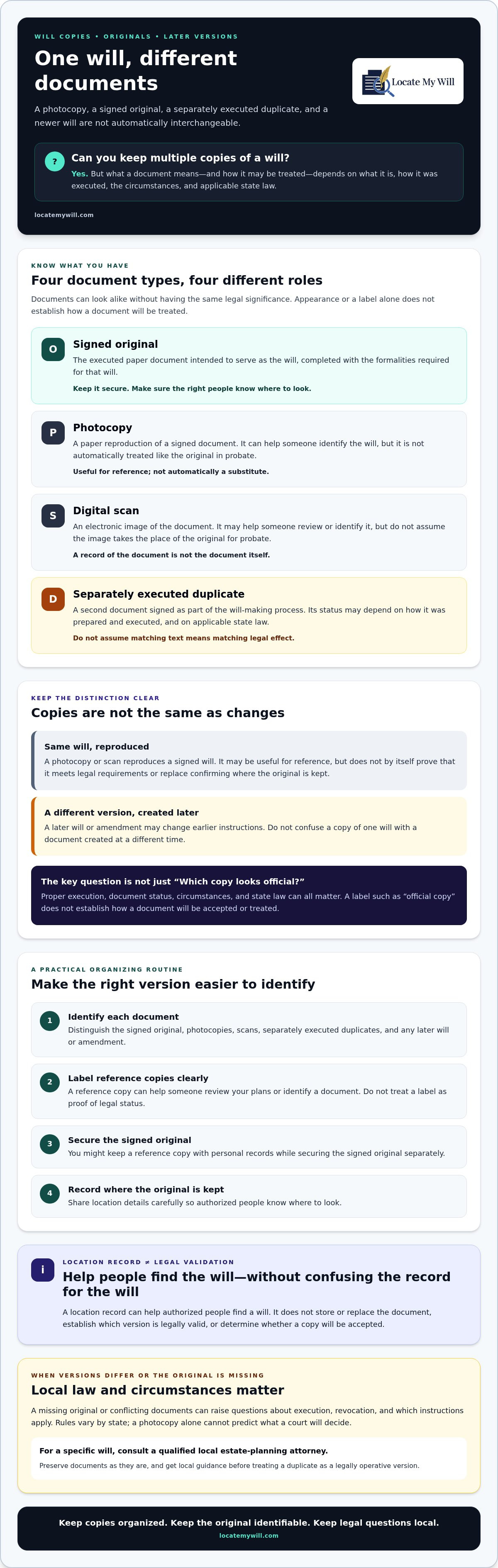
Documents that look alike can have different legal significance. A photocopy or scan reproduces a signed will, while a separately executed duplicate is another document signed as part of the will-making process. The distinction matters because execution formalities and how a document may be used as evidence vary by state. Use this table as a practical guide, not as a determination of what a court will accept.
| Document | What it is | What to keep in mind |
|---|---|---|
| Signed original | The executed paper document intended to serve as the will. | Keep it secure and make sure the right people know where to look for it. |
| Photocopy | A paper reproduction of a signed document. | It can help someone identify the will, but it isn’t automatically treated like the original. |
| Scan | A digital image of the document. | It may help with reference, but don’t assume an image takes the place of the original for probate. |
| Separately executed duplicate | A second document signed as part of the will’s execution. | Its status may depend on how it was prepared and executed, and on applicable state law. |
Document status and proper execution, not appearance alone, help determine how a will may be treated. Also distinguish multiple copies of the same will from documents created at different times. A photocopy and the original may show the same instructions, while a later will or amendment may change them. Don’t assume two signed documents have the same legal effect simply because their text matches.
Is a photocopy of a will valid?
A photocopy may be relevant if the original can’t be found, but acceptance and proof requirements depend on the jurisdiction and circumstances. A missing original can raise questions about what happened to it and whether the copy accurately reflects the executed document. A photocopy alone can’t predict what a court will decide. Ask a qualified local attorney or consult probate court guidance in the state where the estate would be handled.
Are two signed originals the same as two copies?
No. A reproduction copies one signed document; a duplicate original is separately signed. Whether duplicate originals are accepted or advisable depends on the execution process and local rules. If an attorney prepared the will, ask how each document was executed and which original should be preserved. For practical guidance on storing estate planning documents, consider how secure storage and clear access instructions work together. If you also want to record where the physical will is kept, Locate My Will’s will-location service can help authorized people find that information. It doesn’t store or validate the will.
Can multiple wills conflict? Understand versions, changes, and revocation
Two documents that look similar may represent different situations. They could be identical copies of one will, a will and a later amendment, or separate versions with different instructions. Simply photocopying or sharing a will doesn’t automatically revoke it. When documents differ, however, determining which one controls can depend on how each was prepared, signed, changed, or revoked, as well as the law of the state involved.
Don’t destroy, mark, or replace documents based on assumptions about their legal effect. Writing “old” on a document or discarding one version could complicate efforts to understand its history. Keep the papers intact and get legal guidance before taking action.
What if you find two different versions of a will?
Preserve both documents, including envelopes or related papers, and make a separate record of where and when each was found. Avoid writing notes on the documents themselves. A newer date may matter, but it doesn’t by itself establish that the later version was properly executed or that it revokes an earlier will. Have a qualified estate-planning or probate attorney review both and explain the applicable state rules.
Note whether the documents appear to be complete wills, copies, or amendments. One document might contain different instructions, while another could be an unchanged reference copy. That distinction can help an attorney assess the records, but it doesn’t replace legal review.
What is the role of a codicil or later amendment?
A codicil is a document intended to amend a will. It may change particular provisions while leaving other instructions in place, but its effect depends on applicable law and whether the required execution formalities were followed. Don’t assume an unsigned note or informal mark changes a will.
Keep an amendment with the will and identify it clearly in separate records, so someone reviewing the papers can see that the documents may be related. Ask the drafting attorney how the amendment was executed and whether any additional steps are needed to keep the records clear. Rules for amendments, revocation, and interpreting conflicting documents vary by state and circumstance.
If you’re asking, “can you have multiple copies of a will,” remember that identical copies aren’t necessarily conflicting versions. The concern arises when documents differ or someone can’t establish how they relate. Preserve what you find, record its context, and seek qualified local advice rather than choosing a version based on appearance or date alone.
How to organize will copies so the right version can be found
A consistent filing system can help loved ones identify the right document without turning reference copies into competing versions. If you’re asking, “can you have multiple copies of a will,” the practical goal is to distinguish copies clearly and make the original’s location known to the appropriate person.
- Confirm the current version. If you’ve changed your estate plan, check with the drafting attorney about which documents are current and how any amendments relate to the will.
- Label reference copies clearly. Use a separate cover sheet or folder label such as “Reference copy” and note the document’s date. A label helps prevent confusion, but it doesn’t change the document’s legal status.
- Record dates and relationships. Keep a separate inventory noting the will’s date, whether an amendment exists, and where the original and copies are kept. Don’t write on, staple, or otherwise alter an original unless your attorney approves.
- Secure the documents and share location details. Choose storage that is secure yet accessible to the people who may need to find the original. Tell your executor or another trusted, authorized person where it is kept and how to access it.
How should you label and store copies?
Use plain descriptions that distinguish the documents, such as “Original will” and “Reference copy, dated [date].” Store the original in a protected place suited to your circumstances, and consider whether your chosen representative can locate and access it when needed. Keep scans and digital copies behind appropriate privacy controls. They can support reference and organization, but don’t assume they replace the original or satisfy probate requirements.
Keep location notes separate from the will. That lets you update the information if the document moves without changing or marking the original. A short inventory can identify each document and its location without repeating private instructions from the will.
Who should know where the will is kept?
Give the executor or another trusted, authorized person enough information to find the document, including its storage location and any practical access details. You don’t need to share the will’s sensitive contents simply to communicate where it is. Limit location information to people who need it, and update them if the original moves. For guidance on what an executor may need to locate and verify, consult a qualified estate-planning or probate professional.
If you want a way to record where your physical will is kept and manage who may access that location information, explore online will-location registration. The service records location information; it doesn’t store the will or determine which version is legally valid.
Keep will location information clear without confusing copies with legal originals
A record of a will’s location can help an authorized person know where to look, but it’s separate from the document itself. It doesn’t store the will, confirm that the will was properly executed, or establish which version is legally valid. A location record supports document-finding. Questions about a will’s status require review of the document and applicable law.
What a will-location registry can and cannot do
Locate My Will is an optional online service for recording where a will is physically kept and managing authorized searchers and notification recipients. Searchers must be verified before they can access location information. Search activation settings control when searches can be performed and notifications sent. The service doesn’t draft, host, or physically store wills, and it doesn’t determine whether a copy, original, or later version is legally effective.
A location record complements secure storage and clear labels. It can point an authorized person toward the document, but the will remains wherever its owner has placed it. Keep location information current if the document moves, and don’t treat a registry entry as a substitute for legal advice about conflicting versions.
A simple next step for keeping information organized
Before recording a location, confirm with the person who created the will which version is current, whether there are amendments, and where the signed document is kept. Then review who is authorized to search for that information and when searches or notifications are activated. This helps keep the record aligned with the owner’s current arrangements and intended access.
Locate My Will lets users record the physical location of a will, designate up to three authorized searchers and three notification recipients, and control search activation dates. These settings manage access to location information, not to the will’s contents. If you’re still asking, “can you have multiple copies of a will,” remember that organizing where a document is kept can make it easier to find, but it can’t resolve which version is legally effective. For details, learn how Locate My Will helps record a will’s location.
Keep your will organized and easier to locate
So, can you have multiple copies of a will? Yes, but copies, signed originals, and later versions can have different legal significance. Label reference copies clearly, preserve the original without marking it, and ask a qualified local attorney about execution, amendments, or conflicting documents.
Make a separate record of the will’s current location and tell the executor or another trusted person how to find it. A location record can help with that task, but it doesn’t host or validate the will. Locate My Will lets users record where a will is physically kept, with verified authorized searchers and search activation dates that control when searches and notifications can occur.
If documenting the location would help keep your arrangements organized, learn how Locate My Will helps record a will’s location. A clear plan for the document and its location gives the people you trust an orderly place to start.
Frequently Asked Questions
Can you have multiple copies of a will?
Yes, you can keep reference copies, but a copy isn’t automatically equivalent to a properly executed original. If you’re asking “can you have multiple copies of a will,” distinguish photocopies from separately signed documents, since state law and the circumstances can affect how they’re treated. Label reference copies clearly, track the original’s location, and ask a qualified estate-planning attorney how local rules apply.
Is a photocopy of a will legally valid?
It depends on the applicable state law and the circumstances. A photocopy may offer evidence of what a will said, but that doesn’t guarantee it will be accepted as a substitute for a missing original. Preserve available documents and don’t alter them. Before relying on a photocopy, ask a probate or estate-planning attorney in the relevant state what proof may be needed and what options are available.
Can you sign multiple original copies of a will?
Some people may execute duplicate documents, but whether they’re treated as equivalent originals depends on state law and the signing formalities used. Extra signed copies aren’t automatically necessary or a problem. Ask the attorney preparing the will to identify which documents were executed, whether they’re intended as duplicates, and how each should be stored. Keep the documents together or clearly record their relationship without marking the originals.
What happens if there are two different versions of a will?
Two versions don’t automatically establish which document controls. Their dates, execution formalities, amendments, revocation rules, and other circumstances may matter, and applicable rules vary by state. Keep both documents intact, note where and when each was found, and don’t choose based on date alone. Have a qualified estate-planning or probate attorney review the documents before anyone acts on the instructions in either version.
Does making a copy of a will revoke the original?
No, making a copy doesn’t automatically revoke the original. However, the effect of actions involving a will can depend on the person’s intent, what they did, and state law. Don’t destroy, mark, or alter an original based on assumptions. If you’re unsure whether a will remains effective, contact the attorney who prepared it or another qualified local attorney for advice about the document and circumstances.
Should the executor keep a copy of the will?
An executor may benefit from knowing that a will exists and where the original is kept. A reference copy can help identify the document or its date, but it may not replace the original for probate purposes. The person who made the will can discuss appropriate access and storage with their attorney, then share clear location information with the executor while limiting unnecessary disclosure of sensitive contents.
Where should you keep the original will and its copies?
Choose a secure place that remains accessible to the person responsible for locating the will, and tell a trusted person where the original is kept. Label reference copies so they aren’t confused with the original, and keep notes identifying the current version and any related amendments. Since storage choices can affect access, confirm your arrangement with the attorney who prepared the will and update location details if the document moves.


