

The safest place for an original will isn’t always the easiest place for family to reach. A safe deposit box may protect the document, but access can be difficult if the person handling the estate isn’t authorized to open it. Wherever you keep the document, it’s important to record where your will is stored and make sure the right people know how to find it.
It’s reasonable to want both security and reliable access. When choosing where to keep the original, weigh how well the location protects it against how easily an authorized person can retrieve it. A home safe, an attorney’s office, a court repository, or a safe deposit box may suit different circumstances.
This guide compares practical places to keep your will and offers a framework for choosing one that fits your household. You’ll also learn how to keep the location record current, designate authorized searchers, and use notification timing to support discovery while respecting your privacy. A location record can complement physical storage, but it doesn’t store or replace the original will.
Key Takeaways
- Compare home safes, attorneys, trusted people, and safe deposit boxes by considering both protection and how an authorized person can retrieve the original.
- When you record where your will is stored, include precise retrieval details and update them whenever the document moves.
- Share location information selectively with appropriate contacts, and keep it separate from the will’s private provisions.
- A location registry can point authorized searchers to the original without storing or hosting the will itself.
- Review who is authorized to search and when searches or notifications can begin to balance discoverability with privacy.
Where to Record Where Your Will Is Stored: Why the Choice Matters
A signed will can only guide the people handling your affairs if they can locate the original and understand how to retrieve it. A will location record is a separate set of instructions that points authorized people toward the document. It might identify a named professional’s office or a clearly labeled home safe, along with relevant contact or access details. Without clear guidance, loved ones may spend time searching or contacting institutions while trying to establish what steps they can take.
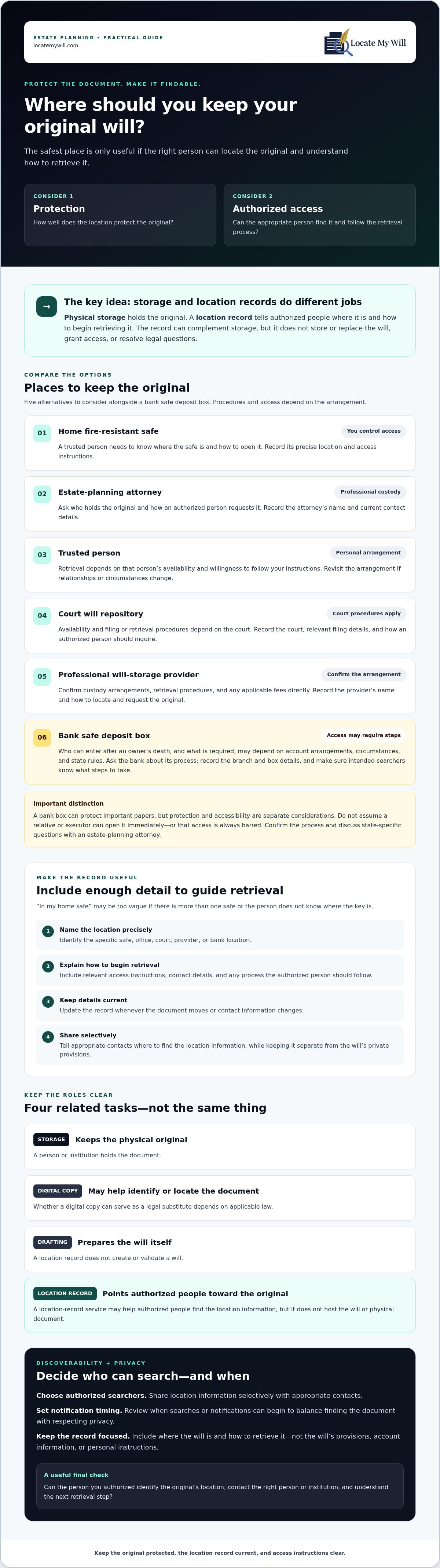
Keep four related tasks distinct. Storage means a person or institution physically keeps the original. A digital copy can help someone identify the document or understand where to look, but whether it can serve as a legal substitute depends on applicable law. Drafting is the preparation of the will itself. A location-record service records where the document is held and may help authorized people find that information. It doesn’t create or validate a will, or store the physical document. For background on a will as a legal document, see the general overview of its role and terminology.
What does it mean to record where your will is stored?
To record where your will is stored, write down enough information to guide the appropriate person to the original. “In my home safe” may be too vague if there are several safes or the person doesn’t know where to find the key. A more useful record could identify the safe’s location and whom to contact for access. For professional storage, name the office and provide current contact details. Keep the record focused on location and retrieval, not the will’s provisions, account information, or personal instructions.
Why can safe deposit boxes raise access questions?
A bank safe deposit box can protect important papers, but protection and accessibility are separate considerations. After an owner’s death, who can enter the box and what steps are required may depend on the account arrangements, circumstances, and state rules. Don’t assume that a relative or executor can open it immediately, or that access is always barred. Ask the bank about its process and discuss state-specific questions with an estate-planning attorney. Include the box’s location in your record, but confirm that the intended person can follow the required process.
These details matter because uncertainty about the original’s whereabouts or access can add practical delays at an already difficult time. A location record doesn’t resolve legal questions or grant access. It helps the right person know where to begin. Review both the storage arrangement and the instructions for finding the document, then confirm any legal concerns with qualified counsel.
Five Alternatives to a Safe Deposit Box for Keeping a Will
A bank box is one option, not an automatic mistake. The right choice depends on who controls access, what steps someone must take to retrieve the original, and how reliably the location can be found. Consider these five alternatives alongside a bank-held box:
| Option | Control and retrieval | Privacy and location-record needs |
|---|---|---|
| Home fire-resistant safe | You control access; a trusted person needs to know where it is and how to open it. | Private, but record the safe’s precise location and access instructions. |
| Estate-planning attorney | Ask who holds the original and how an authorized person requests it. | Professional custody may limit household access; record the attorney’s name and current contact details. |
| Trusted person | Retrieval depends on that person’s availability and willingness to follow your instructions. | Share only with someone you trust; revisit the arrangement if your relationship or their circumstances change. |
| Court will repository | Availability and filing or retrieval procedures depend on the court. | Record the court, relevant filing details, and how an authorized person should inquire. |
| Professional will-storage provider | Confirm custody arrangements, retrieval procedures, and any applicable fees directly. | Record the provider’s name and instructions for locating and requesting the original. |
| Bank safe deposit box, benchmark | Access may depend on account arrangements and applicable rules; confirm procedures with the bank. | Record the branch and box details, and ensure intended searchers know what steps to take. |
When might a home safe or trusted person make sense?
A home safe offers household control and can make the document convenient to retrieve, but its label alone doesn’t guarantee protection from fire, water, or theft. Choose a specific location and make sure the person who may need the will can access it appropriately. A trusted person may also be a practical choice, provided they understand what you’re asking them to keep and how to respond. In either case, update the location record promptly if the original moves.
When might an attorney or safe deposit box be appropriate?
An attorney’s office or bank may suit someone who prefers not to keep the original at home. Before leaving it with an attorney, ask about custody, retrieval steps, and fees. Ask the bank directly how access works after the box owner’s death. Neither option is right for every household; procedures and applicable rules can vary.
A scan or photocopy can help someone identify the will or understand where to look, but it doesn’t move or safeguard the signed original. Keep the original’s storage plan clear. A separate location record can support that plan. For example, Idaho’s state-run will registry records a will’s location rather than holding the will itself. Locate My Will offers a subscription for recording a will’s physical location, not document storage. To explore that kind of location record, visit Locate My Will’s location-record service.
How to Compare Will Storage Options Without Losing Sight of Access
A storage arrangement is workable only if it protects the original and gives the appropriate person a clear path to retrieve it. Compare each option by asking who controls access, what steps are required, and how you’ll keep the location information accurate. A home safe may be convenient but depend on someone knowing how to open it. An attorney or institution may have formal procedures that intended searchers need to follow.
Use this comparison to identify what you still need to confirm. Circumstances and access rules differ, so check details with the relevant professional or institution rather than relying on assumptions.
| Storage option | Advantages and limitations | Follow-up questions |
|---|---|---|
| Home safe | Household control and convenient access; intended searchers may not know the location or how to open it. | Who can access it? Where is the key or combination kept? |
| Estate-planning attorney | Professional custody may suit your planning arrangements; retrieval depends on the office’s procedures. | Who holds the original, and how can an authorized person request it? |
| Trusted person | Can provide a direct route to the document; availability and relationships may change. | Have they agreed to keep it, and what are they permitted to do? |
| Court repository | May offer an established filing process where available; procedures depend on the court. | Does the court accept wills for safekeeping, and how is one retrieved? |
| Professional storage provider | Can keep the original outside your home; access and retrieval terms vary. | What identification, authorization, or fees might retrieval involve? |
| Bank safe deposit box | Offers a secure place for documents; access after the owner’s death may require additional steps. | What does the bank require, and who can access the box? |
Which access and privacy questions should you ask?
Confirm who can enter the storage location and what authorization they would need. Ask whether your intended searchers know whom to contact, without giving them unnecessary details such as combinations or unrelated financial information. Verify procedures directly with the bank, court, attorney, or provider. Share location guidance selectively; broad disclosure can expose sensitive information without making retrieval more reliable.
How can you keep a storage choice workable over time?
Review the record after a move, attorney change, or change in storage method. Check that named contacts remain appropriate and understand their role. Label any scan or photocopy as a copy, and keep location notes separate from the signed original. A digital copy may help someone recognize the document, but it doesn’t explain how to retrieve the original. Keep those instructions current so the record continues to serve its purpose.
How to Make Your Will's Location Easy to Find and Update
A useful location record is specific enough to guide an authorized person, but limited enough to protect private information. Create it in four steps:
- Select the storage arrangement. Decide who or what institution will hold the original.
- Write retrieval details. Record the location, relevant contact information, and the next step for finding or requesting the document.
- Choose appropriate contacts. Tell the people who may need to act that a location record exists, without sharing details they don’t need.
- Review changes. Update the record when the original, custodian, or contact information changes.
Keep this record separate from the will itself. It should point to the document, not reproduce its provisions or list beneficiaries. Avoid placing sensitive credentials, such as a safe combination, in a note that could be seen by people who aren’t authorized to retrieve the will.
What details should a useful location record include?
Include the precise location and enough guidance to help someone take the next step. For a home safe, identify where it is and whom to contact for access. If an attorney or institution holds the original, note the office or institution, a current contact, and how an authorized person should inquire. Label any scan or photocopy as a copy so it can’t be mistaken for the signed original.
For a broader walkthrough, consult Register Will Location Online: Estate Security Guide. Keep location and retrieval information distinct from the will’s contents and your beneficiaries’ personal details.
When should you review or update the record?
Update it whenever the will moves or its custodian changes. Also revisit your chosen searchers and notification recipients after important changes in relationships or contact details. A reminder tied to an existing planning review can help keep the information current; no particular review schedule is implied. Make sure relevant people know that a record exists and whom to contact, without disclosing more than they need.
A location record can be maintained separately or through a service designed to document where the original is held. Locate My Will lets subscribers designate up to three authorized searchers and three notification recipients. Searchers must be verified before they can access the recorded location, and activation dates control when searches and notifications can occur. The platform records the location; it doesn’t store or host the will. Explore will location registration as one way to keep that information organized.
How a Will Location Registry Complements Physical Storage
A location registry and a storage arrangement do different jobs. A person, attorney, court, or other institution keeps the original will; a location-record service documents where it is held so authorized people have a place to start. This distinction matters: recording a location doesn’t give someone access to a safe or institution, and it doesn’t replace the original document or advice from an estate-planning attorney.
Locate My Will is a paid subscription service for recording where a will is physically kept. It does not provide physical storage, digital will hosting, or legal document drafting. It also doesn’t create or validate a will. The original remains with the person or institution you choose, and your location information should be updated if that arrangement changes.
What does Locate My Will record, and what does it not do?
The platform lets users record a will’s location and designate up to three authorized searchers and three notification recipients. These are distinct roles: searchers may look up the recorded location, while notification recipients are designated to receive notifications. Searchers must be verified before they can access location information. This is a controlled way to document where the original is kept, not a public will registry or a place to upload and store the will itself.
Before relying on any location record, make sure the physical custodian and retrieval instructions are accurate. The platform can point an authorized searcher toward the recorded location, but access to the document remains subject to the arrangements and requirements of the person or institution holding it.
How can activation dates support a considered search process?
Search activation dates control when searches can be performed and notifications sent. This lets users set timing for those actions as part of their location-record plan. Consider the dates alongside your chosen searchers and notification recipients, and review them if your circumstances change. Activation timing doesn’t guarantee a search outcome, a response time, or access to the original will.
A location record works best as one part of an orderly plan: keep the original in an appropriate physical location, maintain accurate retrieval details, and select people who are suitable for their assigned roles. To see how the platform records a will’s location and manages authorized searchers and activation dates, review Locate My Will’s location-recording process.
Make Your Will Easier to Find When It Matters
The right storage choice balances protection with practical access. A home safe, attorney, trusted person, court repository, or bank box may work, provided the people handling your affairs can follow the retrieval steps. Keep a separate, accurate location record and review it whenever the original or its custodian changes.
Locate My Will offers a subscription-based way to record where your will is stored without holding or hosting the document. Users can designate up to three authorized searchers and three notification recipients. Searchers must be verified before they can access the recorded location information, and activation dates control when searches can be performed and notifications sent.
Frequently Asked Questions
Can I keep my original will in a safe deposit box?
Yes, a safe deposit box may suit some people, but don’t assume intended searchers can access it immediately when needed. Access procedures can depend on the institution, account arrangements, and applicable state rules. Ask your bank and an estate-planning attorney what would apply in your circumstances. Then record the box’s location and the steps a person may need to follow to request access, keeping those instructions current.
What is the best alternative to a safe deposit box for a will?
There’s no single best alternative for every household. Options may include a home safe, an estate-planning attorney, or another trusted custodian. Compare who controls access, what steps are needed to retrieve the original, and how the location will be communicated to the appropriate people. Consider whether your arrangement will remain workable if circumstances change. Confirm legal and custody questions with a qualified professional familiar with your situation.
Should I keep a digital copy of my will instead of the original?
A digital copy can help someone confirm that a document exists or understand what to look for, but it may not replace the signed original for legal or practical purposes. Requirements and procedures vary, so ask your estate-planning attorney what copies are useful in your circumstances. Keep the original’s location clear, and distinguish a saved copy from online location information. A service that records a location doesn’t necessarily host the will document.
Who should know where my will is stored?
Tell appropriate people how to find the document or whom to contact, while limiting disclosure of sensitive details. Depending on your arrangements, this may include your executor, a trusted family member, or the professional holding the original. Make sure anyone you designate understands their role and knows how to begin the retrieval process. Review your choices if relationships or contact information change, and share only what each person needs to know.
How do I record where my will is stored?
Write down the original’s precise location and practical retrieval instructions. If a professional or institution holds it, note whom to contact and what information may help them locate the document. Keep this record separate from the will’s private provisions, and update it whenever the original moves or its custodian changes. You can also use a location-recording service. Check its scope carefully so you understand what it records and whether it stores the document itself.
Can an online will registry store my actual will?
Some services may offer document storage, so check the service’s scope before signing up. Locate My Will records information about where a will is physically kept. It doesn’t host the document, provide physical storage, or draft or validate a will. A location record works alongside the person or institution holding the original; it doesn’t replace the document or guarantee access to it. Confirm any legal or storage questions with an estate-planning attorney.
What happens if I move my will and forget to update its location?
Outdated directions may make it harder for the people handling your affairs to find the original, even if it remains safely stored. After moving it or changing custodians, update every location record and relevant retrieval instruction. Check that designated searchers and notification details are still appropriate. A reminder during an existing planning review can help you catch changes. If you’re unsure how a move affects your estate plan, consult an estate-planning attorney.
If you’d like a structured way to keep location details and contact choices organized, record your will’s location with Locate My Will.


