

What if your will is still valid, but the person who needs it can’t find the original? If you’re asking how to update will location information, first separate the location record from the legal document. Recording a new place to look doesn’t amend your will, and a registry that records a location doesn’t store the will for you.
Review these details after a move, a document revision, or a change in who should be informed. Your executor or other authorized people need clear, current instructions about where the original is kept and how they’re expected to access it. Without those practical details, even a carefully prepared estate plan may be harder for others to act on.
This annual review checklist helps you confirm the will’s current location, check that your access plan and authorized contacts still make sense, and distinguish an administrative update from a question that may call for legal advice. You’ll also learn what to communicate after an update so your location record reflects reality and your family knows what to do next.
Key Takeaways
- Learn how to update will location details without changing the will itself, and when to correct a location record.
- Use an annual estate-plan review to check the record, and revisit it sooner after a move, will revision, or change in custodian or access plan.
- Compare personal records, direct communication, and location registries to choose an approach that fits your privacy and access needs.
- Follow a verification sequence: find the original, confirm who holds it, update its recorded location, and check that access details are accurate.
- Set a recurring review reminder, while keeping personal recordkeeping distinct from a registry’s location and permission-management functions.
How to Update a Will Location Without Changing the Will
Update the location record whenever the original moves or the access plan changes. A will-location update corrects the information that tells an authorized person where to find the original. It doesn’t edit the will or replace it with a new document.
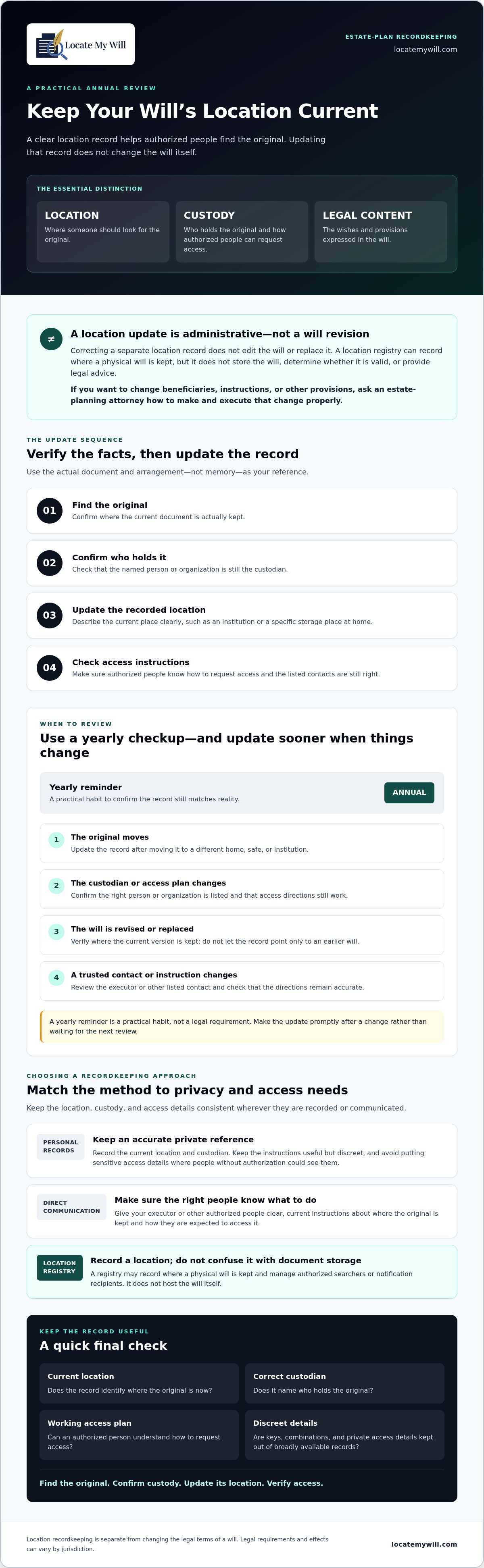
Location tells someone where to look, custody tells them who holds the original, and legal content sets out the wishes expressed in the will. Keeping these details separate helps prevent an administrative update from being mistaken for a legal revision. A location registry can record where a physical will is kept, but it doesn’t host the will itself. For background on the document’s role and terminology, see this overview of a will and testament.
To update will location information, start with the physical document and confirm the details instead of relying on memory. If the original is in a home safe, for example, describe that location clearly and confirm that the person responsible for access is still correct. Don’t put access codes or other sensitive details in a record that people without authorization could see.
What information should a will location record contain?
Record a precise, current location, such as the name of the institution or the specific storage place within a home, as appropriate. Note who has custody of the original and how an authorized person should request access. Make the instructions useful but discreet. Don’t include keys, combinations, or private access details in a broadly available document. Check each detail against the actual arrangement.
Does updating the location change the will?
No. Correcting a separate location record doesn’t change the will’s terms. If you want to revise beneficiaries, instructions, or other provisions, ask an estate-planning attorney how to make and execute that change properly—for example, you can learn more about Szekely Law to see how legal counsel assists with estate planning needs. Requirements and legal effects can vary by jurisdiction, so don’t assume that writing on a location record, attaching a note, or moving the original amends the will.
Think of the location record as an access guide, not a legal instrument. If the will has been revised or replaced, confirm which document is current and update the location information to match. A registry may help record the location and manage authorized searchers or notification recipients, but it doesn’t determine whether a will is valid or provide legal advice.
When to Review Your Will Location During an Annual Estate Checkup
A yearly estate-planning checkup is a useful reminder to confirm that your will location record still matches reality. Don’t wait for the annual review if something changes. Update the record promptly after moving the original or changing who can access it. Someone following the instructions should be directed to the current document, not an outdated location or version.
Review the record alongside other estate-planning information. Cornell Law School’s Legal Information Institute offers a legal definition of a last will and testament. Checking the location is a practical companion to reviewing the document and related arrangements, not a legal review of its terms.
Which life or document changes should trigger an update?
Check the record whenever the original’s location, custodian, or access plan changes. Common prompts include:
- Moving: If you move the original to a different home, safe, or institution, update the record to identify its current location.
- Changing custodians: If another person or organization takes responsibility for the original, confirm that the record names the right custodian and explains how an authorized person can request access.
- Revising or replacing the will: After signing a new version, verify where it’s kept and make sure the location details don’t point only to an earlier will.
- Changing people or instructions: If your executor or another trusted contact changes, review who is listed and whether the access directions still work.
After any of these changes, verify the facts directly. An instruction can become inaccurate without anyone noticing, especially if the original has moved but the written record hasn’t been updated.
How often should you check the record?
Set a yearly reminder, perhaps alongside another recurring review of your estate-planning records. Treat it as a practical habit, not a legal requirement or a substitute for updating the information as soon as it changes. A calendar reminder can help you catch details that might otherwise fade from memory, while an immediate update keeps the record useful between reviews.
If you’re considering how to update will location details as part of that routine, use this will location registration guide for more context. A location registry can record where the physical will is kept and help manage authorized searchers and notification recipients; it doesn’t store the document. To maintain a location record and manage authorized searchers, explore the will owner registration subscription.
Compare Your Will Location Update Options and Their Limits
You can keep a private household record, tell trusted people where to begin, or use a location registry. These approaches can work together, but each has limits. Compare how easy it is to keep information current, how access is handled, who can see the details, and what the method doesn’t provide.
- Private household record: It’s easy to revise, and you control where it’s kept. It can provide clear directions if the right person knows where to find it, but you must keep it current. It doesn’t notify anyone or ensure that someone will find or follow the instructions.
- Direct communication: Telling trusted people where to start can clarify the search plan. You’ll need to share updates when the location or plan changes. Privacy depends on whom you tell and how. A conversation doesn’t create a durable location record or establish legal authority to access the will.
- Will location registry: It can record location information and manage authorized searchers and notification recipients. Keep the registered details current as arrangements change. Only verified searchers can access the location information recorded with Locate My Will. A registry doesn’t host a digital will or physically store the original.
What can a personal record or family communication accomplish?
A note can identify a filing cabinet, safe, or custodian, while a conversation can explain whom to contact or where to begin looking. Both can help if the information stays current and can be found when needed. Tell the relevant person where the instructions are kept instead of assuming they’ll discover them. Neither an informal note nor a conversation guarantees access or grants legal authority.
What does a will location registry add?
A registry keeps the location record separate from the will itself. Locate My Will allows users to designate up to three authorized searchers and three notification recipients. Search activation dates control when searches can be performed and notifications sent. Check current service terms and account settings to understand how these controls apply. The original stays wherever you keep it.
For more on the difference between a location record and digital document hosting, read secure location records versus digital hosting. Whichever approach you choose, confirm that it points to the current original and that appropriate people know what to do next.
Use This Checklist to Update the Will Location Record
Start with the original document, then check the details around it. This sequence helps you correct the location record and confirm that people who may need to act can follow the instructions, without treating a record update as a change to the will.
- Locate the original. Confirm where the current signed original is physically kept. If you’re unsure which version is current, seek appropriate professional guidance before relying on it.
- Confirm the custodian. Verify who holds or controls access to the document. Check the arrangement directly rather than relying on memory.
- Update the location record. Replace outdated information with a clear description of the actual storage location and, where appropriate, the custodian or access procedure.
- Verify access details. Review who is authorized to search or receive notifications, and confirm that the instructions still make sense.
Verify the document and its current storage location
Make sure your record points to the document you intend others to find, not an earlier version or a copy. Include enough detail to distinguish the storage place from other files or belongings, while keeping sensitive access information private. Don’t move the original just to make the record easier to complete. Consider relevant legal or practical guidance before changing its storage arrangement.
After updating the record, compare it with the document’s actual location. If another person or institution holds it, confirm the arrangement with them. For ideas on what an executor might do when searching, see this executor’s will-finding protocol.
Review authorized people and notification instructions
Check that designated searchers and notification recipients remain appropriate and that their contact details are current. A change in family circumstances or a person’s availability may mean the access plan needs attention, even if the will hasn’t moved. Review the current account settings and applicable limits before making changes. Don’t assume an old list or instruction is still accurate.
Locate My Will supports up to three authorized searchers and three notification recipients. Only verified searchers can access recorded location information. These permissions help define who may search or be notified; they don’t give someone legal authority to access the original wherever it’s stored. For more detail on choosing and maintaining authorized people, consult the authorized will searcher guide.
Once you’ve checked the document, custodian, location, and permissions, confirm the final details directly. To maintain a will location record and manage authorized searchers, review the will owner registration subscription.
Keep the Will Location Current With a Reliable Review Routine
A dependable system has two parts: a regular check and a prompt update whenever the facts change. Add a yearly reminder to an existing financial or estate-planning checkup, but don’t wait for that date if you move the original, change its custodian, or revise who should be contacted. This keeps the record current instead of leaving it untouched until someone needs it.
Build a simple annual reminder
During the review, verify the recorded location against the original and confirm who holds it. Then check whether contact details and permissions still match your wishes. Note the date of the review so you can see when the information was last checked, but don’t put sensitive location or access details in a calendar entry that others might see.
A short reminder can prompt you to check:
- Whether the recorded location matches where the original is now kept.
- Whether the named custodian and access instructions remain accurate.
- Whether authorized searchers and notification recipients are still appropriate and reachable.
- Whether any change since the last review calls for an immediate correction.
Your responsibility is to keep the underlying arrangements accurate: know where the document is, confirm who has custody, and communicate appropriate next steps. A registry can record location information and manage permissions, but it doesn’t keep the physical will for you or replace your own review.
Know when to seek professional guidance
A location update is administrative. Questions about signing or executing a will, revoking or amending it, or whether it remains legally valid are different matters. Ask a qualified estate-planning attorney for guidance on those issues, since the answer may depend on the circumstances and applicable law. This checklist isn’t a substitute for advice about state-specific probate or estate rules.
Locate My Will is a subscription-based platform for recording where a physical will is kept, managing authorized searchers and notification recipients, and controlling when searches and notifications activate. It doesn’t draft wills, host digital will files, or physically store documents. If you want a dedicated way to record the document’s location and manage authorized search access, record a will’s location with Locate My Will.
Keep Your Will Location Information Ready for the People Who Need It
A reliable location record should match where the current original is kept and who can help others find it. Review it yearly, then update it promptly after a move, document revision, custodian change, or change to the access plan. Changing a location record doesn’t amend the will. Consult a qualified attorney about questions involving its terms or legal effect.
Locate My Will is a subscription-based platform for recording a physical will’s location and managing authorized search access. Only verified searchers can access the recorded location information. Users can designate up to three authorized searchers and three notification recipients. Activation dates control when searches can be performed and notifications sent, so check current account details when reviewing those settings. The service records location information; it doesn’t draft, host, or physically store your will.
If you’re ready to update will location details and maintain an access plan, review how Locate My Will helps you record a will’s location. A clear, current record gives your family a practical place to begin.
Frequently Asked Questions
How do I update the location of my will?
Confirm where the current original is kept, who has custody, and how an authorized person can access it. Then correct your location record and verify the details. To update will location information, check the physical document and custodian directly instead of relying on memory. If you use a registry, review its current account instructions and settings. Tell appropriate trusted people where to begin, while keeping sensitive access details private.
Does changing my will location change the will itself?
No. Updating a separate location record changes where the record says the document can be found, not the will’s terms. Moving the original or changing a registry entry doesn’t by itself revise beneficiaries or instructions. If you intend to amend or replace the will, or have questions about signing, revocation, or legal effect, consult a qualified estate-planning attorney. Requirements can vary, so don’t rely on a location update as a legal amendment.
When should I update my will location information?
Update it promptly whenever the original moves, custody changes, or the access plan is revised. After signing a revised will or replacing an earlier document, check that the record points to the version you intend people to find. A yearly review alongside other estate-planning records is a useful reminder, but it shouldn’t delay an update after a known change. Confirm the actual location and contact details during each review.
Can I store my will online instead of keeping the original?
Don’t assume an online copy can replace the original in your circumstances. Rules about electronic wills and what document may be needed can vary by jurisdiction and situation, so ask an estate-planning attorney what applies to you. A location registry is different from document hosting: Locate My Will records where a physical will is kept, but doesn’t host digital will files or physically store the original.
Who should I authorize to search for my will location?
Choose people you trust to follow your instructions, who are likely to remain reachable, and who understand how to begin a search. Review those choices if your circumstances or relationships change. Locate My Will allows users to designate up to three authorized searchers and three notification recipients. Only verified searchers can access recorded location information. Check current account settings and discuss appropriate next steps with the people you designate.
What happens if the will location record is outdated?
An outdated record may direct someone to an old address, former custodian, or superseded document, causing confusion as they try to locate the current original. It doesn’t automatically change the will’s terms, but it can make the search less straightforward. Verify the document’s actual location and custody, then correct the record and relevant access details. If you can’t confirm which document is current, seek guidance from an estate-planning attorney.
Does a will location registry keep or draft my will?
No. Locate My Will records where your physical will is kept and helps manage authorized searchers, notification recipients, and search activation dates. It doesn’t draft a will, host digital will files, or physically store the document. The original stays wherever you choose to keep it. Review the current service terms and account details to understand how permissions and activation settings work for your subscription.


