

A missing will is a reason to search more carefully, not proof that no will exists. If you’re unsure what to do if you can’t find a will, it’s understandable to worry that the person’s wishes may be lost or that estate administration will stall. Start with a calm, documented search.
This practical checklist covers likely places to look, people to contact, and ways to keep a clear record of each step. It also explains what to consider if you find only a copy or the original remains missing, and when to seek guidance from an attorney or the relevant probate authority.
Procedures and rules vary by jurisdiction, so don’t assume that a missing original automatically determines what happens next. A careful search can help you avoid overlooking records, manage questions about timing and family disagreements, and understand how securely recording a will’s location can prevent confusion in the future.
Key Takeaways
- If you’re deciding what to do if you can't find a will, begin with a calm, documented search rather than assuming no will exists.
- Check likely locations and contact people who may know where the original is kept, including the will-maker’s attorney if known.
- A copy may offer useful information, but its legal effect and the next steps depend on the relevant jurisdiction. Seek guidance from an attorney or probate authority.
- Use a log to track search leads, contacts, responses, dates, and next actions. Share sensitive details only with people who have a legitimate role.
- For future preparedness, Locate My Will lets subscribers record a will’s physical location and manage authorized access. It doesn’t store the document or locate a will that was never recorded.
What to Do First If You Can't Find a Will
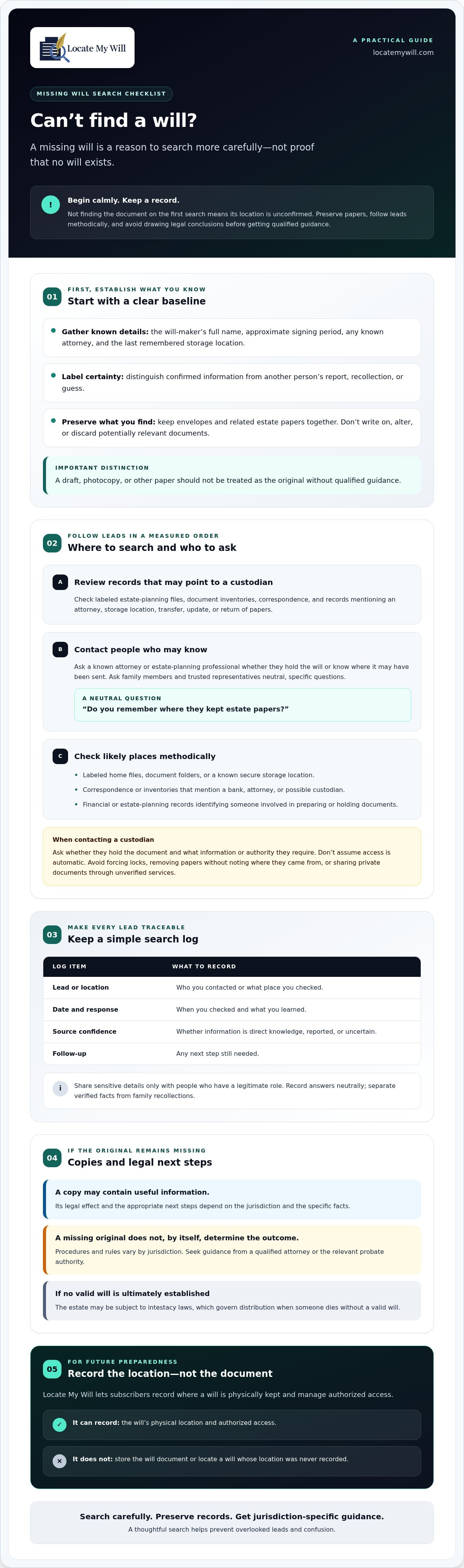
Not finding a will on the first search doesn’t mean no will was made. It means its location hasn’t been confirmed. If you’re working out what to do if you can't find a will, pause before moving or discarding papers. Preserve what you find, identify people or organizations that may have held the document, and write down each search step.
A steady process helps prevent missed leads and separates family recollections from verified information. For a broader, step-by-step approach to searching likely locations, see this systematic will search protocol.
Start with a record of what you know
Begin with basic details: the will-maker’s full name, the approximate period when the will may have been signed, any known attorney, and the last place anyone recalls it being kept. Mark each detail as confirmed, reported by someone else, or uncertain. For example, “attorney’s office confirmed they have no document” is different from “a relative thinks it was in a desk.”
Then create a search log. For each lead, note the person contacted or location checked, the date, what you learned, and any follow-up needed. Keep original envelopes and related estate paperwork together, and don’t write on or alter potentially important documents. Don’t treat a draft, photocopy, or other paper as the original without qualified guidance.
Avoid assuming the will does not exist
An unsuccessful first search is not proof that the person never made a will or that it cannot be found. Storage details may be uncertain, and someone who helped arrange the document may know where it was sent or kept. Ask neutral questions, record the answers, and distinguish direct knowledge from recollection or guesswork.
Preserve related records, even if they don’t appear to be the will. A letter from an attorney, an envelope, or a note naming a storage location may point to someone else to contact. Don’t alter, annotate, or dispose of these materials while their relevance is unclear.
If a will remains unlocated, the legal effect depends on the applicable state’s rules and the specific facts. A missing original doesn’t by itself establish the outcome. If no valid will is ultimately established, the estate may be subject to intestacy laws, which govern distribution when someone dies without a valid will. Speak with a qualified attorney or the relevant probate authority about the appropriate next steps in the jurisdiction involved.
Where to Search for a Missing Will and Who to Contact
Once you’ve recorded what’s already known, follow leads in a measured order. A focused checklist is more useful than searching every drawer or contacting people at random. Treat each person or location as a possible source of information, not a guaranteed place to find the original.
Check records and people who may know the location
Start with paperwork that points to the will or someone who handled it. Review labeled estate-planning files, document inventories, and correspondence for an attorney’s name, a storage reference, or a note about an update. Contact a known attorney or estate-planning professional using contact details you can verify. Ask whether they hold the will or know where it may have been sent.
Ask family members and trusted representatives neutral, specific questions. “Do you remember where they kept estate papers?” is more useful than “Who moved the will?” Record what each person actually knows and whether the information is based on direct knowledge or recollection.
Search likely storage places methodically
Use existing records to guide an orderly check of likely places. These may include:
- Labeled home files, document folders, or a known secure storage location.
- Records showing that estate papers were transferred, updated, or returned from an attorney.
- Correspondence or inventories that mention a bank, attorney, or other possible custodian.
- Financial or estate-planning records that identify someone involved in preparing or holding documents.
If a bank, attorney, or another custodian may have the document, ask whether they hold it and what information or authority they require before discussing it. Don’t assume access is automatic. Avoid forcing locks, removing papers without recording where they came from, or circulating private documents through unverified services. Share only the information needed to confirm a lead.
A will-location registry may help only if the will-maker recorded the location there beforehand. It doesn’t search physical locations or reveal details about a will that was never registered. Locate My Will is a paid subscription platform for recording where a will is physically kept and managing authorized searcher access; it doesn’t store the will itself. If you’re considering this as a future-preparedness measure, review will-location recording and authorized access.
If careful checks don’t locate the original, don’t treat that alone as confirmation that no will exists. The legal consequences depend on the relevant jurisdiction and circumstances. Cornell Law School’s Legal Information Institute explains that state's intestacy rules concern distribution when someone dies without a valid will. Ask a qualified attorney or probate authority what applies before deciding what to do next.
If the Original Will Is Still Missing: Copies, Legal Questions, and Next Steps
If your search turns up a copy but not the original, preserve it and record where it came from. A copy can offer useful information about the person’s wishes and help an attorney assess what to investigate next. It shouldn’t be treated as automatically equivalent to the original. The rules and procedures that may apply depend on the jurisdiction and circumstances.
What a copy can and cannot tell you
Note who supplied the copy, where it was found, and whether it appears complete. Keep it as received, including any envelope or accompanying papers. You can record visible details such as dates, signatures, witness information, amendments, or references to a later version, but don’t draw conclusions about validity from appearance alone.
A copy may help identify the attorney who prepared the will or suggest that an updated document could exist. It does not, by itself, establish whether the document can be used in a probate process. For further context, read about the consequences of a lost will.
When to seek professional guidance
If the original remains unlocated, contact a qualified estate or probate attorney promptly. Seek guidance particularly if relatives have found different versions, disagree about where the original was kept, or give conflicting accounts of whether it was changed. Avoid choosing one document as controlling or assuming an outcome before receiving advice specific to the relevant jurisdiction.
Ask the attorney which probate authority or records, if any, may be relevant and what steps are appropriate locally. Filing procedures and the treatment of a missing original can vary, so general information may not answer the question for your case.
Prepare a concise file for the conversation. Include a timeline of known events, your search log, the copy and related papers, and a list of people or organizations contacted. Keep originals secure and share copies through a method the attorney confirms is appropriate. This organized record can clarify what is known, what remains uncertain, and what to investigate next.
If you’re weighing what to do if you can't find a will, treat the copy as evidence to discuss, not a final answer. A qualified professional can explain which facts matter and how to proceed under the applicable rules.
How to Keep the Search Organized and Protect Important Information
A clear record helps everyone understand what has been checked, what remains uncertain, and who is handling the next step. It can also reduce repeated calls and make it easier to give an attorney or probate professional an accurate account if guidance is needed.
Use a search log that others can follow
Use one shared log or designate a record keeper. Each entry should capture the lead, person or location contacted, response, date, and next action. For example, write “filing cabinet checked, no will found, follow up with attorney’s office” rather than simply “home searched.” Label unconfirmed suggestions as unverified, and assign someone to follow up so leads don’t get lost.
- Lead: A named attorney, file, storage place, or person to contact.
- Contact or check: Who was asked or which location was reviewed.
- Response and date: What was confirmed, and when.
- Next action: The follow-up step and who will take it.
Record documents discovered without writing on or changing the originals. Store notes and copies securely, and limit access to appropriate family representatives and professional advisers. Share only what someone needs for their role, rather than giving them the full set of private papers by default.
Coordinate with family and professional contacts
Where practical, agree on one point of contact for updates and routine requests. That person can keep the log current and direct new leads to the right family member or adviser. Share the search status, such as which likely locations have been checked, without unnecessarily circulating account details, personal identifiers, or copies of sensitive documents. For role-specific context, see the executor's will-finding guide. If your family is also handling practical arrangements and memorial announcements during this time, you can find out more through community funeral directors such as Ashley Edwards.
Keep a distinction between a will’s location information and the will itself. An online location record may indicate where a document was recorded as being kept, but it doesn’t retrieve the physical document or confirm that it is still there. Locate My Will is a paid subscription platform for recording a will’s physical location and managing authorized access; it doesn’t host or store the will. If you want to record a will’s location for future authorized searchers, explore will-location registration.
Keep questions about legal authority, deadlines, or probate procedure separate from the search log. Those details can vary by jurisdiction. Take your organized notes to a qualified attorney or the relevant probate authority for guidance specific to the situation.
Prevent a Future Search: Record the Will's Location for Authorized Searchers
A location record can help authorized people know where to look in the future, but it cannot recover a will that was never recorded. If you’re asking what to do if you can't find a will right now, continue the current search and seek appropriate guidance. A registry is a preparedness measure for a confirmed document location, not a substitute for finding a missing will.
What a will-location registry records
Locate My Will is a paid subscription platform where a will-maker can record where a will is physically kept and manage authorized access. It records location information, not the will itself. The platform doesn’t draft wills, host digital copies, or store physical originals.
Users can designate up to three authorized searchers and up to three notification recipients. Activation dates control when searches can be performed and notifications sent. Searcher access requires verification and follows the user’s recorded settings. Check the current subscription terms, activation details, and verification and notification procedures before relying on them.
A location entry may guide an authorized searcher to a place to check, but it doesn’t confirm that the document remains there or guarantee that it will be found. If you’re considering a location record for future preparedness, the will-location registration guide explains the purpose of recording this information.
When to set up a location record
Record the location only after the will-maker has confirmed where the current document is kept. Use a precise description that an authorized person can understand, while avoiding unnecessary sensitive details. Revisit the record if the will is moved, storage arrangements change, a new adviser is involved, or the will-maker updates the document and changes where it is kept.
A current, securely recorded location can reduce uncertainty for the people designated to search, but it doesn’t determine who may act as executor or settle legal questions. For questions about a will’s validity or estate administration, seek guidance from a qualified professional in the relevant jurisdiction.
If you want to prepare for future document discovery, explore Locate My Will’s Will Owner Registration Subscription and its authorized searcher and activation-date controls. Review the current service details to decide whether recording the location fits your planning needs.
Take the Next Step With a Clear Plan
Knowing what to do if you can't find a will starts with a careful search, not an assumption that no will exists. Preserve related papers, check likely locations and contacts methodically, and log each lead and response. If you find a copy but not the original, get guidance from a qualified professional about the rules that apply in the relevant jurisdiction.
For future preparedness, a current location record can help authorized searchers know where to look. Locate My Will securely records a will’s physical location, not the document itself, and requires searcher verification. Subscribers can designate up to three authorized searchers and three notification recipients. The service can’t recover a will that was never recorded, and it doesn’t host digital copies or store physical documents.
If the will-maker has confirmed where the current will is kept, record your will’s location for authorized searchers. A calm, documented process now can make the next steps clearer and help reduce confusion for the people entrusted to carry out a person’s wishes.
Frequently Asked Questions
What should I do first if I can’t find a will?
One unsuccessful search doesn’t prove that no will exists. Write down what you know, including the will-maker’s known attorney and any last-known storage location, then check likely document files and contact people or custodians who may know more. Keep a dated log of locations checked, responses, and follow-up steps. Don’t assume a particular legal outcome; probate procedures and the effect of a missing document depend on the relevant jurisdiction.
Can a copy of a will be used if the original is missing?
A copy may provide useful information, but it isn’t automatically valid or accepted as a substitute for the original. Preserve it, note where it came from and who supplied it, and record whether it appears complete or refers to amendments or a later version. Don’t decide its legal effect based on its appearance. Ask a qualified estate or probate attorney what rules and procedures apply where the matter is being handled.
What happens if no one can find the original will?
The consequences depend on the circumstances and applicable state law, so don’t assume a particular probate result. An unresolved search is not the same as confirming that no will was ever made or that no later version exists. Document the search, preserve copies and related records, and consult a qualified attorney about next steps. They can help assess which facts and records may matter under the rules that apply to the estate.
Who should I contact when a will is missing?
Start with the will-maker’s known estate-planning attorney, family members who may know where papers were kept, and any identifiable custodian, such as an organization that may hold the document. Record what each person confirms and what remains uncertain. If the search is unsuccessful, ask a qualified attorney which probate authority or records may be relevant. Access requirements and procedures vary, so this general information isn’t legal advice.
Can an online will registry find a will that was never registered?
No. A will-location registry can provide only location information the will-maker recorded with that service. Locate My Will doesn’t host a will, store the physical original, or retrieve an unregistered document. If no location was entered, continue a careful search and contact people or custodians who may know where the will is kept. The platform is designed to help with future discovery when a location has been recorded, not to search for an unknown will.
How can I help my family find my will in the future?
Keep your current will in a secure, known place, tell appropriate trusted people where to find its location information, and update that information whenever storage arrangements change. A location registry can record where the document is kept and manage authorized searchers, but it doesn’t store the will itself. Locate My Will allows up to three authorized searchers and three notification recipients. Review access settings and current subscription terms to keep your arrangements clear.


