

What if the first step in learning how to find parents will isn’t searching at all? If your parent is alive, their will is private, so a respectful conversation should leave them in control of what they share. After a death, the search can feel urgent, but an online court search or will registry may not reveal every document.
It’s understandable to want a clear starting point and to worry about overlooking an important lead. This guide explains how to approach a living parent with care, then how to search methodically after a death. You’ll learn where to check for records and which people or offices may be able to point you toward the next step.
We’ll also explain what public records and location registries can and can’t tell you, what to do if you find only a copy or no will, and when court staff or an estate attorney may help. The goal is a respectful, organized search, not the assumption that one database can find every will.
Key Takeaways
- Use your parent’s wishes and circumstances to decide whether to begin with a conversation or an estate search.
- Follow a practical plan for how to find parents will: check likely household records and ask people already involved in their planning.
- Compare what probate court records, a known attorney or custodian, family files, and a location registry may reveal.
- If the will remains missing, track confirmed facts and unanswered questions so you can ask the relevant court or an estate attorney focused questions.
- For future planning, a parent can choose to record where the physical will is kept and decide who may access that location information.
How to Find Your Parents’ Will Starts With One Question: Are They Living?
A will search can feel deeply personal, especially if your parent is still alive. Before deciding how to find parents will, consider whether your parent can tell you where the document is and whether they want to share that information. A will sets out a person’s wishes for what happens after death. For background, see What is a will?
The right first step depends on your parent’s circumstances. If they’re living, respect their privacy and ask rather than search. If they’ve died, find out who is handling the estate and follow authorized channels. Finding a will means locating the document or getting a reliable lead to the person or organization holding it. It doesn’t mean entering private accounts, opening locked property without permission, or assuming family ties alone grant access.
If your parent is living, ask before searching
Choose a calm moment and frame the conversation around preparedness, not suspicion or disagreement with their decisions. You might say, “I want to make sure I know whom to contact if you’re ever unable to guide us. Would you be comfortable telling me whether you have a will and where the original is kept?”
If they’re willing to talk, ask whom they’ve chosen to contact or act if the document is needed. Your parent can decide what to disclose and who may know its location. Don’t search their files, devices, or locked storage without permission. The goal is to learn how to follow their wishes, not to take control of their private planning.
If your parent has died, establish the immediate facts
Start by asking whether an executor, personal representative, or estate attorney is already involved. That person may know where the original is kept or what steps are underway. For practical inquiries, gather your parent’s full name and known recent contact details, such as an address or the name of a professional they worked with.
Be clear about what you know and what you don’t. Not finding a copy at home, or not finding one immediately, doesn’t prove that no will exists. The original may be with an attorney, another custodian, or in a place you haven’t checked yet. Before accessing property or private records, confirm that you have permission or appropriate authority.
These situations call for different kinds of care. With a living parent, let consent guide the conversation and any access. After a death, identify the person responsible for the estate and ask what information they can share. If you’re unsure whether you’re authorized to access a particular record or place, pause and ask the relevant professional or court what applies. A careful first step protects privacy and gives the search a clear direction.
Where to Look for a Parent’s Will: Search Records and Ask the Right People
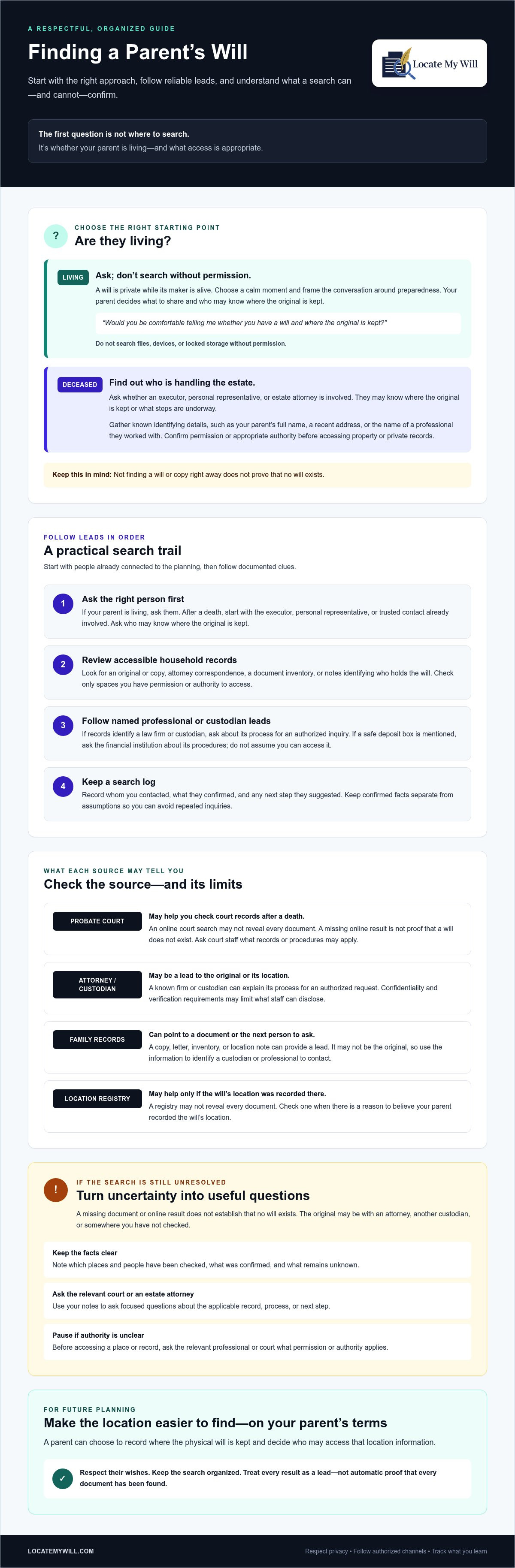
A staged search is more reliable than checking every possible source at once. If you’re researching how to find parents will, begin with people your parent already trusted with estate information, then follow documented leads. Search only records and spaces you’re authorized to access. Not finding the document in one place gives you a lead to follow, not proof that no will exists.
Build a search trail from family records and known contacts
Start with your parent, if living, or with the executor, personal representative, or other trusted contact already involved after a death. Ask where the original is kept and whether anyone knows of an attorney, custodian, or written location instruction. Then work through the available leads in order:
- Ask the right person first. Confirm what they know and whether they can direct you to the next contact.
- Review accessible household files. Look for an original or copy, attorney correspondence, a document inventory, or notes identifying who holds the will. Check only spaces you have permission or authority to access.
- Follow named leads. Contact a professional or custodian identified in the records. If a safe deposit box is mentioned, ask the financial institution about its procedures. Don’t assume you can access it.
- Keep a search log. Record whom you contacted, the date, what they confirmed, and any next step they suggested. This helps prevent repeated inquiries and separates facts from assumptions.
Check with an attorney, custodian, or known registry
If you find a law firm’s letter or an estate-planning invoice, contact the firm and ask whether it can confirm custody or explain its process for receiving an authorized request. Confidentiality and verification requirements may limit what staff can disclose. Check a registry only if there’s a reason to believe your parent recorded the will’s location there. A location registry can point to a recorded location; it can’t find a will that was never registered.
For broader post-death search steps, see How to Find a Deceased Person’s Will. Court procedures differ. Massachusetts, for example, provides official instructions on how to get a copy of a will from a probate case file. For your parent’s situation, follow the relevant court’s guidance rather than assuming the same process applies everywhere.
If a parent is living and wants trusted people to know where the physical will is kept, they may choose to record its location and control who is authorized to access that information. Learn about recording a will’s location as a parent-led preparation option.
Can You Get a Copy of Your Parents’ Will From Court? Understand the Limits
A probate court search can be useful, but it isn’t a complete search for every will. Whether you can view or obtain a court-filed document may depend on whether a probate case has been opened and on state-specific procedures. Being the deceased person’s child, or believing you’re a beneficiary, doesn’t by itself guarantee access. Ask the appropriate probate court what information it can provide and what steps are required.
| Source | What it may tell you | What it cannot confirm |
|---|---|---|
| Probate court | Whether a case or will has been filed, and how to request records under that court’s procedures. | Whether a will exists but remains with a private custodian or has not been filed. |
| Known attorney or custodian | Whether the person or firm can confirm custody or explain its process for an authorized request. | Information they’re not permitted to disclose or a will held elsewhere. |
| Family records | Possible copies, correspondence, inventories, or written directions to the original. | Whether the located copy is the latest version or whether another document exists. |
| Location registry | A recorded lead to where a participant says the physical will is kept. | The will’s text, its legal validity, or the location of an unregistered will. |
What court records can and cannot tell you
Contact the probate court that may handle the estate and ask how to search its case records and request a copy. A search may identify a filed case, but a court can’t confirm every privately held will. A negative search result means no matching record was found through that search; it doesn’t establish that no will exists. Court access and probate procedures vary by state, so verify any legal conclusion with an appropriate state source or qualified estate attorney.
How a will-location registry differs from a will database
A will-location registry records where a participant says their physical document is kept. It is not a copy of the will, digital document hosting, or legal validation. For example, a record might direct an authorized searcher to contact a named custodian. That lead is useful only if the parent chose to register the information and the searcher meets the service’s verification and activation requirements. An unregistered will won’t automatically appear in a private location service.
When considering how to find parents will, treat court records, personal contacts, family files, and registries as distinct sources. Each can provide a lead, but none is a universal lookup or guarantees that every possible location has been checked.
What to Do If You Still Cannot Find Your Parents’ Will
An unsuccessful search leaves an unanswered question, not a definite answer. An incomplete search can’t establish that your parent never made a will, and the legal effect of a missing original or a copy depends on the circumstances and applicable state law. Keep the next steps factual and organized while you seek guidance.
Separate confirmed facts from unanswered questions
Create a brief written record that distinguishes what you’ve verified from what you still need to find out. Include the date, person or office contacted, response, and any lead or follow-up they gave you. For example, “The family files contained a letter from an attorney” is a fact; “the attorney must have the original” is an assumption until confirmed.
Preserve potential evidence. Keep original papers in their current condition, make copies for your records where appropriate, and don’t write on, alter, discard, or present a copy as the original. If you find conflicting versions or only an incomplete copy, set them aside and ask a qualified professional how to handle them.
When to seek guidance from an estate attorney
Contact an estate attorney or the relevant probate court if relatives disagree, the status of a document is unclear, or you’re concerned that a deadline may apply. The correct process can depend on the state and the details, so don’t assume one rule determines whether a will can be used or what happens if an original is missing.
Prepare a concise timeline before you call. Note the date of death, if applicable, who is handling the estate, where you searched, which people or offices you contacted, and what documents or leads you found. Ask which steps apply to your parent’s circumstances and what information or proof you should provide. For background, read the consequences of a lost will, but don’t treat general information as a prediction of your family’s legal outcome.
This record also helps if you’re still working out how to find parents will: it shows which leads have been checked and where uncertainty remains. Keep contact notes and copies together, and update the log when new information comes in. Don’t declare the search complete simply because one office or record source had no result.
If a parent is living and wants to help trusted people locate the physical will in the future, they can choose to record its location and manage who is authorized to access that information. Explore recording a will’s location as a future-planning step. It won’t find a will that hasn’t been registered.
Help Your Parent Make Their Will Easier to Find in the Future
Planning ahead can spare loved ones from guessing where an important document might be. Advice on how to find parents will often focuses on a search after death, but prevention starts with the parent. They decide whether to record the will’s location, which trusted people to authorize, and when access should be available. An adult child shouldn’t create a registration or choose searchers on a parent’s behalf without their consent.
The will itself should remain in a secure place chosen by the parent. The practical goal is to make sure trusted people know how to follow the parent’s directions to its location, not to circulate the document or leave the original unsecured.
What a parent should document for trusted searchers
Encourage your parent to review the details periodically, especially if the original is moved or their preferences change. A useful location record should reflect:
- Where the physical will is kept. Record its current location and update the information if it moves.
- Who may search. Choose authorized searchers deliberately. Locate My Will allows a user to designate up to three authorized searchers and three notification recipients.
- When access may begin. Review activation settings so searches and notifications align with the parent’s privacy preferences. Searchers must be verified before accessing recorded location information, and access follows the parent’s chosen activation settings.
These choices belong to the will owner. Discuss them together, but let your parent make and manage the decisions.
When a will-location registry may help
Locate My Will is a paid online service for recording where a will is physically kept, managing authorized searchers, and controlling when searches and notifications can be activated. It records location information; it doesn’t draft the will, host a digital copy, or store the physical document. A registry can provide a lead only if the parent participates and records the will’s location. It won’t automatically find an unregistered will.
If your parent is interested, talk through what the service records, whom they would authorize, and how activation settings work before they decide whether to register. The parent should control registration and access rather than having an adult child set it up without consent.
A clear, parent-directed location record can give trusted people a more orderly starting point when they need to act. Explore how Locate My Will records a will’s location and discuss whether this preparation option fits your parent’s wishes.
Make the Next Step Clear and Respectful
Finding a parent’s will starts with understanding whether they’re living. If they are, ask with care and let them decide what to share. After a death, follow documented leads, contact people already involved, and keep a clear record of what you’ve checked. A court search or location registry can offer useful information, but neither confirms that every possible location has been searched. If the document remains missing or its status is unclear, ask the relevant court or an estate attorney which steps fit the circumstances.
For future planning, a parent may choose to record where the physical will is kept and decide who can access that location information. Locate My Will lets users designate up to three authorized searchers and three notification recipients. Searchers must complete the platform’s access process, and activation settings guide when searches and notifications can occur.
If your parent wants to consider this option, explore how Locate My Will records a will’s location. A thoughtful conversation and an orderly plan can make the next step easier for everyone.
Frequently Asked Questions
Can I get a copy of my parents’ will from the courthouse?
You may be able to request a copy if the will has been filed with the appropriate probate court, but access procedures depend on the court and state rules. Contact the court that may handle the estate and ask how to search its records and request documents. Being a child or presumed beneficiary doesn’t automatically guarantee access. A court search also can’t confirm whether a will is held privately and hasn’t been filed.
How do I find my parents’ will if they are still alive?
Ask your parent directly and respectfully; their will is private while they’re living. You can ask whether they have one, where the original is kept, and whom they want contacted if it’s needed. Let them decide what to disclose. Don’t search private accounts, files, or locked property without permission. If you’re researching how to find parents will, consent is the right starting point when your parent is alive.
How do I find my parents’ will after they die?
First, find out whether an executor, personal representative, or estate attorney is involved and ask about the will’s location. Then check accessible household records for the original, a copy, attorney correspondence, or written instructions. Follow leads to a known attorney or custodian, and ask the probate court about its records process. Keep a log of contacts and results. Don’t treat an empty file or unsuccessful court search as proof that no will exists.
Are wills public record before probate?
Generally, a will is a private document during its maker’s lifetime. Whether it can be accessed after death may depend on whether it has been filed with the court and on state-specific rules. A will that hasn’t been filed may remain with a private custodian, such as an attorney or another person. Ask the relevant probate court or an estate attorney about the rules that apply; don’t assume a document is public before probate.
Can I search online to find my parents’ will?
You can check whether the relevant probate court offers an online case search, but an online result may show only records filed with that court. Private will-location registries are different: they record where a participant says the physical document is kept. A registry can provide a lead only if your parent registered the location, and it doesn’t contain the will’s text or find every unregistered will. Treat online searches as one part of a broader search.
What should I do if I cannot find the original will?
Keep any copy, correspondence, and location clues in their current condition, and write down where you searched and whom you contacted. Don’t alter or discard potential evidence, or present a copy as the original. Ask an estate attorney or the appropriate probate court how to handle the specific document and what rules apply in that state. Whether a copy can be considered, and what evidence may be needed, depends on the circumstances and applicable law.
What if my parents never made a will?
If a careful search confirms that no will exists, the estate may be handled under the state’s intestacy laws, which set rules for distributing assets and may not reflect your parent’s wishes. A court may appoint an administrator to handle the estate, but the applicable process depends on state law and the circumstances. Ask the probate court or an estate attorney what steps apply before assuming there was no will or predicting who will inherit.


