

What happens to a will no one can find, and will the estate still follow the person’s wishes? A missing original doesn’t automatically mean those wishes are lost, but it can create a fact-specific probate question. Whether a copy or other evidence can be used depends on the circumstances and state law. If no effective will can be established, the estate may be handled under intestacy rules instead.
It’s understandable to worry that beneficiaries could lose what the deceased intended for them, or that probate cannot move forward without the original. Neither outcome is automatic, and a copy does not guarantee that a court will accept the will. Preserving relevant records and getting advice from probate counsel can help clarify the available options.
This article explains what may happen when an original will is missing, what families can search for and document, and what information to discuss with counsel. It also explains how recording a will’s location, without storing the document itself, can give authorized searchers a useful place to start.
Key Takeaways
- What happens to a will no one can find depends on state law and the evidence available, so there isn’t one outcome for every estate.
- A misplaced original, an available copy, and evidence of intentional revocation can raise different questions for probate counsel.
- Preserve relevant documents and communications, and record where and when each item was found.
- Possible probate paths depend on whether the will is located, other evidence can be considered, or intestacy rules govern the estate.
- Recording a will’s location and designating authorized searchers and notification recipients can help guide future searches.
What happens when no one can find a will?
The estate process depends on state law and the evidence available. There isn’t one universal outcome when a will is missing: the original may be misplaced, a copy may exist, or the circumstances may raise questions about whether the will was revoked. Those situations are not interchangeable. A family’s inability to locate a document does not, by itself, establish what happened to it or determine how the estate must be handled.
The original will’s location can matter in probate because it may help establish which document contains the deceased’s final, legally effective instructions. What happens to a will no one can find therefore depends on the specific evidence and the rules that apply where the estate is administered.
Does a missing will automatically mean the estate follows intestacy?
No. Intestacy laws govern how property is distributed when no effective will applies, but whether that process controls depends on the facts and state law. A missing original is not automatically proof that the person revoked the will. At the same time, some jurisdictions may treat an original that cannot be found as evidence relevant to possible revocation. Probate counsel can assess how local rules apply.
Why the original document and its location matter
An original, a copy, and other evidence can raise different questions about authenticity, the will’s contents, and whether it remained effective. A court may consider the document alongside the circumstances, while probate counsel can explain what evidence may be relevant under state law. For a closer look at potential effects on heirs, read about the consequences of a lost will for beneficiaries.
For example, a signed copy might help show the deceased’s intended provisions, but it does not necessarily resolve whether a court can accept it or what proof is required. Evidence that the original was deliberately destroyed may raise different issues from evidence that it was moved, misplaced, or held by someone who has not yet been contacted. The details matter. Uncertainty about where the will is does not prove the person intended to revoke it.
If the will cannot be located or accepted as effective, the estate may ultimately be handled under intestacy rules. Those rules vary by state and may distribute property differently from the wishes expressed in the missing document. First establish what is known, preserve relevant records, and discuss the evidence with probate counsel before drawing conclusions.
How a missing original, a copy, or possible revocation can change the outcome
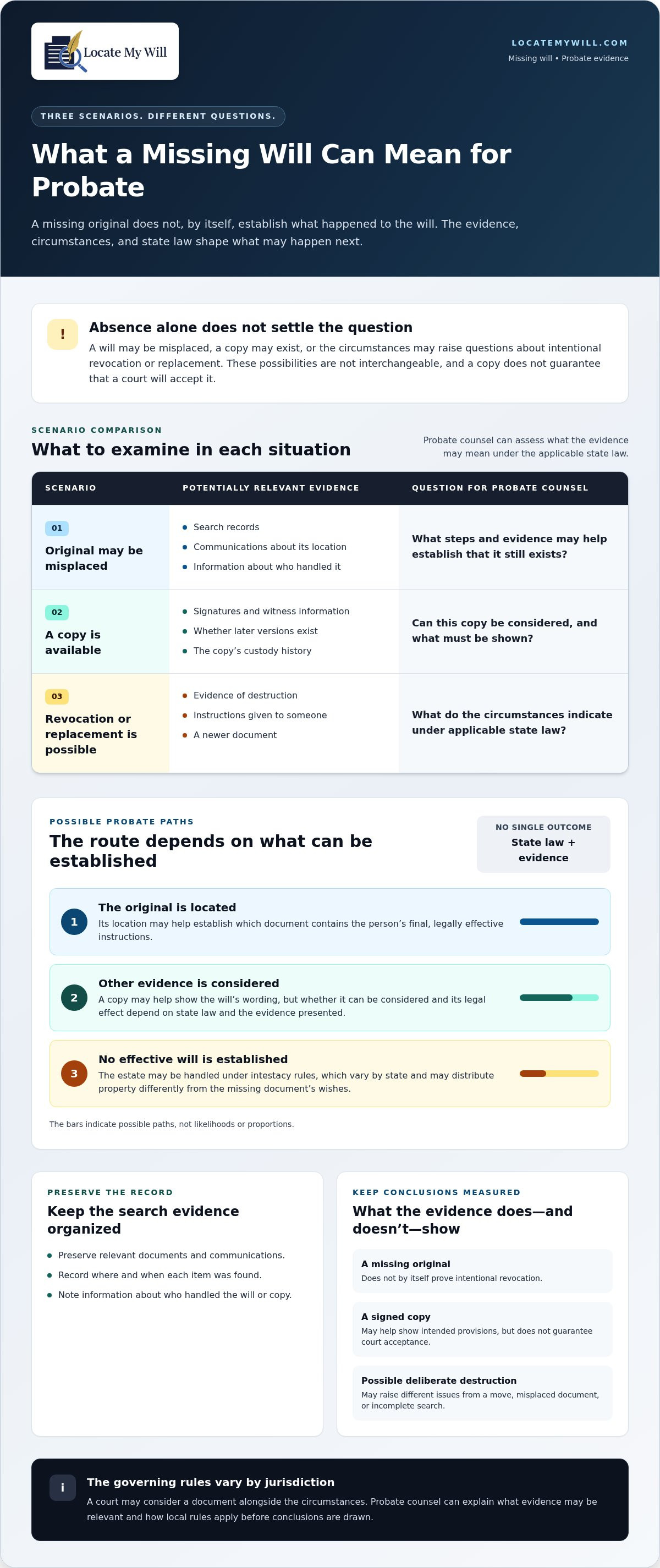
A missing original leaves several possibilities open: it may have been misplaced, a copy may survive, or the circumstances may suggest that the will was intentionally destroyed or replaced. Each scenario can raise different evidentiary questions. State law governs how those questions are assessed, so families shouldn’t assume that a missing document proves either that the will was revoked or that a copy will control.
| Scenario | Potentially relevant evidence | Question for probate counsel |
|---|---|---|
| The original may be misplaced | Search records, communications about its location, and information about who handled it | What steps and evidence may help establish that it still exists? |
| A copy is available | Signatures, witness information, later versions, and the copy’s custody history | Can this copy be considered, and what must be shown? |
| Intentional revocation or replacement is possible | Evidence of destruction, instructions to someone, or a newer document | What do the circumstances indicate under applicable state law? |
What if someone finds a copy but not the original?
A copy may help show the will’s wording, but whether it can be considered and what legal effect it has depend on state law and the evidence presented. Signatures and witness details may matter, as may whether a later version exists and how the copy was kept. A copy can be important evidence, but it doesn’t guarantee the same result in every state. Probate counsel can assess what proof may be needed without assuming the copy is equivalent to the original.
Could the absence of a will suggest it was revoked?
The circumstances of the disappearance matter. Accidental loss, a move, or an incomplete search does not establish intentional destruction. Evidence that the person deliberately destroyed the document or created a replacement may raise different questions. Rules and presumptions vary by jurisdiction, so avoid drawing conclusions from the document’s absence alone. For an organized approach to locating documents, see this systematic guide to finding a deceased person’s will.
General reference material, including wikipedia.org, can explain will-related terms, but it can’t determine how a court will treat specific evidence. To reduce future uncertainty about where to look, consider recording your will’s location for authorized searchers. A location record can guide a search without replacing the will or probate advice.
What may happen to the estate and beneficiaries if the will stays missing?
If the will remains unlocated, the estate may still move forward, but the route depends on what can be established under applicable state law. The main possibilities are that the original is found, the court considers other evidence of the will, or no effective will is recognized and intestacy rules apply. A missing document alone doesn’t prove the deceased had no wishes. It means those wishes may be harder to establish through probate.
Administration may involve additional questions or procedural steps as the people handling the estate gather documents and determine what the court can consider. That doesn’t guarantee a particular delay or outcome. It does make careful recordkeeping and jurisdiction-specific guidance especially useful.
How probate may proceed when no original is available
Probate is governed by state law, so the process isn’t uniform across the country. Depending on the circumstances, an executor or other personal representative may need to provide the court with relevant documents and information about the estate and missing will. A probate attorney in the jurisdiction where the estate is being administered can explain which procedures and evidence may apply. General online material, including this additional reference, shouldn’t be treated as a substitute for that local advice.
What beneficiaries should understand about possible distribution
Beneficiaries may expect to receive property described in a will or believe they know what the deceased intended. Those expectations matter personally, but they don’t establish what a court will recognize. Distribution may follow a valid will if it is located or accepted through the applicable process. If no effective will governs, state intestacy law may determine who inherits. The result depends on the facts and the law, not solely on what family members remember or anticipated.
For a closer look at issues beneficiaries may face, read about the legal and financial consequences of a lost will. If you’re helping administer an estate, keep communications and documents organized, and ask probate counsel how each item may affect the available paths. That helps distinguish what is known from what still needs to be established.
What should family members do when the will cannot be found?
Focus first on preserving reliable information, not deciding what the missing will means. The answer to “what happens to a will no one can find” depends on the facts and state law. Avoid assuming the estate must follow intestacy or that an available copy settles the matter.
Preserve the facts before making assumptions
Keep potentially relevant materials together and note where and when each item was found. A simple written record can help distinguish what someone directly observed from what they heard later. Record search steps as well, including locations checked and people contacted, so the family can avoid repeating the same inquiries and share a clear account with counsel.
- Keep available will versions, envelopes, correspondence, and related notes in their current condition. Make copies for reference, but preserve the originals.
- Write down the will’s last known location, if known, and who may have handled or moved it.
- Record relevant communications, including who shared the information and when. Avoid discarding materials or treating a copy as conclusive proof of the will’s legal effect.
These notes won’t decide whether a document can be used in probate. They can help counsel understand the sequence of events and identify which details still need clarification.
Bring the right questions to probate counsel
Seek advice promptly from an attorney familiar with probate in the jurisdiction handling the estate. Explain what’s missing, what versions or records are available, and what is known about the document’s last location. Ask:
- How does the applicable state law treat the available original, copy, and circumstances of disappearance?
- What documents or information are needed to determine the next procedural step?
- Should the family take any specific steps to preserve or provide the materials?
Don’t assume that intestacy applies before getting jurisdiction-specific guidance, and don’t rely on a copy as though it necessarily has the same effect as an original. For a structured search reference, see the executor’s systematic guide to finding the will.
Once the immediate facts are organized, turn to prevention for your own estate planning. Record where your will is kept so authorized searchers can know where to look. The location record is not the will itself and doesn’t replace legal advice or probate procedures.
How recording a will’s location can help prevent uncertainty later
A will-location record addresses one practical problem: people who need to find the document may not know where it is kept. It doesn’t settle probate questions or guarantee that a will will be accepted. Instead, it gives authorized people a clear place to start, which can reduce confusion when circumstances are difficult.
What a will-location record does and doesn’t do
The record identifies where the physical will is kept, such as a named location or with a designated custodian. It gives authorized people location information so they can look for the document. It does not digitally host, draft, or physically store the will. The owner remains responsible for keeping the document current and legally valid, and for ensuring that its actual location matches the information recorded.
That distinction matters: a location record can make the document easier to find, but it doesn’t replace the document itself, legal advice, or probate procedures. For a practical overview of setting up a record, read this will-location registration guide.
Plan access with verified searchers and notifications
With Locate My Will, an owner can designate up to three authorized searchers and up to three notification recipients. Verified searchers access the will-location information according to the owner’s configured activation date. That date controls when searches can be performed and notifications sent, subject to the settings in place.
Choose people who are likely to know how to act on the information, and update the location record if the document moves. Keeping the record aligned with the will’s actual location gives authorized people a practical starting point instead of leaving them to search without guidance.
If you’ve wondered what happens to a will no one can find, recording its location in advance can address the practical uncertainty of where to look. It won’t determine the legal outcome if a will is later missing, but it can give authorized searchers a useful starting point. Record your will’s location securely when you’re ready.
Make Your Will Easier to Find
What happens to a will no one can find depends on the evidence and state law, so a missing original doesn’t lead to one automatic outcome. A copy or other records may raise important questions, and probate counsel can explain which rules apply. For families, preserving documents and noting where they were found can help clarify the facts without assuming what a court will decide.
For future peace of mind, make the will’s location easier for the right people to find. A location record points authorized searchers toward the physical document; it doesn’t store the will or replace legal advice. With Locate My Will, users can designate up to three authorized searchers and three notification recipients. Verified searchers access the location information according to the owner’s configured activation date.
Record your will’s location securely with a Locate My Will subscription, giving authorized people a practical starting point when they need it.
Frequently Asked Questions
What happens if no one can find the original will?
What happens to a will no one can find depends on the facts and state law. If a court can consider the will through acceptable evidence, the estate may proceed under it. If no effective will is established, state intestacy rules may govern distribution. A missing original doesn’t produce one automatic result everywhere. Contact probate counsel in the jurisdiction handling the estate promptly to understand the evidence and procedures that may apply.
Can an estate go through probate without the original will?
Possibly, but probate procedures and evidentiary rules differ by state. A copy or other evidence may be considered in some circumstances, but families shouldn’t assume it will be accepted or have the same effect as the original. The court or probate process determines what evidence is sufficient under applicable law. A probate attorney in the relevant jurisdiction can explain what information may help establish the will’s contents and status.
Does a missing will mean the person died intestate?
Not necessarily. Intestacy means property is distributed under applicable state law when no effective will governs the estate. A will’s absence from its expected location doesn’t by itself establish that no valid will exists or determine the final outcome. Family members should preserve available documents and information, then seek jurisdiction-specific guidance before concluding that intestacy rules apply. The estate’s next steps depend on the evidence and local law.
Can a copy of a will be used if the original cannot be found?
A copy may be relevant evidence, but whether it can be used and what effect it has depend on state law and the circumstances. Details such as signatures, witness information, later versions, and the history of the original’s custody or disappearance may matter. Don’t assume a copy will be accepted or treated as equivalent to the original. Probate counsel can explain what evidence may be required in the applicable jurisdiction.
Could a will be treated as revoked if no one can find it?
Possibly, depending on the facts and state law, but there’s no universal rule that resolves every missing-will situation. Accidental loss or misplacement is different from evidence that the person intentionally destroyed or replaced the will. The document’s absence alone may not establish what happened. Consult probate counsel before assuming the will was revoked or relying on another version, since local presumptions and proof requirements can vary.
What should family members do first when they cannot find a will?
Preserve any available versions and related records, and write down the will’s last known location and who may have handled it, if known. Keep relevant correspondence and notes together, and don’t treat a copy as conclusive proof. Then seek advice from probate counsel in the jurisdiction handling the estate. Counsel can explain how local law treats the available evidence and what information may be needed for the next procedural step.
How can someone make sure their family knows where the will is kept?
Keep the location information current and arrange for appropriate people to know how they can access it. A will-location registry can record where the document is kept and manage authorized searchers and notification settings, but it doesn’t store the will itself. Locate My Will lets users designate up to three authorized searchers and three notification recipients. Review the record whenever the will’s location or arrangements change.


