

How can you ask your parents where their will is kept without making them feel pressured or uncomfortable? Talking to parents about will location can feel like crossing a personal boundary, especially if the conversation sounds as though you’re questioning their plans. The goal is practical: make it easier for the family to find the document when needed, while leaving decisions and control with your parents.
It’s reasonable to want a clear answer, and just as important to respect how much your parents choose to share. The conversation doesn’t need to cover the contents of the will or every detail of their estate plan. It can focus on who should know where the original is and how that information can stay current.
This guide explains how to choose an appropriate moment, open the conversation without judgment, and respond if your parents prefer to keep details private. You’ll also learn how to agree on a straightforward way to keep location information findable. If your parents want another option, they can record the will’s location in their own account with a location registry. The will itself isn’t uploaded or stored there.
Key Takeaways
- Define your specific concern before raising the subject, so the conversation stays focused on practical preparation.
- Use an adaptable opener that invites discussion without asking to read the will or take control of your parents’ plans.
- When talking to parents about will location, agree only on the details they’re comfortable sharing and who may know them.
- Choose one manageable next step, such as noting the agreed location information and deciding when to review it.
- If your parents want a private way to record location details, a location registry lets them designate authorized searchers and control when searches can be performed.
Why talking to parents about will location can protect their wishes
It’s understandable if this conversation feels uncomfortable. Wills can bring up sensitive thoughts about privacy, family roles, and the future. But talking to parents about will location doesn’t have to become a discussion about death or a review of their personal decisions. A respectful, practical conversation can help ensure the right people know where to look if the document is needed.
Will location means information about where a will is kept, such as the name of a person or office holding it, or the place where the paper document can be found. It isn’t the will itself. A family may know a parent has made a will but not know where the current document is kept. If no one can find it, the family may have difficulty identifying the document the parent intended them to consult. Procedures can depend on the circumstances, so this conversation shouldn’t be treated as a legal determination.
Why the location matters separately from the will itself
A will records a person’s wishes and may have legal significance. Wikipedia offers a neutral overview of what a will is. Knowing where it is kept is a separate, practical matter. Finding a document doesn’t mean interpreting its language, changing its contents, or administering an estate. Those are distinct questions, and knowing its location doesn’t give a family member authority over the document or the decisions it contains.
Knowing where a will is kept is not the same as having permission to access, interpret, or control it. Keeping that distinction clear can make the conversation feel less intrusive. Your parents might choose to share only a general location or identify someone else who already knows the details. They don’t need to disclose the will’s contents to make its location easier to find.
How to frame the subject around their wishes
Approach the subject as a way to respect your parents’ decisions, not as a request to inspect or manage their plans. Choose an ordinary, calm moment, perhaps during a broader conversation about organizing important information. Avoid raising it during a crisis, an argument, or a discussion that could make the question feel like pressure. Age alone is not a reason to assume a parent lacks a plan or needs persuading to make one.
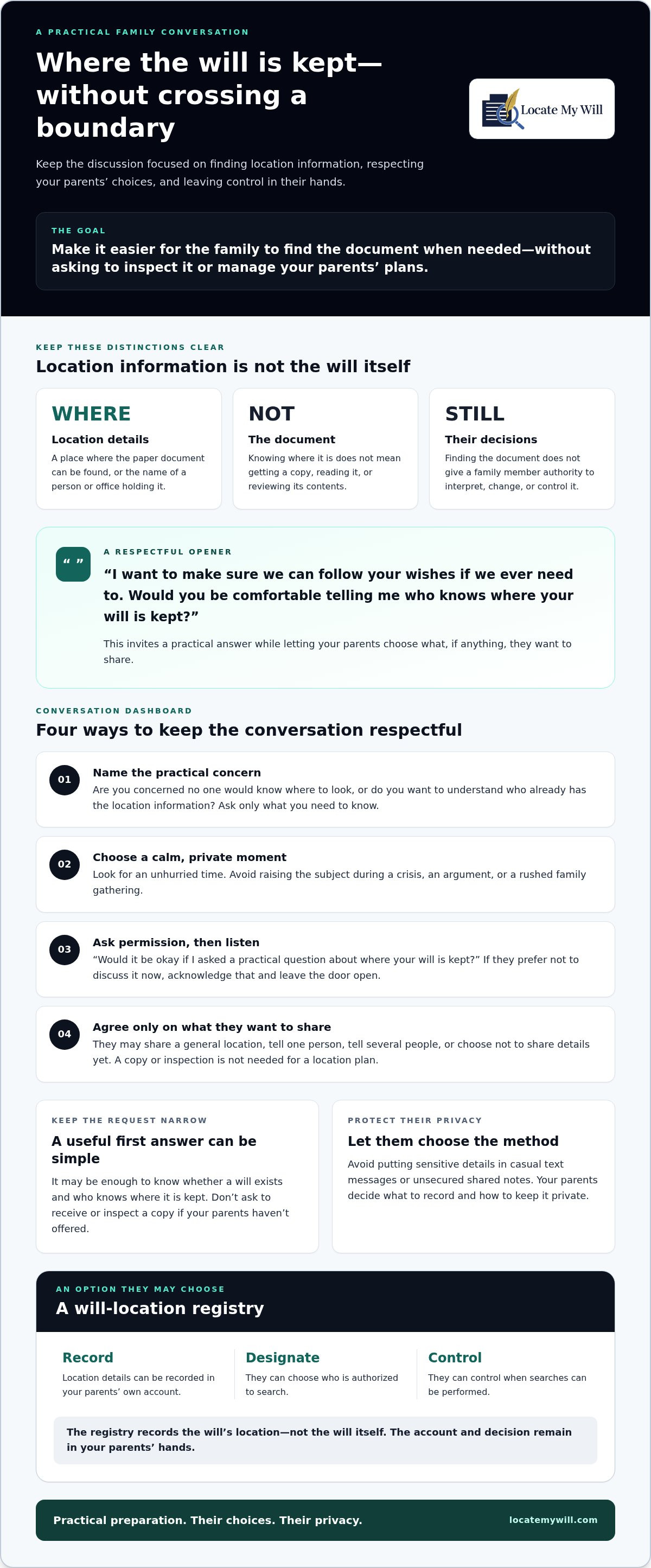
A simple opener can keep the focus on their preferences: “I want to make sure we can follow your wishes if we ever need to. Would you be comfortable telling me who knows where your will is kept?” This leaves room for your parents to decide what, if anything, they want to share. The aim isn’t to obtain the document or question their choices. It’s to make a practical arrangement that supports the plan they’ve already chosen.
How to prepare before asking parents where their will is kept
A little preparation can keep this from becoming a broad or emotionally loaded discussion. Before talking to parents about will location, identify the concern behind your question. Are you worried no one would know where to look, or do you want to understand who your parents have already told? Naming the practical issue helps you ask only what you need to know, rather than opening questions about their choices, finances, or the contents of their will.
Then decide what a useful answer would look like. For an initial conversation, it may be enough to know whether a will exists and who holds the location information. You don’t need to request a copy or ask to inspect the document. RBC Wealth Management also offers guidance on how to talk to your parents about their estate plan, including ways to approach a sensitive discussion thoughtfully.
Choose the right moment and decide what you need to know
Look for a private, unhurried moment when you can both focus. Avoid an argument, emergency, or rushed family gathering, where a practical question could feel like pressure. You might ask, “Would you be comfortable telling me whether you have a will and who knows where it’s kept?” Keep the request narrow. If your parents don’t offer more, don’t ask to see or receive a copy.
Set privacy boundaries before the conversation begins
Make your purpose clear: you’re trying to understand how to find location information, not review personal decisions. Your parents can choose whether to tell one person, several people, or no one yet. They can also decide what details to share and when. Asking permission first gives them room to set those boundaries.
Ask permission before discussing sensitive planning details, and let your parents decide how much to share. For example: “Would it be okay if I asked a practical question about where your will is kept?” If they agree, listen without pressing for information they haven’t volunteered. If they’d rather not discuss it now, acknowledge that and leave the door open for another time.
Avoid recording sensitive details in casual text messages or unsecured shared notes. If your parents want location information recorded, they can choose a method that suits their privacy preferences. A location registry lets them record details in their own account, designate authorized searchers, and control when searches can be performed. It records location information, not the will itself. You can introduce a will-location registry as an option, while leaving the decision and account in your parents’ hands.
What to say when talking to parents about will location
The most useful wording is clear, calm, and easy for your parents to answer. You don’t need a perfect script. Choose language that sounds natural in your family, then keep the request focused on where location information can be found, not on what the will says or who receives what.
Gentle ways to begin the conversation
You might start with the practical reason for asking: “I want to make sure we can find important documents when needed.” Then ask, “Would you be comfortable telling me how we would locate your will?” This invites an answer without demanding to see the document or learn its contents.
If your family tends to be direct, you could say, “Do you have a plan for making sure someone knows where your will is kept?” If a softer approach feels more suitable, try, “I’m not asking to read it. I’d just like to know who we should ask if we ever need to find it.” Adapt the phrasing to your usual way of speaking rather than forcing a formal style.
As you talk, listen for what your parent is comfortable sharing. If they seem uneasy, pause before asking anything else. You could acknowledge the feeling with, “I understand this is personal. I’m not trying to question your decisions.” A location question is about finding the document, not challenging the choices it contains. Keep that distinction clear if your parent seems to interpret the question as doubt or criticism.
How to respond to hesitation or a no
If your parent declines, accept the answer without arguing, pressing for a reason, or repeating the question in different words. A measured response might be, “I understand. Would you prefer to talk about it another time, or would you rather not discuss it with me?” This gives them a genuine choice. If they want to revisit the subject later, agree on a time only if they suggest or welcome one.
Some parents may prefer to share location information with another trusted person. You can ask once, without steering their decision: “Would you rather choose someone else to know where it is?” They may name a relative, another trusted person, or no one at this point. Respect their preference and don’t treat a different choice as rejection.
Your parents retain control over what they share, who they tell, and when they share it. That boundary can reassure them that the conversation is not a request for access or authority. If they agree to share only a contact name or general location, accept that as a useful answer. Talking to parents about will location works best when their comfort sets the pace and your next question follows from what they choose to disclose.
How to agree on a practical, privacy-conscious next step
Once your parent is comfortable discussing the subject, keep the next step small and specific. Agree on what location information, if any, they want recorded, who may receive it, and when it should be available. This turns a sensitive conversation into a clear arrangement without expanding it into a review of the will or a search for the document.
What a useful location record can include
A location record should contain only details your parent has agreed to share. It might say that the original is held by a named professional or kept in a known secure location. It doesn’t need to include a copy of the will, passwords, account credentials, or private information about its contents. The document stays wherever your parent chooses to keep it.
Be precise about permission, too. Ask who may receive the location information and whether it should be shared now or only later. Your parent might choose one trusted person or authorize several people. A registry can support those choices: parents can name up to three authorized searchers, designate up to three notification recipients, and set activation dates that control when searches and notifications can occur. Searchers must be verified before accessing location information.
A will-location registry is one way for a parent to keep agreed location details organized in their own account. It records where the will is kept, not the will itself. If this approach suits your parent, explore a will-location registry as a recordkeeping option.
When to revisit the arrangement
Location details can become outdated if your parent moves the document or changes where it’s kept. Agree on a simple way to revisit the information after such a change, rather than checking repeatedly without their invitation. Updating the details should remain their choice, along with the decision about who can see them.
If your parent wants to share the information with more family members, keep the same boundaries in place: share only what they approve, with the people they name, at the time they choose. For ideas on communicating the details to relatives, see How to Tell Family Where Your Will Is Kept. Confirm any change with your parent before updating a shared record, so the location information reflects their current preferences.
Talking to parents about will location is most useful when it ends with one agreed action, not an open-ended obligation. That might mean noting an approved location, identifying who will hold the information, or deciding when it can be shared. Keep the arrangement as limited as your parent prefers.
Keep the conversation respectful as parents decide what to share
A useful conversation doesn’t require your parents to disclose every detail or make a new arrangement on the spot. They decide what location information to share, who may receive it, and when it should become available. Your role is to listen, confirm what they’re comfortable with, and let them choose whether a next step makes sense.
If they want a structured way to record the information, Locate My Will is designed for will-location details. It doesn’t draft or store the will. The document remains wherever your parents choose to keep it, while the service records information about its location.
When a will-location registry may fit the family’s plan
Parents can use a location registry in their own account to record where their will is kept and manage who is authorized to search for that information. They can designate up to three authorized searchers and up to three notification recipients. Searchers must be verified before they can access location information, and activation dates govern when searches and notifications can occur.
These controls let parents set permissions and timing according to their preferences. A registry is an optional recordkeeping approach, not a public will-search database, and recording location details doesn’t upload or physically store the will. If your parents would rather use another method or share information with one trusted person, respect that choice.
A simple close that keeps the decision with parents
As you wrap up, keep the conversation focused: choose a calm moment, ask clearly, respect boundaries, and agree on one next step only if your parents want to. You might confirm a location detail they’ve approved, note who they’ve chosen to inform, or simply leave the topic for another time. Don’t assume permission to share more widely or follow up without their agreement.
Talking to parents about will location is ultimately about supporting their decisions, not taking over their planning. For a practical overview of recording location details, see Register Will Location Online: Estate Security Guide. Your parents can consider whether a registry suits their preferences, without changing where the will is kept or sharing its contents.
If they choose to explore that option, explore a secure way to record a will’s location. The choice remains theirs, including what information to record and who may access it.
Make the Next Step Your Parents’ Choice
Talking to parents about will location can be a calm, practical conversation when it starts with respect for their wishes. Choose an unhurried moment, ask only for the information they’re comfortable sharing, and agree on one next step together. The goal is to make location details findable, not to inspect or take control of the will.
If your parents want a structured way to record those details, Locate My Will lets them designate up to three authorized searchers and three notification recipients. Searchers must be verified before accessing location information, and activation dates control when searches and notifications can occur. The will itself remains wherever your parents choose to keep it.
If they decide a registry fits their preferences, explore a secure way to record a will’s location. A thoughtful conversation can begin with one simple question, and your parents remain in control at every step.
Frequently Asked Questions
How do I bring up my parents’ will without upsetting them?
Choose a calm, private moment and explain that you want to help the family honor their wishes. Talking to parents about will location can start with asking permission: “Would it be okay to talk about where important documents are kept?” Keep the first discussion focused on finding the will, not reading it or discussing its contents. Listen to their response. If they seem uncomfortable, acknowledge that and offer to revisit the subject later.
Should I ask my parents to show me their will?
No, not unless they choose to offer. Asking where a will is kept is different from asking to read it or receive a copy. Explain that you’re trying to understand how the family could locate it if needed, then let your parents decide what to share. If they’d rather not tell you, you can ask whether they would prefer to identify another trusted person who can keep the location information.
What if my parents refuse to tell me where their will is?
Respect their decision and don’t turn one conversation into repeated requests. You can briefly explain that knowing how to locate the document may help the family follow their wishes, then leave the choice with them. Ask whether they’d prefer to revisit the topic later or share the information with someone else. If they say no to both, accept that answer and avoid pressuring them.
Can I record where my parents keep their will without seeing it?
You can record location information without seeing the will, but only if your parents agree to share it and have it recorded. Keep the note limited to an agreed description, such as the name of the person holding the document or its general storage location. Decide together who may access the information and how updates will be handled if your parents move the will.
How can I explain that asking about will location is not about money?
State your reason plainly: you want to know how the family could find the document so your parents’ wishes can be followed. Keep the conversation centered on location and avoid asking about inheritance, assets, or who receives what. You might say, “I’m not asking to review your decisions. I just want to know how we’d find the will if it were needed.” Reassure them that they control what they disclose.
Is a will-location registry the same as storing a will online?
No. A will-location registry records information about where a will is kept; it doesn’t host the will itself. Locate My Will lets users record location details, designate up to three authorized searchers and three notification recipients, and set activation dates for searches and notifications. Searchers must be verified before accessing the information. The will remains where its owner chooses to keep it, and no digital copy is stored in the registry.
When should we update information about where a parent’s will is kept?
Update the location details if your parent moves the will or tells you the existing information is no longer accurate. Make any change with their knowledge and according to their privacy preferences. It can help to agree in advance who will confirm updates and who may receive them. Avoid treating the information as permanent; a record is useful only if it reflects the location your parent currently wants to share.


