

What if the key difference in an online will registry comparison isn’t where the will is kept, but who can find out where you placed it? Registry services may record a document’s location, store a digital copy, or offer both. Those functions aren’t interchangeable: a location record can help authorized people find the will, but it doesn’t replace the original document or legal advice.
Making a will is only part of planning ahead. Your loved ones also need a practical way to locate it, with access handled according to your wishes. Compare what information a registry records, who can access it, and when a search or notification can take place.
This guide compares registry models by access controls, notifications, and document-location features. It also explains how Locate My Will’s verified searchers, limits on authorized searchers and notification recipients, and search activation dates fit into the comparison. You’ll see what the service records, what it doesn’t provide, and what to check before choosing a registry for your circumstances.
Key Takeaways
- An online will registry comparison helps you assess what each service records and how its access process works.
- Check identity verification, authorized roles, search timing, and notifications before deciding who may locate your will.
- Match a registry to the document you need to locate and the people you expect to search. Coverage may not extend to trusts or other estate documents.
- Review subscription terms, cancellation conditions, permissions, and data handling instead of assuming services work alike.
- Keep the location record current if you move or change where the will is kept, and confirm what the registry does not provide.
Online Will Registry Comparison: What Services Actually Compare?
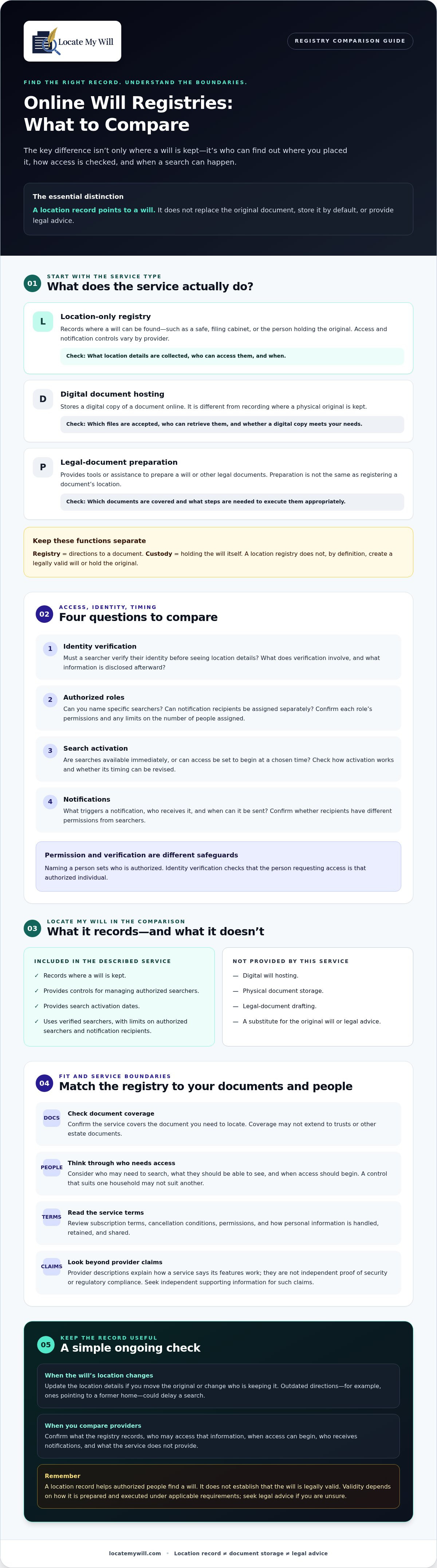
A will-location registry records where a will is kept. It provides directions to the document, not the document itself. A service labeled a “will registry” might record a location, host a digital file, help prepare legal documents, or combine functions. Start an online will registry comparison by checking what each service actually does, rather than relying on its name.
| Service type | What it may provide | What to verify |
|---|---|---|
| Location-only registry | A record identifying where the will can be found, along with access or notification controls that vary by provider. | What location details are collected, who can access them, and when. |
| Digital document hosting | Online storage for a digital copy of a document. | Which files are accepted, who can retrieve them, and whether a digital copy meets your needs. |
| Legal-document preparation | Tools or assistance to prepare a will or other legal documents. | What documents are covered and what steps are required to execute them appropriately. |
What information does a will-location registry record?
A location record might point to a safe, a filing cabinet, or a person who holds the original. It should help an authorized searcher work out where to look, not imply that the registry holds the will. Providers may request different information, so check their terms to see what you’ll be asked to record and who may see it.
Keep the record current. If you move the original or change who is keeping it, update the location details. For example, directions that still point to a former home could delay a search.
How is a registry different from will storage or drafting?
Document hosting stores a file, physical storage keeps an original, and preparation services help create documents. A registry focused on location does none of those things by definition. It also doesn’t create a legally valid will. Whether a will is valid depends on how it’s prepared and executed under applicable requirements, so seek legal advice if you’re unsure.
A location record points to a will; document custody means holding the will itself. Locate My Will records where a will is kept and provides controls for managing authorized searchers and search activation dates. It doesn’t host digital wills, draft legal documents, or store physical documents. For background on the distinct concept of digital wills and digital assets, consult the linked overview. Compare each service’s functions and boundaries with what your documents and family need.
Compare Will Registries by Access, Verification, and Timing
A location record is useful only if the right people can access it at the right time. In an online will registry comparison, look beyond feature labels and examine the actual process: who may search, how their identity is checked, when access begins, and who receives notifications.
| Access question | What to compare | What to confirm in the terms |
|---|---|---|
| Identity checks | Whether searchers must verify their identity before seeing location details. | What verification involves and what information is disclosed after it’s completed. |
| Authorized roles | Whether the owner can name searchers and, separately, notification recipients. | How many people can be assigned to each role and whether those roles have different permissions. |
| Access timing | Whether searches are available immediately or can be set to activate at a chosen time. | How activation works and whether the owner can revise the timing. |
| Notifications | Whether the service sends notifications, and to whom. | What triggers a notification, who receives it, and when it can be sent. |
Use provider descriptions to understand how a service says its features work, but don’t treat those descriptions as independent proof of security or regulatory compliance. If a provider makes a security or compliance claim, look for supporting information from an independent source. Review its privacy terms to learn how personal information is handled, retained, and shared. A control that suits one household may not suit another, so consider who needs to act, what they should be able to see, and when.
Who can search for a will, and how are they verified?
Check whether you can name specific searchers in advance and whether a searcher must be verified before receiving location information. These are separate safeguards: naming someone sets permission, while verification checks that the person seeking access is the authorized individual. Locate My Will allows up to three authorized searchers, who must be verified before they can access location information.
When do searches and notifications become available?
Some services may offer owner-controlled timing; others may not. Ask whether search access and notifications activate together or follow separate rules. Timing controls can let an owner prepare for a future need while limiting access before that point. Locate My Will lets users set search activation dates, which control when searches can be performed and notifications sent. Don’t assume every registry offers this feature.
Ask four questions: Who can search, how are they verified, when does access activate, and who is notified? For a concrete example of searcher management and activation-date controls, review will-location access controls.
Which Online Will Registry Fits Your Documents and Family?
The right registry depends on what you need people to locate, where the original is kept, and who may need to act. A service that records a will’s location may not support a trust, power of attorney, or other estate document. Check the provider’s supported document types before creating an account, and don’t assume one registration covers every item in your plan.
What should you check for a will, trust, or multiple documents?
Start by listing the documents you want people to be able to find. Then confirm whether the service accepts each type and whether each needs a separate location record. Don’t treat a will-location entry as a record for a living trust unless the provider says it supports that document too. For trust-specific search guidance, see Locating a Living Trust Document.
Consider where each document is actually kept. If the will is with one person and the trust document is stored elsewhere, a single vague note may not tell an authorized searcher where to begin. Record each document’s location distinctly where the service allows it, and check the terms to understand the limits of its coverage.
How many searchers and notification recipients do you need?
List people by the role they may need to perform. Someone who should be able to search for the document may not be the same person who needs to receive a notification. Make your list before comparing services, then check whether each provider supports enough people and keeps permissions clear.
- Who is likely to look for the document?
- Who should receive a notification that a search can take place?
- Do different documents or family arrangements call for different people?
Family structure can affect those answers. For example, you might want one relative to locate the will and another trusted person to receive a notification. Don’t assume a service permits unlimited access or treats searchers and recipients as interchangeable. Locate My Will allows users to designate up to three notification recipients. Compare that limit with your needs, and confirm current terms before relying on any feature.
An online will registry comparison is most useful when it reflects your documents and intended searchers, not a generalized ranking. Providers may change their supported documents and service terms, so compare like with like and verify current details directly. Choose a service only after confirming that its document coverage, location records, and permission limits match your arrangements.
How to Evaluate Fees, Privacy, and Service Limitations
Compare the service agreement, not just the advertised features. A registry may record a will’s location, but its subscription terms determine how long that record remains available, what happens if you cancel, and who may access information. Assess each provider separately because billing, permissions, and data practices can differ.
Which subscription and cancellation terms should you inspect?
Before enrolling, review these five areas in the current agreement:
- Billing and renewal: Check billing frequency, renewal conditions, and how the provider explains future charges. Don’t assume another service uses the same billing schedule.
- Cancellation: Find the cancellation steps and any stated deadlines or conditions. Confirm whether cancellation takes effect immediately or at another point described in the agreement.
- Feature limits: Check any limits on searchers, notification recipients, document records, or other features relevant to your arrangements.
- Permissions and account access: Confirm who can see location information, what verification is required, and what happens to authorized access if the account changes status.
- Data handling and changes: Ask the provider how long records are retained, how account access is managed, and how you can update or correct information.
Pay particular attention to whether subscription status affects searches, notifications, or the availability of the location record. If the agreement doesn’t explain what happens, ask the provider before signing up. Keep a copy of the applicable terms so you can refer to the conditions you accepted.
What can a registry not guarantee or replace?
A registry can help authorized people locate a will, but it can’t guarantee that the will is legally valid or that estate administration will proceed successfully. A location record doesn’t replace the original document, and it isn’t a substitute for legal advice about preparing or updating estate documents.
An outdated or unclear record may make a will harder to find, so keep the registry information aligned with where the document is actually held. For context on what may follow when a document can’t be located, see The Cost of a Lost Will and Consequences of a Lost Will for Beneficiaries.
Review the current terms and features for Locate My Will’s will-location registration before deciding whether its controls suit your needs.
Choose a Will Registry and Keep the Record Useful
A registry is most helpful when its location record reflects your current arrangements and the people you’ve authorized can use it. Use the online will registry comparison criteria to make a practical choice: compare features, verify current terms, choose searchers and notification recipients, record the will’s location, and review the entry when circumstances change.
What should you prepare before registering a will’s location?
Before creating a record, confirm where the signed will is kept and who controls access to that place. A location note should give an authorized person enough direction to begin looking without implying that the registry holds the document.
Next, decide who may need to search and who should receive a notification. Check the provider’s stated limits and distinguish between the two roles. With Locate My Will, owners can designate up to three authorized searchers and three notification recipients. Confirm the service’s current terms and feature availability, including how search activation dates work. Keep your own contact details current so service communications can reach you as intended.
How can you keep a will-location record dependable over time?
Treat the record as something to maintain, not a one-time task. If you move the will from a home safe to a lawyer’s office, update the directions. Review the entry after a move, a change in document storage, or a change in who you trust to search or receive notifications. These checks help prevent an accurate record from becoming stale.
- Compare: Match the registry’s functions to your document and family needs.
- Verify: Read the current subscription terms, access rules, and feature limits.
- Choose: Assign searchers and notification recipients within those limits.
- Record: Enter clear directions to where the signed will is kept.
- Review: Update the record and permissions when arrangements or contacts change.
Locate My Will is one option for recording a will’s location, managing authorized searchers, and setting activation dates for searches and notifications. It doesn’t host digital wills, draft legal documents, or store physical documents. For a step-by-step registration walkthrough, see Register Will Location Online: Estate Security Guide. Review Locate My Will’s current platform features and subscription details to confirm they fit your needs.
Make Your Will Easier to Locate
A useful online will registry comparison looks past labels to what each service records, who can access that information, and when. A location registry helps authorized people find a will, but it doesn’t hold the original, host a digital will, or replace legal advice. Check document coverage, privacy terms, and subscription conditions before choosing.
Keep the record aligned with your real arrangements. Confirm where the signed will is kept, select appropriate searchers and notification recipients, and review the entry when storage or family circumstances change. Locate My Will allows up to three authorized searchers and three notification recipients. Searchers must be verified before accessing the recorded location, and activation dates control when searches and notifications can occur.
If those controls fit your needs, review Locate My Will’s features and subscription details before deciding whether its location registry is right for you. A clear, current record is a practical step toward helping the right people find your will when they need to.
Frequently Asked Questions
What is an online will registry?
An online will registry records information about where a will is kept so authorized people can locate it. It typically provides directions to the document rather than holding the original. Providers differ in what they collect and how they control access. Before registering, check which documents the service covers, who may see the location information, and whether searches or notifications are controlled by an activation date.
Is an online will registry the same as storing a will online?
No. A will registry may record the location of a paper document, while a document-hosting service stores a digital file. Those functions aren’t interchangeable. A location record can point a searcher to an original held in a safe or by another person, but it doesn’t provide the document itself. Confirm whether a provider records locations, hosts files, or offers both, and don’t assume one feature includes another.
Is there a national will registry in the United States?
The United States does not have a national government-run will registry. Private services may offer will-location registration, but each provider sets its own records and access rules. Don’t assume that registering with a private platform creates an official government record or makes a will discoverable through every search process. Check how the service works, what information it records, and whether it fits your document and family arrangements.
Who should be authorized to search a will registry?
Choose people you trust who are likely to help locate the will when needed, such as a responsible family member or another appropriate representative. Consider separately who should be able to search and who should receive notifications, since those permissions may differ. Check the provider’s limits and verification process before assigning roles. Locate My Will permits up to three authorized searchers, who must be verified before accessing location information.
Can an online will registry keep my will private until it is needed?
Some services offer access controls, but privacy depends on each provider’s rules and how it operates. Check whether you can name searchers, what verification is required, when searches become available, and who receives notifications. Locate My Will uses search activation dates to control when searches and notifications can occur. Review the provider’s privacy terms directly, and don’t treat a feature description as a guarantee of confidentiality.
Does registering a will’s location make the will legally valid?
No. Recording a will’s location doesn’t create the document or establish its legal validity. A registry helps authorized people find the will; it doesn’t replace the original or legal advice. Requirements for preparing and executing a will depend on applicable law, so consult a qualified legal professional if you have questions about your circumstances. Keep the signed document in its intended location and update the registry record if that location changes.
What should I compare before paying for a will registry subscription?
In an online will registry comparison, assess what information the service records, which documents it supports, who can search, how identities are verified, and when access or notifications activate. Then review billing frequency, renewal terms, cancellation steps, feature limits, data handling, and what happens to your record if the subscription ends. Confirm unclear points with the provider before enrolling, since subscription conditions and access rules can vary.


