

What happens if a family knows a will exists but no one knows where to find it? Keeping that information private is understandable, but uncertainty can add stress at an already difficult time. A will registry for families offers a way to coordinate where each person’s will is kept without putting the document itself online.
The process is simple: each person records the will’s location, chooses who may search for that information, and updates the record when circumstances change. With Locate My Will, each individual can designate up to three authorized searchers. Only verified searchers can access recorded information, and activation dates control when searches and notifications can occur.
This article explains how to coordinate individual records without assuming a shared family account, choose trusted searchers, and keep location details current after a move or other life change. You’ll also learn how a registry can help people locate a will while the original remains in its chosen physical location.
Key Takeaways
- A will registry for families can help relatives coordinate where individual wills are kept without putting the documents online.
- Compare verbal instructions, shared spreadsheets, and controlled-access registries to choose an approach that fits your family’s privacy and update needs.
- Give each will owner responsibility for an accurate location record, and agree on trusted people who may search for it.
- Build a review habit so location details and authorized searchers can be updated after moves or other life changes.
- Locate My Will supports individual records, with up to three authorized searchers and three notification recipients per user.
Why a Will Registry for Families Starts with Findable, Separate Records
A will can be carefully prepared, signed, and placed somewhere safe, yet still be hard for relatives to locate when they need it. Often, the problem isn’t that the document is missing. It’s that the people looking for it don’t know which drawer, safe, office, or other location holds the original, or whether the storage arrangement has changed.
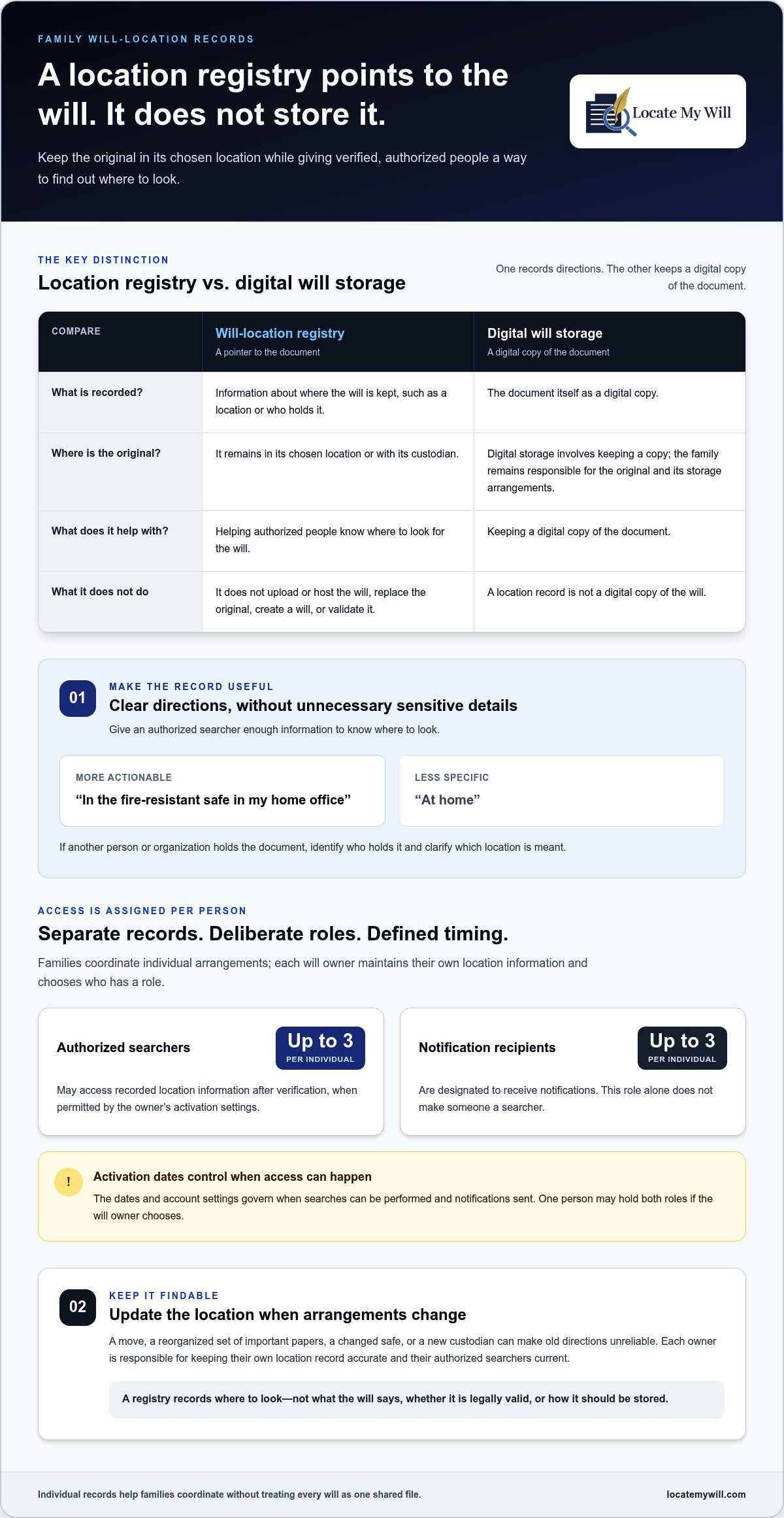
A will-location registry addresses this practical gap by recording where a will is kept, not what it says. It acts as a pointer to the document, rather than an online copy or a place to store the original. This lets a will owner share useful location information with authorized people while keeping the document in its chosen location. For foundational context on what a will and testament is, the document itself remains separate from the record that helps someone find it.
Families generally coordinate individual arrangements rather than assume every will is kept in one place. Each person may have a separate will, a different storage location, and different authorized searchers. A will registry for families works best when each owner’s record makes those boundaries clear. Registration organizes location details; it doesn’t determine whether a will is legally valid or change its legal status. For practical guidance on recording a location, see this online will location registration guide.
What does a will registry for families record?
A useful location record gives an authorized person enough information to know where to look. For example, “in the fire-resistant safe in my home office” is more actionable than “at home.” If someone else holds the document, the record can identify the person or organization and clarify which location is meant. Make the description specific enough to guide a search, but avoid adding unnecessary sensitive details.
Separate records also make responsibility clearer. One person might keep a will in a home safe and name their own trusted searchers, while another uses a different arrangement and authorizes different people. Each owner maintains their own location information. Because the registry records locations, not document contents, relatives can understand where to search without treating the family’s arrangements as one shared file.
Why can a family lose track of a will’s location?
Ordinary changes can make old instructions unreliable. Someone may move, reorganize important papers, change a safe, or place the original with a different custodian. If the location record isn’t updated, relatives may follow instructions that no longer lead to the document.
Relying on one person’s memory creates another weak point. That person may be unavailable, remember only part of the arrangement, or not know that the storage location changed. A clear, current record gives authorized searchers a shared reference without making every relative responsible for remembering private details.
A will’s existence and knowing where it is kept are two different parts of family preparedness. Treating them separately helps families protect privacy while making the next practical step easier to understand.
How a Family Will Registry Works Without Storing the Documents
A will-location registry separates two things that are easy to confuse: the document and the information that helps someone find it. Each will owner maintains an individual record. A will registry for families is therefore a way to coordinate, not a shared digital folder containing everyone’s documents.
The process is straightforward. The will owner creates an account, records a practical description of where the will is kept, and designates people who may have a role in finding that information. With Locate My Will, an individual can designate up to three authorized searchers and up to three notification recipients. The roles differ: searchers may access location information after verification, while notification recipients are designated to receive notifications. One person can hold both roles if the owner chooses.
Activation dates provide another layer of control. They govern when searches can be performed and notifications sent, according to the account settings. This lets an owner plan access in advance without making location details generally available. The timing depends on the dates and settings entered for that individual record.
What is the difference between a location registry and digital will storage?
A location registry records directions to a will, such as where the original is kept or which custodian holds it. Digital will storage, by contrast, involves keeping a digital copy of the document itself. Locate My Will records location information; it doesn’t upload or host the will.
The family remains responsible for the document and its storage arrangements. A registry doesn’t replace the original, create a will, or complete signing or witnessing formalities. It also doesn’t validate the document. Its purpose is narrower: to help authorized people know where to look.
How do authorized access and activation dates support privacy?
Assign roles deliberately. An authorized searcher is someone the owner permits to access the recorded location information after verification. A notification recipient is designated to receive notifications; that role alone doesn’t make the person a searcher. Activation dates control when searches and notifications can occur, adding a defined timing condition to the owner’s access plan.
Only verified searchers designated by the will owner can access location information, and access is governed by the account’s activation settings. This helps limit sensitive details to people selected for a specific purpose. It also gives the owner a clear reason to review the settings if relationships, responsibilities, or preferences change.
For family coordination, each person should create and maintain their own record rather than assume another relative’s account covers them. The owner should make sure the location description is useful, choose searchers and notification recipients carefully, and keep the physical will in its intended place. Locate My Will offers a paid subscription for recording and managing will-location information. To organize an individual location record, record where your will is kept with Locate My Will.
Compare Family Will-Location Methods: Conversations, Spreadsheets, and Registries
Families can share will-location information in different ways, from a direct conversation to a structured registry. The right approach depends on how many individual records need coordination, how often details may change, and how narrowly the information should be shared. A method can clarify responsibilities, but none guarantees that a will will be found or establishes its legal validity. A will registry for families is one way to organize location details, not a replacement for clear communication.
| Method | Updateability | Responsibility | Access control |
|---|---|---|---|
| Verbal instructions | Easy to clarify in conversation, but changes may not reach everyone. | Can be unclear if no one is specifically asked to remember or share details. | Depends on who is told and whether they pass the information on. |
| Shared spreadsheet | Can be edited as details change, but updates depend on someone maintaining it. | Can identify an owner for each entry if roles are recorded clearly. | Visibility depends on sharing and permission settings; access may be broader than intended. |
| Controlled-access registry | Location records can be updated by their owners as arrangements change. | Individual records and named searchers make roles more explicit. | Access is limited to verified, authorized searchers under the account’s settings. |
When might a family conversation or shared list be enough?
A conversation or simple list may suit a family with few wills, straightforward storage arrangements, and relatives who communicate regularly. For example, each will owner could tell a trusted relative where the document is kept and note the location in a shared list. Keep the information concise and name someone to review it periodically. The main limitation is that informal details can become outdated after a move, a new storage arrangement, or a change in family responsibilities.
When can a controlled-access registry add structure?
A registry can help when relatives live apart, each person has a different arrangement, or location details shouldn’t be visible to everyone. Each owner can maintain their own record and designate authorized searchers, rather than relying on one family member to hold every detail. Access controls clarify who may see the information, while communication still matters: trusted people should understand their role and know that a record exists.
Choose the method that fits your family’s needs, then make upkeep part of the process. If you use a conversation or shared list, agree on who will check that details remain current. With a controlled-access registry, each owner should review their record and permissions when circumstances change. These practices can reduce uncertainty, but they don’t guarantee discovery or ensure agreement among relatives. For context on why finding a will matters, read about the consequences of a lost will.
Set Up a Family Will Registry with Clear Roles and Review Habits
A useful setup gives each will owner responsibility for their own location record and makes search and notification roles clear. Treat it as individual records coordinated by family agreement, not as a single shared family account. Use this checklist to create a practical routine.
- Identify whose will-location information needs its own record. List the family members who want to document where their wills are kept. Each person should manage a separate record for their own document.
- Write a location description that guides a search. Name the storage place clearly, such as “the labeled folder in the locked office cabinet.” If someone else holds the will, identify that person or organization and describe how an authorized searcher can tell which location is meant. Avoid vague notes such as “with my papers.”
- Choose searchers and notification recipients deliberately. Locate My Will supports up to three authorized searchers and three notification recipients per user. Decide who should be able to search for location information and who should receive notifications. These are distinct roles, even if one person is assigned both.
- Check that each record reflects the owner’s current arrangements. Confirm the location description and selected contacts with the will owner. A family discussion can clarify responsibilities, but the owner remains responsible for keeping their own record accurate.
- Set a review habit and update after changes. Add a recurring reminder to review the record, and update it promptly after a move, a change in where the will is kept, replacement of the document, or a change in trusted contacts.
How should relatives decide who is authorized to search?
Choose people the will owner trusts to handle private location details carefully, expects to be reachable when needed, and believes will understand the owner’s instructions. A searcher is authorized to access location information after verification; a notification recipient is designated to receive notifications. Neither role, by itself, gives someone ownership of the will or authority to make decisions about it.
Keep the choice personal. Each owner can select their own contacts rather than assuming the same relative should serve every family member. This can make responsibilities easier to understand, especially when relatives have different relationships or practical availability.
When should a family review registered location details?
Review each record periodically, such as when setting an annual planning reminder, and whenever the will’s storage location changes. A replacement will is another prompt to confirm that the record points to the intended document. Update searchers and notification recipients promptly if a trusted contact’s circumstances or role changes.
Keep the review focused on accuracy: does the description still lead to the right place, and are the listed people still the owner’s intended contacts? With a will registry for families, this maintenance habit helps prevent outdated information from becoming another source of confusion. Create your individual will-location record and keep its details current.
Use Locate My Will to Coordinate Individual Family Records
The choice comes down to how your family wants to balance clarity, privacy, and upkeep. Locate My Will gives each will owner an individual record for documenting where their will is kept and managing who may search for that location information. Relatives can coordinate by agreeing on trusted contacts and review habits, without relying on a shared family account or treating separate records as one combined plan.
What can a family member organize through an individual record?
Each owner can record a practical description of where their will is kept and designate people for specific roles. Locate My Will supports up to three authorized searchers and up to three notification recipients per user. Searchers must be verified to access the recorded information; notification recipients are designated to receive notifications. The owner chooses contacts according to their preferences.
A clear location description gives a designated relative a practical next step: where to begin looking, or which named custodian or organization is associated with the document. The platform records location information only. It doesn’t draft, host, or physically store a will, so the owner remains responsible for the document and its storage arrangements.
Activation dates control when searches can be performed and notifications sent. Each owner can set access timing for their own record. These controls apply to individual accounts and settings, not to a shared family schedule.
How can families begin organizing will locations?
Start with a conversation about the process, not a demand to share every private detail. Each family member who wants to participate can create and maintain their own record. Then agree on a few practical habits:
- Each will owner enters a location description that an authorized searcher can understand.
- Each owner chooses trusted searchers and notification recipients, staying within the platform’s limits.
- Relatives clarify who has been designated for which role, without assuming that a notification recipient can search.
- Owners review their records after a move, a storage change, or a change in trusted contacts.
This approach makes coordination possible while keeping ownership of each record with the individual will owner. It also gives families a repeatable way to maintain accurate information as circumstances change. A registry supports the search process, but it doesn’t replace communication or guarantee that a will will be found.
When you’re ready to document your own arrangement, create a Locate My Will account and record where your will is kept.
Take One Clear Step Toward Easier Family Preparation
Make findability part of how your family approaches future planning. A brief conversation can establish that each person is responsible for their own arrangements while leaving everyone free to choose how much location information to share. This can make planning feel more manageable: no one needs to disclose every private detail to agree that trusted people should know how to proceed.
A will registry for families is most useful when it fits naturally into each person’s ongoing preparations. Start with your own record, then invite relatives to consider their arrangements in their own time. Small, deliberate steps can replace uncertainty with a clearer path forward.
Create your will-location record with Locate My Will and take a practical step toward making your wishes easier for trusted people to find. Thoughtful preparation today can give your family greater clarity when it matters.
Frequently Asked Questions
Can a will registry make a will legally valid?
No. Registering a location is an organizational step; it doesn’t create a will or establish that the document meets legal requirements. Validity depends on applicable law and the circumstances in which the will was made. For example, recording where a signed document is kept doesn’t correct a problem with how it was prepared or executed. If you’re unsure about validity, consult a qualified estate-planning attorney familiar with the relevant jurisdiction.
Does a will registry store the original will?
No. Locate My Will records where a will is kept, not the physical original or a hosted copy. The owner chooses and maintains the document’s storage arrangement. If a will is moved from a home safe to another location, the owner should update the record so authorized searchers aren’t directed to an outdated place. The registry points to the document; it doesn’t preserve or replace it.
Can family members register separate wills?
Yes. Each person can maintain a separate will-location record and choose their own searchers and notification recipients. This is useful when, for example, spouses keep their wills in different places or prefer different trusted contacts. Separate records avoid treating everyone’s documents as one shared file. Locate My Will supports up to three authorized searchers and three notification recipients for each user’s record.
Who should I name as a will searcher?
Choose someone you trust to handle sensitive information carefully and who is likely to be reachable when needed. Explain the role so the person understands that they may access location information, not take ownership of the document. For example, a relative who lives nearby may be practical, but trust and availability matter more than family title. Naming a searcher alone doesn’t establish executor status or decision-making authority.
How often should I update a will-location record?
Update the record whenever the will moves, is replaced, or its storage arrangement changes. Review it periodically as well, especially after changes in trusted contacts. A reminder tied to an existing annual planning task can make this easier to maintain. If an authorized person is no longer someone you want to designate, revise the record promptly so its contact information reflects your current choices.
Is a will registry the same as public probate records?
No. A will registry is a planning record about a will’s location and the access settings chosen by its owner. Probate records relate to court proceedings, and public access rules can vary by jurisdiction and case. Registering a location doesn’t itself make the will public or replace any court process that may apply. A registry entry and a court record serve different purposes, so don’t assume one contains or substitutes for the other.


