

What if your family knew exactly where to find your will without having access to its private contents? If you’re wondering how to tell family where your will is, you don’t need to share every detail of your estate plan. You do need to give the right people clear, usable directions.
It’s understandable to feel uneasy discussing death or worry relatives will forget what you tell them. Keep the conversation practical: choose trusted people, explain where the document is kept, and decide what information each person needs. The instructions should be private but specific enough to follow.
This article covers what to share, whom to tell, and how to keep your directions current if you move or change where your will is stored. A secure location record, such as Locate My Will, can complement a direct conversation. The platform records where a will is kept, not the will itself. The aim is to make the document findable while protecting its contents.
Key Takeaways
- Choose who should know based on responsibility, trust, and availability. Name a primary contact and a practical alternate.
- Compare a conversation, a written note, and a secure location record to find an approach that balances clarity, privacy, and ease of updating.
- Give plain directions that identify the will and its storage location without sharing unnecessary details.
- Review and update your instructions whenever the will’s location or the people responsible for finding it change.
- Locate My Will lets you record the will’s location and manage authorized searchers and notification recipients. It records location information, not the will itself.
Why telling family where your will is kept matters
Talking about a will can feel uncomfortable. You may worry the conversation will sound alarming, invite questions you’d rather keep private, or turn into a discussion about what’s in the document. Keep it calm and practical by focusing on one point: trusted people should know how to locate your will if they need to, without automatically being given access to its contents.
A will can communicate important decisions, but its existence alone may not help the people trying to find it. If no one knows whether it’s in a home safe, a filing cabinet, or with a legal representative, they may not know where to begin. Clear directions give the right person a starting point when finding the document is appropriate. They don’t guarantee a particular legal or probate outcome, because procedures can vary by state.
What family needs to know about a will’s location
Separate practical directions from private instructions. Your family may need to know that a will exists and where to look, but they don’t necessarily need to read it now or know how you’ve divided property. A location message might say that your current will is in a labeled folder in a locked home safe. Share access details only with people you trust to handle them securely.
This distinction can make the conversation easier to start. You might say, “I’m not ready to discuss the details, but I want you to know where to find my will if it’s needed.” That gives the conversation a clear purpose without turning a location update into a review of your personal decisions. For general background on the document itself, see Will and testament.
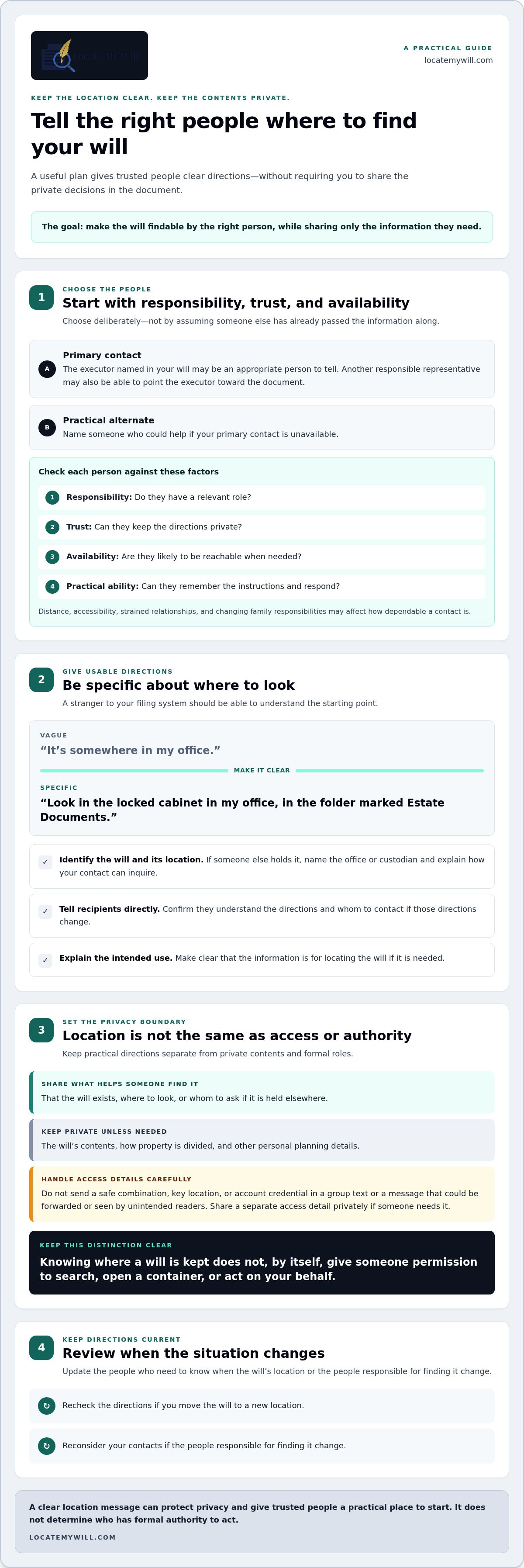
Be specific enough that someone unfamiliar with your filing system can act. “It’s somewhere in my office” leaves room for guesswork. “Look in the locked cabinet in my office, in the folder marked Estate Documents” gives a more useful starting point. If the will is held elsewhere, identify the office or custodian and explain how your contact can inquire about it.
Who should receive the location information
Choose recipients based on their likely role, reliability, and ability to keep the information private, rather than assuming a particular family structure. The person named as executor may be an appropriate contact. You might also tell a trusted family member or another responsible representative who can point the executor toward the document. Name a practical alternate in case your first contact is unavailable.
You decide whom to inform and how much to disclose. Consider whether each person understands the responsibility, can keep the directions secure, and is likely to remember where they received them. Make the message clear about both the location and its intended use. This approach answers how to tell family where your will is while respecting your privacy and giving trusted people a practical way to find it.
Decide what to share and who should know where your will is
Choose recipients deliberately rather than telling everyone by default or assuming someone else has passed the information along. The right person has a relevant role and can handle the information discreetly. Consider responsibility, trust, availability, and practical ability to act. Your choice should reflect your circumstances, not an assumed family structure.
Start with the person most likely to have a relevant role, such as the executor named in your will or another responsible representative. Then identify an alternate who could help if the primary contact is unavailable. Knowing where a document is kept does not, by itself, establish that someone has authority to act for you. Keep the difference between knowing a location and having a formal role clear.
Choosing trusted recipients for the location details
Consider whether each person can remember the instructions, keep them private, and respond when the information is needed. Distance, limited accessibility, strained relationships, or changing family responsibilities may affect whether someone is a dependable contact. These factors don’t automatically rule anyone out, but they’re worth considering before you rely on that person.
Tell recipients directly. A relative may not remember a passing comment, and secondhand information can become incomplete or outdated. Confirm that the person understands what you’re sharing and whom to contact if the directions change. This helps prevent the assumption that “someone else knows” from leaving nobody with clear instructions.
Sharing enough information while preserving privacy
Give each recipient the information needed for their role, not a broad account of your estate. You might share the storage location and the appropriate route for finding or requesting the document while keeping its contents and other private planning details to yourself. Tailor what you disclose to the person and the responsibility you expect them to carry.
Be careful with access details. Don’t send a safe combination, key location, or account credential in a group text or another message that could be forwarded or seen by unintended readers. If someone needs a separate access detail, share it privately and consider whether they need it now or only if a specific situation arises. Clear boundaries reduce unnecessary exposure without making the will impossible to find.
A location record and access authorization are different things. A record can state where a will is kept, but it doesn’t automatically grant someone permission to search, open a container, or act on your behalf. Make sure your instructions distinguish the person who can locate information from anyone formally authorized for a role. Locate My Will lets users designate up to three authorized searchers, providing a structured way to record who may search through the platform. It complements, rather than replaces, a direct conversation.
To decide how to tell family where your will is, write down your primary contact, alternate, and the precise information each should receive. Locate My Will’s will-location record provides a way to record location details and manage authorized searchers.
Compare ways to tell family where your will is kept
The best way to share the location depends on how much context the recipient needs and how likely the information is to remain easy to find. A conversation can clarify your intent, a written note preserves exact directions, and a secure location record keeps details organized. These methods can work together: discuss the plan, then leave a private reference the recipient can consult later.
Use this comparison to weigh the options. The right combination depends on your privacy preferences and how often the will’s location may change.
| Method | Strengths | Limitations |
|---|---|---|
| Private conversation | Lets you explain context and confirm understanding. | Details may be forgotten or remembered differently. |
| Written note | Preserves precise directions that can be checked later. | May become outdated or be hard to find if stored poorly. |
| Secure location record | Keeps location information organized and easier to revise in one record. | Doesn’t replace a conversation or store the will itself. |
When a conversation or written note works well
A conversation is useful when you want to explain why you’re sharing the information, answer questions, and make sure the recipient understands what to do. Keep the scope clear: you’re identifying where the will is, not inviting a review of its contents. If you want to check that the directions are clear, ask the person to repeat them in their own words.
Follow up with a short, private note containing the exact storage location and appropriate steps for finding it. Avoid putting sensitive access details in a note that could easily be seen by others. Store the note securely and tell the intended recipient where to find it. A note is useful only if it can be located and still reflects the current arrangement.
When a secure location record adds value
A dedicated record gives you a structured place to keep location information and revise it when the will moves. It can be useful if you want the directions kept separate from casual messages or personal papers. For example, a record can identify that the will is held in a particular safe or by a named custodian without including the will’s private provisions.
Keep the distinction clear: a location registry records where a document is kept; it isn’t digital will hosting or physical document storage. Locate My Will lets users securely record will locations and designate authorized searchers, complementing a direct conversation and written instructions. Locate My Will records document locations in a structured format.
As you decide how to tell family where your will is, consider what each method does best. A conversation adds understanding, a private note preserves exact directions, and a secure record provides a place to maintain location details. Whichever combination you choose, review it whenever the will’s location changes.
Create a clear message and update it when your will moves
Good instructions are easy to understand, specific enough to follow, and simple to revise. Use a short process to create them, then make sure the people who need the information know where the current version is kept. Breaking the task into steps makes a sensitive subject easier to handle.
- Identify recipients. Choose the person with the relevant responsibility and a practical alternate. Be clear about who should receive the location details.
- Confirm the current location. Check where the latest version of your will is actually kept, rather than relying on memory or an old message.
- Write clear directions. Name the storage place and include useful retrieval instructions. Keep combinations, keys, and other sensitive credentials separate.
- Share and confirm. Speak with each intended recipient and tell them where to find the written instructions. Ask them to confirm they understand the route.
- Review after a change. Revisit the directions after moving, changing storage arrangements, or updating your will. Replace old versions and tell recipients what changed.
For example, you could say: “My current will is kept in the locked safe in my home office, inside the folder labeled ‘Estate Documents.’ If you can’t access it, contact [name or office] for guidance. I’ve kept any access details separately.” Adapt the wording to your actual storage arrangement. Don’t include a safe combination or credential in a message that could be forwarded or seen by others.
Write location instructions someone can follow
Use specific, recognizable details. “In my desk” may leave someone searching through several drawers; “in the blue folder in the locked cabinet in my study” gives a clearer route. If the will is held by an attorney or another custodian, identify the office or person and the appropriate way to inquire. Tell recipients whom to contact if the document can’t be accessed, but don’t imply that knowing its location gives them authority to act.
Keep family instructions current
A move, a new storage arrangement, or a revised will can make old directions misleading. Update every relevant copy, including written notes and any secure location record, and tell designated recipients that previous instructions are obsolete. Ask them to remove or clearly mark outdated notes so they don’t accidentally follow the wrong directions.
Don’t rely only on memory, an old email, or one person’s recollection. Keep a current reference in the place you’ve chosen and make sure the intended contacts know how to find it without exposing credentials. A secure location record offers a structured way to maintain the document’s location separately from the document itself.
Use a will-location record as a dependable next step
A dependable plan has four parts: choose trusted people, explain how to find the will, record its current location, and review the information when circumstances change. Each part supports the others. A record preserves the details, while a direct conversation helps recipients understand why they have the information and what to do with it.
Locate My Will provides a platform for securely recording where a will is kept and managing who is authorized to search for that information. Users can designate up to three authorized searchers and three notification recipients. The platform also lets users set activation dates that control when searches can be performed and notifications sent.
What a will-location registry does and does not do
A will-location record identifies where the document is held, such as a home safe or another physical location. It is not the will itself: Locate My Will does not host wills or physically store documents. Recording a location also doesn’t replace separate authority or access arrangements that may apply. Explain these distinctions to the people you’ve chosen.
Think of the registry as a structured complement to communication, not a substitute for it. Tell the appropriate people that a location record exists and explain how it fits with your instructions. Accurate information may not be useful to someone who doesn’t know where to look or whom to contact.
Turn your communication plan into an ongoing routine
Review the information you’ve already shared. Confirm that the recorded location matches where the current will is kept and that the people identified as searchers or notification recipients are still appropriate. If the document moves or your circumstances change, update the location details and tell the relevant people not to rely on earlier instructions.
A review can follow a change to the will, a move, a new storage arrangement, or a change in the people you trust with the information. Don’t rely on a relative’s memory to keep every detail current. A consistent record and a direct update help keep instructions aligned. Activation-date settings provide a way to control when searches and notifications can occur.
Use the registration guide to organize the location details and choose appropriate recipients. Then explain the record to those people so they know it exists and understand their role. The goal isn’t to disclose more than necessary. It’s to make the location findable by the right people at the appropriate time.
A secure will-location record can help put that plan in place and keep the information aligned with your instructions.
Make the first conversation a simple next step
You don’t need to settle every estate-planning detail in one conversation. Start with the person you trust most to receive the information and keep the opening focused: “I’m organizing an important document, and I’d like you to know how to find it if it’s needed.” This makes how to tell family where your will is feel less like a discussion about death and more like a practical act of care.
Choose a time when you can speak privately and without rushing. Explain that sharing the location doesn’t mean sharing the will’s contents, then check that the person understands what you’re asking them to remember. A brief, clear exchange can make the plan easier for both of you to follow.
When you’re ready to take the next step, create a secure record of where your will is kept. A little preparation can help your wishes remain easier to find when they matter.
Frequently Asked Questions
Can I tell my family where my will is without giving them a copy?
Yes. You can tell a trusted person where the will is kept without handing over a copy or inviting them to read it. Identify the filing cabinet or custodian and explain how to ask for the document if needed. Keep your message limited to what the recipient needs to know. A location record can preserve directions without containing the will’s provisions.
Should my executor know where the original will is?
Telling your named executor where to begin looking is a sensible practical step. If the will is held by someone else, identify that person or office and the information the executor may need to make an inquiry. Also make sure the executor knows how to reach you while you’re alive if they have questions. Location instructions don’t replace any formal authority or legal steps that may apply.
Is it safe to keep a will in a safe-deposit box?
A safe-deposit box may protect a paper will, but consider whether the person who may need to locate it can find the box details and what access procedures apply. Access after the owner’s death can depend on the institution and applicable state procedures, so don’t assume a relative can open the box immediately. Keep a separate, secure record identifying the institution and box location, without putting a key or access code in an exposed message.
What should I do if I move my will to a different location?
Update every set of directions that names the old location, including notes, emails, and any will-location record. Tell the people who received the previous instructions that they’re outdated, then provide the corrected location through a private channel. If you’ve moved the will to another person’s care, update the contact details too. A dated note can help recipients distinguish current directions from older versions.
Can I store my will online instead of keeping a paper original?
Don’t assume an online copy can replace a signed paper will. Whether an electronic will or copy is recognized can depend on applicable law and how the document was created or stored. Keep your original document in its designated physical location unless you’ve received guidance specific to your circumstances. Locate My Will records information about where a will is kept; it doesn’t host the will or store the physical document.
How often should I remind family where my will is?
There’s no single reminder schedule that suits everyone. Tell the relevant people when you first set up the instructions, then update them whenever the location, document, or responsible contacts change. You could also set a calendar reminder to review the details during a regular personal or estate-planning check-in. Ask recipients to confirm they still know how to find the current instructions, rather than relying on an old conversation.
What if I do not want my family to know the contents of my will?
You can keep the contents private while sharing only the information needed to locate the document. Explain that you’re providing directions, not a copy or summary of your decisions. If you prefer not to discuss details with relatives, consider telling the person with a relevant formal role or another trusted representative. Keep access information separate and share it only with someone who needs it for an appropriate purpose.


