
A will can be safely stored and still be hard to find when it matters. Knowing where to keep will information is a separate part of planning: the original document needs protection, while its location needs to be findable by the right person. It’s understandable to want privacy, especially when the details are personal, but keeping the location entirely to yourself can leave loved ones without a clear starting point.
This guide explains how to create a secure, practical record of your will’s location, share access with an appropriate person, and keep the details current if you move or change where the document is stored. It also explains how a location record differs from storing the will itself.
We’ll cover what to record, where to keep the information, and when to review it. A controlled approach can balance privacy with future access. For example, Locate My Will lets users record a will’s location, designate up to three authorized searchers, and set activation dates that govern when searches and notifications may occur. The goal is straightforward: protect the will and make its location deliberately findable.
Key Takeaways
- Choose where to keep will information by weighing confidentiality, dependable access, ease of updating, and reliance on one person.
- Write clear directions to the original document, including enough detail to locate it without recording unnecessary access credentials.
- Decide who should be able to find the location record and when access should become available.
- Review your plan after a move, a change to the will, or a change in where the original is kept.
- A location record can complement secure storage of the original without containing the will itself.
Where to Keep Will Information: Start with the Difference Between the Will and Its Location
A securely stored will can still be difficult to find if nobody knows where the original is kept. A separate location record bridges that gap without duplicating or replacing the legal document. The distinction matters: a will sets out a person’s wishes, while a location record gives practical directions for finding the will. For a general overview of the document itself, see Will and testament.
A will-location record is a private set of directions identifying where the original will is kept and how an appropriate person can locate it. It doesn’t contain the will’s terms, change the document, or establish anyone’s authority to access or act on it. Keep the record focused on helping someone find the original while limiting exposure of sensitive information.
What information belongs in a will-location record?
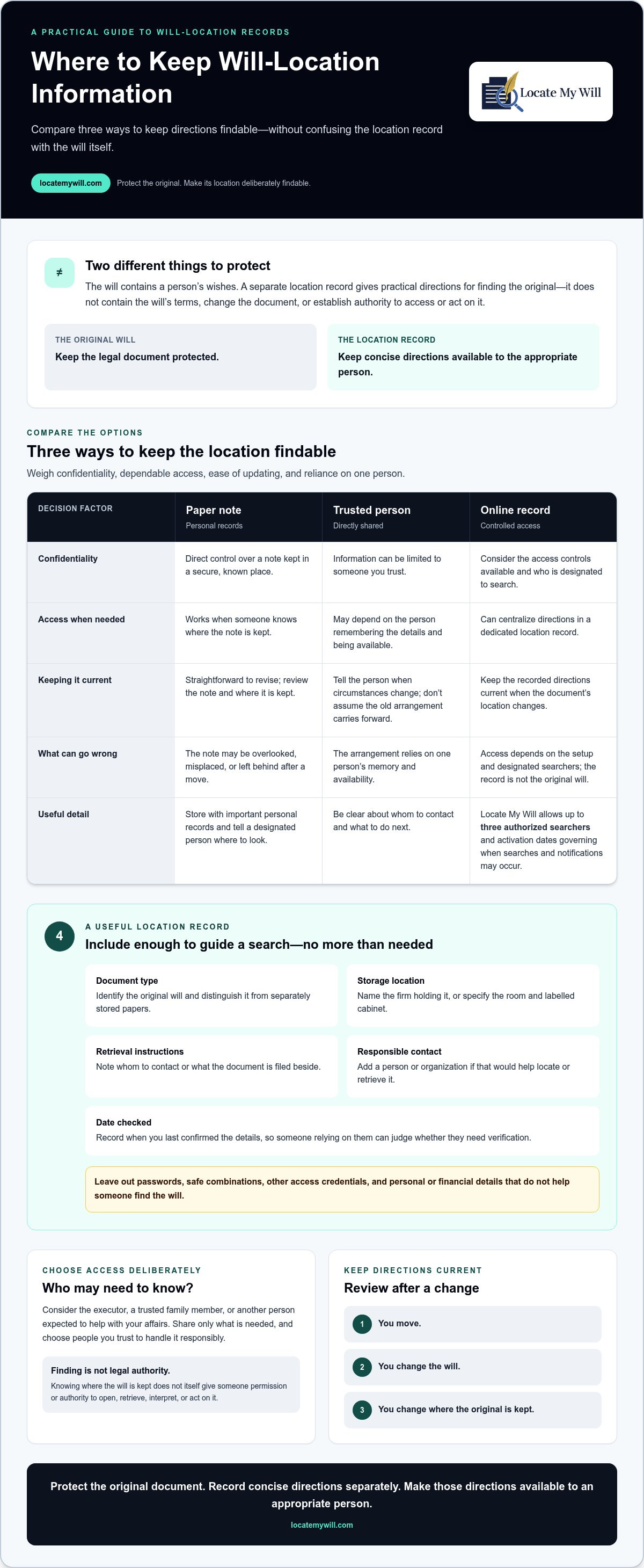
Make the record specific enough to be useful, but include only what a searcher needs. Consider adding:
- Document type: Identify it as the original will. Distinguish it from related estate-planning papers if they’re stored separately.
- Storage location: Give a clear direction, such as the name of the firm holding it or the room and labelled cabinet where it is kept.
- Retrieval instructions: Note practical next steps, such as whom to contact or what the document is filed beside. Don’t include passwords, safe combinations, or other access credentials in a record that could be exposed.
- Responsible contact: Add a person or organization to contact if that would help locate or retrieve the document.
- Date checked: Record when you last confirmed the details so anyone relying on them can judge whether they may need to be verified.
Leave out personal or financial details that don’t help someone find the will. The record is for practical directions, not a complete inventory of your affairs.
Who may need to know where the will is kept?
Consider who is likely to have a relevant role, such as the executor, a trusted family member, or another person you expect to help with your affairs. You can share the location directly or make sure the person knows how to access the location record. Share only what’s needed, and choose people you trust to handle the information responsibly.
Knowing where a will is kept is not the same as having permission or legal authority to open, retrieve, interpret, or act on it. Those questions depend on the circumstances and applicable rules. Keep that distinction clear when you share directions. An executor may need to locate the document as part of their responsibilities, while another trusted person may simply help point them toward it. A systematic will-search protocol for executors can help organize the search if the location isn’t immediately clear.
When deciding where to keep will information, use deliberate access: protect the original, record concise directions separately, and make those directions available to an appropriate person.
How to Keep Will-Location Details Secure Without Making Them Unfindable
There’s no single best place for every location record. A paper note gives you direct control, a trusted-person arrangement depends on clear communication, and a controlled online record provides a central place for directions. Compare the options by asking four questions: Who can see the information? Can the right person access it when needed? How easy is it to update? Will the plan still work if one person moves, forgets, or becomes unavailable?
Useful directions identify the will’s location without reproducing the will or exposing more private information than necessary. Estate documents can affect what happens after a person dies, and AARP’s guide to estate planning documents and probate explains why these records deserve careful attention.
Paper notes and personal records: useful, but easy to overlook
A clearly labelled note kept in a secure, known place can work well when someone already knows to look there. You might store it with other important personal records and tell a designated person where to find it. This method is straightforward and easy to revise, but a note can be overlooked, misplaced, or left behind after a move. Review both the directions and the note’s location whenever your document storage changes.
A trusted-person arrangement: simple, but reliant on communication
You can tell an appropriate person where the original is kept, either directly or by giving them directions to a written record. This limits the information to someone you trust, but access may depend on that person remembering the details and being available. Be specific about whom to contact and what to do next. If your circumstances change, update the person rather than assuming the old arrangement will carry forward.
Digital records and controlled access
A dedicated online location record can centralize directions separately from the will itself. It records where the document is stored; it doesn’t replace the original or host its contents. Consider what access controls are available and who is designated to search for the information. Locate My Will lets users designate up to three authorized searchers and set activation dates that govern when searches may occur. This creates a planned access arrangement instead of relying on a note that may circulate more widely.
Whichever method you choose, don’t put safe combinations, account passwords, or unnecessary financial details in a general note. Keep retrieval directions practical and limited. For more detail on recording a will’s location online, see the will-location registration guide.
Locate My Will provides a way to record where your will is stored, while you keep the original document in its chosen physical location.
Which Will-Information Storage Method Fits Your Privacy and Access Needs?
The right method depends on who needs to find the will, how likely the directions are to stay current, and how much personal information you want to share. No option is automatically safest. A private note may suit someone with a stable filing system, while a digital location record may be easier to maintain if circumstances change. You can plan for discoverability without making the will or its location public.
Use this comparison to identify the trade-offs that matter most:
| Method | Privacy exposure | Access after an emergency | Update effort | Dependence on one person |
|---|---|---|---|---|
| Private paper note | Limited if secured, but exposed if misplaced or found by someone else. | Useful if the right person knows where the note is kept. | Simple to change, but old copies may remain in circulation. | Can be low if more than one appropriate person knows where to look. |
| Trusted-person communication | Limited to the people you tell. | Depends on the person remembering and being available. | Requires you to communicate changes directly. | Higher if only one person holds the directions. |
| Controlled online record | Access is limited according to the record’s designated access arrangements. | Can make directions available to authorized searchers according to the arrangement. | Can be updated in one central record. | Can reduce reliance on one person, depending on who is designated. |
These are practical considerations, not guarantees. A carefully secured paper note may be more private than a record shared too widely, while a central record may be easier to keep current than a conversation from years ago. Match the method to your household, storage arrangements, and preferred level of sharing.
When a trusted person or professional contact is part of the plan
A person who knows where the will is stored can clarify practical instructions, such as whom to contact or which office holds the document. Make sure they understand their role and know how to find the directions. Sharing a location is not the same as sharing the will’s contents or granting authority to act on it. Choose someone dependable, and tell them when your instructions change.
When a secure location record may add continuity
A maintained record can preserve directions beyond a single conversation or paper note, particularly if the original document’s location changes. Locate My Will lets users designate up to three authorized searchers and three notification recipients, with activation dates governing when searches and notifications may occur. This supports planned discovery without public disclosure. Registration records the will’s location; it doesn’t change the will’s validity, custody, contents, or legal effect.
To decide where to keep will information, aim for a practical balance: limit access, make the directions findable by appropriate people, and choose a process you can maintain as circumstances change.
How to Create and Maintain a Findable Will-Location Plan
A useful plan is more than a note saying “the will is at home.” It identifies the current document, gives someone clear directions to it, and stays accurate as your circumstances change. Keep the record separate from the will itself, and share it only through an access arrangement that suits your privacy needs.
Build the plan in four steps:
- Confirm the document: Identify which version is current and where the signed original is held. If an older copy remains elsewhere, make sure your directions don’t confuse it with the current document.
- Record the directions: State the storage location and practical next steps. For example, name the organization holding the original or describe the labelled folder and cabinet where it is kept.
- Choose appropriate access: Decide who should be able to follow the directions. Make sure they know how to find the location record, not only that one exists.
- Set a review reminder: Choose a regular time to check the record, and update it after a meaningful change.
A practical checklist for recording the location
Before you finish, check that the directions are precise enough for someone unfamiliar with your filing system. Include the document type, current storage location, any practical contact needed to retrieve it, and the date you last verified the information. Identify the appropriate person to follow the directions. Don’t include safe combinations, passwords, or unrelated personal details in the location record.
Then set a review reminder. Recheck the record after a move, a change in storage, a replacement will, or a change in the people you’ve designated. Updating the will without updating its location details can leave an otherwise careful plan pointing to the wrong place.
Keep privacy and legal questions in perspective
Storage and location records help people find a document, but they don’t answer every legal question about making, changing, accessing, or administering a will. Rules can depend on where you live and on your circumstances, so don’t assume one storage practice applies everywhere. If you’re unsure about state-specific requirements or the legal effect of a document, speak with a qualified estate-planning professional.
Keeping directions current also gives people a reliable starting point and can reduce the need for a search. If the original is lost or destroyed, the consequences can be serious and may depend on the circumstances. Guidance on protecting a will from loss or destruction can help explain why preserving both the document and clear location directions matters.
Locate My Will lets you record your will’s location alongside your existing storage arrangements. The location record complements the original; it doesn’t store or replace it.
Use a Secure Will-Location Record to Help the Right People Find It
Once you’ve chosen where to keep the original will, make its location findable through a plan you can maintain. A dedicated location record complements your storage arrangements by keeping directions separate from the legal document. It gives selected people a clear way to discover where the will is held without making the will or its contents public.
Locate My Will is a paid online platform for recording where a will is stored. It records location details, not the will itself: it doesn’t draft the document, hold the physical original, or host a digital copy of its contents. The original remains in its chosen location, while the record provides directions for those designated to search.
How a location registry fits into a broader plan
Think of a registry as one part of a wider arrangement, not a substitute for safely storing the original or keeping its directions current. Record enough detail to point an appropriate person toward the document, then decide who should be able to search for that information. Review the record after moving or replacing the will, or changing the people you’ve designated, so the directions continue to match your arrangements.
This approach avoids relying solely on a conversation or a note that may be misplaced. It also keeps the purpose narrow: recording a location does not change the will’s contents, custody, validity, or legal effect.
Set up a will-location record with clear access expectations
Choose searchers and notification recipients deliberately. Locate My Will allows users to designate up to three authorized searchers and up to three notification recipients. Before entering details, consider who should be able to look for the location information and who should receive a notification. These roles support a planned process for discovery rather than broad or unintended sharing.
Activation dates control when searches may occur and notifications may be sent. Consider your preferred timing when setting up the record, and make sure your choices reflect your intentions. Revisit the arrangements if your contacts or circumstances change. A registration is a location record, not a guarantee that someone will recover a missing document or that a particular legal outcome will follow.
Learn more about Locate My Will’s will-location registration. Keep the original in its chosen storage place, and review the recorded location whenever that changes.
Make Your Will-Location Plan Part of Your Routine
Give your will-location plan an owner: you. Add a reminder to your calendar to review it, and treat major life changes as a prompt to check that the record still reflects your wishes. This small habit can help keep the answer to where to keep will information useful over time, rather than leaving it as a one-time task.
You don’t need to resolve every detail today. Start by deciding whether a maintained location record would make your arrangements easier to manage, then consider who should be able to use it and when. Locate My Will provides a way to record the will’s location separately from the document itself.
Explore a secure way to record your will’s location and take a considered next step toward keeping your plan findable.
Frequently Asked Questions
Is it better to keep will information at home or online?
Neither option is automatically better; the right choice depends on what you’re protecting and who may need to find it. Keep the signed will in a secure location that suits the document and applicable requirements, then record its location separately. For example, you might keep the original with important papers and use a private note or controlled online record for directions. Prioritize confidentiality, dependable access, and a simple update routine when deciding where to keep will information.
Can I store my will digitally instead of keeping a paper original?
Don’t assume a scanned copy has the same status as a properly executed original. Requirements for valid wills and acceptable document forms can vary by state and circumstance, so retain the original and get state-specific legal guidance before relying on a digital version. A scan may help someone understand what document to look for, but a separate location record can direct them to the original without substituting for it.
What should I write down about where my will is kept?
Write directions that let an appropriate person identify the right storage place and understand the next practical step. For example, specify whether the document is held by an organization or filed with other records, and include a relevant contact if clarification may be needed. Avoid passwords, combinations, or unrelated personal details. Add the date you checked the directions, and revise them if the will, storage location, or contacts change.
Should my executor know where my will is kept?
It’s generally useful for the person expected to handle estate matters to know how to locate the will, though the best arrangement depends on your circumstances and applicable law. You can share directions without sharing the document’s contents. Make sure the person knows which instructions are current and whom to contact if they encounter an access issue. For questions about the executor’s authority or responsibilities, seek state-specific legal advice.
Is a safe-deposit box a good place to keep a will?
A safe-deposit box may provide secure storage, but access after the owner’s death can depend on the bank’s procedures, account arrangements, and state law. Don’t assume a particular person will be able to open it when needed. Before choosing this option, learn how access works in your situation and make sure your location directions identify the box and the relevant institution. An estate-planning professional can help assess whether it fits your plan.
How often should I update information about my will’s location?
Update the record whenever you move, change storage arrangements, replace or amend the will, or change the people who should be contacted. A regular review can also catch outdated directions before anyone needs to rely on them. Include a last-reviewed date so a reader can judge whether the information may need checking. Keep the process manageable, such as reviewing it alongside another recurring personal-records check.
To make your will’s location easier for authorized people to find, record it with Locate My Will and keep the entry current when your arrangements change.


