

What if the original will is safely stored, but no one knows where to look? That uncertainty is why learning how to record where your will is kept matters. A clear locator record can spare trusted people a frustrating search while keeping the will itself separate from its location instructions. The record points to the document; it doesn’t replace, revise, or store it.
You want to give trusted people enough information to find the original without sharing sensitive details too widely. This guide explains what to include, how to describe the storage location, and when to update the record. You’ll also learn how a personal organizer can work alongside a dedicated location registry. Locate My Will lets you record a will’s physical location, designate up to three authorized searchers and three notification recipients, and set search activation dates. Only verified searchers can access the recorded location information. A simple review routine helps keep those directions useful when they’re needed.
Key Takeaways
- Keep the will and its location record distinct: the record should help trusted people find the original, not reproduce its contents.
- Include practical locator details, such as the current storage place, a clear description of the document, and relevant access instructions.
- Compare paper notes, personal digital organizers, and controlled-access registries to choose a method that fits your privacy and update needs.
- Use a checklist to confirm the original’s location, share directions appropriately, and review the record whenever storage arrangements change.
- Learn how to record where your will is kept and how a location registry can give authorized searchers access to locator information according to your settings.
Why record where your will is kept instead of relying on memory?
Your will sets out your wishes. A separate location record helps the people you trust find the original document when they need it. The distinction matters: the locator is a set of practical directions, not another version of the will or a substitute for it.
A Will and testament is a document with legal significance, so knowing where the original is kept is part of keeping your arrangements organized. A will-location record is a concise note identifying where to look and, when necessary, how an authorized person can access that location. It doesn’t need to describe your wishes or repeat the document’s contents.
What is a will-location record?
Think of it as a locator note kept separately from the will and any legal instructions. For example, it might say that the original is in a particular home safe and that a trusted person can provide access details. The note should give someone a clear route to the document without gathering sensitive information in a broadly shared file.
Make directions specific enough to follow, but limit them to their purpose. “In the house” leaves too much guesswork; naming a room or container narrows the search. Handle access information carefully, especially if it would let someone open the storage location directly.
Why can a will be hard to find later?
People often choose a sensible storage place but forget to tell anyone. A move can leave directions pointing to a former home. A safe may be relocated, a trusted person may no longer have access details, or instructions may be tucked into an organizer relatives don’t know exists. Even a clear plan can become difficult to follow if the record isn’t updated when arrangements change.
These are ordinary recordkeeping problems, not a reason to assume the worst. A missing location note is not the same as a missing will, and it doesn’t by itself determine whether a will is legally valid. It simply leaves the person searching with less guidance. If you have a case-specific concern about a will’s status or what to do if it cannot be located, consult a qualified legal professional.
To decide how to record where your will is kept, ask whether a trusted person could follow your directions without guessing or accessing information they shouldn’t have. Then consider how you’ll keep the record current. A paper note, personal organizer, or controlled-access registry can each help, provided the location details stay accurate and are shared appropriately. For an overview of registry-based records, see this guide to registering a will’s location online.
What details should your end-of-life document organizer include?
A useful will-location entry answers a practical question: where can a trusted person find the original, and what should they know before trying to access it? Keep the record concise and factual. It should guide someone to the document without becoming a second copy of your will or a collection of sensitive credentials.
As you decide how to record where your will is kept, separate locator information from the document itself. Give the will its own entry, and keep its contents, legal instructions, and direct access credentials out of that entry.
The essential fields for a useful will-location note
Include enough detail to identify the location, but no more personal information than the task requires. A practical entry can include:
- Current storage place: Identify the building or institution, then specify the room, safe, cabinet, or other container as appropriate.
- Document description: State whether the location holds the original signed will or another clearly labeled version. Don’t leave the reader to guess which document is authoritative.
- Access guidance: Explain the next step, such as contacting the person who can provide access details. Don’t write a safe combination, password, or key code in a note that could be exposed.
- Responsible contact: Record a name and reliable contact details only if the person has agreed to help. Update the entry if their role or information changes.
- Last checked: Add the date you confirmed the location. This helps distinguish current directions from an older note that may no longer apply.
Specificity makes a difference. “Stored at home” leaves too many possibilities. “Original will in the locked safe in the study; contact Jordan for access instructions” gives a clearer route while keeping the combination separate.
What should stay out of the location record?
The locator is not the will. Don’t copy its provisions, summarize who receives property, or treat a scan as a replacement for the original. If your organizer tracks other estate documents, give each item its own location entry rather than assuming the will’s directions apply to everything.
Protect direct access credentials, too. A note that names a safe and includes its combination puts the location and the means of entry together. Instead, record who holds the key or knows the credential, if that person has agreed to help, and how a trusted searcher can reach them.
Locate My Will follows this distinction: users record where the will is physically kept, while the platform does not host digital will files or store the original. You can record your will’s location with Locate My Will and manage authorized searchers and access timing.
Which method is best for recording where your will is kept?
The best format is one your trusted people can find and access appropriately, and that you can keep current. A paper note, personal digital organizer, and controlled-access location registry can all record directions, but they handle access, privacy, and updates differently. None changes the will itself, and none automatically gives a reader legal authority to act.
Paper note, digital organizer, or controlled-access registry?
Use this comparison to weigh the practical trade-offs. Whichever format you choose, include the same core location details.
| Method | Access | Privacy | Updateability | Main limitation |
|---|---|---|---|---|
| Sealed paper note | Can be straightforward to read if its location is known. | Can be kept privately, but anyone who finds it may read it. | Requires replacing or correcting the note when details change. | It may be misplaced, overlooked, or left outdated. |
| Personal digital organizer | Convenient for someone who knows where it is and can access the account or device. | Privacy depends on device and account protections, plus who can access them. | Can be edited directly, but changes need to be saved and backed up. | A trusted person may not be able to access the device, account, or backup when needed. |
| Controlled-access location registry | Can make location information available to authorized, verified searchers according to set access timing. | Access is restricted rather than public. | Location information can be maintained through an online account. | It records where the will is kept; it does not store the physical original or host the will file. |
How to choose a format without exposing private information
Before deciding how to record where your will is kept, consider who may need the directions and when they may need them. Would they know where to find a paper note? Can they access your digital organizer without relying on a device or password only you know? If you use a registry, consider how designated searchers are verified and when access can begin.
Keep the location record focused. Don’t combine it with the will’s contents, financial records, or passwords. If someone needs a key or credential, identify who holds it or how to reach that person without putting the credential in the locator itself. Keeping these details separate limits unnecessary exposure while preserving a clear route to the document.
There’s no universal winner. Choose the format that fits your trusted people’s likely access and your ability to review and update the information. A location registry is distinct from digital will hosting: it maintains locator information, not a copy of the legal document. For more on the difference, see this comparison of document-location registries and digital hosting.
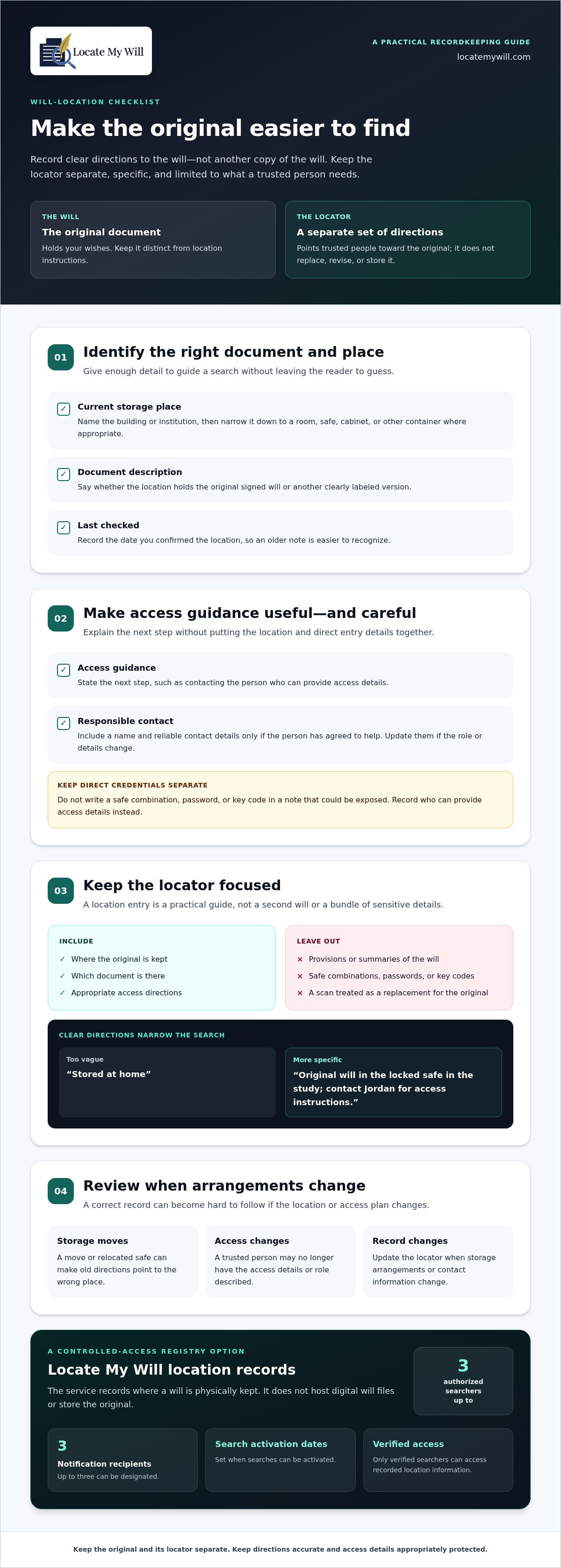
How to record and maintain your will’s location: a practical checklist
A location record is useful only if it reflects the document’s current storage arrangement and gives the right people a practical way to find it. Follow these steps, then add a brief review to your personal document routine. Keep the directions focused on the latest known location, not the will’s contents.
A five-step checklist for creating the record
- Identify the original. Find the will you currently intend to serve as the original and distinguish it from drafts, copies, or superseded documents. If you’re unsure which document is current, seek qualified legal guidance before describing it in the record.
- Confirm where it is stored. Check the document’s actual location rather than relying on an old note or memory. Identify the place and container clearly enough to narrow the search without guesswork.
- Write the location and access route. In your chosen organizer, state where the original is kept and whether a trusted person holds a key or can provide access instructions. Don’t include passwords, combinations, or other direct credentials in an exposed note.
- Share directions appropriately. Tell the trusted people who need to know where the record can be found and how to use it. If you use a controlled-access registry, designate the intended searchers and explain how access is managed. A location record itself doesn’t establish a person’s authority to act.
- Record when you checked it. Add a date so you and your trusted contacts can tell when the location was last verified. Keep the note separate from the will, and replace outdated directions rather than leaving competing versions in circulation.
When to review or update the record
Review the directions whenever something changes that could make them inaccurate. Common triggers include moving, changing the will’s physical storage place, preparing a revised will, or changing the trusted person who holds access information. After a change, confirm the document’s current location and update every locator record you rely on.
A recurring reminder can catch changes that don’t prompt an immediate update. Attach it to a document-review routine you can maintain, such as a regular annual check or another interval that works for you. Ask: Is the latest original still where this record says it is, and can the people named still help? If either answer is uncertain, verify the details and revise the directions.
If someone is searching after a death, a systematic guide to finding a deceased person’s will can help organize that separate search process.
Locate My Will lets you maintain a location record with designated authorized searchers and user-set search activation dates. The platform records location information, not the will itself, so keep the original in its chosen physical location. Record your will’s location with Locate My Will.
How Locate My Will can help keep your location record organized
Once you know what your locator record should contain, decide how to make it available to the right people without making it public. Locate My Will is a paid online platform for recording the physical location of your will. It organizes location information and access planning; it does not hold the will itself. Your original stays wherever you choose to store it.
How the location-record process works
Create an online account and enter details identifying where your will is physically kept. The information serves as a locator record, not a digital copy of the document. You can designate up to three authorized searchers and up to three notification recipients. These roles organize who may search for the location information and who may receive notifications.
Only verified searchers can access the recorded location information. You set activation dates that govern when searches can be performed and notifications sent. This lets you plan access timing in advance instead of sharing the location record broadly or relying only on a paper note that may be difficult to find.
The record is useful only if it reflects your current arrangements. If you move the original or change where it is stored, update the location information in your account. Review your designated searchers and notification recipients as well, so they remain appropriate.
What the service does, and does not do
Locate My Will manages information about where a will is kept and gives verified searchers access according to the user’s settings. It does not draft legal documents, provide legal advice, host digital will files, or physically store documents. It also can’t guarantee that a will will be found or determine whether a searcher has legal authority to act. Those are separate from recording a location.
This distinction keeps the task clear: the platform helps maintain a route to the original, while you remain responsible for keeping the document in its physical storage place and the location details accurate. It can complement a personal document organizer, but it doesn’t replace the original will or other legal arrangements.
To organize your will’s location record, use Locate My Will. Add the current location, designate the searchers and notification recipients you intend, and choose activation dates that reflect your access plan.
Make your location record part of your planning routine
A will-location record isn’t a task you complete once and forget. Treat it as part of your personal planning: when your circumstances or arrangements change, confirm that the directions still lead to the right place. This habit helps keep your preparations clear and useful over time.
If you’ve been considering how to record where your will is kept, choose a format you can maintain and take the next step: add the current location, decide who should access the information, and set a reminder to review it. Locate My Will provides a way to organize that locator record and manage planned access, while your will remains in its physical storage location.
Organize your will’s location record with Locate My Will when you’re ready to put your plan in place. A clear, maintained record helps trusted people find the document more easily.
Frequently Asked Questions
Does recording where my will is kept change the will itself?
No. A location record is separate from the will and doesn’t change the document’s wording, signatures, or stated wishes. It simply helps someone know where to look. For example, adding a note that the original is in a particular cabinet doesn’t revise who inherits under the will. If you want to change your wishes, address that through the appropriate legal process, not by editing the locator note.
Should I record the location of every copy of my will?
Record the original’s location clearly, and include copies only if knowing where they are could help avoid confusion. Label each entry so readers can distinguish the original from a photocopy, draft, or older version. For example, identify the original in one location and a reference copy elsewhere. Don’t let several entries imply that multiple versions are equally current.
How often should I check that my will-location record is accurate?
There’s no single review schedule that suits everyone. Set a recurring reminder you’ll follow, then check the record sooner if something changes. A practical prompt is to confirm the location when you review other important personal records. Ask whether the described container is still in place, whether the original is still there, and whether the person listed for access can still help.
Can I put a safe combination or password in the location record?
It’s safer not to put a direct entry code or password in a note that also identifies the storage location. Keep the directions useful without including the credential: state who holds the key or access information, if that person has agreed, and how an appropriate searcher can reach them. Store credentials separately using a method suited to their sensitivity.
What if I move or change where my will is stored?
Update the location record as soon as you’ve confirmed the original’s new place. Don’t rely on a forwarding address or assume an old contact will know about the change. If you keep more than one locator note, revise each one and remove outdated directions where practical. Then tell the trusted people who rely on the record where to find the current version.
Can an online will-location registry provide a copy of my will?
No. Locate My Will records information about where your will is physically kept; it doesn’t host or provide a digital copy of the document. Keep the original in its chosen storage place, and use the location record as directions to it. If you need another copy, the registry isn’t the source for one. This distinction helps prevent a locator entry from being mistaken for the will itself.


