

What good is a carefully prepared will if the people who need it can’t find the original? A clear will location record can point an executor or family member to the document without exposing its contents or replacing it.
It’s reasonable to want the original kept secure while making sure authorized people know where to look. The key is to distinguish the will from information about its location: a record can say where the document is held, but it isn’t a digital will and doesn’t establish the will’s legal validity.
This article explains what details to include, how to keep the record current, and how to plan access. It also covers how a managed registry can help organize that plan. Locate My Will lets users record location details, designate up to three authorized searchers and three notification recipients, and set activation dates that control when searches and notifications can occur. The platform records information about the will; it doesn’t host or physically store the document.
Key Takeaways
- A useful will location record identifies the document and gives enough detail to guide an authorized person to where it’s kept.
- Record whether the document is the original or another version, but don’t include the will’s text.
- Compare a personal note, spreadsheet, and managed registry by considering continuity, access administration, privacy, and who will keep the information current.
- Review your will location record whenever the document moves or its custodian changes, so the directions stay accurate.
- Locate My Will lets you manage designated searchers, notification recipients, and activation dates as part of access planning.
Why a Will Location Record Matters When Someone Needs the Will
A will location record is a written or digital note identifying where a will can be found. It addresses a practical gap: creating a will and making sure the appropriate person can locate it are separate parts of planning. A document may be kept in a home safe, with an attorney, or in another chosen place. If the person expected to look for it doesn’t know which place, or how to begin, they may have to search without clear directions.
A location record can reduce that uncertainty by pointing to the document and identifying which version is there. It doesn’t guarantee the will will be found, and it doesn’t determine what happens after someone dies. Procedures and consequences vary by state, so treat this record as an organizational aid, not legal guidance. For background on the document itself, see this overview of a will and testament.
What a will location record does, and does not, do
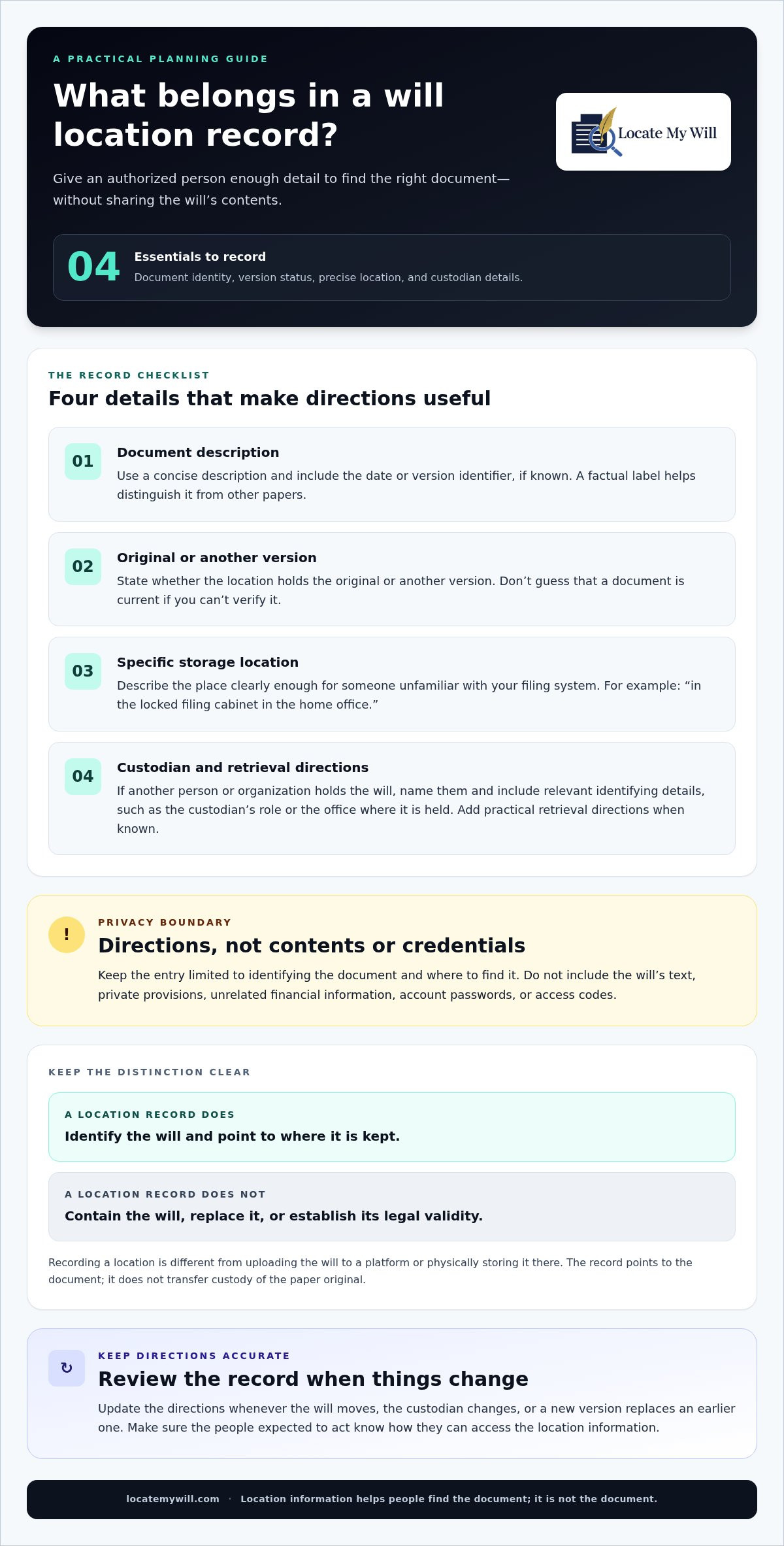
A will location record identifies a will and gives directions to where it is kept. Useful directions name the custodian and describe the storage place clearly enough to distinguish it from other files or containers. The record can also identify the document by date and note whether the location holds the original or another version.
It isn’t the will, a copy of the will, or proof that the will is valid. It doesn’t create, amend, validate, or replace the document. Recording a location is also different from uploading the will to an online platform or physically storing it there. A location entry points to the document; it doesn’t contain the will’s terms or transfer custody of the paper original.
Why clear directions help families and representatives
After a death, family members and representatives may be handling practical arrangements while trying to understand what documents exist. A direction such as “in the home safe” may leave questions: Which safe? Who can open it? Is the will with another custodian instead? More specific information can narrow the search and reduce guesswork during a demanding time.
Accuracy matters as much as detail. If the will moves, the named custodian changes, or a new version replaces an earlier one, outdated directions may lead someone to the wrong place or document. Review the record whenever one of these changes occurs, and make sure the people expected to act know how they can access the information. Share only the location details needed for that purpose.
Keep the distinction clear: the will expresses a person’s instructions, while the location record helps an authorized person find the document. It’s a small administrative step that connects the planning already completed with the practical task of locating the right paperwork when needed.
What Information Makes a Will Location Record Useful?
A useful record gives an authorized person enough information to identify the right document and understand where to look, without reproducing the will. Think of it as practical directions, not a second copy of your estate paperwork. The right level of detail depends on where the document is kept: a specific drawer at home needs different directions from a document held by an attorney or another organization.
Describe the storage place so another person can identify it
Choose clear, specific wording instead of a label like “important papers.” For example, “in the locked filing cabinet in the home office” gives more guidance than “at home.” Avoid directions that rely on knowledge only you have, such as “the usual place.” Consider what someone unfamiliar with your filing system would need to recognize the location.
If another person or organization holds the will, record its name and relevant identifying details, such as the custodian’s role or the office where the document is held. Add practical retrieval directions when you know them. Don’t put account passwords or access codes in a general location entry. A registry that records location information doesn’t store or retrieve the physical will for you, so make clear who holds it and where the search should begin.
Identify the document without sharing unnecessary contents
Include a simple description that distinguishes the will from other estate-planning papers. Note whether the record points to the original or another version, and add a date or version identifier if known. This can help a searcher distinguish the document you intend them to find from older papers in the same folder or held by the same custodian.
Keep the entry limited to identification and location. The will’s private provisions, unrelated financial information, and account credentials don’t belong in a location record. If you’re unsure how to describe the version, use a factual label you can verify, such as the date shown on the document, rather than guessing that it is current. The record should help identify the paper, not interpret its contents or establish its legal status.
Checklist: record the document’s description and date, whether it’s the original or another version, the specific storage location, the relevant custodian, and any practical retrieval directions. Don’t include the will’s text or access credentials.
- Document: A concise description and date or version identifier, if known.
- Status: Whether the location holds the original or another version.
- Location: A clear place name and directions specific enough to follow.
- Custodian: The relevant person or organization, when applicable.
Review these details whenever the document moves or its custodian changes. If you prefer a managed way to record the location and administer access for designated searchers, Locate My Will’s location-record platform keeps the entry focused on where the will is kept, not the will itself.
Will Location Record, Personal Note, or Online Registry?
A personal note, spreadsheet, and managed registry can all record where a will is kept. The practical difference is how the information is maintained and how an intended searcher is expected to access it. No format stays current on its own: someone must update it when the will or its custodian changes. Choose an approach that fits the people who will maintain the record and those who may need to use it.
| Method | Continuity | Access administration | Updates and privacy |
|---|---|---|---|
| Personal note | Depends on where it is kept and whether it remains available. | Searchers need to know the note exists and how to find it. | The writer updates it; privacy depends on where and with whom it is shared. |
| Spreadsheet | Can be revised and shared, but depends on file access and upkeep. | Access depends on how the file is stored and shared. | The owner maintains entries and sharing choices. |
| Managed location registry | Centralizes location details in a managed record. | Can administer access for designated searchers. | The owner updates the location; access is managed for the designated people. |
This comparison is about organization, not a claim that one method is automatically safer or more effective. A private note may suit someone who has a reliable way to tell the right person where it is. A spreadsheet may fit a household that already maintains shared records. A registry may suit someone who wants location information and authorized-searcher administration managed together.
When an informal record may be difficult to maintain
An informal record can work, but it relies on a consistent maintenance habit. If a will moves from a filing cabinet to an attorney’s office and the note stays unchanged, a searcher may start in the wrong place. Access also depends on someone knowing the note exists and being able to locate it. Decide who will update the details and how the intended searchers will learn where the record is kept.
What a managed registry adds to location planning
A managed registry brings location details together and supports administration of designated searchers. With Locate My Will, users can designate up to three authorized searchers and three notification recipients. Verified searchers can access the location information, while activation dates control when searches and notifications can occur. These features organize access planning; they don’t guarantee a search will succeed or keep the physical will.
The distinction is important: a registry records where a will is held rather than hosting the document itself. The owner remains responsible for keeping location details accurate. For a broader overview of the process, see this guide to registering a will’s location online.
How to Create and Maintain an Accurate Will Location Record
A useful will location record depends on two things: it must describe the right document, and its directions must reflect where that document is now. Use this process to set up the record, decide who may access the location information, and keep the details aligned with changes over time.
- Identify the document. Confirm which will the entry refers to. Note its date or version identifier if known, and whether the location holds the original or another version. This helps prevent confusion if older papers are kept nearby.
- Record its current location. Describe the storage place in terms another person can follow. If a person or organization holds the will, identify the relevant custodian and include practical directions for where a search should begin.
- Plan who may access the information. Choose the people you want to be able to search for the location record, and make sure their details are accurate. If using a managed registry, review its access settings and activation dates so they reflect your intended access plan.
- Review and update changes. Add the date you last checked the information. Update the entry promptly if the will moves, its custodian changes, or you replace it with a later version.
Set up the record around the document’s current location
Start by confirming the document and its present custodian, rather than relying on memory or an older note. Write directions that would make sense to someone who doesn’t know your filing habits. “In the home office filing cabinet, second drawer” is more useful than “with important papers.” Record the review date, too, so a future reader can tell when the details were last checked.
Keep the record focused on locating the document. It isn’t a substitute for the will or legal advice, and it can’t determine whether a document meets legal requirements. If you’re organizing information for an executor after a death, the executor’s guide to finding a will covers a systematic search approach.
Review the record when circumstances change
Make a review part of any change that could affect the directions. Moving house, changing storage arrangements, leaving the will with a different custodian, or preparing a replacement version are all prompts to check the entry. Also confirm that designated searchers and notification recipients remain appropriate, and review activation dates if the record is managed through a service that uses them.
A location record is useful only while it reflects where the document is actually kept. A brief review after a change can prevent old directions from lingering unnoticed. With Locate My Will, users can manage up to three authorized searchers and three notification recipients, and set activation dates that control when searches and notifications can occur. Set up managed will-location information to keep the record and access planning together.
How Locate My Will Manages Will Location Records
Locate My Will provides a managed way to record where a will is kept and plan who can access that location information. The process centers on the location entry and the people designated to search or receive notifications. It doesn’t involve uploading the will or placing the physical document in the platform’s custody.
This distinction matters. The service helps organize information about where a document is located; the will itself remains wherever its owner has chosen to keep it. A location record can guide an authorized searcher, but it doesn’t establish the document’s legal validity or guarantee that a search will succeed.
How registration and authorized access work
The process begins with creating an account, entering the will’s location details, and managing the people associated with the record. The owner can designate up to three authorized searchers and up to three notification recipients. These roles have different purposes: searchers are designated to access the location information, while notification recipients are designated to receive notifications.
Only verified searchers can access the location information. This gives the owner a defined way to plan who may look up the recorded directions, rather than relying only on a note someone may not know about. Choose people with their future role in mind, and keep their information current. The service manages location details and access planning; it doesn’t retrieve or physically store the will.
How activation dates support planned access
Activation dates control when searches can be performed and notifications can be sent. They let users plan the timing of access in advance according to their selected dates. An activation date is an access control, not a determination that someone has died, and it doesn’t confirm that the will remains in the recorded location. The owner still needs to update the record if the document or custodian changes.
Consider the arrangement as a whole: accurate location details, carefully designated people, and activation dates that reflect the intended access plan. Understanding how to register a will’s location online can help clarify the broader steps involved in setting up this type of record.
Locate My Will is designed for recording and administering will-location information, not hosting a digital will or providing legal advice. If a managed record, designated searchers, and date-based access planning fit your needs, create a Locate My Will account and enter the location information for the document you keep elsewhere.
Make Your Will-Location Plan Part of Ongoing Care
Planning is most useful when it keeps pace with life. A move, a change in family circumstances, or a new set of trusted representatives can all be good prompts to revisit your arrangements. Consider adding a brief will-location review to an existing annual planning routine, so the information doesn’t become an out-of-sight task.
Think, too, about how the people you’ve chosen will know where to begin. A clear plan can help them understand their role without sharing more private information than they need. The aim isn’t to anticipate every future situation. It’s to make one practical step easier for the people who may need to act.
A will location record is a small piece of preparation that can connect your intentions with the people you trust. Put that information into a managed plan by recording your will’s location with Locate My Will.
Frequently Asked Questions
Does a will location record make a will legally valid?
No. A will location record has no role in creating or validating the document; it simply helps identify where the will can be found. For example, an entry pointing to a signed paper in a file cabinet doesn’t confirm that it meets legal requirements. Validity depends on applicable law and the circumstances of creation. Ask a qualified legal professional about a particular will, especially if its status is uncertain.
Can a will location record replace the original will?
No. The record is not a substitute for the will, and it doesn’t establish whether an original or copy should be used. If a family finds several documents, such as a signed original and a photocopy with handwritten changes, they shouldn’t rely on the location entry alone to decide which controls. Keep the record descriptive and seek state-specific legal guidance about the document’s status or whether a copy may be sufficient.
Is a will location record public information?
Not necessarily. Whether location details are accessible depends on where they’re recorded, the permissions governing access, and applicable law. Don’t assume an online entry is a public filing, or that information kept in a personal document is private simply because it isn’t posted publicly. Locate My Will provides access to location information for verified searchers designated by the user. Keep entries limited to necessary details and avoid adding unrelated sensitive information.
Can I record a will kept by an attorney or another custodian?
Yes. You can note that a will is held by an attorney or another custodian and include identifying details that help an authorized searcher know whom to contact or where to begin. For instance, identify the relevant office or custodian rather than writing only “with my lawyer.” Keep those details current. A location record doesn’t retrieve the document or explain the custodian’s release requirements, so access questions may need separate guidance.
Should I record the location of an older will as well as a newer one?
Make the record clear about which document it describes, particularly if older versions remain nearby or with the same custodian. A practical label might include the date shown on each document and identify whether it is the original or another version. Don’t assume that the newest date alone determines which will is legally effective. Questions about revocation or validity depend on the circumstances and applicable state law.
What if my executor cannot access the location record?
Review the access plan before it’s needed. Make sure the person you expect to search knows they’ve been designated and understands how to initiate a search, without sending passwords or other credentials insecurely. Locate My Will uses verified searchers and activation-date controls that govern when searches and notifications can occur. These controls don’t guarantee that a search will succeed, so they shouldn’t replace clear communication about the executor’s role.


